The next day Danglars was again hungry; certainly the air of that
dungeon was very provocative of appetite. The prisoner expected that he
would be at no expense that day, for like an economical man he had
concealed half of his fowl and a piece of the bread in the corner of
his cell. But he had no sooner eaten than he felt thirsty; he had
forgotten that. He struggled against his thirst till his tongue clave
to the roof of his mouth; then, no longer able to resist, he called
out. The sentinel opened the door; it was a new face. He thought it
would be better to transact business with his old acquaintance, so he
sent for Peppino.
“Here I am, your excellency,” said Peppino, with an eagerness which
Danglars thought favorable to him. “What do you want?”
“Something to drink.”
“Your excellency knows that wine is beyond all price near Rome.”
“Then give me water,” cried Danglars, endeavoring to parry the blow.
“Oh, water is even more scarce than wine, your excellency,—there has
been such a drought.”
“Come,” thought Danglars, “it is the same old story.” And while he
smiled as he attempted to regard the affair as a joke, he felt his
temples get moist with perspiration.
“Come, my friend,” said Danglars, seeing that he made no impression on
Peppino, “you will not refuse me a glass of wine?”
“I have already told you that we do not sell at retail.”
“Well, then, let me have a bottle of the least expensive.”
“They are all the same price.”
“And what is that?”
“Twenty-five thousand francs a bottle.”
“Tell me,” cried Danglars, in a tone whose bitterness Harpagon30 alone
has been capable of revealing—“tell me that you wish to despoil me of
all; it will be sooner over than devouring me piecemeal.”
“It is possible such may be the master’s intention.”
“The master?—who is he?”
“The person to whom you were conducted yesterday.”
“Where is he?”
“Here.”
“Let me see him.”
“Certainly.”
And the next moment Luigi Vampa appeared before Danglars.
“You sent for me?” he said to the prisoner.
“Are you, sir, the chief of the people who brought me here?”
“Yes, your excellency. What then?”
“How much do you require for my ransom?”
“Merely the 5,000,000 you have about you.” Danglars felt a dreadful
spasm dart through his heart.
“But this is all I have left in the world,” he said, “out of an immense
fortune. If you deprive me of that, take away my life also.”
“We are forbidden to shed your blood.”
“And by whom are you forbidden?”
“By him we obey.”
“You do, then, obey someone?”
“Yes, a chief.”
“I thought you said you were the chief?”
“So I am of these men; but there is another over me.”
“And did your superior order you to treat me in this way?”
“Yes.”
“But my purse will be exhausted.”
“Probably.”
“Come,” said Danglars, “will you take a million?”
“No.”
“Two millions?—three?—four? Come, four? I will give them to you on
condition that you let me go.”
“Why do you offer me 4,000,000 for what is worth 5,000,000? This is a
kind of usury, banker, that I do not understand.”
“Take all, then—take all, I tell you, and kill me!”
“Come, come, calm yourself. You will excite your blood, and that would
produce an appetite it would require a million a day to satisfy. Be
more economical.”
“But when I have no more money left to pay you?” asked the infuriated
Danglars.
“Then you must suffer hunger.”
“Suffer hunger?” said Danglars, becoming pale.
“Most likely,” replied Vampa coolly.
“But you say you do not wish to kill me?”
“No.”
“And yet you will let me perish with hunger?”
“Ah, that is a different thing.”
“Well, then, wretches,” cried Danglars, “I will defy your infamous
calculations—I would rather die at once! You may torture, torment, kill
me, but you shall not have my signature again!”
“As your excellency pleases,” said Vampa, as he left the cell.
Danglars, raving, threw himself on the goat-skin. Who could these men
be? Who was the invisible chief? What could be his intentions towards
him? And why, when everyone else was allowed to be ransomed, might he
not also be? Oh, yes; certainly a speedy, violent death would be a fine
means of deceiving these remorseless enemies, who appeared to pursue
him with such incomprehensible vengeance. But to die? For the first
time in his life, Danglars contemplated death with a mixture of dread
and desire; the time had come when the implacable spectre, which exists
in the mind of every human creature, arrested his attention and called
out with every pulsation of his heart, “Thou shalt die!”
Danglars resembled a timid animal excited in the chase; first it flies,
then despairs, and at last, by the very force of desperation, sometimes
succeeds in eluding its pursuers. Danglars meditated an escape; but the
walls were solid rock, a man was sitting reading at the only outlet to
the cell, and behind that man shapes armed with guns continually
passed. His resolution not to sign lasted two days, after which he
offered a million for some food. They sent him a magnificent supper,
and took his million.
From this time the prisoner resolved to suffer no longer, but to have
everything he wanted. At the end of twelve days, after having made a
splendid dinner, he reckoned his accounts, and found that he had only
50,000 francs left. Then a strange reaction took place; he who had just
abandoned 5,000,000 endeavored to save the 50,000 francs he had left,
and sooner than give them up he resolved to enter again upon a life of
privation—he was deluded by the hopefulness that is a premonition of
madness.
He, who for so long a time had forgotten God, began to think that
miracles were possible—that the accursed cavern might be discovered by
the officers of the Papal States, who would release him; that then he
would have 50,000 remaining, which would be sufficient to save him from
starvation; and finally he prayed that this sum might be preserved to
him, and as he prayed he wept. Three days passed thus, during which his
prayers were frequent, if not heartfelt. Sometimes he was delirious,
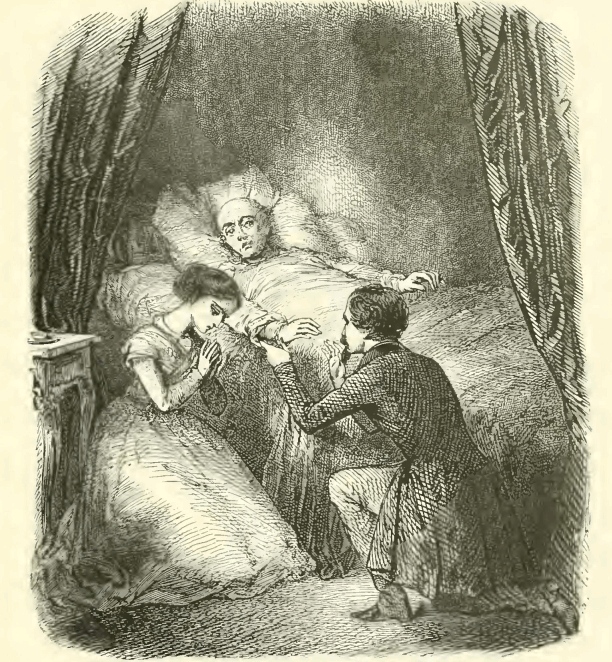
and fancied he saw an old man stretched on a pallet; he, also, was
dying of hunger.
On the fourth, he was no longer a man, but a living corpse. He had
picked up every crumb that had been left from his former meals, and was
beginning to eat the matting which covered the floor of his cell. Then
he entreated Peppino, as he would a guardian angel, to give him food;
he offered him 1,000 francs for a mouthful of bread. But Peppino did
not answer. On the fifth day he dragged himself to the door of the
cell.
“Are you not a Christian?” he said, falling on his knees. “Do you wish
to assassinate a man who, in the eyes of Heaven, is a brother? Oh, my
former friends, my former friends!” he murmured, and fell with his face
to the ground. Then rising in despair, he exclaimed, “The chief, the
chief!”
“Here I am,” said Vampa, instantly appearing; “what do you want?”
“Take my last gold,” muttered Danglars, holding out his pocket-book,
“and let me live here; I ask no more for liberty—I only ask to live!”
“Then you suffer a great deal?”
“Oh, yes, yes, cruelly!”
“Still, there have been men who suffered more than you.”
“I do not think so.”
“Yes; those who have died of hunger.”
Danglars thought of the old man whom, in his hours of delirium, he had
seen groaning on his bed. He struck his forehead on the ground and
groaned. “Yes,” he said, “there have been some who have suffered more
than I have, but then they must have been martyrs at least.”
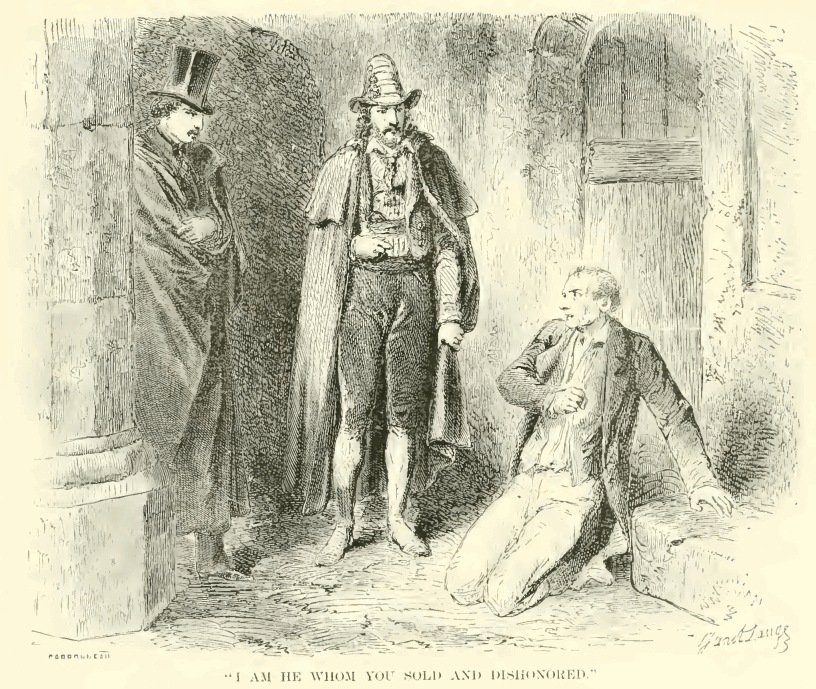
“Do you repent?” asked a deep, solemn voice, which caused Danglars’
hair to stand on end. His feeble eyes endeavored to distinguish
objects, and behind the bandit he saw a man enveloped in a cloak, half
lost in the shadow of a stone column.
“Of what must I repent?” stammered Danglars.
“Of the evil you have done,” said the voice.
“Oh, yes; oh, yes, I do indeed repent.” And he struck his breast with
his emaciated fist.
“Then I forgive you,” said the man, dropping his cloak, and advancing
to the light.
“The Count of Monte Cristo!” said Danglars, more pale from terror than
he had been just before from hunger and misery.
“You are mistaken—I am not the Count of Monte Cristo.”
“Then who are you?”
“I am he whom you sold and dishonored—I am he whose betrothed you
prostituted—I am he upon whom you trampled that you might raise
yourself to fortune—I am he whose father you condemned to die of
hunger—I am he whom you also condemned to starvation, and who yet
forgives you, because he hopes to be forgiven—I am Edmond Dantès!”
Danglars uttered a cry, and fell prostrate.
“Rise,” said the count, “your life is safe; the same good fortune has
not happened to your accomplices—one is mad, the other dead. Keep the
50,000 francs you have left—I give them to you. The 5,000,000 you stole
from the hospitals has been restored to them by an unknown hand. And
now eat and drink; I will entertain you tonight. Vampa, when this man
is satisfied, let him be free.”
Danglars remained prostrate while the count withdrew; when he raised
his head he saw disappearing down the passage nothing but a shadow,
before which the bandits bowed.
According to the count’s directions, Danglars was waited on by Vampa,
who brought him the best wine and fruits of Italy; then, having
conducted him to the road, and pointed to the post-chaise, left him
leaning against a tree. He remained there all night, not knowing where
he was. When daylight dawned he saw that he was near a stream; he was
thirsty, and dragged himself towards it. As he stooped down to drink,
he saw that his hair had become entirely white.
Chapter CXVII
October the Fifth
It was about six o’clock in the evening; an opal-colored light, through
which an autumnal sun shed its golden rays, descended on the blue
ocean. The heat of the day had gradually decreased, and a light breeze
arose, seeming like the respiration of nature on awakening from the
burning siesta of the south. A delicious zephyr played along the coasts
of the Mediterranean, and wafted from shore to shore the sweet perfume
of plants, mingled with the fresh smell of the sea.
A light yacht, chaste and elegant in its form, was gliding amidst the
first dews of night over the immense lake, extending from Gibraltar to
the Dardanelles, and from Tunis to Venice. The vessel resembled a swan
with its wings opened towards the wind, gliding on the water. It
advanced swiftly and gracefully, leaving behind it a glittering stretch
of foam. By degrees the sun disappeared behind the western horizon; but
as though to prove the truth of the fanciful ideas in heathen
mythology, its indiscreet rays reappeared on the summit of every wave,
as if the god of fire had just sunk upon the bosom of Amphitrite, who
in vain endeavored to hide her lover beneath her azure mantle.
The yacht moved rapidly on, though there did not appear to be
sufficient wind to ruffle the curls on the head of a young girl.
Standing on the prow was a tall man, of a dark complexion, who saw with
dilating eyes that they were approaching a dark mass of land in the
shape of a cone, which rose from the midst of the waves like the hat of
a Catalan.
“Is that Monte Cristo?” asked the traveller, to whose orders the yacht
was for the time submitted, in a melancholy voice.
“Yes, your excellency,” said the captain, “we have reached it.”
“We have reached it!” repeated the traveller in an accent of
indescribable sadness.
Then he added, in a low tone, “Yes; that is the haven.”
And then he again plunged into a train of thought, the character of
which was better revealed by a sad smile, than it would have been by
tears. A few minutes afterwards a flash of light, which was
extinguished instantly, was seen on the land, and the sound of firearms
reached the yacht.
“Your excellency,” said the captain, “that was the land signal, will
you answer yourself?”
“What signal?”
The captain pointed towards the island, up the side of which ascended a
volume of smoke, increasing as it rose.
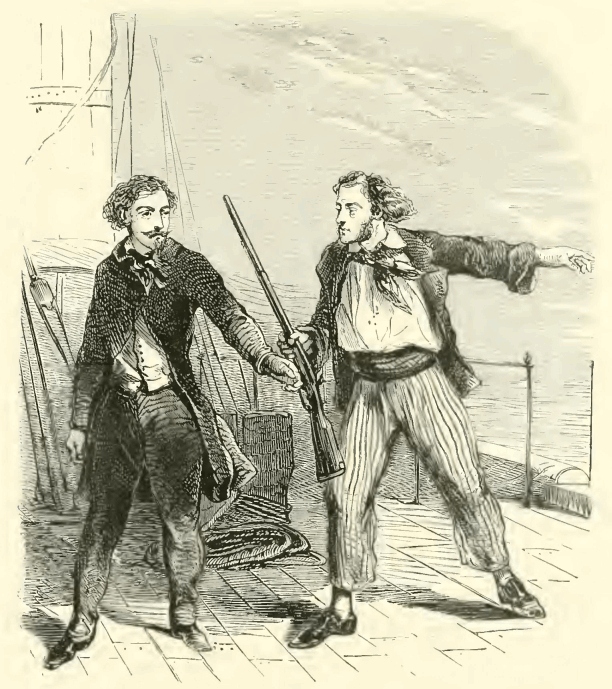
“Ah, yes,” he said, as if awaking from a dream. “Give it to me.”
The captain gave him a loaded carbine; the traveller slowly raised it,
and fired in the air. Ten minutes afterwards, the sails were furled,
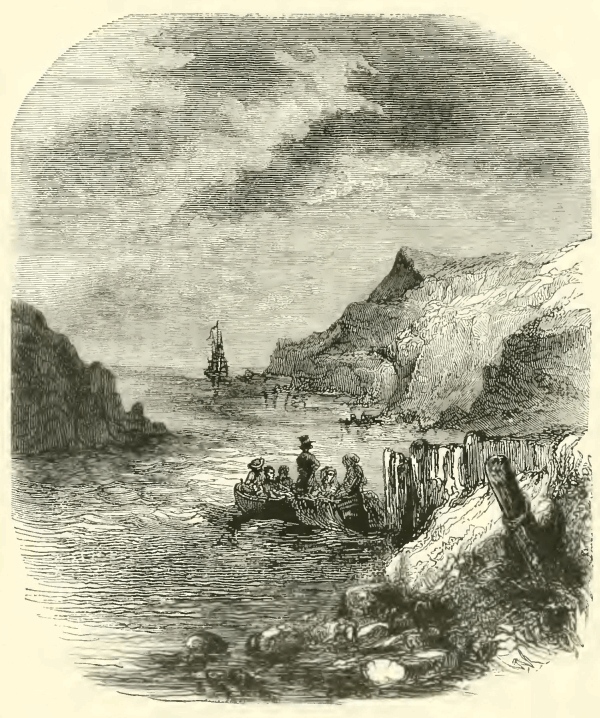
and they cast anchor about a hundred fathoms from the little harbor.
The gig was already lowered, and in it were four oarsmen and a
coxswain. The traveller descended, and instead of sitting down at the
stern of the boat, which had been decorated with a blue carpet for his
accommodation, stood up with his arms crossed. The rowers waited, their
oars half lifted out of the water, like birds drying their wings.
“Give way,” said the traveller. The eight oars fell into the sea
simultaneously without splashing a drop of water, and the boat,
yielding to the impulsion, glided forward. In an instant they found
themselves in a little harbor, formed in a natural creek; the boat
grounded on the fine sand.
“Will your excellency be so good as to mount the shoulders of two of
our men, they will carry you ashore?” The young man answered this
invitation with a gesture of indifference, and stepped out of the boat;
the sea immediately rose to his waist.
“Ah, your excellency,” murmured the pilot, “you should not have done
so; our master will scold us for it.”
The young man continued to advance, following the sailors, who chose a
firm footing. Thirty strides brought them to dry land; the young man
stamped on the ground to shake off the wet, and looked around for
someone to show him his road, for it was quite dark. Just as he turned,
a hand rested on his shoulder, and a voice which made him shudder
exclaimed:
“Good-evening, Maximilian; you are punctual, thank you!”
“Ah, is it you, count?” said the young man, in an almost joyful accent,
pressing Monte Cristo’s hand with both his own.
“Yes; you see I am as exact as you are. But you are dripping, my dear
fellow; you must change your clothes, as Calypso said to Telemachus.
Come, I have a habitation prepared for you in which you will soon
forget fatigue and cold.”
Monte Cristo perceived that the young man had turned around; indeed,
Morrel saw with surprise that the men who had brought him had left
without being paid, or uttering a word. Already the sound of their oars
might be heard as they returned to the yacht.
“Oh, yes,” said the count, “you are looking for the sailors.”
“Yes, I paid them nothing, and yet they are gone.”
“Never mind that, Maximilian,” said Monte Cristo, smiling. “I have made
an agreement with the navy, that the access to my island shall be free
of all charge. I have made a bargain.”
Morrel looked at the count with surprise. “Count,” he said, “you are
not the same here as in Paris.”
“How so?”
“Here you laugh.” The count’s brow became clouded.
“You are right to recall me to myself, Maximilian,” he said; “I was
delighted to see you again, and forgot for the moment that all
happiness is fleeting.”
“Oh, no, no, count,” cried Maximilian, seizing the count’s hands, “pray
laugh; be happy, and prove to me, by your indifference, that life is
endurable to sufferers. Oh, how charitable, kind, and good you are; you
affect this gayety to inspire me with courage.”
“You are wrong, Morrel; I was really happy.”
“Then you forget me, so much the better.”
“How so?”
“Yes; for as the gladiator said to the emperor, when he entered the
arena, ‘He who is about to die salutes you.’”
“Then you are not consoled?” asked the count, surprised.
“Oh,” exclaimed Morrel, with a glance full of bitter reproach, “do you
think it possible that I could be?”
“Listen,” said the count. “Do you understand the meaning of my words?
You cannot take me for a commonplace man, a mere rattle, emitting a
vague and senseless noise. When I ask you if you are consoled, I speak
to you as a man for whom the human heart has no secrets. Well, Morrel,
let us both examine the depths of your heart. Do you still feel the
same feverish impatience of grief which made you start like a wounded
lion? Have you still that devouring thirst which can only be appeased
in the grave? Are you still actuated by the regret which drags the
living to the pursuit of death; or are you only suffering from the
prostration of fatigue and the weariness of hope deferred? Has the loss
of memory rendered it impossible for you to weep? Oh, my dear friend,
if this be the case,—if you can no longer weep, if your frozen heart be
dead, if you put all your trust in God, then, Maximilian, you are
consoled—do not complain.”
“Count,” said Morrel, in a firm and at the same time soft voice,
“listen to me, as to a man whose thoughts are raised to heaven, though
he remains on earth; I come to die in the arms of a friend. Certainly,
there are people whom I love. I love my sister Julie,—I love her
husband Emmanuel; but I require a strong mind to smile on my last
moments. My sister would be bathed in tears and fainting; I could not
bear to see her suffer. Emmanuel would tear the weapon from my hand,
and alarm the house with his cries. You, count, who are more than
mortal, will, I am sure, lead me to death by a pleasant path, will you
not?”
“My friend,” said the count, “I have still one doubt,—are you weak
enough to pride yourself upon your sufferings?”
“No, indeed,—I am calm,” said Morrel, giving his hand to the count; “my
pulse does not beat slower or faster than usual. No, I feel that I have
reached the goal, and I will go no farther. You told me to wait and
hope; do you know what you did, unfortunate adviser? I waited a month,
or rather I suffered for a month! I did hope (man is a poor wretched
creature), I did hope. What I cannot tell,—something wonderful, an
absurdity, a miracle,—of what nature he alone can tell who has mingled
with our reason that folly we call hope. Yes, I did wait—yes, I did
hope, count, and during this quarter of an hour we have been talking
together, you have unconsciously wounded, tortured my heart, for every
word you have uttered proved that there was no hope for me. Oh, count,
I shall sleep calmly, deliciously in the arms of death.”
Morrel uttered these words with an energy which made the count shudder.
“My friend,” continued Morrel, “you named the fifth of October as the
end of the period of waiting,—today is the fifth of October,” he took
out his watch, “it is now nine o’clock,—I have yet three hours to
live.”
“Be it so,” said the count, “come.” Morrel mechanically followed the
count, and they had entered the grotto before he perceived it. He felt
a carpet under his feet, a door opened, perfumes surrounded him, and a
brilliant light dazzled his eyes. Morrel hesitated to advance; he
dreaded the enervating effect of all that he saw. Monte Cristo drew him
in gently.
“Why should we not spend the last three hours remaining to us of life,
like those ancient Romans, who when condemned by Nero, their emperor
and heir, sat down at a table covered with flowers, and gently glided
into death, amid the perfume of heliotropes and roses?”
Morrel smiled. “As you please,” he said; “death is always death,—that
is forgetfulness, repose, exclusion from life, and therefore from
grief.”
He sat down, and Monte Cristo placed himself opposite to him. They were
in the marvellous dining-room before described, where the statues had
baskets on their heads always filled with fruits and flowers. Morrel
had looked carelessly around, and had probably noticed nothing.
“Let us talk like men,” he said, looking at the count.
“Go on!”
“Count,” said Morrel, “you are the epitome of all human knowledge, and
you seem like a being descended from a wiser and more advanced world
than ours.”
“There is something true in what you say,” said the count, with that
smile which made him so handsome; “I have descended from a planet
called grief.”
“I believe all you tell me without questioning its meaning; for
instance, you told me to live, and I did live; you told me to hope, and
I almost did so. I am almost inclined to ask you, as though you had
experienced death, ‘is it painful to die?’”
Monte Cristo looked upon Morrel with indescribable tenderness. “Yes,”
he said, “yes, doubtless it is painful, if you violently break the
outer covering which obstinately begs for life. If you plunge a dagger
into your flesh, if you insinuate a bullet into your brain, which the
least shock disorders,—then certainly, you will suffer pain, and you
will repent quitting a life for a repose you have bought at so dear a
price.”
“Yes; I know that there is a secret of luxury and pain in death, as
well as in life; the only thing is to understand it.”
“You have spoken truly, Maximilian; according to the care we bestow
upon it, death is either a friend who rocks us gently as a nurse, or an
enemy who violently drags the soul from the body. Some day, when the
world is much older, and when mankind will be masters of all the
destructive powers in nature, to serve for the general good of
humanity; when mankind, as you were just saying, have discovered the
secrets of death, then that death will become as sweet and voluptuous
as a slumber in the arms of your beloved.”
“And if you wished to die, you would choose this death, count?”
“Yes.”
Morrel extended his hand. “Now I understand,” he said, “why you had me
brought here to this desolate spot, in the midst of the ocean, to this
subterranean palace; it was because you loved me, was it not, count? It
was because you loved me well enough to give me one of those sweet
means of death of which we were speaking; a death without agony, a
death which allows me to fade away while pronouncing Valentine’s name
and pressing your hand.”
“Yes, you have guessed rightly, Morrel,” said the count, “that is what
I intended.”
“Thanks; the idea that tomorrow I shall no longer suffer, is sweet to
my heart.”
“Do you then regret nothing?”
“No,” replied Morrel.
“Not even me?” asked the count with deep emotion. Morrel’s clear eye
was for the moment clouded, then it shone with unusual lustre, and a
large tear rolled down his cheek.
“What,” said the count, “do you still regret anything in the world, and
yet die?”
“Oh, I entreat you,” exclaimed Morrel in a low voice, “do not speak
another word, count; do not prolong my punishment.”
The count fancied that he was yielding, and this belief revived the
horrible doubt that had overwhelmed him at the Château d’If.
“I am endeavoring,” he thought, “to make this man happy; I look upon
this restitution as a weight thrown into the scale to balance the evil
I have wrought. Now, supposing I am deceived, supposing this man has
not been unhappy enough to merit happiness. Alas, what would become of
me who can only atone for evil by doing good?”
Then he said aloud: “Listen, Morrel, I see your grief is great, but
still you do not like to risk your soul.” Morrel smiled sadly.
“Count,” he said, “I swear to you my soul is no longer my own.”
“Maximilian, you know I have no relation in the world. I have
accustomed myself to regard you as my son: well, then, to save my son,
I will sacrifice my life, nay, even my fortune.”
“What do you mean?”
“I mean, that you wish to quit life because you do not understand all
the enjoyments which are the fruits of a large fortune. Morrel, I
possess nearly a hundred millions and I give them to you; with such a
fortune you can attain every wish. Are you ambitious? Every career is
open to you. Overturn the world, change its character, yield to mad
ideas, be even criminal—but live.”
“Count, I have your word,” said Morrel coldly; then taking out his
watch, he added, “It is half-past eleven.”
“Morrel, can you intend it in my house, under my very eyes?”
“Then let me go,” said Maximilian, “or I shall think you did not love
me for my own sake, but for yours;” and he arose.
“It is well,” said Monte Cristo whose countenance brightened at these
words; “you wish it—you are inflexible. Yes, as you said, you are
indeed wretched and a miracle alone can cure you. Sit down, Morrel, and
wait.”
Morrel obeyed; the count arose, and unlocking a closet with a key
suspended from his gold chain, took from it a little silver casket,
beautifully carved and chased, the corners of which represented four
bending figures, similar to the Caryatides, the forms of women, symbols
of the angels aspiring to heaven.
He placed the casket on the table; then opening it took out a little
golden box, the top of which flew open when touched by a secret spring.
This box contained an unctuous substance partly solid, of which it was
impossible to discover the color, owing to the reflection of the
polished gold, sapphires, rubies, emeralds, which ornamented the box.
It was a mixed mass of blue, red, and gold.
The count took out a small quantity of this with a gilt spoon, and
offered it to Morrel, fixing a long steadfast glance upon him. It was
then observable that the substance was greenish.
“This is what you asked for,” he said, “and what I promised to give
you.”
“I thank you from the depths of my heart,” said the young man, taking
the spoon from the hands of Monte Cristo. The count took another spoon,
and again dipped it into the golden box. “What are you going to do, my
friend?” asked Morrel, arresting his hand.
“Well, the fact is, Morrel, I was thinking that I too am weary of life,
and since an opportunity presents itself——”
“Stay!” said the young man. “You who love, and are beloved; you, who
have faith and hope,—oh, do not follow my example. In your case it
would be a crime. Adieu, my noble and generous friend, adieu; I will go
and tell Valentine what you have done for me.”
And slowly, though without any hesitation, only waiting to press the
count’s hand fervently, he swallowed the mysterious substance offered
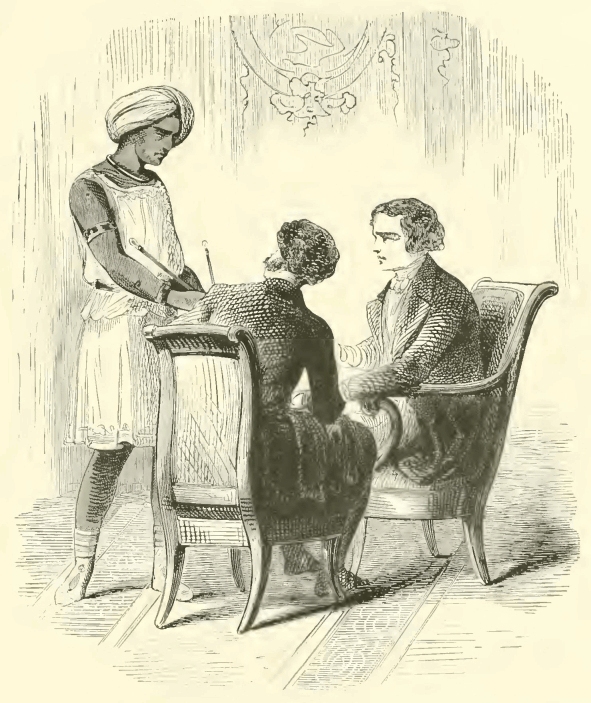
by Monte Cristo. Then they were both silent. Ali, mute and attentive,
brought the pipes and coffee, and disappeared. By degrees, the light of
the lamps gradually faded in the hands of the marble statues which held
them, and the perfumes appeared less powerful to Morrel. Seated
opposite to him, Monte Cristo watched him in the shadow, and Morrel saw
nothing but the bright eyes of the count. An overpowering sadness took
possession of the young man, his hands relaxed their hold, the objects
in the room gradually lost their form and color, and his disturbed
vision seemed to perceive doors and curtains open in the wall.
“Friend,” he cried, “I feel that I am dying; thanks!”
He made a last effort to extend his hand, but it fell powerless beside
him. Then it appeared to him that Monte Cristo smiled, not with the
strange and fearful expression which had sometimes revealed to him the
secrets of his heart, but with the benevolent kindness of a father for
a child. At the same time the count appeared to increase in stature,
his form, nearly double its usual height, stood out in relief against
the red tapestry, his black hair was thrown back, and he stood in the
attitude of an avenging angel. Morrel, overpowered, turned around in
the armchair; a delicious torpor permeated every vein. A change of
ideas presented themselves to his brain, like a new design on the
kaleidoscope. Enervated, prostrate, and breathless, he became
unconscious of outward objects; he seemed to be entering that vague
delirium preceding death. He wished once again to press the count’s
hand, but his own was immovable. He wished to articulate a last
farewell, but his tongue lay motionless and heavy in his throat, like a
stone at the mouth of a sepulchre. Involuntarily his languid eyes
closed, and still through his eyelashes a well-known form seemed to
move amid the obscurity with which he thought himself enveloped.
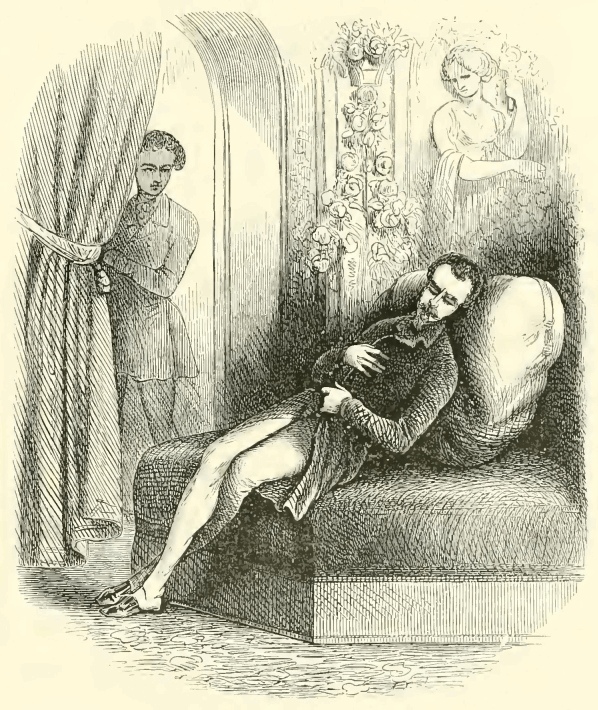
The count had just opened a door. Immediately a brilliant light from
the next room, or rather from the palace adjoining, shone upon the room
in which he was gently gliding into his last sleep. Then he saw a woman
of marvellous beauty appear on the threshold of the door separating the
two rooms. Pale, and sweetly smiling, she looked like an angel of mercy
conjuring the angel of vengeance.
“Is it heaven that opens before me?” thought the dying man; “that angel
resembles the one I have lost.”
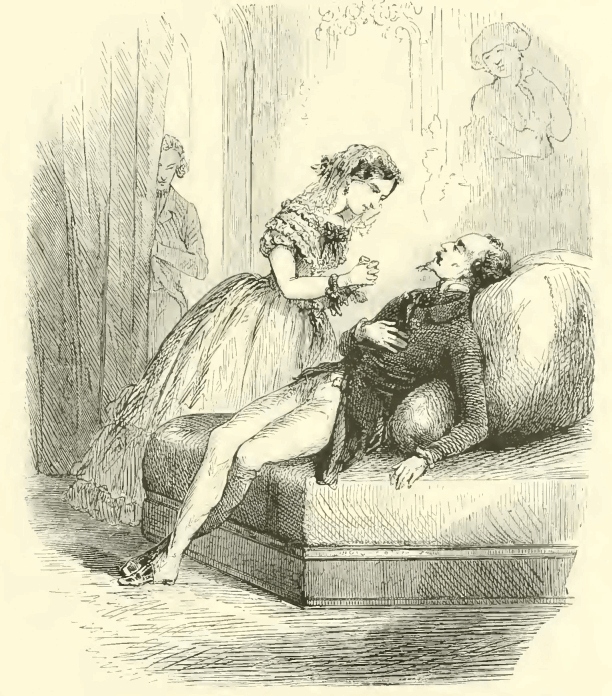
Monte Cristo pointed out Morrel to the young woman, who advanced
towards him with clasped hands and a smile upon her lips.
“Valentine, Valentine!” he mentally ejaculated; but his lips uttered no
sound, and as though all his strength were centred in that internal
emotion, he sighed and closed his eyes. Valentine rushed towards him;
his lips again moved.
“He is calling you,” said the count; “he to whom you have confided your
destiny—he from whom death would have separated you, calls you to him.
Happily, I vanquished death. Henceforth, Valentine, you will never
again be separated on earth, since he has rushed into death to find
you. Without me, you would both have died. May God accept my atonement
in the preservation of these two existences!”
Valentine seized the count’s hand, and in her irresistible impulse of
joy carried it to her lips.
“Oh, thank me again!” said the count; “tell me till you are weary, that
I have restored you to happiness; you do not know how much I require
this assurance.”
“Oh, yes, yes, I thank you with all my heart,” said Valentine; “and if
you doubt the sincerity of my gratitude, oh, then, ask Haydée! ask my
beloved sister Haydée, who ever since our departure from France, has
caused me to wait patiently for this happy day, while talking to me of
you.”
“You then love Haydée?” asked Monte Cristo with an emotion he in vain
endeavored to dissimulate.
“Oh, yes, with all my soul.”
“Well, then, listen, Valentine,” said the count; “I have a favor to ask
of you.”
“Of me? Oh, am I happy enough for that?”
“Yes; you have called Haydée your sister,—let her become so indeed,
Valentine; render her all the gratitude you fancy that you owe to me;
protect her, for” (the count’s voice was thick with emotion)
“henceforth she will be alone in the world.”
“Alone in the world!” repeated a voice behind the count, “and why?”
Monte Cristo turned around; Haydée was standing pale, motionless,
looking at the count with an expression of fearful amazement.
“Because tomorrow, Haydée, you will be free; you will then assume your
proper position in society, for I will not allow my destiny to
overshadow yours. Daughter of a prince, I restore to you the riches and
name of your father.”
Haydée became pale, and lifting her transparent hands to heaven,
exclaimed in a voice stifled with tears, “Then you leave me, my lord?”
“Haydée, Haydée, you are young and beautiful; forget even my name, and
be happy.”
“It is well,” said Haydée; “your order shall be executed, my lord; I
will forget even your name, and be happy.” And she stepped back to
retire.
“Oh, heavens,” exclaimed Valentine, who was supporting the head of
Morrel on her shoulder, “do you not see how pale she is? Do you not see
how she suffers?”
Haydée answered with a heartrending expression,
“Why should he understand this, my sister? He is my master, and I am
his slave; he has the right to notice nothing.”
The count shuddered at the tones of a voice which penetrated the inmost
recesses of his heart; his eyes met those of the young girl and he
could not bear their brilliancy.
“Oh, heavens,” exclaimed Monte Cristo, “can my suspicions be correct?
Haydée, would it please you not to leave me?”
“I am young,” gently replied Haydée; “I love the life you have made so
sweet to me, and I should be sorry to die.”
“You mean, then, that if I leave you, Haydée——”
“I should die; yes, my lord.”
“Do you then love me?”
“Oh, Valentine, he asks if I love him. Valentine, tell him if you love
Maximilian.”
The count felt his heart dilate and throb; he opened his arms, and
Haydée, uttering a cry, sprang into them.
“Oh, yes,” she cried, “I do love you! I love you as one loves a father,
brother, husband! I love you as my life, for you are the best, the
noblest of created beings!”
“Let it be, then, as you wish, sweet angel; God has sustained me in my
struggle with my enemies, and has given me this reward; he will not let
me end my triumph in suffering; I wished to punish myself, but he has
pardoned me. Love me then, Haydée! Who knows? perhaps your love will
make me forget all that I do not wish to remember.”
“What do you mean, my lord?”
“I mean that one word from you has enlightened me more than twenty
years of slow experience; I have but you in the world, Haydée; through
you I again take hold on life, through you I shall suffer, through you
rejoice.”
“Do you hear him, Valentine?” exclaimed Haydée; “he says that through
me he will suffer—through me, who would yield my life for his.”
The count withdrew for a moment. “Have I discovered the truth?” he
said; “but whether it be for recompense or punishment, I accept my
fate. Come, Haydée, come!” and throwing his arm around the young girl’s
waist, he pressed the hand of Valentine, and disappeared.
An hour had nearly passed, during which Valentine, breathless and
motionless, watched steadfastly over Morrel. At length she felt his
heart beat, a faint breath played upon his lips, a slight shudder,
announcing the return of life, passed through the young man’s frame. At
length his eyes opened, but they were at first fixed and
expressionless; then sight returned, and with it feeling and grief.
“Oh,” he cried, in an accent of despair, “the count has deceived me; I
am yet living;” and extending his hand towards the table, he seized a
knife.
“Dearest,” exclaimed Valentine, with her adorable smile, “awake, and
look at me!” Morrel uttered a loud exclamation, and frantic, doubtful,
dazzled, as though by a celestial vision, he fell upon his knees.
The next morning at daybreak, Valentine and Morrel were walking
arm-in-arm on the seashore, Valentine relating how Monte Cristo had
appeared in her room, explained everything, revealed the crime, and,
finally, how he had saved her life by enabling her to simulate death.
They had found the door of the grotto opened, and gone forth; on the
azure dome of heaven still glittered a few remaining stars.
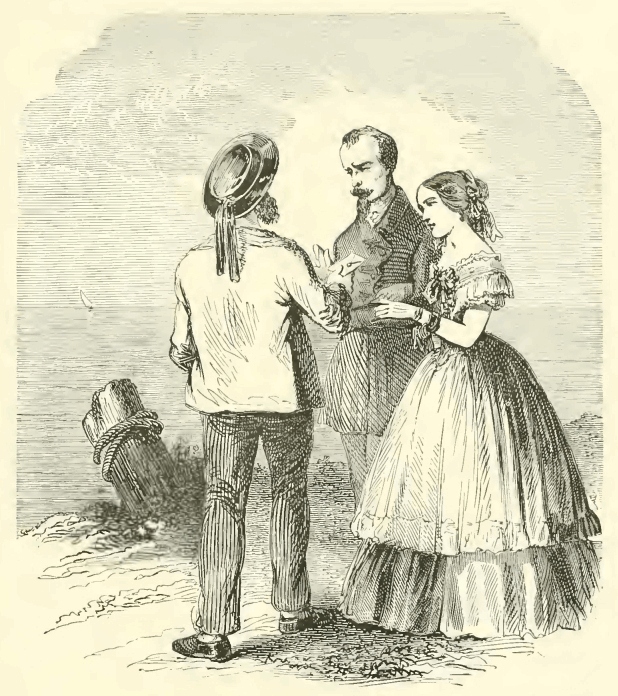
Morrel soon perceived a man standing among the rocks, apparently
awaiting a sign from them to advance, and pointed him out to Valentine.
“Ah, it is Jacopo,” she said, “the captain of the yacht;” and she
beckoned him towards them.
“Do you wish to speak to us?” asked Morrel.
“I have a letter to give you from the count.”
“From the count!” murmured the two young people.
“Yes; read it.”
Morrel opened the letter, and read:
“My Dear Maximilian,
“There is a felucca for you at anchor. Jacopo will carry you to
Leghorn, where Monsieur Noirtier awaits his granddaughter, whom he
wishes to bless before you lead her to the altar. All that is in this
grotto, my friend, my house in the Champs-Élysées, and my château at
Tréport, are the marriage gifts bestowed by Edmond Dantès upon the son
of his old master, Morrel. Mademoiselle de Villefort will share them
with you; for I entreat her to give to the poor the immense fortune
reverting to her from her father, now a madman, and her brother who
died last September with his mother. Tell the angel who will watch over
your future destiny, Morrel, to pray sometimes for a man, who, like
Satan, thought himself for an instant equal to God, but who now
acknowledges with Christian humility that God alone possesses supreme
power and infinite wisdom. Perhaps those prayers may soften the remorse
he feels in his heart. As for you, Morrel, this is the secret of my
conduct towards you. There is neither happiness nor misery in the
world; there is only the comparison of one state with another, nothing
more. He who has felt the deepest grief is best able to experience
supreme happiness. We must have felt what it is to die, Morrel, that we
may appreciate the enjoyments of living.
“Live, then, and be happy, beloved children of my heart, and never
forget that until the day when God shall deign to reveal the future to
man, all human wisdom is summed up in these two words,—‘_Wait and
hope_.’—Your friend,
“Edmond Dantès, Count of Monte Cristo.”
During the perusal of this letter, which informed Valentine for the
first time of the madness of her father and the death of her brother,
she became pale, a heavy sigh escaped from her bosom, and tears, not
the less painful because they were silent, ran down her cheeks; her
happiness cost her very dear.
Morrel looked around uneasily.
“But,” he said, “the count’s generosity is too overwhelming; Valentine
will be satisfied with my humble fortune. Where is the count, friend?
Lead me to him.”
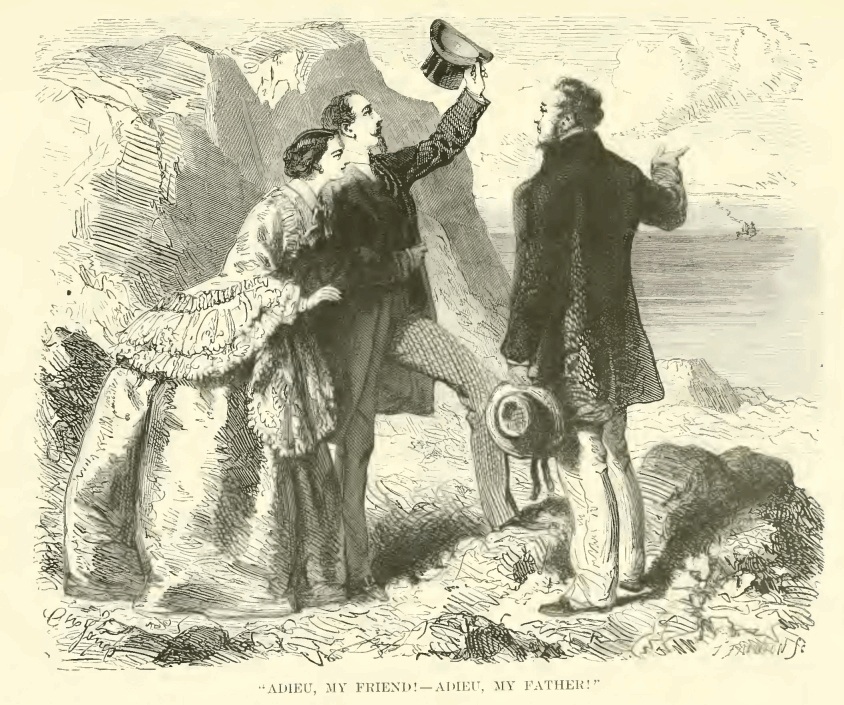
Jacopo pointed towards the horizon.
“What do you mean?” asked Valentine. “Where is the count?—where is
Haydée?”
“Look!” said Jacopo.
The eyes of both were fixed upon the spot indicated by the sailor, and
on the blue line separating the sky from the Mediterranean Sea, they
perceived a large white sail.
“Gone,” said Morrel; “gone!—adieu, my friend—adieu, my father!”
“Gone,” murmured Valentine; “adieu, my sweet Haydée—adieu, my sister!”
“Who can say whether we shall ever see them again?” said Morrel with
tearful eyes.
“Darling,” replied Valentine, “has not the count just told us that all
human wisdom is summed up in two words: