The next day Danglars was again hungry; certainly the air of that
dungeon was very provocative of appetite. The prisoner expected that he
would be at no expense that day, for like an economical man he had
concealed half of his fowl and a piece of the bread in the corner of
his cell. But he had no sooner eaten than he felt thirsty; he had
forgotten that. He struggled against his thirst till his tongue clave
to the roof of his mouth; then, no longer able to resist, he called
out. The sentinel opened the door; it was a new face. He thought it
would be better to transact business with his old acquaintance, so he
sent for Peppino.
“Here I am, your excellency,” said Peppino, with an eagerness which
Danglars thought favorable to him. “What do you want?”
“Something to drink.”
“Your excellency knows that wine is beyond all price near Rome.”
“Then give me water,” cried Danglars, endeavoring to parry the blow.
“Oh, water is even more scarce than wine, your excellency,—there has
been such a drought.”
“Come,” thought Danglars, “it is the same old story.” And while he
smiled as he attempted to regard the affair as a joke, he felt his
temples get moist with perspiration.
“Come, my friend,” said Danglars, seeing that he made no impression on
Peppino, “you will not refuse me a glass of wine?”
“I have already told you that we do not sell at retail.”
“Well, then, let me have a bottle of the least expensive.”
“They are all the same price.”
“And what is that?”
“Twenty-five thousand francs a bottle.”
“Tell me,” cried Danglars, in a tone whose bitterness Harpagon30 alone
has been capable of revealing—“tell me that you wish to despoil me of
all; it will be sooner over than devouring me piecemeal.”
“It is possible such may be the master’s intention.”
“The master?—who is he?”
“The person to whom you were conducted yesterday.”
“Where is he?”
“Here.”
“Let me see him.”
“Certainly.”
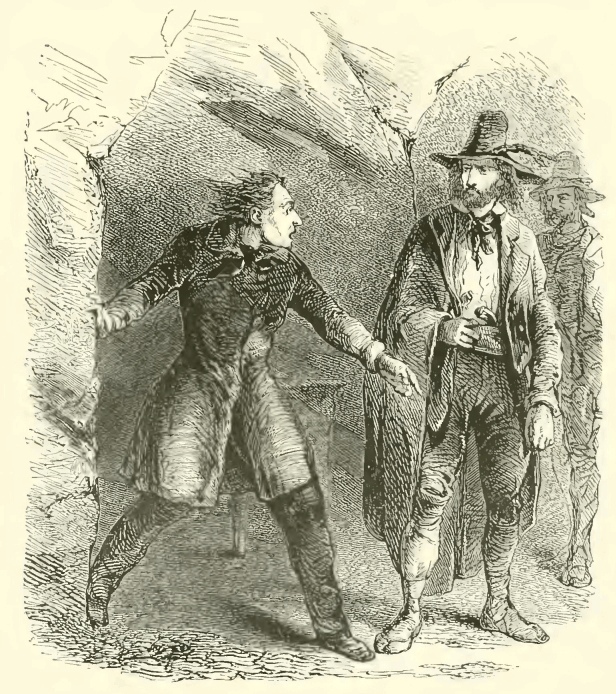
And the next moment Luigi Vampa appeared before Danglars.
“You sent for me?” he said to the prisoner.
“Are you, sir, the chief of the people who brought me here?”
“Yes, your excellency. What then?”
“How much do you require for my ransom?”
“Merely the 5,000,000 you have about you.” Danglars felt a dreadful
spasm dart through his heart.
“But this is all I have left in the world,” he said, “out of an immense
fortune. If you deprive me of that, take away my life also.”
“We are forbidden to shed your blood.”
“And by whom are you forbidden?”
“By him we obey.”
“You do, then, obey someone?”
“Yes, a chief.”
“I thought you said you were the chief?”
“So I am of these men; but there is another over me.”
“And did your superior order you to treat me in this way?”
“Yes.”
“But my purse will be exhausted.”
“Probably.”
“Come,” said Danglars, “will you take a million?”
“No.”
“Two millions?—three?—four? Come, four? I will give them to you on
condition that you let me go.”
“Why do you offer me 4,000,000 for what is worth 5,000,000? This is a
kind of usury, banker, that I do not understand.”
“Take all, then—take all, I tell you, and kill me!”
“Come, come, calm yourself. You will excite your blood, and that would
produce an appetite it would require a million a day to satisfy. Be
more economical.”
“But when I have no more money left to pay you?” asked the infuriated
Danglars.
“Then you must suffer hunger.”
“Suffer hunger?” said Danglars, becoming pale.
“Most likely,” replied Vampa coolly.
“But you say you do not wish to kill me?”
“No.”
“And yet you will let me perish with hunger?”
“Ah, that is a different thing.”
“Well, then, wretches,” cried Danglars, “I will defy your infamous
calculations—I would rather die at once! You may torture, torment, kill
me, but you shall not have my signature again!”
“As your excellency pleases,” said Vampa, as he left the cell.
Danglars, raving, threw himself on the goat-skin. Who could these men
be? Who was the invisible chief? What could be his intentions towards
him? And why, when everyone else was allowed to be ransomed, might he
not also be? Oh, yes; certainly a speedy, violent death would be a fine
means of deceiving these remorseless enemies, who appeared to pursue
him with such incomprehensible vengeance. But to die? For the first
time in his life, Danglars contemplated death with a mixture of dread
and desire; the time had come when the implacable spectre, which exists
in the mind of every human creature, arrested his attention and called
out with every pulsation of his heart, “Thou shalt die!”
Danglars resembled a timid animal excited in the chase; first it flies,
then despairs, and at last, by the very force of desperation, sometimes
succeeds in eluding its pursuers. Danglars meditated an escape; but the
walls were solid rock, a man was sitting reading at the only outlet to
the cell, and behind that man shapes armed with guns continually
passed. His resolution not to sign lasted two days, after which he
offered a million for some food. They sent him a magnificent supper,
and took his million.
From this time the prisoner resolved to suffer no longer, but to have
everything he wanted. At the end of twelve days, after having made a
splendid dinner, he reckoned his accounts, and found that he had only
50,000 francs left. Then a strange reaction took place; he who had just
abandoned 5,000,000 endeavored to save the 50,000 francs he had left,
and sooner than give them up he resolved to enter again upon a life of
privation—he was deluded by the hopefulness that is a premonition of
madness.
He, who for so long a time had forgotten God, began to think that
miracles were possible—that the accursed cavern might be discovered by
the officers of the Papal States, who would release him; that then he
would have 50,000 remaining, which would be sufficient to save him from
starvation; and finally he prayed that this sum might be preserved to
him, and as he prayed he wept. Three days passed thus, during which his
prayers were frequent, if not heartfelt. Sometimes he was delirious,
and fancied he saw an old man stretched on a pallet; he, also, was
dying of hunger.
On the fourth, he was no longer a man, but a living corpse. He had
picked up every crumb that had been left from his former meals, and was
beginning to eat the matting which covered the floor of his cell. Then
he entreated Peppino, as he would a guardian angel, to give him food;
he offered him 1,000 francs for a mouthful of bread. But Peppino did
not answer. On the fifth day he dragged himself to the door of the
cell.
“Are you not a Christian?” he said, falling on his knees. “Do you wish
to assassinate a man who, in the eyes of Heaven, is a brother? Oh, my
former friends, my former friends!” he murmured, and fell with his face
to the ground. Then rising in despair, he exclaimed, “The chief, the
chief!”
“Here I am,” said Vampa, instantly appearing; “what do you want?”
“Take my last gold,” muttered Danglars, holding out his pocket-book,
“and let me live here; I ask no more for liberty—I only ask to live!”
“Then you suffer a great deal?”
“Oh, yes, yes, cruelly!”
“Still, there have been men who suffered more than you.”
“I do not think so.”
“Yes; those who have died of hunger.”
Danglars thought of the old man whom, in his hours of delirium, he had
seen groaning on his bed. He struck his forehead on the ground and
groaned. “Yes,” he said, “there have been some who have suffered more
than I have, but then they must have been martyrs at least.”
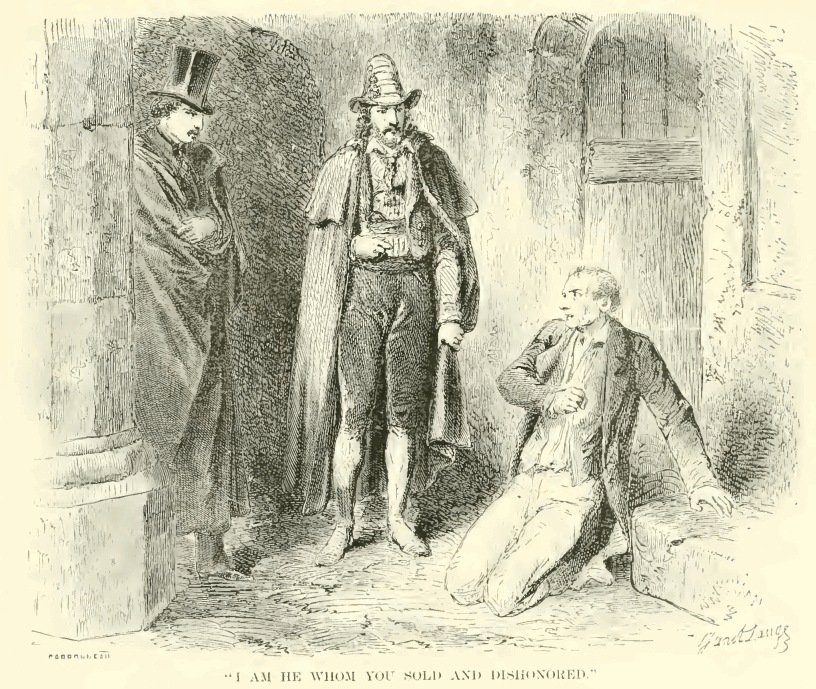
“Do you repent?” asked a deep, solemn voice, which caused Danglars’
hair to stand on end. His feeble eyes endeavored to distinguish
objects, and behind the bandit he saw a man enveloped in a cloak, half
lost in the shadow of a stone column.
“Of what must I repent?” stammered Danglars.
“Of the evil you have done,” said the voice.
“Oh, yes; oh, yes, I do indeed repent.” And he struck his breast with
his emaciated fist.
“Then I forgive you,” said the man, dropping his cloak, and advancing
to the light.
“The Count of Monte Cristo!” said Danglars, more pale from terror than
he had been just before from hunger and misery.
“You are mistaken—I am not the Count of Monte Cristo.”
“Then who are you?”
“I am he whom you sold and dishonored—I am he whose betrothed you
prostituted—I am he upon whom you trampled that you might raise
yourself to fortune—I am he whose father you condemned to die of
hunger—I am he whom you also condemned to starvation, and who yet
forgives you, because he hopes to be forgiven—I am Edmond Dantès!”
Danglars uttered a cry, and fell prostrate.
“Rise,” said the count, “your life is safe; the same good fortune has
not happened to your accomplices—one is mad, the other dead. Keep the
50,000 francs you have left—I give them to you. The 5,000,000 you stole
from the hospitals has been restored to them by an unknown hand. And
now eat and drink; I will entertain you tonight. Vampa, when this man
is satisfied, let him be free.”
Danglars remained prostrate while the count withdrew; when he raised
his head he saw disappearing down the passage nothing but a shadow,
before which the bandits bowed.
According to the count’s directions, Danglars was waited on by Vampa,
who brought him the best wine and fruits of Italy; then, having
conducted him to the road, and pointed to the post-chaise, left him
leaning against a tree. He remained there all night, not knowing where
he was. When daylight dawned he saw that he was near a stream; he was
thirsty, and dragged himself towards it. As he stooped down to drink,
he saw that his hair had become entirely white.
Chapter CXIV
Peppino
At the same time that the steamer disappeared behind Cape Morgiou, a
man travelling post on the road from Florence to Rome had just passed
the little town of Aquapendente. He was travelling fast enough to cover
a great deal of ground without exciting suspicion. This man was dressed
in a greatcoat, or rather a surtout, a little worse for the journey,
but which exhibited the ribbon of the Legion of Honor still fresh and
brilliant, a decoration which also ornamented the under coat. He might
be recognized, not only by these signs, but also from the accent with
which he spoke to the postilion, as a Frenchman.
Another proof that he was a native of the universal country was
apparent in the fact of his knowing no other Italian words than the
terms used in music, and which like the “goddam” of Figaro, served all
possible linguistic requirements. “Allegro!” he called out to the
postilions at every ascent. “Moderato!” he cried as they descended.
And heaven knows there are hills enough between Rome and Florence by
the way of Aquapendente! These two words greatly amused the men to whom
they were addressed. On reaching La Storta, the point from whence Rome
is first visible, the traveller evinced none of the enthusiastic
curiosity which usually leads strangers to stand up and endeavor to
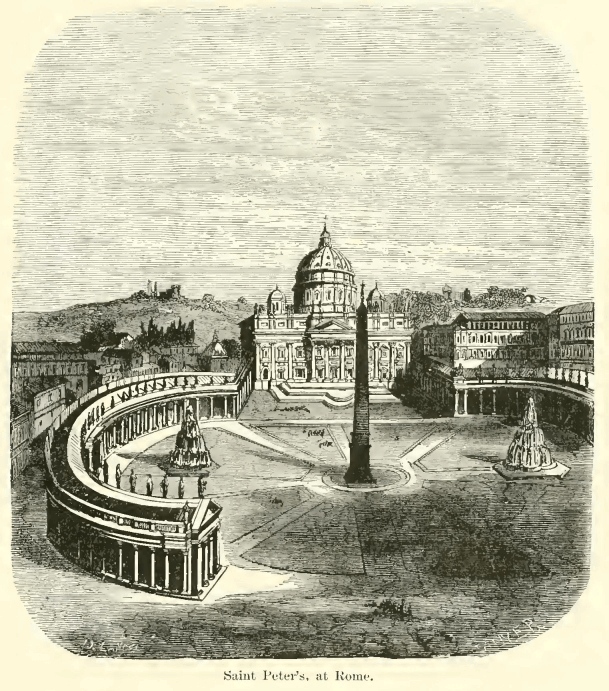
catch sight of the dome of Saint Peter’s, which may be seen long before
any other object is distinguishable. No, he merely drew a pocketbook
from his pocket, and took from it a paper folded in four, and after
having examined it in a manner almost reverential, he said:
“Good! I have it still!”
The carriage entered by the Porta del Popolo, turned to the left, and
stopped at the Hôtel d’Espagne. Old Pastrini, our former acquaintance,
received the traveller at the door, hat in hand. The traveller
alighted, ordered a good dinner, and inquired the address of the house
of Thomson & French, which was immediately given to him, as it was one
of the most celebrated in Rome. It was situated in the Via dei Banchi,
near St. Peter’s.
In Rome, as everywhere else, the arrival of a post-chaise is an event.
Ten young descendants of Marius and the Gracchi, barefooted and out at
elbows, with one hand resting on the hip and the other gracefully
curved above the head, stared at the traveller, the post-chaise, and
the horses; to these were added about fifty little vagabonds from the
Papal States, who earned a pittance by diving into the Tiber at high
water from the bridge of St. Angelo. Now, as these street Arabs of
Rome, more fortunate than those of Paris, understand every language,
more especially the French, they heard the traveller order an
apartment, a dinner, and finally inquire the way to the house of
Thomson & French.
The result was that when the new-comer left the hotel with the
cicerone, a man detached himself from the rest of the idlers, and
without having been seen by the traveller, and appearing to excite no
attention from the guide, followed the stranger with as much skill as a
Parisian police agent would have used.
The Frenchman had been so impatient to reach the house of Thomson &
French that he would not wait for the horses to be harnessed, but left
word for the carriage to overtake him on the road, or to wait for him
at the bankers’ door. He reached it before the carriage arrived. The
Frenchman entered, leaving in the anteroom his guide, who immediately
entered into conversation with two or three of the industrious idlers
who are always to be found in Rome at the doors of banking-houses,
churches, museums, or theatres. With the Frenchman, the man who had
followed him entered too; the Frenchman knocked at the inner door, and
entered the first room; his shadow did the same.
“Messrs. Thomson & French?” inquired the stranger.
An attendant arose at a sign from a confidential clerk at the first
desk.
“Whom shall I announce?” said the attendant.
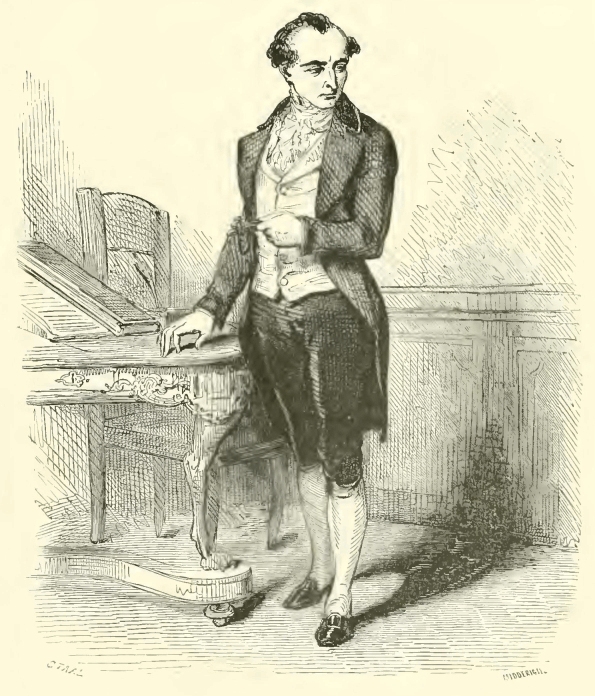
“Baron Danglars.”
“Follow me,” said the man.
A door opened, through which the attendant and the baron disappeared.
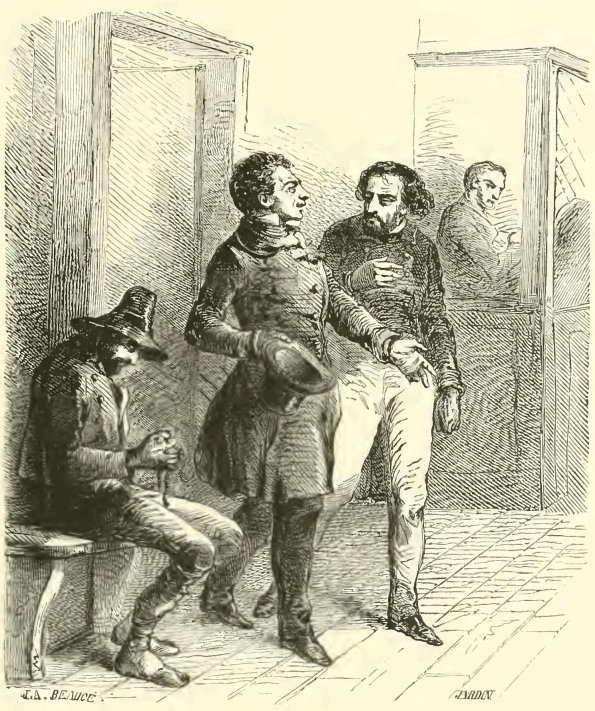
The man who had followed Danglars sat down on a bench. The clerk
continued to write for the next five minutes; the man preserved
profound silence, and remained perfectly motionless. Then the pen of
the clerk ceased to move over the paper; he raised his head, and
appearing to be perfectly sure of privacy:
“Ah, ha,” he said, “here you are, Peppino!”
“Yes,” was the laconic reply. “You have found out that there is
something worth having about this large gentleman?”
“There is no great merit due to me, for we were informed of it.”
“You know his business here, then.”
“Pardieu, he has come to draw, but I don’t know how much!”
“You will know presently, my friend.”
“Very well, only do not give me false information as you did the other
day.”
“What do you mean?—of whom do you speak? Was it the Englishman who
carried off 3,000 crowns from here the other day?”
“No; he really had 3,000 crowns, and we found them. I mean the Russian
prince, who you said had 30,000 livres, and we only found 22,000.”
“You must have searched badly.”
“Luigi Vampa himself searched.”
“In that case he must either have paid his debts——”
“A Russian do that?”
“Or spent the money?”
“Possibly, after all.”
“Certainly. But you must let me make my observations, or the Frenchman
will transact his business without my knowing the sum.”
Peppino nodded, and taking a rosary from his pocket began to mutter a
few prayers while the clerk disappeared through the same door by which
Danglars and the attendant had gone out. At the expiration of ten
minutes the clerk returned with a beaming countenance.
“Well?” asked Peppino of his friend.
“Joy, joy—the sum is large!”
“Five or six millions, is it not?”
“Yes, you know the amount.”
“On the receipt of the Count of Monte Cristo?”
“Why, how came you to be so well acquainted with all this?”
“I told you we were informed beforehand.”
“Then why do you apply to me?”
“That I may be sure I have the right man.”
“Yes, it is indeed he. Five millions—a pretty sum, eh, Peppino?”
“Hush—here is our man!” The clerk seized his pen, and Peppino his
beads; one was writing and the other praying when the door opened.
Danglars looked radiant with joy; the banker accompanied him to the
door. Peppino followed Danglars.
According to the arrangements, the carriage was waiting at the door.
The guide held the door open. Guides are useful people, who will turn
their hands to anything. Danglars leaped into the carriage like a young
man of twenty. The cicerone reclosed the door, and sprang up by the
side of the coachman. Peppino mounted the seat behind.
“Will your excellency visit Saint Peter’s?” asked the cicerone.
“I did not come to Rome to see,” said Danglars aloud; then he added
softly, with an avaricious smile, “I came to touch!” and he rapped his
pocket-book, in which he had just placed a letter.
“Then your excellency is going——”
“To the hotel.”
“Casa Pastrini!” said the cicerone to the coachman, and the carriage
drove rapidly on.
Ten minutes afterwards the baron entered his apartment, and Peppino
stationed himself on the bench outside the door of the hotel, after
having whispered something in the ear of one of the descendants of
Marius and the Gracchi whom we noticed at the beginning of the chapter,
who immediately ran down the road leading to the Capitol at his fullest
speed. Danglars was tired and sleepy; he therefore went to bed, placing
his pocketbook under his pillow. Peppino had a little spare time, so he
had a game of morra with the facchini, lost three crowns, and then to
console himself drank a bottle of Orvieto.
The next morning Danglars awoke late, though he went to bed so early;
he had not slept well for five or six nights, even if he had slept at
all. He breakfasted heartily, and caring little, as he said, for the
beauties of the Eternal City, ordered post-horses at noon. But Danglars
had not reckoned upon the formalities of the police and the idleness of
the posting-master. The horses only arrived at two o’clock, and the
cicerone did not bring the passport till three.
All these preparations had collected a number of idlers round the door
of Signor Pastrini’s; the descendants of Marius and the Gracchi were
also not wanting. The baron walked triumphantly through the crowd, who
for the sake of gain styled him “your excellency.” As Danglars had
hitherto contented himself with being called a baron, he felt rather
flattered at the title of excellency, and distributed a dozen silver
coins among the beggars, who were ready, for twelve more, to call him
“your highness.”
“Which road?” asked the postilion in Italian.
“The Ancona road,” replied the baron. Signor Pastrini interpreted the
question and answer, and the horses galloped off.
Danglars intended travelling to Venice, where he would receive one part
of his fortune, and then proceeding to Vienna, where he would find the
rest, he meant to take up his residence in the latter town, which he
had been told was a city of pleasure.
He had scarcely advanced three leagues out of Rome when daylight began
to disappear. Danglars had not intended starting so late, or he would
have remained; he put his head out and asked the postilion how long it
would be before they reached the next town. “Non capisco” (do not
understand), was the reply. Danglars bent his head, which he meant to
imply, “Very well.” The carriage again moved on.
“I will stop at the first posting-house,” said Danglars to himself.
He still felt the same self-satisfaction which he had experienced the
previous evening, and which had procured him so good a night’s rest. He
was luxuriously stretched in a good English calash, with double
springs; he was drawn by four good horses, at full gallop; he knew the
relay to be at a distance of seven leagues. What subject of meditation
could present itself to the banker, so fortunately become bankrupt?
Danglars thought for ten minutes about his wife in Paris; another ten
minutes about his daughter travelling with Mademoiselle d’Armilly; the
same period was given to his creditors, and the manner in which he
intended spending their money; and then, having no subject left for
contemplation, he shut his eyes, and fell asleep. Now and then a jolt
more violent than the rest caused him to open his eyes; then he felt
that he was still being carried with great rapidity over the same
country, thickly strewn with broken aqueducts, which looked like
granite giants petrified while running a race. But the night was cold,
dull, and rainy, and it was much more pleasant for a traveller to
remain in the warm carriage than to put his head out of the window to
make inquiries of a postilion whose only answer was “Non capisco.”
Danglars therefore continued to sleep, saying to himself that he would
be sure to awake at the posting-house. The carriage stopped. Danglars
fancied that they had reached the long-desired point; he opened his
eyes and looked through the window, expecting to find himself in the
midst of some town, or at least village; but he saw nothing except what
seemed like a ruin, where three or four men went and came like shadows.
Danglars waited a moment, expecting the postilion to come and demand
payment with the termination of his stage. He intended taking advantage
of the opportunity to make fresh inquiries of the new conductor; but
the horses were unharnessed, and others put in their places, without
anyone claiming money from the traveller. Danglars, astonished, opened
the door; but a strong hand pushed him back, and the carriage rolled
on. The baron was completely roused.
“Eh?” he said to the postilion, “eh, mio caro?”
This was another little piece of Italian the baron had learned from
hearing his daughter sing Italian duets with Cavalcanti. But mio caro
did not reply. Danglars then opened the window.
“Come, my friend,” he said, thrusting his hand through the opening,
“where are we going?”
“Dentro la testa!” answered a solemn and imperious voice, accompanied
by a menacing gesture.
Danglars thought dentro la testa meant, “Put in your head!” He was
making rapid progress in Italian. He obeyed, not without some
uneasiness, which, momentarily increasing, caused his mind, instead of
being as unoccupied as it was when he began his journey, to fill with
ideas which were very likely to keep a traveller awake, more especially
one in such a situation as Danglars. His eyes acquired that quality
which in the first moment of strong emotion enables them to see
distinctly, and which afterwards fails from being too much taxed.
Before we are alarmed, we see correctly; when we are alarmed, we see
double; and when we have been alarmed, we see nothing but trouble.
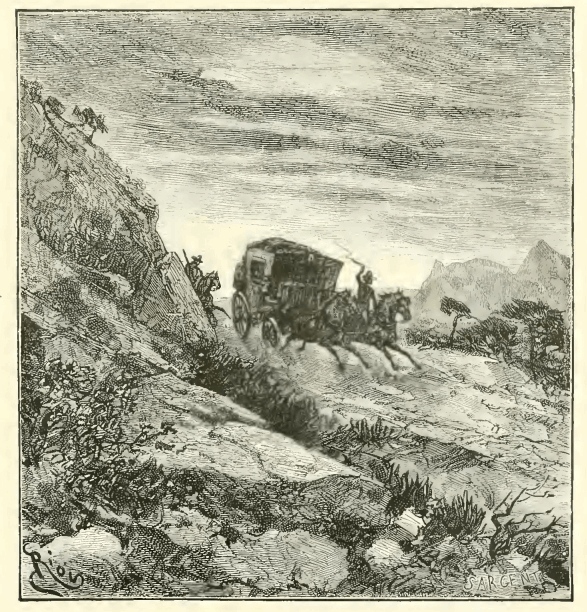
Danglars observed a man in a cloak galloping at the right hand of the
carriage.
“Some gendarme!” he exclaimed. “Can I have been intercepted by French
telegrams to the pontifical authorities?”
He resolved to end his anxiety. “Where are you taking me?” he asked.
“Dentro la testa,” replied the same voice, with the same menacing
accent.
Danglars turned to the left; another man on horseback was galloping on
that side.
“Decidedly,” said Danglars, with the perspiration on his forehead, “I
must be under arrest.” And he threw himself back in the calash, not
this time to sleep, but to think.
Directly afterwards the moon rose. He then saw the great aqueducts,
those stone phantoms which he had before remarked, only then they were
on the right hand, now they were on the left. He understood that they
had described a circle, and were bringing him back to Rome.
“Oh, unfortunate!” he cried, “they must have obtained my arrest.”
The carriage continued to roll on with frightful speed. An hour of
terror elapsed, for every spot they passed showed that they were on the
road back. At length he saw a dark mass, against which it seemed as if
the carriage was about to dash; but the vehicle turned to one side,
leaving the barrier behind and Danglars saw that it was one of the
ramparts encircling Rome.
“Mon dieu!” cried Danglars, “we are not returning to Rome; then it is
not justice which is pursuing me! Gracious heavens; another idea
presents itself—what if they should be——”
His hair stood on end. He remembered those interesting stories, so
little believed in Paris, respecting Roman bandits; he remembered the
adventures that Albert de Morcerf had related when it was intended that
he should marry Mademoiselle Eugénie. “They are robbers, perhaps,” he
muttered.
Just then the carriage rolled on something harder than gravel road.
Danglars hazarded a look on both sides of the road, and perceived
monuments of a singular form, and his mind now recalled all the details
Morcerf had related, and comparing them with his own situation, he felt
sure that he must be on the Appian Way. On the left, in a sort of
valley, he perceived a circular excavation. It was Caracalla’s circus.
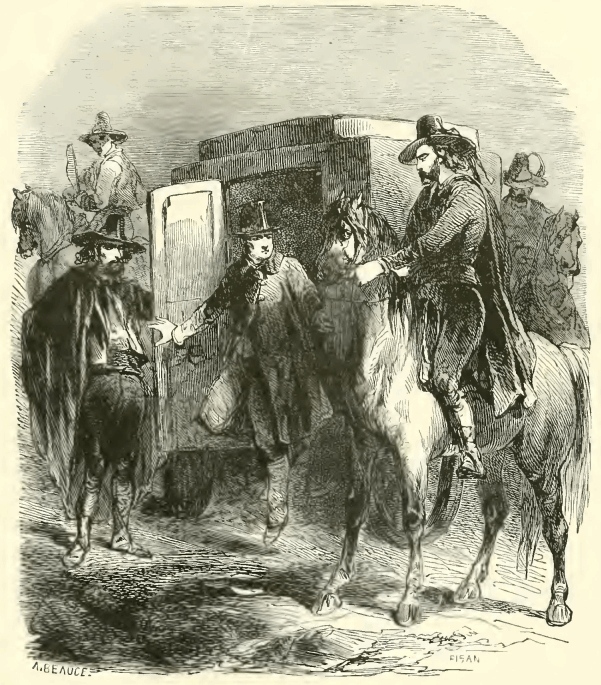
On a word from the man who rode at the side of the carriage, it
stopped. At the same time the door was opened. “Scendi!” exclaimed a
commanding voice.
Danglars instantly descended; although he did not yet speak Italian, he
understood it very well. More dead than alive, he looked around him.
Four men surrounded him, besides the postilion.
“Di quà,” said one of the men, descending a little path leading out
of the Appian Way. Danglars followed his guide without opposition, and
had no occasion to turn around to see whether the three others were
following him. Still it appeared as though they were stationed at equal
distances from one another, like sentinels. After walking for about ten
minutes, during which Danglars did not exchange a single word with his
guide, he found himself between a hillock and a clump of high weeds;
three men, standing silent, formed a triangle, of which he was the
centre. He wished to speak, but his tongue refused to move.
“Avanti!” said the same sharp and imperative voice.
This time Danglars had double reason to understand, for if the word and
gesture had not explained the speaker’s meaning, it was clearly
expressed by the man walking behind him, who pushed him so rudely that
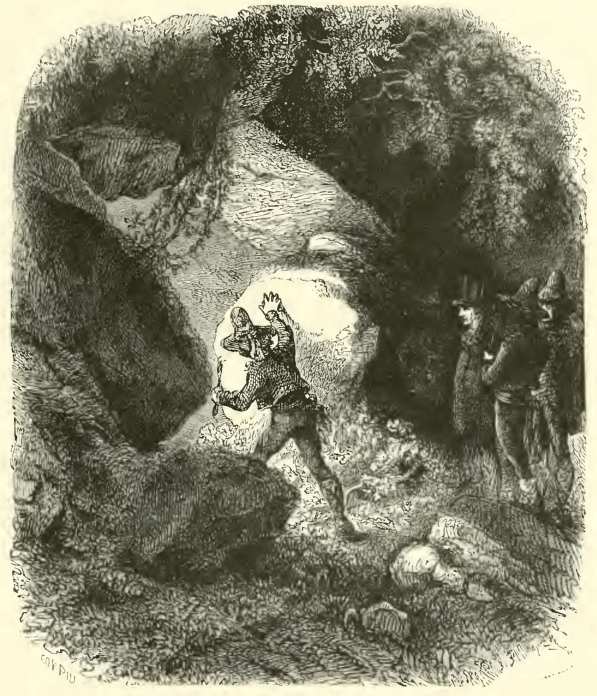
he struck against the guide. This guide was our friend Peppino, who
dashed into the thicket of high weeds, through a path which none but
lizards or polecats could have imagined to be an open road.
Peppino stopped before a rock overhung by thick hedges; the rock, half
open, afforded a passage to the young man, who disappeared like the
evil spirits in the fairy tales. The voice and gesture of the man who
followed Danglars ordered him to do the same. There was no longer any
doubt, the bankrupt was in the hands of Roman banditti. Danglars
acquitted himself like a man placed between two dangerous positions,
and who is rendered brave by fear. Notwithstanding his large stomach,
certainly not intended to penetrate the fissures of the Campagna, he
slid down like Peppino, and closing his eyes fell upon his feet. As he
touched the ground, he opened his eyes.
The path was wide, but dark. Peppino, who cared little for being
recognized now that he was in his own territories, struck a light and
lit a torch. Two other men descended after Danglars forming the
rearguard, and pushing Danglars whenever he happened to stop, they came
by a gentle declivity to the intersection of two corridors. The walls
were hollowed out in sepulchres, one above the other, and which seemed
in contrast with the white stones to open their large dark eyes, like
those which we see on the faces of the dead. A sentinel struck the
rings of his carbine against his left hand.
“Who comes there?” he cried.
“A friend, a friend!” said Peppino; “but where is the captain?”
“There,” said the sentinel, pointing over his shoulder to a spacious
crypt, hollowed out of the rock, the lights from which shone into the
passage through the large arched openings.
“Fine spoil, captain, fine spoil!” said Peppino in Italian, and taking
Danglars by the collar of his coat he dragged him to an opening
resembling a door, through which they entered the apartment which the
captain appeared to have made his dwelling-place.
“Is this the man?” asked the captain, who was attentively reading
Plutarch’s Life of Alexander.
“Himself, captain—himself.”
“Very well, show him to me.”
At this rather impertinent order, Peppino raised his torch to the face
of Danglars, who hastily withdrew that he might not have his eyelashes
burnt. His agitated features presented the appearance of pale and
hideous terror.
“The man is tired,” said the captain, “conduct him to his bed.”
“Oh,” murmured Danglars, “that bed is probably one of the coffins
hollowed in the wall, and the sleep I shall enjoy will be death from
one of the poniards I see glistening in the darkness.”
From their beds of dried leaves or wolf-skins at the back of the
chamber now arose the companions of the man who had been found by
Albert de Morcerf reading Cæsar’s Commentaries, and by Danglars
studying the Life of Alexander. The banker uttered a groan and
followed his guide; he neither supplicated nor exclaimed. He no longer
possessed strength, will, power, or feeling; he followed where they led
him. At length he found himself at the foot of a staircase, and he
mechanically lifted his foot five or six times. Then a low door was
opened before him, and bending his head to avoid striking his forehead
he entered a small room cut out of the rock. The cell was clean, though
empty, and dry, though situated at an immeasurable distance under the
earth. A bed of dried grass covered with goat-skins was placed in one
corner. Danglars brightened up on beholding it, fancying that it gave
some promise of safety.
“Oh, God be praised,” he said; “it is a real bed!”
This was the second time within the hour that he had invoked the name
of God. He had not done so for ten years before.
“Ecco!” said the guide, and pushing Danglars into the cell, he closed
the door upon him.
A bolt grated and Danglars was a prisoner. If there had been no bolt,
it would have been impossible for him to pass through the midst of the
garrison who held the catacombs of St. Sebastian, encamped round a
master whom our readers must have recognized as the famous Luigi Vampa.
Danglars, too, had recognized the bandit, whose existence he would not
believe when Albert de Morcerf mentioned him in Paris; and not only did
he recognize him, but the cell in which Albert had been confined, and
which was probably kept for the accommodation of strangers. These
recollections were dwelt upon with some pleasure by Danglars, and
restored him to some degree of tranquillity. Since the bandits had not
despatched him at once, he felt that they would not kill him at all.
They had arrested him for the purpose of robbery, and as he had only a
few louis about him, he doubted not he would be ransomed.
He remembered that Morcerf had been taxed at 4,000 crowns, and as he
considered himself of much greater importance than Morcerf he fixed his
own price at 8,000 crowns. Eight thousand crowns amounted to 48,000
livres; he would then have about 5,050,000 francs left. With this sum
he could manage to keep out of difficulties. Therefore, tolerably
secure in being able to extricate himself from his position, provided
he were not rated at the unreasonable sum of 5,050,000 francs, he
stretched himself on his bed, and after turning over two or three
times, fell asleep with the tranquillity of the hero whose life Luigi
Vampa was studying.
Chapter CXV
Luigi Vampa's Bill of Fare
We awake from every sleep except the one dreaded by Danglars. He awoke.
To a Parisian accustomed to silken curtains, walls hung with velvet
drapery, and the soft perfume of burning wood, the white smoke of which
diffuses itself in graceful curves around the room, the appearance of
the whitewashed cell which greeted his eyes on awakening seemed like
the continuation of some disagreeable dream. But in such a situation a
single moment suffices to change the strongest doubt into certainty.
“Yes, yes,” he murmured, “I am in the hands of the brigands of whom
Albert de Morcerf spoke.” His first idea was to breathe, that he might
know whether he was wounded. He borrowed this from Don Quixote, the
only book he had ever read, but which he still slightly remembered.
“No,” he cried, “they have not wounded, but perhaps they have robbed
me!” and he thrust his hands into his pockets. They were untouched; the
hundred louis he had reserved for his journey from Rome to Venice were
in his trousers pocket, and in that of his greatcoat he found the
little note-case containing his letter of credit for 5,050,000 francs.
“Singular bandits!” he exclaimed; “they have left me my purse and
pocket-book. As I was saying last night, they intend me to be ransomed.
Hello, here is my watch! Let me see what time it is.”
Danglars’ watch, one of Breguet’s repeaters, which he had carefully
wound up on the previous night, struck half past five. Without this,
Danglars would have been quite ignorant of the time, for daylight did
not reach his cell. Should he demand an explanation from the bandits,
or should he wait patiently for them to propose it? The last
alternative seemed the most prudent, so he waited until twelve o’clock.
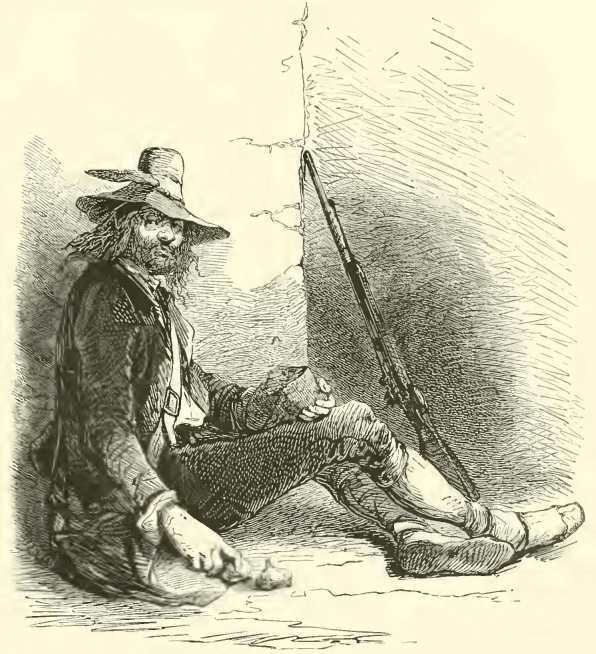
During all this time a sentinel, who had been relieved at eight
o’clock, had been watching his door.
Danglars suddenly felt a strong inclination to see the person who kept
watch over him. He had noticed that a few rays, not of daylight, but
from a lamp, penetrated through the ill-joined planks of the door; he
approached just as the brigand was refreshing himself with a mouthful
of brandy, which, owing to the leathern bottle containing it, sent
forth an odor which was extremely unpleasant to Danglars. “Faugh!” he
exclaimed, retreating to the farther corner of his cell.
At twelve this man was replaced by another functionary, and Danglars,
wishing to catch sight of his new guardian, approached the door again.
He was an athletic, gigantic bandit, with large eyes, thick lips, and a
flat nose; his red hair fell in dishevelled masses like snakes around
his shoulders.
“Ah, ha,” cried Danglars, “this fellow is more like an ogre than
anything else; however, I am rather too old and tough to be very good
eating!”
We see that Danglars was collected enough to jest; at the same time, as
though to disprove the ogreish propensities, the man took some black
bread, cheese, and onions from his wallet, which he began devouring
voraciously.
“May I be hanged,” said Danglars, glancing at the bandit’s dinner
through the crevices of the door,—“may I be hanged if I can understand
how people can eat such filth!” and he withdrew to seat himself upon
his goat-skin, which reminded him of the smell of the brandy.
But the mysteries of nature are incomprehensible, and there are certain
invitations contained in even the coarsest food which appeal very
irresistibly to a fasting stomach. Danglars felt his own not to be very
well supplied just then, and gradually the man appeared less ugly, the
bread less black, and the cheese more fresh, while those dreadful
vulgar onions recalled to his mind certain sauces and side-dishes,
which his cook prepared in a very superior manner whenever he said,
“Monsieur Deniseau, let me have a nice little fricassee today.” He got
up and knocked on the door; the bandit raised his head. Danglars knew
that he was heard, so he redoubled his blows.
“Che cosa?” asked the bandit.
“Come, come,” said Danglars, tapping his fingers against the door, “I
think it is quite time to think of giving me something to eat!”
But whether he did not understand him, or whether he had received no
orders respecting the nourishment of Danglars, the giant, without
answering, went on with his dinner. Danglars’ feelings were hurt, and
not wishing to put himself under obligations to the brute, the banker
threw himself down again on his goat-skin and did not breathe another
word.
Four hours passed by and the giant was replaced by another bandit.
Danglars, who really began to experience sundry gnawings at the
stomach, arose softly, again applied his eye to the crack of the door,
and recognized the intelligent countenance of his guide. It was,
indeed, Peppino who was preparing to mount guard as comfortably as
possible by seating himself opposite to the door, and placing between
his legs an earthen pan, containing chick-peas stewed with bacon. Near
the pan he also placed a pretty little basket of Villetri grapes and a
flask of Orvieto. Peppino was decidedly an epicure. Danglars watched
these preparations and his mouth watered.
“Come,” he said to himself, “let me try if he will be more tractable
than the other;” and he tapped gently at the door.
“On y va,” (coming) exclaimed Peppino, who from frequenting the house
of Signor Pastrini understood French perfectly in all its idioms.
Danglars immediately recognized him as the man who had called out in
such a furious manner, “Put in your head!” But this was not the time
for recrimination, so he assumed his most agreeable manner and said
with a gracious smile:
“Excuse me, sir, but are they not going to give me any dinner?”
“Does your excellency happen to be hungry?”
“Happen to be hungry,—that’s pretty good, when I haven’t eaten for
twenty-four hours!” muttered Danglars. Then he added aloud, “Yes, sir,
I am hungry—very hungry.”
“And your excellency wants something to eat?”
“At once, if possible”
“Nothing easier,” said Peppino. “Here you can get anything you want; by
paying for it, of course, as among honest folk.”
“Of course!” cried Danglars. “Although, in justice, the people who
arrest and imprison you, ought, at least, to feed you.”
“That is not the custom, excellency,” said Peppino.
“A bad reason,” replied Danglars, who reckoned on conciliating his
keeper; “but I am content. Let me have some dinner!”
“At once! What would your excellency like?”
And Peppino placed his pan on the ground, so that the steam rose
directly under the nostrils of Danglars. “Give your orders.”
“Have you kitchens here?”
“Kitchens?—of course—complete ones.”
“And cooks?”
“Excellent!”
“Well, a fowl, fish, game,—it signifies little, so that I eat.”
“As your excellency pleases. You mentioned a fowl, I think?”
“Yes, a fowl.”
Peppino, turning around, shouted, “A fowl for his excellency!” His
voice yet echoed in the archway when a handsome, graceful, and
half-naked young man appeared, bearing a fowl in a silver dish on his
head, without the assistance of his hands.
“I could almost believe myself at the Café de Paris,” murmured
Danglars.
“Here, your excellency,” said Peppino, taking the fowl from the young
bandit and placing it on the worm-eaten table, which with the stool and
the goat-skin bed formed the entire furniture of the cell. Danglars
asked for a knife and fork.
“Here, excellency,” said Peppino, offering him a little blunt knife and
a boxwood fork. Danglars took the knife in one hand and the fork in the
other, and was about to cut up the fowl.
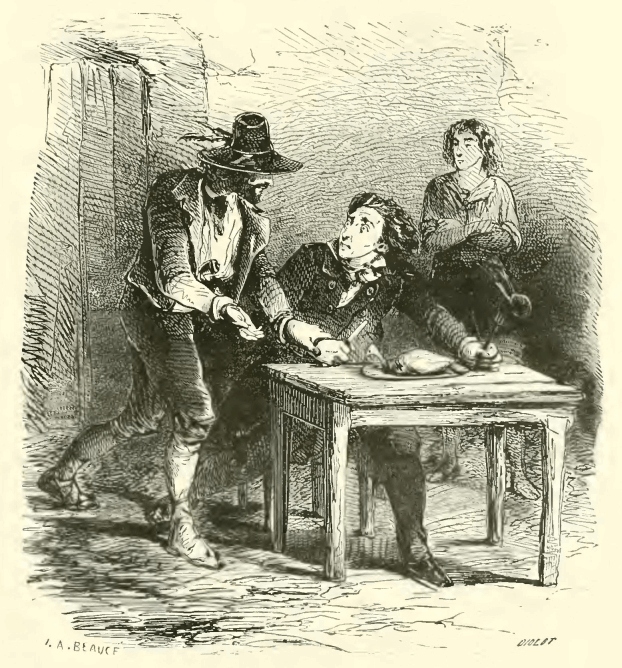
“Pardon me, excellency,” said Peppino, placing his hand on the banker’s
shoulder; “people pay here before they eat. They might not be
satisfied, and——”
“Ah, ha,” thought Danglars, “this is not so much like Paris, except
that I shall probably be skinned! Never mind, I’ll fix that all right.
I have always heard how cheap poultry is in Italy; I should think a
fowl is worth about twelve sous at Rome.—There,” he said, throwing a
louis down.
Peppino picked up the louis, and Danglars again prepared to carve the
fowl.
“Stay a moment, your excellency,” said Peppino, rising; “you still owe
me something.”
“I said they would skin me,” thought Danglars; but resolving to resist
the extortion, he said, “Come, how much do I owe you for this fowl?”
“Your excellency has given me a louis on account.”
“A louis on account for a fowl?”
“Certainly; and your excellency now owes me 4,999 louis.”
Danglars opened his enormous eyes on hearing this gigantic joke.
“Very droll,” he muttered, “very droll indeed,” and he again began to
carve the fowl, when Peppino stopped the baron’s right hand with his
left, and held out his other hand.
“Come, now,” he said.
“Is it not a joke?” said Danglars.
“We never joke,” replied Peppino, solemn as a Quaker.
“What! A hundred thousand francs for a fowl!”
“Ah, excellency, you cannot imagine how hard it is to rear fowls in
these horrible caves!”
“Come, come, this is very droll—very amusing—I allow; but, as I am very
hungry, pray allow me to eat. Stay, here is another louis for you.”
“Then that will make only 4,998 louis more,” said Peppino with the same
indifference. “I shall get them all in time.”
“Oh, as for that,” said Danglars, angry at this prolongation of the
jest,—“as for that you won’t get them at all. Go to the devil! You do
not know with whom you have to deal!”
Peppino made a sign, and the youth hastily removed the fowl. Danglars
threw himself upon his goat-skin, and Peppino, reclosing the door,
again began eating his peas and bacon. Though Danglars could not see
Peppino, the noise of his teeth allowed no doubt as to his occupation.
He was certainly eating, and noisily too, like an ill-bred man.
“Brute!” said Danglars. Peppino pretended not to hear him, and without
even turning his head continued to eat slowly. Danglars’ stomach felt
so empty, that it seemed as if it would be impossible ever to fill it
again; still he had patience for another half-hour, which appeared to
him like a century. He again arose and went to the door.
“Come, sir, do not keep me starving here any longer, but tell me what
they want.”
“Nay, your excellency, it is you who should tell us what you want. Give
your orders, and we will execute them.”
“Then open the door directly.” Peppino obeyed. “Now look here, I want
something to eat! To eat—do you hear?”
“Are you hungry?”
“Come, you understand me.”
“What would your excellency like to eat?”
“A piece of dry bread, since the fowls are beyond all price in this
accursed place.”
“Bread? Very well. Holloa, there, some bread!” he called. The youth
brought a small loaf. “How much?” asked Danglars.
“Four thousand nine hundred and ninety-eight louis,” said Peppino; “You
have paid two louis in advance.”
“What? One hundred thousand francs for a loaf?”
“One hundred thousand francs,” repeated Peppino.
“But you only asked 100,000 francs for a fowl!”
“We have a fixed price for all our provisions. It signifies nothing
whether you eat much or little—whether you have ten dishes or one—it is
always the same price.”
“What, still keeping up this silly jest? My dear fellow, it is
perfectly ridiculous—stupid! You had better tell me at once that you
intend starving me to death.”
“Oh, dear, no, your excellency, unless you intend to commit suicide.
Pay and eat.”
“And what am I to pay with, brute?” said Danglars, enraged. “Do you
suppose I carry 100,000 francs in my pocket?”
“Your excellency has 5,050,000 francs in your pocket; that will be
fifty fowls at 100,000 francs apiece, and half a fowl for the 50,000.”
Danglars shuddered. The bandage fell from his eyes, and he understood
the joke, which he did not think quite so stupid as he had done just
before.
“Come,” he said, “if I pay you the 100,000 francs, will you be
satisfied, and allow me to eat at my ease?”
“Certainly,” said Peppino.
“But how can I pay them?”
“Oh, nothing easier; you have an account open with Messrs. Thomson &
French, Via dei Banchi, Rome; give me a draft for 4,998 louis on these
gentlemen, and our banker shall take it.”
Danglars thought it as well to comply with a good grace, so he took the
pen, ink, and paper Peppino offered him, wrote the draft, and signed
it.
“Here,” he said, “here is a draft at sight.”
“And here is your fowl.”
Danglars sighed while he carved the fowl; it appeared very thin for the
price it had cost. As for Peppino, he examined the paper attentively,
put it into his pocket, and continued eating his peas.