In the house in the Rue du Helder, where Albert had invited the Count
of Monte Cristo, everything was being prepared on the morning of the
21st of May to do honor to the occasion. Albert de Morcerf inhabited a
pavilion situated at the corner of a large court, and directly opposite
another building, in which were the servants’ apartments. Two windows
only of the pavilion faced the street; three other windows looked into
the court, and two at the back into the garden.
Between the court and the garden, built in the heavy style of the
imperial architecture, was the large and fashionable dwelling of the
Count and Countess of Morcerf.
A high wall surrounded the whole of the property, surmounted at
intervals by vases filled with flowers, and broken in the centre by a
large gate of gilded iron, which served as the carriage entrance. A
small door, close to the lodge of the concierge, gave ingress and
egress to the servants and masters when they were on foot.
It was easy to discover that the delicate care of a mother, unwilling
to part from her son, and yet aware that a young man of the viscount’s
age required the full exercise of his liberty, had chosen this
habitation for Albert. There were not lacking, however, evidences of
what we may call the intelligent egoism of a youth who is charmed with
the indolent, careless life of an only son, and who lives as it were in
a gilded cage. By means of the two windows looking into the street,
Albert could see all that passed; the sight of what is going on is
necessary to young men, who always want to see the world traverse their
horizon, even if that horizon is only a public thoroughfare. Then,
should anything appear to merit a more minute examination, Albert de
Morcerf could follow up his researches by means of a small gate,
similar to that close to the concierge’s door, and which merits a
particular description.
It was a little entrance that seemed never to have been opened since
the house was built, so entirely was it covered with dust and dirt; but
the well-oiled hinges and locks told quite another story. This door was
a mockery to the concierge, from whose vigilance and jurisdiction it
was free, and, like that famous portal in the Arabian Nights, opening
at the “Sesame” of Ali Baba, it was wont to swing backward at a
cabalistic word or a concerted tap from without from the sweetest
voices or whitest fingers in the world.
At the end of a long corridor, with which the door communicated, and
which formed the antechamber, was, on the right, Albert’s
breakfast-room, looking into the court, and on the left the salon,
looking into the garden. Shrubs and creeping plants covered the
windows, and hid from the garden and court these two apartments, the
only rooms into which, as they were on the ground floor, the prying
eyes of the curious could penetrate.
On the floor above were similar rooms, with the addition of a third,
formed out of the antechamber; these three rooms were a salon, a
boudoir, and a bedroom. The salon downstairs was only an Algerian
divan, for the use of smokers. The boudoir upstairs communicated with
the bedchamber by an invisible door on the staircase; it was evident
that every precaution had been taken. Above this floor was a large
atelier, which had been increased in size by pulling down the
partitions—a pandemonium, in which the artist and the dandy strove for
pre-eminence.
There were collected and piled up all Albert’s successive caprices,
hunting-horns, bass-viols, flutes—a whole orchestra, for Albert had had
not a taste but a fancy for music; easels, palettes, brushes,
pencils—for music had been succeeded by painting; foils, boxing-gloves,
broadswords, and single-sticks—for, following the example of the
fashionable young men of the time, Albert de Morcerf cultivated, with
far more perseverance than music and drawing, the three arts that
complete a dandy’s education, i.e., fencing, boxing, and single-stick;
and it was here that he received Grisier, Cooks, and Charles Leboucher.
The rest of the furniture of this privileged apartment consisted of old
cabinets, filled with Chinese porcelain and Japanese vases, Lucca della
Robbia faïences, and Palissy platters; of old armchairs, in which
perhaps had sat Henry IV. or Sully, Louis XIII. or Richelieu—for two of
these armchairs, adorned with a carved shield, on which were engraved
the fleur-de-lis of France on an azure field, evidently came from the
Louvre, or, at least, some royal residence.
Over these dark and sombre chairs were thrown splendid stuffs, dyed
beneath Persia’s sun, or woven by the fingers of the women of Calcutta
or of Chandernagor. What these stuffs did there, it was impossible to
say; they awaited, while gratifying the eyes, a destination unknown to
their owner himself; in the meantime they filled the place with their
golden and silky reflections.
In the centre of the room was a Roller and Blanchet “baby grand” piano
in rosewood, but holding the potentialities of an orchestra in its
narrow and sonorous cavity, and groaning beneath the weight of the
chefs-d’œuvre of Beethoven, Weber, Mozart, Haydn, Grétry, and
Porpora.
On the walls, over the doors, on the ceiling, were swords, daggers,
Malay creeses, maces, battle-axes; gilded, damasked, and inlaid suits
of armor; dried plants, minerals, and stuffed birds, their
flame-colored wings outspread in motionless flight, and their beaks
forever open. This was Albert’s favorite lounging place.
However, the morning of the appointment, the young man had established
himself in the small salon downstairs. There, on a table, surrounded at
some distance by a large and luxurious divan, every species of tobacco
known,—from the yellow tobacco of Petersburg to the black of Sinai, and
so on along the scale from Maryland and Porto Rico, to Latakia,—was
exposed in pots of crackled earthenware of which the Dutch are so fond;
beside them, in boxes of fragrant wood, were ranged, according to their
size and quality, puros, regalias, havanas, and manillas; and, in an
open cabinet, a collection of German pipes, of chibouques, with their
amber mouth-pieces ornamented with coral, and of narghiles, with their
long tubes of morocco, awaiting the caprice or the sympathy of the
smokers.
Albert had himself presided at the arrangement, or, rather, the
symmetrical derangement, which, after coffee, the guests at a breakfast
of modern days love to contemplate through the vapor that escapes from
their mouths, and ascends in long and fanciful wreaths to the ceiling.
At a quarter to ten, a valet entered; he composed, with a little groom
named John, and who only spoke English, all Albert’s establishment,
although the cook of the hotel was always at his service, and on great
occasions the count’s chasseur also. This valet, whose name was
Germain, and who enjoyed the entire confidence of his young master,
held in one hand a number of papers, and in the other a packet of
letters, which he gave to Albert. Albert glanced carelessly at the
different missives, selected two written in a small and delicate hand,
and enclosed in scented envelopes, opened them and perused their
contents with some attention.
“How did these letters come?” said he.
“One by the post, Madame Danglars’ footman left the other.”
“Let Madame Danglars know that I accept the place she offers me in her
box. Wait; then, during the day, tell Rosa that when I leave the Opera
I will sup with her as she wishes. Take her six bottles of different
wine—Cyprus, sherry, and Malaga, and a barrel of Ostend oysters; get
them at Borel’s, and be sure you say they are for me.”
“At what o’clock, sir, do you breakfast?”
“What time is it now?”
“A quarter to ten.”
“Very well, at half past ten. Debray will, perhaps, be obliged to go to
the minister—and besides” (Albert looked at his tablets), “it is the
hour I told the count, 21st May, at half past ten; and though I do not
much rely upon his promise, I wish to be punctual. Is the countess up
yet?”
“If you wish, I will inquire.”
“Yes, ask her for one of her liqueur cellarets, mine is incomplete;
and tell her I shall have the honor of seeing her about three o’clock,
and that I request permission to introduce someone to her.”
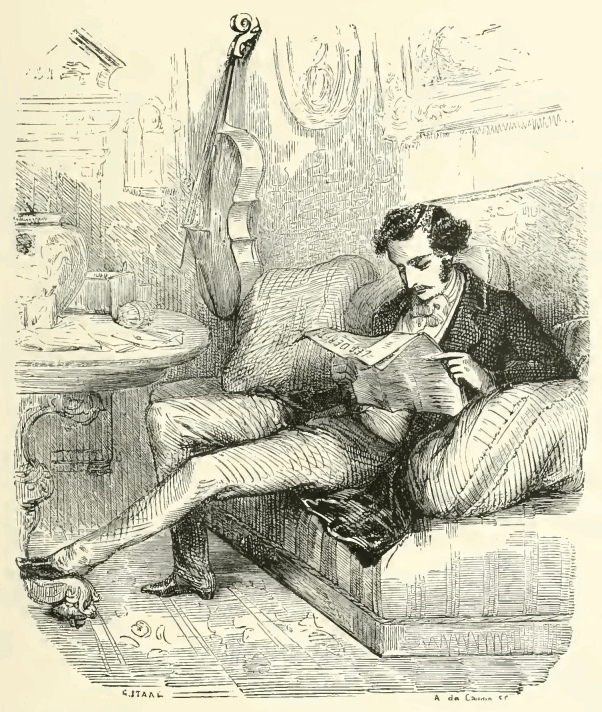
The valet left the room. Albert threw himself on the divan, tore off
the cover of two or three of the papers, looked at the theatre
announcements, made a face seeing they gave an opera, and not a ballet;
hunted vainly amongst the advertisements for a new tooth-powder of
which he had heard, and threw down, one after the other, the three
leading papers of Paris, muttering,
“These papers become more and more stupid every day.”
A moment after, a carriage stopped before the door, and the servant
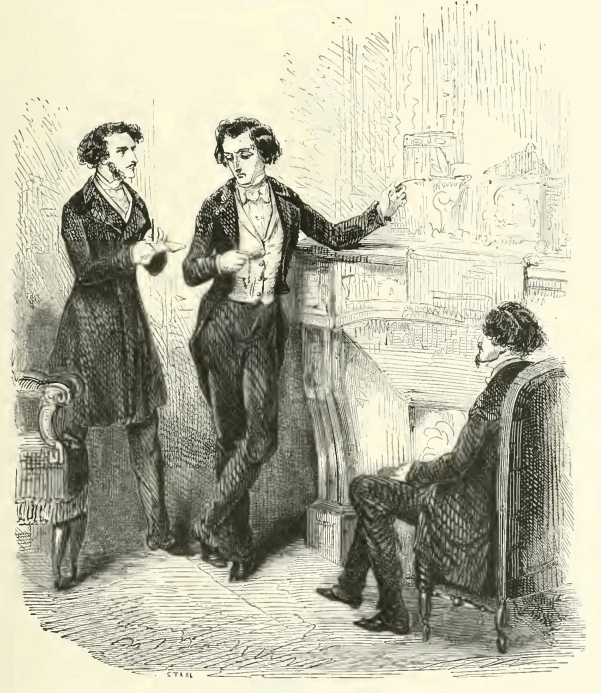
announced M. Lucien Debray. A tall young man, with light hair, clear
gray eyes, and thin and compressed lips, dressed in a blue coat with
beautifully carved gold buttons, a white neckcloth, and a tortoiseshell
eye-glass suspended by a silken thread, and which, by an effort of the
superciliary and zygomatic muscles, he fixed in his eye, entered, with
a half-official air, without smiling or speaking.
“Good-morning, Lucien, good-morning,” said Albert; “your punctuality
really alarms me. What do I say? punctuality! You, whom I expected
last, you arrive at five minutes to ten, when the time fixed was
half-past! Has the ministry resigned?”
“No, my dear fellow,” returned the young man, seating himself on the
divan; “reassure yourself; we are tottering always, but we never fall,
and I begin to believe that we shall pass into a state of immobility,
and then the affairs of the Peninsula will completely consolidate us.”
“Ah, true; you drive Don Carlos out of Spain.”
“No, no, my dear fellow, do not confound our plans. We take him to the
other side of the French frontier, and offer him hospitality at
Bourges.”
“At Bourges?”
“Yes, he has not much to complain of; Bourges is the capital of Charles
VII. Do you not know that all Paris knew it yesterday, and the day
before it had already transpired on the Bourse, and M. Danglars (I do
not know by what means that man contrives to obtain intelligence as
soon as we do) made a million!”
“And you another order, for I see you have a blue ribbon at your
button-hole.”
“Yes; they sent me the order of Charles III.,” returned Debray
carelessly.
“Come, do not affect indifference, but confess you were pleased to have
it.”
“Oh, it is very well as a finish to the toilet. It looks very neat on a
black coat buttoned up.”
“And makes you resemble the Prince of Wales or the Duke of Reichstadt.”
“It is for that reason you see me so early.”
“Because you have the order of Charles III., and you wish to announce
the good news to me?”
“No, because I passed the night writing letters,—five-and-twenty
despatches. I returned home at daybreak, and strove to sleep; but my
head ached and I got up to have a ride for an hour. At the Bois de
Boulogne, ennui and hunger attacked me at once,—two enemies who
rarely accompany each other, and who are yet leagued against me, a sort
of Carlo-republican alliance. I then recollected you gave a breakfast
this morning, and here I am. I am hungry, feed me; I am bored, amuse
me.”
“It is my duty as your host,” returned Albert, ringing the bell, while
Lucien turned over, with his gold-mounted cane, the papers that lay on
the table. “Germain, a glass of sherry and a biscuit. In the meantime,
my dear Lucien, here are cigars—contraband, of course—try them, and
persuade the minister to sell us such instead of poisoning us with
cabbage leaves.”
“Peste! I will do nothing of the kind; the moment they come from
government you would find them execrable. Besides, that does not
concern the home but the financial department. Address yourself to M.
Humann, section of the indirect contributions, corridor A., No. 26.”
“On my word,” said Albert, “you astonish me by the extent of your
knowledge. Take a cigar.”
“Really, my dear Albert,” replied Lucien, lighting a manilla at a
rose-colored taper that burnt in a beautifully enamelled stand—“how
happy you are to have nothing to do. You do not know your own good
fortune!”
“And what would you do, my dear diplomatist,” replied Morcerf, with a
slight degree of irony in his voice, “if you did nothing? What? private
secretary to a minister, plunged at once into European cabals and
Parisian intrigues; having kings, and, better still, queens, to
protect, parties to unite, elections to direct; making more use of your
cabinet with your pen and your telegraph than Napoleon did of his
battle-fields with his sword and his victories; possessing
five-and-twenty thousand francs a year, besides your place; a horse,
for which Château-Renaud offered you four hundred louis, and which you
would not part with; a tailor who never disappoints you; with the
opera, the jockey-club, and other diversions, can you not amuse
yourself? Well, I will amuse you.”
“How?”
“By introducing to you a new acquaintance.”
“A man or a woman?”
“A man.”
“I know so many men already.”
“But you do not know this man.”
“Where does he come from—the end of the world?”
“Farther still, perhaps.”
“The deuce! I hope he does not bring our breakfast with him.”
“Oh, no; our breakfast comes from my father’s kitchen. Are you hungry?”
“Humiliating as such a confession is, I am. But I dined at M. de
Villefort’s, and lawyers always give you very bad dinners. You would
think they felt some remorse; did you ever remark that?”
“Ah, depreciate other persons’ dinners; you ministers give such
splendid ones.”
“Yes; but we do not invite people of fashion. If we were not forced to
entertain a parcel of country boobies because they think and vote with
us, we should never dream of dining at home, I assure you.”
“Well, take another glass of sherry and another biscuit.”
“Willingly. Your Spanish wine is excellent. You see we were quite right
to pacify that country.”
“Yes; but Don Carlos?”
“Well, Don Carlos will drink Bordeaux, and in ten years we will marry
his son to the little queen.”
“You will then obtain the Golden Fleece, if you are still in the
ministry.”
“I think, Albert, you have adopted the system of feeding me on smoke
this morning.”
“Well, you must allow it is the best thing for the stomach; but I hear
Beauchamp in the next room; you can dispute together, and that will
pass away the time.”
“About what?”
“About the papers.”
“My dear friend,” said Lucien with an air of sovereign contempt, “do I
ever read the papers?”
“Then you will dispute the more.”
“M. Beauchamp,” announced the servant. “Come in, come in,” said Albert,
rising and advancing to meet the young man. “Here is Debray, who
detests you without reading you, so he says.”
“He is quite right,” returned Beauchamp; “for I criticise him without
knowing what he does. Good-day, commander!”
“Ah, you know that already,” said the private secretary, smiling and
shaking hands with him.
“Pardieu!”
“And what do they say of it in the world?”
“In which world? we have so many worlds in the year of grace 1838.”
“In the entire political world, of which you are one of the leaders.”
“They say that it is quite fair, and that sowing so much red, you ought
to reap a little blue.”
“Come, come, that is not bad!” said Lucien. “Why do you not join our
party, my dear Beauchamp? With your talents you would make your fortune
in three or four years.”
“I only await one thing before following your advice; that is, a
minister who will hold office for six months. My dear Albert, one word,
for I must give poor Lucien a respite. Do we breakfast or dine? I must
go to the Chamber, for our life is not an idle one.”
“You only breakfast; I await two persons, and the instant they arrive
we shall sit down to table.”
Chapter XXXVII
The Catacombs of Saint Sebastian
In his whole life, perhaps, Franz had never before experienced so
sudden an impression, so rapid a transition from gayety to sadness, as
in this moment. It seemed as though Rome, under the magic breath of
some demon of the night, had suddenly changed into a vast tomb. By a
chance, which added yet more to the intensity of the darkness, the
moon, which was on the wane, did not rise until eleven o’clock, and the
streets which the young man traversed were plunged in the deepest
obscurity.
The distance was short, and at the end of ten minutes his carriage, or
rather the count’s, stopped before the Hôtel de Londres.
Dinner was waiting, but as Albert had told him that he should not
return so soon, Franz sat down without him. Signor Pastrini, who had
been accustomed to see them dine together, inquired into the cause of
his absence, but Franz merely replied that Albert had received on the
previous evening an invitation which he had accepted.
The sudden extinction of the moccoletti, the darkness which had
replaced the light, and the silence which had succeeded the turmoil,
had left in Franz’s mind a certain depression which was not free from
uneasiness. He therefore dined very silently, in spite of the officious
attention of his host, who presented himself two or three times to
inquire if he wanted anything.
Franz resolved to wait for Albert as late as possible. He ordered the
carriage, therefore, for eleven o’clock, desiring Signor Pastrini to
inform him the moment that Albert returned to the hotel.
At eleven o’clock Albert had not come back. Franz dressed himself, and
went out, telling his host that he was going to pass the night at the
Duke of Bracciano’s. The house of the Duke of Bracciano is one of the
most delightful in Rome, the duchess, one of the last heiresses of the
Colonnas, does its honors with the most consummate grace, and thus
their fêtes have a European celebrity.
Franz and Albert had brought to Rome letters of introduction to them,
and their first question on his arrival was to inquire the whereabouts
of his travelling companion. Franz replied that he had left him at the
moment they were about to extinguish the moccoli, and that he had
lost sight of him in the Via Macello.
“Then he has not returned?” said the duke.
“I waited for him until this hour,” replied Franz.
“And do you know whither he went?”
“No, not precisely; however, I think it was something very like a
rendezvous.”
“Diavolo!” said the duke, “this is a bad day, or rather a bad night,
to be out late; is it not, countess?”
These words were addressed to the Countess G——, who had just arrived,
and was leaning on the arm of Signor Torlonia, the duke’s brother.
“I think, on the contrary, that it is a charming night,” replied the
countess, “and those who are here will complain of but one thing, that
of its too rapid flight.”
“I am not speaking,” said the duke with a smile, “of the persons who
are here; the men run no other danger than that of falling in love with
you, and the women of falling ill of jealousy at seeing you so lovely;
I meant persons who were out in the streets of Rome.”
“Ah,” asked the countess, “who is out in the streets of Rome at this
hour, unless it be to go to a ball?”
“Our friend, Albert de Morcerf, countess, whom I left in pursuit of his
unknown about seven o’clock this evening,” said Franz, “and whom I have
not seen since.”
“And don’t you know where he is?”
“Not at all.”
“Is he armed?”
“He is in masquerade.”
“You should not have allowed him to go,” said the duke to Franz; “you,
who know Rome better than he does.”
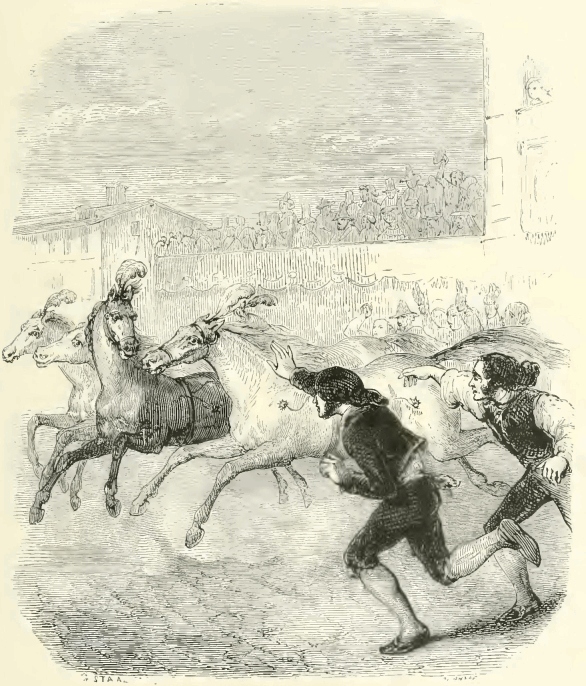
“You might as well have tried to stop number three of the barberi,
who gained the prize in the race today,” replied Franz; “and then
moreover, what could happen to him?”
“Who can tell? The night is gloomy, and the Tiber is very near the Via
Macello.” Franz felt a shudder run through his veins at observing that
the feeling of the duke and the countess was so much in unison with his
own personal disquietude.
“I informed them at the hotel that I had the honor of passing the night
here, duke,” said Franz, “and desired them to come and inform me of his
return.”
“Ah,” replied the duke, “here I think, is one of my servants who is
seeking you.”
The duke was not mistaken; when he saw Franz, the servant came up to
him.
“Your excellency,” he said, “the master of the Hôtel de Londres has
sent to let you know that a man is waiting for you with a letter from
the Viscount of Morcerf.”
“A letter from the viscount!” exclaimed Franz.
“Yes.”
“And who is the man?”
“I do not know.”
“Why did he not bring it to me here?”
“The messenger did not say.”
“And where is the messenger?”
“He went away directly he saw me enter the ball-room to find you.”
“Oh,” said the countess to Franz, “go with all speed—poor young man!
Perhaps some accident has happened to him.”
“I will hasten,” replied Franz.
“Shall we see you again to give us any information?” inquired the
countess.
“Yes, if it is not any serious affair, otherwise I cannot answer as to
what I may do myself.”
“Be prudent, in any event,” said the countess.
“Oh! pray be assured of that.”
Franz took his hat and went away in haste. He had sent away his
carriage with orders for it to fetch him at two o’clock; fortunately
the Palazzo Bracciano, which is on one side in the Corso, and on the
other in the Square of the Holy Apostles, is hardly ten minutes’ walk
from the Hôtel de Londres.
As he came near the hotel, Franz saw a man in the middle of the street.
He had no doubt that it was the messenger from Albert. The man was
wrapped up in a large cloak. He went up to him, but, to his extreme
astonishment, the stranger first addressed him.
“What wants your excellency of me?” inquired the man, retreating a step
or two, as if to keep on his guard.
“Are not you the person who brought me a letter,” inquired Franz, “from
the Viscount of Morcerf?”
“Your excellency lodges at Pastrini’s hotel?”
“I do.”
“Your excellency is the travelling companion of the viscount?”
“I am.”
“Your excellency’s name——”
“Is the Baron Franz d’Épinay.”
“Then it is to your excellency that this letter is addressed.”
“Is there any answer?” inquired Franz, taking the letter from him.
“Yes—your friend at least hopes so.”
“Come upstairs with me, and I will give it to you.”
“I prefer waiting here,” said the messenger, with a smile.
“And why?”
“Your excellency will know when you have read the letter.”
“Shall I find you here, then?”
“Certainly.”
Franz entered the hotel. On the staircase he met Signor Pastrini.
“Well?” said the landlord.
“Well—what?” responded Franz.
“You have seen the man who desired to speak with you from your friend?”
he asked of Franz.
“Yes, I have seen him,” he replied, “and he has handed this letter to
me. Light the candles in my apartment, if you please.”
The innkeeper gave orders to a servant to go before Franz with a light.
The young man had found Signor Pastrini looking very much alarmed, and
this had only made him the more anxious to read Albert’s letter; and so
he went instantly towards the waxlight, and unfolded it. It was written
and signed by Albert. Franz read it twice before he could comprehend
what it contained. It was thus worded:
“My dear Fellow,
“The moment you have received this, have the kindness to take the
letter of credit from my pocket-book, which you will find in the square
drawer of the secrétaire; add your own to it, if it be not
sufficient. Run to Torlonia, draw from him instantly four thousand
piastres, and give them to the bearer. It is urgent that I should have
this money without delay. I do not say more, relying on you as you may
rely on me.
“Your friend,
“Albert de Morcerf.
“P.S.—I now believe in Italian banditti.”
Below these lines were written, in a strange hand, the following in
Italian:
“_Se alle sei della mattina le quattro mille piastre non sono nelle mie
mani, alla sette il Conte Alberto avrà cessato di vivere_.
“Luigi Vampa.”
“_If by six in the morning the four thousand piastres are not in my
hands, by seven o’clock the Count Albert will have ceased to live_.”
This second signature explained everything to Franz, who now understood
the objection of the messenger to coming up into the apartment; the
street was safer for him. Albert, then, had fallen into the hands of
the famous bandit chief, in whose existence he had for so long a time
refused to believe.
There was no time to lose. He hastened to open the secrétaire, and
found the pocket-book in the drawer, and in it the letter of credit.
There were in all six thousand piastres, but of these six thousand
Albert had already expended three thousand.
As to Franz, he had no letter of credit, as he lived at Florence, and
had only come to Rome to pass seven or eight days; he had brought but a
hundred louis, and of these he had not more than fifty left. Thus seven
or eight hundred piastres were wanting to them both to make up the sum
that Albert required. True, he might in such a case rely on the
kindness of Signor Torlonia. He was, therefore, about to return to the
Palazzo Bracciano without loss of time, when suddenly a luminous idea
crossed his mind.
He remembered the Count of Monte Cristo. Franz was about to ring for
Signor Pastrini, when that worthy presented himself.
“My dear sir,” he said, hastily, “do you know if the count is within?”
“Yes, your excellency; he has this moment returned.”
“Is he in bed?”
“I should say no.”
“Then ring at his door, if you please, and request him to be so kind as
to give me an audience.”
Signor Pastrini did as he was desired, and returning five minutes
after, he said:
“The count awaits your excellency.”
Franz went along the corridor, and a servant introduced him to the
count. He was in a small room which Franz had not yet seen, and which
was surrounded with divans. The count came towards him.
“Well, what good wind blows you hither at this hour?” said he; “have
you come to sup with me? It would be very kind of you.”
“No; I have come to speak to you of a very serious matter.”
“A serious matter,” said the count, looking at Franz with the
earnestness usual to him; “and what may it be?”
“Are we alone?”
“Yes,” replied the count, going to the door, and returning. Franz gave
him Albert’s letter.
“Read that,” he said.
The count read it.
“Well, well!” said he.
“Did you see the postscript?”
“I did, indeed.
“_‘Se alle sei della mattina le quattro mille piastre non sono nelle
mie mani, alla sette il conte Alberto avrà cessato di vivere. _
“‘Luigi Vampa.’”
“What think you of that?” inquired Franz.
“Have you the money he demands?”
“Yes, all but eight hundred piastres.”
The count went to his secrétaire, opened it, and pulling out a drawer
filled with gold, said to Franz, “I hope you will not offend me by
applying to anyone but myself.”
“You see, on the contrary, I come to you first and instantly,” replied
Franz.
“And I thank you; have what you will;” and he made a sign to Franz to
take what he pleased.
“Is it absolutely necessary, then, to send the money to Luigi Vampa?”
asked the young man, looking fixedly in his turn at the count.
“Judge for yourself,” replied he. “The postscript is explicit.”
“I think that if you would take the trouble of reflecting, you could
find a way of simplifying the negotiation,” said Franz.
“How so?” returned the count, with surprise.
“If we were to go together to Luigi Vampa, I am sure he would not
refuse you Albert’s freedom.”
“What influence can I possibly have over a bandit?”
“Have you not just rendered him a service that can never be forgotten?”
“What is that?”
“Have you not saved Peppino’s life?”
“Well, well,” said the count, “who told you that?”
“No matter; I know it.” The count knit his brows, and remained silent
an instant.
“And if I went to seek Vampa, would you accompany me?”
“If my society would not be disagreeable.”
“Be it so. It is a lovely night, and a walk without Rome will do us
both good.”
“Shall I take any arms?”
“For what purpose?”
“Any money?”
“It is useless. Where is the man who brought the letter?”
“In the street.”
“He awaits the answer?”
“Yes.”
“I must learn where we are going. I will summon him hither.”
“It is useless; he would not come up.”
“To your apartments, perhaps; but he will not make any difficulty at
entering mine.”
The count went to the window of the apartment that looked on to the
street, and whistled in a peculiar manner. The man in the mantle
quitted the wall, and advanced into the middle of the street.
“Salite!” said the count, in the same tone in which he would have
given an order to his servant. The messenger obeyed without the least
hesitation, but rather with alacrity, and, mounting the steps at a
bound, entered the hotel; five seconds afterwards he was at the door of
the room.
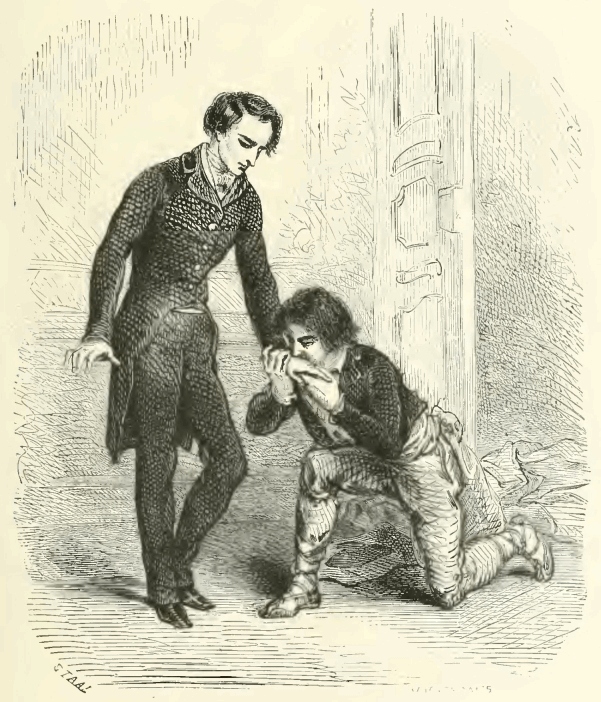
“Ah, it is you, Peppino,” said the count. But Peppino, instead of
answering, threw himself on his knees, seized the count’s hand, and
covered it with kisses. “Ah,” said the count, “you have, then, not
forgotten that I saved your life; that is strange, for it is a week
ago.”
“No, excellency; and never shall I forget it,” returned Peppino, with
an accent of profound gratitude.
“Never? That is a long time; but it is something that you believe so.
Rise and answer.”
Peppino glanced anxiously at Franz.
“Oh, you may speak before his excellency,” said he; “he is one of my
friends. You allow me to give you this title?” continued the count in
French, “it is necessary to excite this man’s confidence.”
“You can speak before me,” said Franz; “I am a friend of the count’s.”
“Good!” returned Peppino. “I am ready to answer any questions your
excellency may address to me.”
“How did the Viscount Albert fall into Luigi’s hands?”
“Excellency, the Frenchman’s carriage passed several times the one in
which was Teresa.”
“The chief’s mistress?”
“Yes. The Frenchman threw her a bouquet; Teresa returned it—all this
with the consent of the chief, who was in the carriage.”
“What?” cried Franz, “was Luigi Vampa in the carriage with the Roman
peasants?”
“It was he who drove, disguised as the coachman,” replied Peppino.
“Well?” said the count.
“Well, then, the Frenchman took off his mask; Teresa, with the chief’s
consent, did the same. The Frenchman asked for a rendezvous; Teresa
gave him one—only, instead of Teresa, it was Beppo who was on the steps
of the church of San Giacomo.”
“What!” exclaimed Franz, “the peasant girl who snatched his mocoletto
from him——”
“Was a lad of fifteen,” replied Peppino. “But it was no disgrace to
your friend to have been deceived; Beppo has taken in plenty of
others.”
“And Beppo led him outside the walls?” said the count.
“Exactly so; a carriage was waiting at the end of the Via Macello.
Beppo got in, inviting the Frenchman to follow him, and he did not wait
to be asked twice. He gallantly offered the right-hand seat to Beppo,
and sat by him. Beppo told him he was going to take him to a villa a
league from Rome; the Frenchman assured him he would follow him to the
end of the world. The coachman went up the Via di Ripetta and the Porta
San Paolo; and when they were two hundred yards outside, as the
Frenchman became somewhat too forward, Beppo put a brace of pistols to
his head, the coachman pulled up and did the same. At the same time,
four of the band, who were concealed on the banks of the Almo,
surrounded the carriage. The Frenchman made some resistance, and nearly
strangled Beppo; but he could not resist five armed men, and was forced
to yield. They made him get out, walk along the banks of the river, and
then brought him to Teresa and Luigi, who were waiting for him in the
catacombs of St. Sebastian.”
“Well,” said the count, turning towards Franz, “it seems to me that
this is a very likely story. What do you say to it?”
“Why, that I should think it very amusing,” replied Franz, “if it had
happened to anyone but poor Albert.”
“And, in truth, if you had not found me here,” said the count, “it
might have proved a gallant adventure which would have cost your friend
dear; but now, be assured, his alarm will be the only serious
consequence.”
“And shall we go and find him?” inquired Franz.
“Oh, decidedly, sir. He is in a very picturesque place—do you know the
catacombs of St. Sebastian?”
“I was never in them; but I have often resolved to visit them.”
“Well, here is an opportunity made to your hand, and it would be
difficult to contrive a better. Have you a carriage?”
“No.”
“That is of no consequence; I always have one ready, day and night.”
“Always ready?”
“Yes. I am a very capricious being, and I should tell you that
sometimes when I rise, or after my dinner, or in the middle of the
night, I resolve on starting for some particular point, and away I go.”
The count rang, and a footman appeared.
“Order out the carriage,” he said, “and remove the pistols which are in
the holsters. You need not awaken the coachman; Ali will drive.”
In a very short time the noise of wheels was heard, and the carriage
stopped at the door. The count took out his watch.
“Half-past twelve,” he said. “We might start at five o’clock and be in
time, but the delay may cause your friend to pass an uneasy night, and
therefore we had better go with all speed to extricate him from the
hands of the infidels. Are you still resolved to accompany me?”
“More determined than ever.”
“Well, then, come along.”
Franz and the count went downstairs, accompanied by Peppino. At the
door they found the carriage. Ali was on the box, in whom Franz
recognized the dumb slave of the grotto of Monte Cristo. Franz and the
count got into the carriage. Peppino placed himself beside Ali, and
they set off at a rapid pace. Ali had received his instructions, and
went down the Corso, crossed the Campo Vaccino, went up the Strada San
Gregorio, and reached the gates of St. Sebastian. Then the porter
raised some difficulties, but the Count of Monte Cristo produced a
permit from the governor of Rome, allowing him to leave or enter the
city at any hour of the day or night; the portcullis was therefore
raised, the porter had a louis for his trouble, and they went on their
way.
The road which the carriage now traversed was the ancient Appian Way,
and bordered with tombs. From time to time, by the light of the moon,
which began to rise, Franz imagined that he saw something like a
sentinel appear at various points among the ruins, and suddenly retreat
into the darkness on a signal from Peppino.
A short time before they reached the Baths of Caracalla the carriage
stopped, Peppino opened the door, and the count and Franz alighted.
“In ten minutes,” said the count to his companion, “we shall be there.”
He then took Peppino aside, gave him an order in a low voice, and
Peppino went away, taking with him a torch, brought with them in the
carriage. Five minutes elapsed, during which Franz saw the shepherd
going along a narrow path that led over the irregular and broken
surface of the Campagna; and finally he disappeared in the midst of the
tall red herbage, which seemed like the bristling mane of an enormous
lion.
“Now,” said the count, “let us follow him.”
Franz and the count in their turn then advanced along the same path,
which, at the distance of a hundred paces, led them over a declivity to
the bottom of a small valley. They then perceived two men conversing in
the obscurity.
“Ought we to go on?” asked Franz of the count; “or should we pause?”
“Let us go on; Peppino will have warned the sentry of our coming.”
One of the two men was Peppino, and the other a bandit on the lookout.
Franz and the count advanced, and the bandit saluted them.
“Your excellency,” said Peppino, addressing the count, “if you will
follow me, the opening of the catacombs is close at hand.”
“Go on, then,” replied the count. They came to an opening behind a
clump of bushes and in the midst of a pile of rocks, by which a man
could scarcely pass. Peppino glided first into this crevice; after they
got along a few paces the passage widened. Peppino passed, lighted his
torch, and turned to see if they came after him. The count first
reached an open space and Franz followed him closely. The passageway
sloped in a gentle descent, enlarging as they proceeded; still Franz
and the count were compelled to advance in a stooping posture, and were
scarcely able to proceed abreast of one another. They went on a hundred
and fifty paces in this way, and then were stopped by, “Who comes
there?” At the same time they saw the reflection of a torch on a
carbine barrel.
“A friend!” responded Peppino; and, advancing alone towards the sentry,
he said a few words to him in a low tone; and then he, like the first,
saluted the nocturnal visitors, making a sign that they might proceed.
Behind the sentinel was a staircase with twenty steps. Franz and the
count descended these, and found themselves in a mortuary chamber. Five
corridors diverged like the rays of a star, and the walls, dug into
niches, which were arranged one above the other in the shape of
coffins, showed that they were at last in the catacombs. Down one of
the corridors, whose extent it was impossible to determine, rays of
light were visible. The count laid his hand on Franz’s shoulder.
“Would you like to see a camp of bandits in repose?” he inquired.
“Exceedingly,” replied Franz.
“Come with me, then. Peppino, put out the torch.” Peppino obeyed, and
Franz and the count were in utter darkness, except that fifty paces in
advance of them a reddish glare, more evident since Peppino had put out
his torch, was visible along the wall.
They advanced silently, the count guiding Franz as if he had the
singular faculty of seeing in the dark. Franz himself, however, saw his
way more plainly in proportion as he went on towards the light, which
served in some manner as a guide. Three arcades were before them, and
the middle one was used as a door. These arcades opened on one side
into the corridor where the count and Franz were, and on the other into
a large square chamber, entirely surrounded by niches similar to those
of which we have spoken.
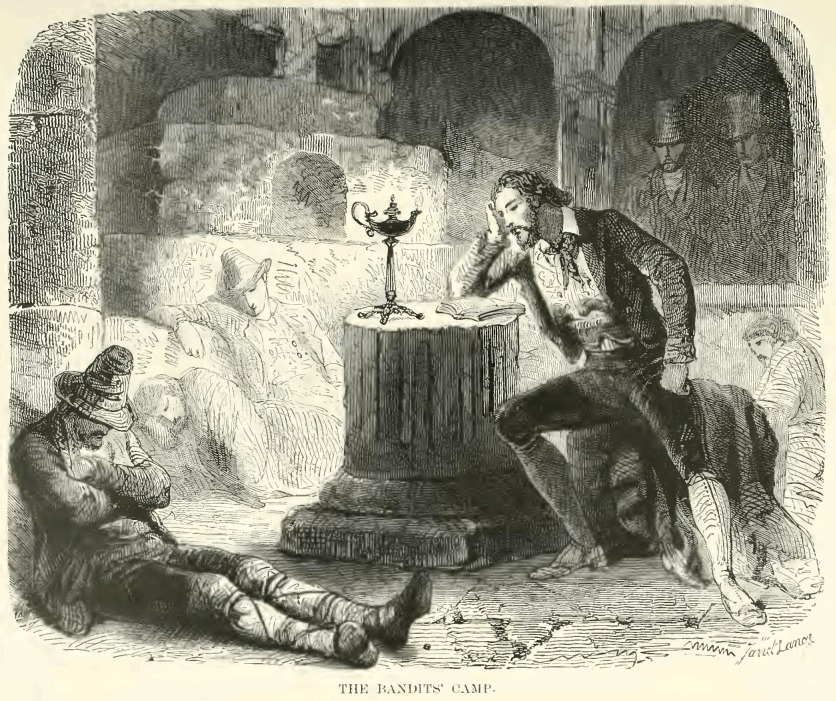
In the midst of this chamber were four stones, which had formerly
served as an altar, as was evident from the cross which still
surmounted them. A lamp, placed at the base of a pillar, lighted up
with its pale and flickering flame the singular scene which presented
itself to the eyes of the two visitors concealed in the shadow.
A man was seated with his elbow leaning on the column, and was reading
with his back turned to the arcades, through the openings of which the
new-comers contemplated him. This was the chief of the band, Luigi
Vampa. Around him, and in groups, according to their fancy, lying in
their mantles, or with their backs against a sort of stone bench, which
went all round the columbarium, were to be seen twenty brigands or
more, each having his carbine within reach. At the other end, silent,
scarcely visible, and like a shadow, was a sentinel, who was walking up
and down before a grotto, which was only distinguishable because in
that spot the darkness seemed more dense than elsewhere.
When the count thought Franz had gazed sufficiently on this picturesque
tableau, he raised his finger to his lips, to warn him to be silent,
and, ascending the three steps which led to the corridor of the
columbarium, entered the chamber by the middle arcade, and advanced
towards Vampa, who was so intent on the book before him that he did not
hear the noise of his footsteps.
“Who comes there?” cried the sentinel, who was less abstracted, and who
saw by the lamp-light a shadow approaching his chief. At this
challenge, Vampa rose quickly, drawing at the same moment a pistol from
his girdle. In a moment all the bandits were on their feet, and twenty
carbines were levelled at the count.
“Well,” said he in a voice perfectly calm, and no muscle of his
countenance disturbed, “well, my dear Vampa, it appears to me that you
receive a friend with a great deal of ceremony.”
“Ground arms,” exclaimed the chief, with an imperative sign of the
hand, while with the other he took off his hat respectfully; then,
turning to the singular personage who had caused this scene, he said,
“Your pardon, your excellency, but I was so far from expecting the
honor of a visit, that I did not really recognize you.”
“It seems that your memory is equally short in everything, Vampa,” said
the count, “and that not only do you forget people’s faces, but also
the conditions you make with them.”
“What conditions have I forgotten, your excellency?” inquired the
bandit, with the air of a man who, having committed an error, is
anxious to repair it.
“Was it not agreed,” asked the count, “that not only my person, but
also that of my friends, should be respected by you?”
“And how have I broken that treaty, your excellency?”
“You have this evening carried off and conveyed hither the Viscount
Albert de Morcerf. Well,” continued the count, in a tone that made
Franz shudder, “this young gentleman is one of my friends—this young
gentleman lodges in the same hotel as myself—this young gentleman has
been up and down the Corso for eight hours in my private carriage, and
yet, I repeat to you, you have carried him off, and conveyed him
hither, and,” added the count, taking the letter from his pocket, “you
have set a ransom on him, as if he were an utter stranger.”
“Why did you not tell me all this—you?” inquired the brigand chief,
turning towards his men, who all retreated before his look. “Why have
you caused me thus to fail in my word towards a gentleman like the
count, who has all our lives in his hands? By heavens! if I thought one
of you knew that the young gentleman was the friend of his excellency,
I would blow his brains out with my own hand!”
“Well,” said the count, turning towards Franz, “I told you there was
some mistake in this.”
“Are you not alone?” asked Vampa with uneasiness.
“I am with the person to whom this letter was addressed, and to whom I
desired to prove that Luigi Vampa was a man of his word. Come, your
excellency,” the count added, turning to Franz, “here is Luigi Vampa,
who will himself express to you his deep regret at the mistake he has
committed.”
Franz approached, the chief advancing several steps to meet him.
“Welcome among us, your excellency,” he said to him; “you heard what
the count just said, and also my reply; let me add that I would not for
the four thousand piastres at which I had fixed your friend’s ransom,
that this had happened.”
“But,” said Franz, looking round him uneasily, “where is the
viscount?—I do not see him.”
“Nothing has happened to him, I hope,” said the count frowningly.
“The prisoner is there,” replied Vampa, pointing to the hollow space in
front of which the bandit was on guard, “and I will go myself and tell
him he is free.”
The chief went towards the place he had pointed out as Albert’s prison,
and Franz and the count followed him.
“What is the prisoner doing?” inquired Vampa of the sentinel.
“Ma foi, captain,” replied the sentry, “I do not know; for the last
hour I have not heard him stir.”
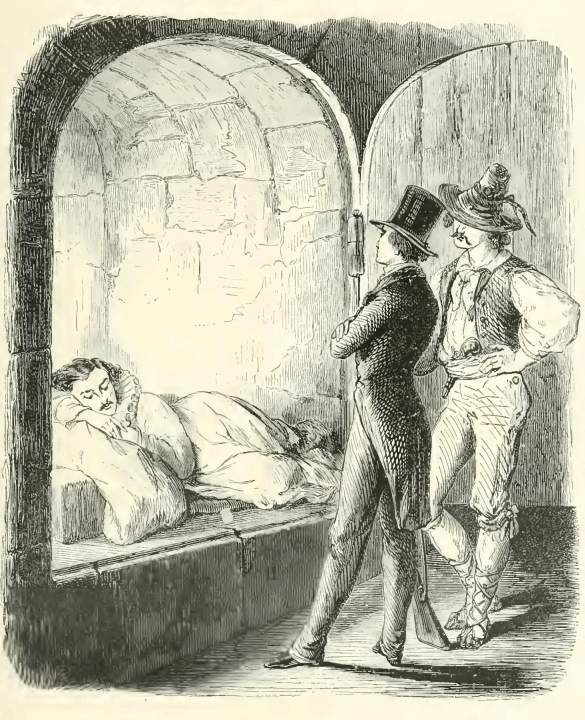
“Come in, your excellency,” said Vampa. The count and Franz ascended
seven or eight steps after the chief, who drew back a bolt and opened a
door. Then, by the gleam of a lamp, similar to that which lighted the
columbarium, Albert was to be seen wrapped up in a cloak which one of
the bandits had lent him, lying in a corner in profound slumber.
“Come,” said the count, smiling with his own peculiar smile, “not so
bad for a man who is to be shot at seven o’clock tomorrow morning.”
Vampa looked at Albert with a kind of admiration; he was not insensible
to such a proof of courage.
“You are right, your excellency,” he said; “this must be one of your
friends.”
Then going to Albert, he touched him on the shoulder, saying, “Will
your excellency please to awaken?”
Albert stretched out his arms, rubbed his eyelids, and opened his eyes.
“Oh,” said he, “is it you, captain? You should have allowed me to
sleep. I had such a delightful dream. I was dancing the galop at
Torlonia’s with the Countess G——.” Then he drew his watch from his
pocket, that he might see how time sped.
“Half-past one only?” said he. “Why the devil do you rouse me at this
hour?”
“To tell you that you are free, your excellency.”
“My dear fellow,” replied Albert, with perfect ease of mind, “remember,
for the future, Napoleon’s maxim, ‘Never awaken me but for bad news;’
if you had let me sleep on, I should have finished my galop, and have
been grateful to you all my life. So, then, they have paid my ransom?”
“No, your excellency.”
“Well, then, how am I free?”
“A person to whom I can refuse nothing has come to demand you.”
“Come hither?”
“Yes, hither.”
“Really? Then that person is a most amiable person.”
Albert looked around and perceived Franz. “What,” said he, “is it you,
my dear Franz, whose devotion and friendship are thus displayed?”
“No, not I,” replied Franz, “but our neighbor, the Count of Monte
Cristo.”
“Oh, my dear count,” said Albert gayly, arranging his cravat and
wristbands, “you are really most kind, and I hope you will consider me
as under eternal obligations to you, in the first place for the
carriage, and in the next for this visit,” and he put out his hand to
the count, who shuddered as he gave his own, but who nevertheless did
give it.
The bandit gazed on this scene with amazement; he was evidently
accustomed to see his prisoners tremble before him, and yet here was
one whose gay temperament was not for a moment altered; as for Franz,
he was enchanted at the way in which Albert had sustained the national
honor in the presence of the bandit.
“My dear Albert,” he said, “if you will make haste, we shall yet have
time to finish the night at Torlonia’s. You may conclude your
interrupted galop, so that you will owe no ill-will to Signor Luigi,
who has, indeed, throughout this whole affair acted like a gentleman.”
“You are decidedly right, and we may reach the Palazzo by two o’clock.
Signor Luigi,” continued Albert, “is there any formality to fulfil
before I take leave of your excellency?”
“None, sir,” replied the bandit, “you are as free as air.”
“Well, then, a happy and merry life to you. Come, gentlemen, come.”
And Albert, followed by Franz and the count, descended the staircase,
crossed the square chamber, where stood all the bandits, hat in hand.
“Peppino,” said the brigand chief, “give me the torch.”
“What are you going to do?” inquired the count.
“I will show you the way back myself,” said the captain; “that is the
least honor that I can render to your excellency.”
And taking the lighted torch from the hands of the herdsman, he
preceded his guests, not as a servant who performs an act of civility,
but like a king who precedes ambassadors. On reaching the door, he
bowed.
“And now, your excellency,” added he, “allow me to repeat my apologies,
and I hope you will not entertain any resentment at what has occurred.”
“No, my dear Vampa,” replied the count; “besides, you compensate for
your mistakes in so gentlemanly a way, that one almost feels obliged to
you for having committed them.”
“Gentlemen,” added the chief, turning towards the young men, “perhaps
the offer may not appear very tempting to you; but if you should ever
feel inclined to pay me a second visit, wherever I may be, you shall be
welcome.”
Franz and Albert bowed. The count went out first, then Albert. Franz
paused for a moment.
“Has your excellency anything to ask me?” said Vampa with a smile.
“Yes, I have,” replied Franz; “I am curious to know what work you were
perusing with so much attention as we entered.”
“Cæsar’s Commentaries,” said the bandit, “it is my favorite work.”
“Well, are you coming?” asked Albert.
“Yes,” replied Franz, “here I am,” and he, in his turn, left the caves.
They advanced to the plain.
“Ah, your pardon,” said Albert, turning round; “will you allow me,
captain?”
And he lighted his cigar at Vampa’s torch.
“Now, my dear count,” he said, “let us on with all the speed we may. I
am enormously anxious to finish my night at the Duke of Bracciano’s.”
They found the carriage where they had left it. The count said a word
in Arabic to Ali, and the horses went on at great speed.
It was just two o’clock by Albert’s watch when the two friends entered
into the dancing-room. Their return was quite an event, but as they
entered together, all uneasiness on Albert’s account ceased instantly.
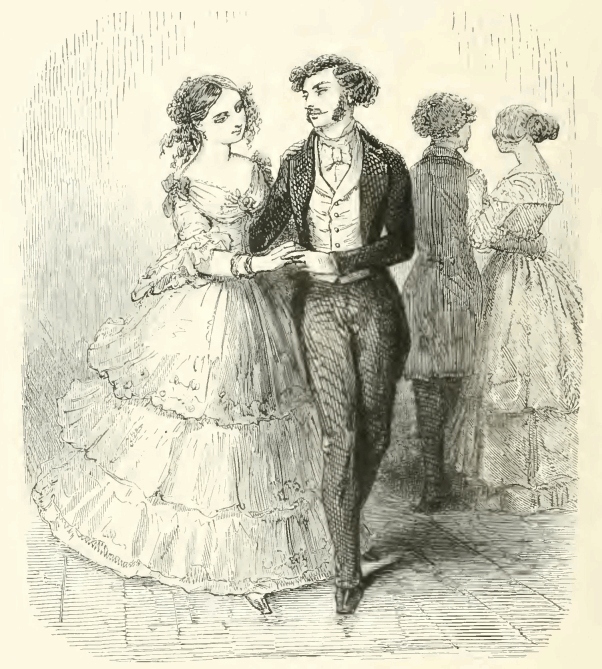
“Madame,” said the Viscount of Morcerf, advancing towards the countess,
“yesterday you were so condescending as to promise me a galop; I am
rather late in claiming this gracious promise, but here is my friend,
whose character for veracity you well know, and he will assure you the
delay arose from no fault of mine.”
And as at this moment the orchestra gave the signal for the waltz,
Albert put his arm round the waist of the countess, and disappeared
with her in the whirl of dancers.
In the meanwhile Franz was considering the singular shudder that had
passed over the Count of Monte Cristo at the moment when he had been,
in some sort, forced to give his hand to Albert.
Chapter XXXVIII
The Rendez-vous
The first words that Albert uttered to his friend, on the following
morning, contained a request that Franz would accompany him on a visit
to the count; true, the young man had warmly and energetically thanked
the count on the previous evening; but services such as he had rendered
could never be too often acknowledged. Franz, who seemed attracted by
some invisible influence towards the count, in which terror was
strangely mingled, felt an extreme reluctance to permit his friend to
be exposed alone to the singular fascination that this mysterious
personage seemed to exercise over him, and therefore made no objection
to Albert’s request, but at once accompanied him to the desired spot,
and, after a short delay, the count joined them in the salon.
“My dear count,” said Albert, advancing to meet him, “permit me to
repeat the poor thanks I offered last night, and to assure you that the
remembrance of all I owe to you will never be effaced from my memory;
believe me, as long as I live, I shall never cease to dwell with
grateful recollection on the prompt and important service you rendered
me; and also to remember that to you I am indebted even for my life.”
“My very good friend and excellent neighbor,” replied the count, with a
smile, “you really exaggerate my trifling exertions. You owe me nothing
but some trifle of 20,000 francs, which you have been saved out of your
travelling expenses, so that there is not much of a score between
us;—but you must really permit me to congratulate you on the ease and
unconcern with which you resigned yourself to your fate, and the
perfect indifference you manifested as to the turn events might take.”
“Upon my word,” said Albert, “I deserve no credit for what I could not
help, namely, a determination to take everything as I found it, and to
let those bandits see, that although men get into troublesome scrapes
all over the world, there is no nation but the French that can smile
even in the face of grim Death himself. All that, however, has nothing
to do with my obligations to you, and I now come to ask you whether, in
my own person, my family, or connections, I can in any way serve you?
My father, the Comte de Morcerf, although of Spanish origin, possesses
considerable influence, both at the court of France and Madrid, and I
unhesitatingly place the best services of myself, and all to whom my
life is dear, at your disposal.”
“Monsieur de Morcerf,” replied the count, “your offer, far from
surprising me, is precisely what I expected from you, and I accept it
in the same spirit of hearty sincerity with which it is made;—nay, I
will go still further, and say that I had previously made up my mind to
ask a great favor at your hands.”
“Oh, pray name it.”
“I am wholly a stranger to Paris—it is a city I have never yet seen.”
“Is it possible,” exclaimed Albert, “that you have reached your present
age without visiting the finest capital in the world? I can scarcely
credit it.”
“Nevertheless, it is quite true; still, I agree with you in thinking
that my present ignorance of the first city in Europe is a reproach to
me in every way, and calls for immediate correction; but, in all
probability, I should have performed so important, so necessary a duty,
as that of making myself acquainted with the wonders and beauties of
your justly celebrated capital, had I known any person who would have
introduced me into the fashionable world, but unfortunately I possessed
no acquaintance there, and, of necessity, was compelled to abandon the
idea.”
“So distinguished an individual as yourself,” cried Albert, “could
scarcely have required an introduction.”
“You are most kind; but as regards myself, I can find no merit I
possess, save that, as a millionaire, I might have become a partner in
the speculations of M. Aguado and M. Rothschild; but as my motive in
travelling to your capital would not have been for the pleasure of
dabbling in stocks, I stayed away till some favorable chance should
present itself of carrying my wish into execution. Your offer, however,
smooths all difficulties, and I have only to ask you, my dear M. de
Morcerf” (these words were accompanied by a most peculiar smile),
“whether you undertake, upon my arrival in France, to open to me the
doors of that fashionable world of which I know no more than a Huron or
a native of Cochin-China?”
“Oh, that I do, and with infinite pleasure,” answered Albert; “and so
much the more readily as a letter received this morning from my father
summons me to Paris, in consequence of a treaty of marriage (my dear
Franz, do not smile, I beg of you) with a family of high standing, and
connected with the very cream of Parisian society.”
“Connected by marriage, you mean,” said Franz, laughingly.
“Well, never mind how it is,” answered Albert, “it comes to the same
thing in the end. Perhaps by the time you return to Paris, I shall be
quite a sober, staid father of a family! A most edifying representative
I shall make of all the domestic virtues—don’t you think so? But as
regards your wish to visit our fine city, my dear count, I can only say
that you may command me and mine to any extent you please.”
“Then it is settled,” said the count, “and I give you my solemn
assurance that I only waited an opportunity like the present to realize
plans that I have long meditated.”
Franz did not doubt that these plans were the same concerning which the
count had dropped a few words in the grotto of Monte Cristo, and while
the count was speaking the young man watched him closely, hoping to
read something of his purpose in his face, but his countenance was
inscrutable especially when, as in the present case, it was veiled in a
sphinx-like smile.
“But tell me now, count,” exclaimed Albert, delighted at the idea of
having to chaperon so distinguished a person as Monte Cristo; “tell me
truly whether you are in earnest, or if this project of visiting Paris
is merely one of the chimerical and uncertain air castles of which we
make so many in the course of our lives, but which, like a house built
on the sand, is liable to be blown over by the first puff of wind?”
“I pledge you my honor,” returned the count, “that I mean to do as I
have said; both inclination and positive necessity compel me to visit
Paris.”
“When do you propose going thither?”
“Have you made up your mind when you shall be there yourself?”
“Certainly I have; in a fortnight or three weeks’ time, that is to say,
as fast as I can get there!”
“Nay,” said the Count; “I will give you three months ere I join you;
you see I make an ample allowance for all delays and difficulties.
“And in three months’ time,” said Albert, “you will be at my house?”
“Shall we make a positive appointment for a particular day and hour?”
inquired the count; “only let me warn you that I am proverbial for my
punctilious exactitude in keeping my engagements.”
“Day for day, hour for hour,” said Albert; “that will suit me to a
dot.”
“So be it, then,” replied the count, and extending his hand towards a
calendar, suspended near the chimney-piece, he said, “today is the 21st
of February;” and drawing out his watch, added, “it is exactly
half-past ten o’clock. Now promise me to remember this, and expect me
the 21st of May at the same hour in the forenoon.”
“Capital!” exclaimed Albert; “your breakfast shall be waiting.”
“Where do you live?”
“No. 27, Rue du Helder.”
“Have you bachelor’s apartments there? I hope my coming will not put
you to any inconvenience.”
“I reside in my father’s house, but occupy a pavilion at the farther
side of the courtyard, entirely separated from the main building.”
“Quite sufficient,” replied the count, as, taking out his tablets, he
wrote down “No. 27, Rue du Helder, 21st May, half-past ten in the
morning.”
“Now then,” said the count, returning his tablets to his pocket, “make
yourself perfectly easy; the hand of your time-piece will not be more
accurate in marking the time than myself.”
“Shall I see you again ere my departure?” asked Albert.
“That depends; when do you leave?”
“Tomorrow evening, at five o’clock.”
“In that case I must say adieu to you, as I am compelled to go to
Naples, and shall not return hither before Saturday evening or Sunday
morning. And you, baron,” pursued the count, addressing Franz, “do you
also depart tomorrow?”
“Yes.”
“For France?”
“No, for Venice; I shall remain in Italy for another year or two.”
“Then we shall not meet in Paris?”
“I fear I shall not have that honor.”
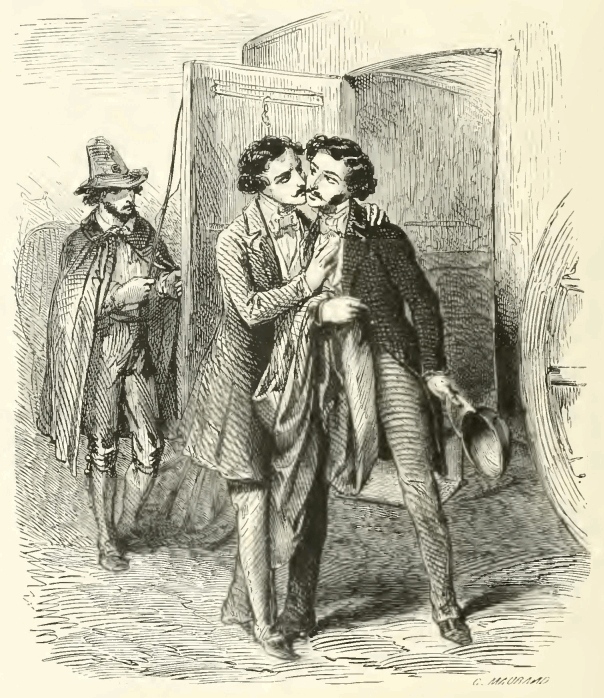
“Well, since we must part,” said the count, holding out a hand to each
of the young men, “allow me to wish you both a safe and pleasant
journey.”
It was the first time the hand of Franz had come in contact with that
of the mysterious individual before him, and unconsciously he shuddered
at its touch, for it felt cold and icy as that of a corpse.
“Let us understand each other,” said Albert; “it is agreed—is it
not?—that you are to be at No. 27, in the Rue du Helder, on the 21st of
May, at half-past ten in the morning, and your word of honor passed for
your punctuality?”
“The 21st of May, at half-past ten in the morning, Rue du Helder, No.
27,” replied the count.
The young men then rose, and bowing to the count, quitted the room.
“What is the matter?” asked Albert of Franz, when they had returned to
their own apartments; “you seem more than commonly thoughtful.”
“I will confess to you, Albert,” replied Franz, “the count is a very
singular person, and the appointment you have made to meet him in Paris
fills me with a thousand apprehensions.”
“My dear fellow,” exclaimed Albert, “what can there possibly be in that
to excite uneasiness? Why, you must have lost your senses.”
“Whether I am in my senses or not,” answered Franz, “that is the way I
feel.”
“Listen to me, Franz,” said Albert; “I am glad that the occasion has
presented itself for saying this to you, for I have noticed how cold
you are in your bearing towards the count, while he, on the other hand,
has always been courtesy itself to us. Have you anything particular
against him?”
“Possibly.”
“Did you ever meet him previously to coming hither?”
“I have.”
“And where?”
“Will you promise me not to repeat a single word of what I am about to
tell you?”
“I promise.”
“Upon your honor?”
“Upon my honor.”
“Then listen to me.”
Franz then related to his friend the history of his excursion to the
Island of Monte Cristo and of his finding a party of smugglers there,
and the two Corsican bandits with them. He dwelt with considerable
force and energy on the almost magical hospitality he had received from
the count, and the magnificence of his entertainment in the grotto of
the Thousand and One Nights.
He recounted, with circumstantial exactitude, all the particulars of
the supper, the hashish, the statues, the dream, and how, at his
awakening, there remained no proof or trace of all these events, save
the small yacht, seen in the distant horizon driving under full sail
toward Porto-Vecchio.
Then he detailed the conversation overheard by him at the Colosseum,
between the count and Vampa, in which the count had promised to obtain
the release of the bandit Peppino,—an engagement which, as our readers
are aware, he most faithfully fulfilled.
At last he arrived at the adventure of the preceding night, and the
embarrassment in which he found himself placed by not having sufficient
cash by six or seven hundred piastres to make up the sum required, and
finally of his application to the count and the picturesque and
satisfactory result that followed. Albert listened with the most
profound attention.
“Well,” said he, when Franz had concluded, “what do you find to object
to in all you have related? The count is fond of travelling, and, being
rich, possesses a vessel of his own. Go but to Portsmouth or
Southampton, and you will find the harbors crowded with the yachts
belonging to such of the English as can afford the expense, and have
the same liking for this amusement. Now, by way of having a
resting-place during his excursions, avoiding the wretched
cookery—which has been trying its best to poison me during the last
four months, while you have manfully resisted its effects for as many
years,—and obtaining a bed on which it is possible to slumber, Monte
Cristo has furnished for himself a temporary abode where you first
found him; but, to prevent the possibility of the Tuscan government
taking a fancy to his enchanted palace, and thereby depriving him of
the advantages naturally expected from so large an outlay of capital,
he has wisely enough purchased the island, and taken its name. Just ask
yourself, my good fellow, whether there are not many persons of our
acquaintance who assume the names of lands and properties they never in
their lives were masters of?”
“But,” said Franz, “the Corsican bandits that were among the crew of
his vessel?”
“Why, really the thing seems to me simple enough. Nobody knows better
than yourself that the bandits of Corsica are not rogues or thieves,
but purely and simply fugitives, driven by some sinister motive from
their native town or village, and that their fellowship involves no
disgrace or stigma; for my own part, I protest that, should I ever go
to Corsica, my first visit, ere even I presented myself to the mayor or
prefect, should be to the bandits of Colomba, if I could only manage to
find them; for, on my conscience, they are a race of men I admire
greatly.”
“Still,” persisted Franz, “I suppose you will allow that such men as
Vampa and his band are regular villains, who have no other motive than
plunder when they seize your person. How do you explain the influence
the count evidently possessed over those ruffians?”
“My good friend, as in all probability I own my present safety to that
influence, it would ill become me to search too closely into its
source; therefore, instead of condemning him for his intimacy with
outlaws, you must give me leave to excuse any little irregularity there
may be in such a connection; not altogether for preserving my life, for
my own idea was that it never was in much danger, but certainly for
saving me 4,000 piastres, which, being translated, means neither more
nor less than 24,000 livres of our money—a sum at which, most
assuredly, I should never have been estimated in France, proving most
indisputably,” added Albert with a laugh, “that no prophet is honored
in his own country.”
“Talking of countries,” replied Franz, “of what country is the count,
what is his native tongue, whence does he derive his immense fortune,
and what were those events of his early life—a life as marvellous as
unknown—that have tinctured his succeeding years with so dark and
gloomy a misanthropy? Certainly these are questions that, in your
place, I should like to have answered.”
“My dear Franz,” replied Albert, “when, upon receipt of my letter, you
found the necessity of asking the count’s assistance, you promptly went
to him, saying, ‘My friend Albert de Morcerf is in danger; help me to
deliver him.’ Was not that nearly what you said?”
“It was.”
“Well, then, did he ask you, ‘Who is M. Albert de Morcerf? how does he
come by his name—his fortune? what are his means of existence? what is
his birthplace? of what country is he a native?’ Tell me, did he put
all these questions to you?”
“I confess he asked me none.”
“No; he merely came and freed me from the hands of Signor Vampa, where,
I can assure you, in spite of all my outward appearance of ease and
unconcern, I did not very particularly care to remain. Now, then,
Franz, when, for services so promptly and unhesitatingly rendered, he
but asks me in return to do for him what is done daily for any Russian
prince or Italian nobleman who may pass through Paris—merely to
introduce him into society—would you have me refuse? My good fellow,
you must have lost your senses to think it possible I could act with
such cold-blooded policy.”
And this time it must be confessed that, contrary to the usual state of
affairs in discussions between the young men, the effective arguments
were all on Albert’s side.
“Well,” said Franz with a sigh, “do as you please my dear viscount, for
your arguments are beyond my powers of refutation. Still, in spite of
all, you must admit that this Count of Monte Cristo is a most singular
personage.”
“He is a philanthropist,” answered the other; “and no doubt his motive
in visiting Paris is to compete for the Monthyon prize, given, as you
are aware, to whoever shall be proved to have most materially advanced
the interests of virtue and humanity. If my vote and interest can
obtain it for him, I will readily give him the one and promise the
other. And now, my dear Franz, let us talk of something else. Come,
shall we take our luncheon, and then pay a last visit to St. Peter’s?”
Franz silently assented; and the following afternoon, at half-past five
o’clock, the young men parted. Albert de Morcerf to return to Paris,
and Franz d’Épinay to pass a fortnight at Venice.
But, ere he entered his travelling carriage, Albert, fearing that his
expected guest might forget the engagement he had entered into, placed
in the care of a waiter at the hotel a card to be delivered to the
Count of Monte Cristo, on which, beneath the name of Viscount Albert de
Morcerf, he had written in pencil:
“27, Rue du Helder, on the 21st May, half-past ten A.M.”