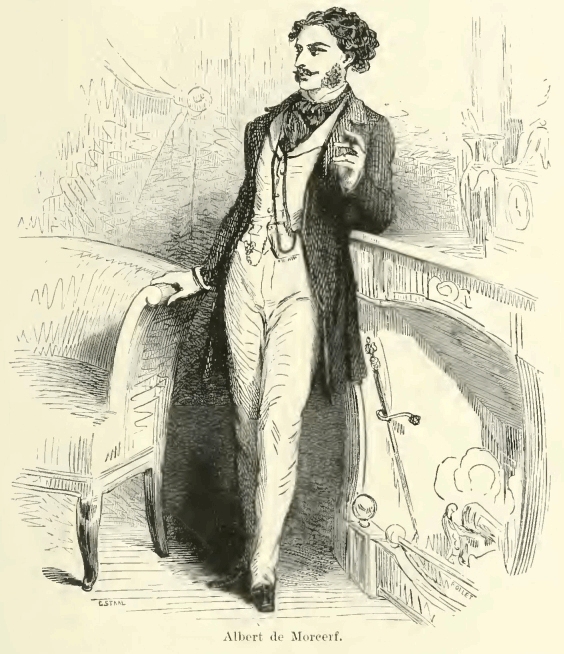
“Gentlemen,” said the Count of Monte Cristo as he entered, “I pray you
excuse me for suffering my visit to be anticipated; but I feared to
disturb you by presenting myself earlier at your apartments; besides,
you sent me word that you would come to me, and I have held myself at
your disposal.”
“Franz and I have to thank you a thousand times, count,” returned
Albert; “you extricated us from a great dilemma, and we were on the
point of inventing a very fantastic vehicle when your friendly
invitation reached us.”
“Indeed,” returned the count, motioning the two young men to sit down.
“It was the fault of that blockhead Pastrini, that I did not sooner
assist you in your distress. He did not mention a syllable of your
embarrassment to me, when he knows that, alone and isolated as I am, I
seek every opportunity of making the acquaintance of my neighbors. As
soon as I learned I could in any way assist you, I most eagerly seized
the opportunity of offering my services.”
The two young men bowed. Franz had, as yet, found nothing to say; he
had come to no determination, and as nothing in the count’s manner
manifested the wish that he should recognize him, he did not know
whether to make any allusion to the past, or wait until he had more
proof; besides, although sure it was he who had been in the box the
previous evening, he could not be equally positive that this was the
man he had seen at the Colosseum. He resolved, therefore, to let things
take their course without making any direct overture to the count.
Moreover, he had this advantage, he was master of the count’s secret,
while the count had no hold on Franz, who had nothing to conceal.
However, he resolved to lead the conversation to a subject which might
possibly clear up his doubts.
“Count,” said he, “you have offered us places in your carriage, and at
your windows in the Rospoli Palace. Can you tell us where we can obtain
a sight of the Piazza del Popolo?”
“Ah,” said the count negligently, looking attentively at Morcerf, “is
there not something like an execution upon the Piazza del Popolo?”
“Yes,” returned Franz, finding that the count was coming to the point
he wished.
“Stay, I think I told my steward yesterday to attend to this; perhaps I
can render you this slight service also.”
He extended his hand, and rang the bell thrice.
“Did you ever occupy yourself,” said he to Franz, “with the employment
of time and the means of simplifying the summoning your servants? I
have. When I ring once, it is for my valet; twice, for my majordomo;
thrice, for my steward,—thus I do not waste a minute or a word. Here he
is.”
A man of about forty-five or fifty entered, exactly resembling the
smuggler who had introduced Franz into the cavern; but he did not
appear to recognize him. It was evident he had his orders.
“Monsieur Bertuccio,” said the count, “you have procured me windows
looking on the Piazza del Popolo, as I ordered you yesterday.”
“Yes, excellency,” returned the steward; “but it was very late.”
“Did I not tell you I wished for one?” replied the count, frowning.
“And your excellency has one, which was let to Prince Lobanieff; but I
was obliged to pay a hundred——”
“That will do—that will do, Monsieur Bertuccio; spare these gentlemen
all such domestic arrangements. You have the window, that is
sufficient. Give orders to the coachman; and be in readiness on the
stairs to conduct us to it.”
The steward bowed, and was about to quit the room.
“Ah!” continued the count, “be good enough to ask Pastrini if he has
received the tavoletta, and if he can send us an account of the
execution.”
“There is no need to do that,” said Franz, taking out his tablets; “for
I saw the account, and copied it down.”
“Very well, you can retire, M. Bertuccio; I need you no longer. Let us
know when breakfast is ready. These gentlemen,” added he, turning to
the two friends, “will, I trust, do me the honor to breakfast with me?”
“But, my dear count,” said Albert, “we shall abuse your kindness.”
“Not at all; on the contrary, you will give me great pleasure. You
will, one or other of you, perhaps both, return it to me at Paris. M.
Bertuccio, lay covers for three.”
He then took Franz’s tablets out of his hand. “‘We announce,’ he read,
in the same tone with which he would have read a newspaper, ‘that
today, the 23rd of February, will be executed Andrea Rondolo, guilty of
murder on the person of the respected and venerated Don César Torlini,
canon of the church of St. John Lateran, and Peppino, called Rocca
Priori, convicted of complicity with the detestable bandit Luigi Vampa,
and the men of his band.’
“Hum! ‘The first will be mazzolato, the second decapitato.’ Yes,”
continued the count, “it was at first arranged in this way; but I think
since yesterday some change has taken place in the order of the
ceremony.”
“Really?” said Franz.
“Yes, I passed the evening at the Cardinal Rospigliosi’s, and there
mention was made of something like a pardon for one of the two men.”
“For Andrea Rondolo?” asked Franz.
“No,” replied the count, carelessly; “for the other (he glanced at the
tablets as if to recall the name), for Peppino, called Rocca Priori.
You are thus deprived of seeing a man guillotined; but the mazzolata
still remains, which is a very curious punishment when seen for the
first time, and even the second, while the other, as you must know, is
very simple. The mandaïa6 never fails, never trembles, never strikes
thirty times ineffectually, like the soldier who beheaded the Count of
Chalais, and to whose tender mercy Richelieu had doubtless recommended
the sufferer. Ah,” added the count, in a contemptuous tone, “do not
tell me of European punishments, they are in the infancy, or rather the
old age, of cruelty.”
“Really, count,” replied Franz, “one would think that you had studied
the different tortures of all the nations of the world.”
“There are, at least, few that I have not seen,” said the count coldly.
“And you took pleasure in beholding these dreadful spectacles?”
“My first sentiment was horror, the second indifference, the third
curiosity.”
“Curiosity—that is a terrible word.”
“Why so? In life, our greatest preoccupation is death; is it not then,
curious to study the different ways by which the soul and body can
part; and how, according to their different characters, temperaments,
and even the different customs of their countries, different persons
bear the transition from life to death, from existence to annihilation?
As for myself, I can assure you of one thing,—the more men you see die,
the easier it becomes to die yourself; and in my opinion, death may be
a torture, but it is not an expiation.”
“I do not quite understand you,” replied Franz; “pray explain your
meaning, for you excite my curiosity to the highest pitch.”
“Listen,” said the count, and deep hatred mounted to his face, as the
blood would to the face of any other. “If a man had by unheard-of and
excruciating tortures destroyed your father, your mother, your
betrothed,—a being who, when torn from you, left a desolation, a wound
that never closes, in your breast,—do you think the reparation that
society gives you is sufficient when it interposes the knife of the
guillotine between the base of the occiput and the trapezal muscles of
the murderer, and allows him who has caused us years of moral
sufferings to escape with a few moments of physical pain?”
“Yes, I know,” said Franz, “that human justice is insufficient to
console us; she can give blood in return for blood, that is all; but
you must demand from her only what it is in her power to grant.”
“I will put another case to you,” continued the count; “that where
society, attacked by the death of a person, avenges death by death. But
are there not a thousand tortures by which a man may be made to suffer
without society taking the least cognizance of them, or offering him
even the insufficient means of vengeance, of which we have just spoken?
Are there not crimes for which the impalement of the Turks, the augers
of the Persians, the stake and the brand of the Iroquois Indians, are
inadequate tortures, and which are unpunished by society? Answer me, do
not these crimes exist?”
“Yes,” answered Franz; “and it is to punish them that duelling is
tolerated.”
“Ah, duelling,” cried the count; “a pleasant manner, upon my soul, of
arriving at your end when that end is vengeance! A man has carried off
your mistress, a man has seduced your wife, a man has dishonored your
daughter; he has rendered the whole life of one who had the right to
expect from Heaven that portion of happiness God has promised to
everyone of his creatures, an existence of misery and infamy; and you
think you are avenged because you send a ball through the head, or pass
a sword through the breast, of that man who has planted madness in your
brain, and despair in your heart. And remember, moreover, that it is
often he who comes off victorious from the strife, absolved of all
crime in the eyes of the world. No, no,” continued the count, “had I to
avenge myself, it is not thus I would take revenge.”
“Then you disapprove of duelling? You would not fight a duel?” asked
Albert in his turn, astonished at this strange theory.
“Oh, yes,” replied the count; “understand me, I would fight a duel for
a trifle, for an insult, for a blow; and the more so that, thanks to my
skill in all bodily exercises, and the indifference to danger I have
gradually acquired, I should be almost certain to kill my man. Oh, I
would fight for such a cause; but in return for a slow, profound,
eternal torture, I would give back the same, were it possible; an eye
for an eye, a tooth for a tooth, as the Orientalists say,—our masters
in everything,—those favored creatures who have formed for themselves a
life of dreams and a paradise of realities.”
“But,” said Franz to the count, “with this theory, which renders you at
once judge and executioner of your own cause, it would be difficult to
adopt a course that would forever prevent your falling under the power
of the law. Hatred is blind, rage carries you away; and he who pours
out vengeance runs the risk of tasting a bitter draught.”
“Yes, if he be poor and inexperienced, not if he be rich and skilful;
besides, the worst that could happen to him would be the punishment of
which we have already spoken, and which the philanthropic French
Revolution has substituted for being torn to pieces by horses or broken
on the wheel. What matters this punishment, as long as he is avenged?
On my word, I almost regret that in all probability this miserable
Peppino will not be beheaded, as you might have had an opportunity then
of seeing how short a time the punishment lasts, and whether it is
worth even mentioning; but, really this is a most singular conversation
for the Carnival, gentlemen; how did it arise? Ah, I recollect, you
asked for a place at my window; you shall have it; but let us first sit
down to table, for here comes the servant to inform us that breakfast
is ready.”
As he spoke, a servant opened one of the four doors of the apartment,
saying:
“Al suo commodo!”
The two young men arose and entered the breakfast-room.
During the meal, which was excellent, and admirably served, Franz
looked repeatedly at Albert, in order to observe the impressions which
he doubted not had been made on him by the words of their entertainer;
but whether with his usual carelessness he had paid but little
attention to him, whether the explanation of the Count of Monte Cristo
with regard to duelling had satisfied him, or whether the events which
Franz knew of had had their effect on him alone, he remarked that his
companion did not pay the least regard to them, but on the contrary ate
like a man who for the last four or five months had been condemned to
partake of Italian cookery—that is, the worst in the world.
As for the count, he just touched the dishes; he seemed to fulfil the
duties of a host by sitting down with his guests, and awaited their
departure to be served with some strange or more delicate food. This
brought back to Franz, in spite of himself, the recollection of the
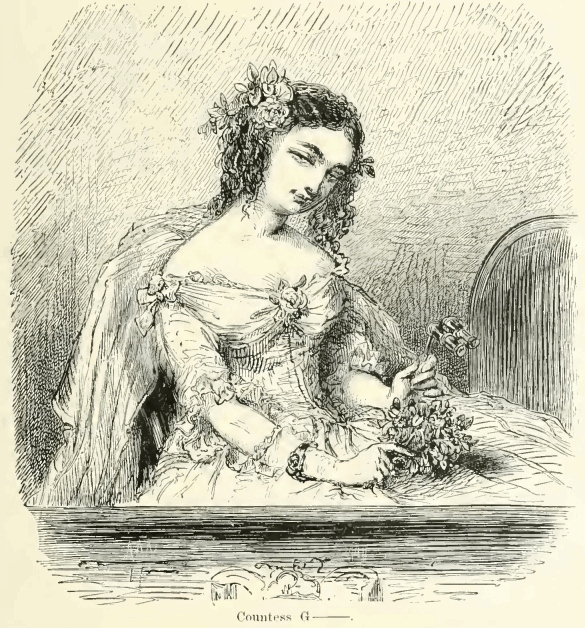
terror with which the count had inspired the Countess G——, and her firm
conviction that the man in the opposite box was a vampire.
At the end of the breakfast Franz took out his watch.
“Well,” said the count, “what are you doing?”
“You must excuse us, count,” returned Franz, “but we have still much to
do.”
“What may that be?”
“We have no masks, and it is absolutely necessary to procure them.”
“Do not concern yourself about that; we have, I think, a private room
in the Piazza del Popolo; I will have whatever costumes you choose
brought to us, and you can dress there.”
“After the execution?” cried Franz.
“Before or after, whichever you please.”
“Opposite the scaffold?”
“The scaffold forms part of the fête.”
“Count, I have reflected on the matter,” said Franz, “I thank you for
your courtesy, but I shall content myself with accepting a place in
your carriage and at your window at the Rospoli Palace, and I leave you
at liberty to dispose of my place at the Piazza del Popolo.”
“But I warn you, you will lose a very curious sight,” returned the
count.
“You will describe it to me,” replied Franz, “and the recital from your
lips will make as great an impression on me as if I had witnessed it. I
have more than once intended witnessing an execution, but I have never
been able to make up my mind; and you, Albert?”
“I,” replied the viscount,—“I saw Castaing executed, but I think I was
rather intoxicated that day, for I had quitted college the same
morning, and we had passed the previous night at a tavern.”
“Besides, it is no reason because you have not seen an execution at
Paris, that you should not see one anywhere else; when you travel, it
is to see everything. Think what a figure you will make when you are
asked, ‘How do they execute at Rome?’ and you reply, ‘I do not know!’
And, besides, they say that the culprit is an infamous scoundrel, who
killed with a log of wood a worthy canon who had brought him up like
his own son. Diable! when a churchman is killed, it should be with a
different weapon than a log, especially when he has behaved like a
father. If you went to Spain, would you not see the bull-fights? Well,
suppose it is a bull-fight you are going to see? Recollect the ancient
Romans of the Circus, and the sports where they killed three hundred
lions and a hundred men. Think of the eighty thousand applauding
spectators, the sage matrons who took their daughters, and the charming
Vestals who made with the thumb of their white hands the fatal sign
that said, ‘Come, despatch the dying.’”
“Shall you go, then, Albert?” asked Franz.
“Ma foi, yes; like you, I hesitated, but the count’s eloquence
decides me.”
“Let us go, then,” said Franz, “since you wish it; but on our way to
the Piazza del Popolo, I wish to pass through the Corso. Is this
possible, count?”
“On foot, yes, in a carriage, no.”
“I will go on foot, then.”
“Is it important that you should go that way?”
“Yes, there is something I wish to see.”
“Well, we will go by the Corso. We will send the carriage to wait for
us on the Piazza del Popolo, by the Via del Babuino, for I shall be
glad to pass, myself, through the Corso, to see if some orders I have
given have been executed.”
“Excellency,” said a servant, opening the door, “a man in the dress of
a penitent wishes to speak to you.”
“Ah! yes,” returned the count, “I know who he is, gentlemen; will you
return to the salon? you will find good cigars on the centre table. I
will be with you directly.”
The young men rose and returned into the salon, while the count, again
apologizing, left by another door. Albert, who was a great smoker, and
who had considered it no small sacrifice to be deprived of the cigars
of the Café de Paris, approached the table, and uttered a cry of joy at
perceiving some veritable puros.
“Well,” asked Franz, “what think you of the Count of Monte Cristo?”
“What do I think?” said Albert, evidently surprised at such a question
from his companion; “I think he is a delightful fellow, who does the
honors of his table admirably; who has travelled much, read much, is,
like Brutus, of the Stoic school, and moreover,” added he, sending a
volume of smoke up towards the ceiling, “that he has excellent cigars.”
Such was Albert’s opinion of the count, and as Franz well knew that
Albert professed never to form an opinion except upon long reflection,
he made no attempt to change it.
“But,” said he, “did you observe one very singular thing?”
“What?”
“How attentively he looked at you.”
“At me?”
“Yes.”
Albert reflected. “Ah,” replied he, sighing, “that is not very
surprising; I have been more than a year absent from Paris, and my
clothes are of a most antiquated cut; the count takes me for a
provincial. The first opportunity you have, undeceive him, I beg, and
tell him I am nothing of the kind.”
Franz smiled; an instant after the count entered.
“I am now quite at your service, gentlemen,” said he. “The carriage is
going one way to the Piazza del Popolo, and we will go another; and, if
you please, by the Corso. Take some more of these cigars, M. de
Morcerf.”
“With all my heart,” returned Albert; “Italian cigars are horrible.
When you come to Paris, I will return all this.”
“I will not refuse; I intend going there soon, and since you allow me,
I will pay you a visit. Come, we have not any time to lose, it is
half-past twelve—let us set off.”
All three descended; the coachman received his master’s orders, and
drove down the Via del Babuino. While the three gentlemen walked along
the Piazza di Spagna and the Via Frattina, which led directly between
the Fiano and Rospoli palaces, Franz’s attention was directed towards
the windows of that last palace, for he had not forgotten the signal
agreed upon between the man in the mantle and the Transtevere peasant.
“Which are your windows?” asked he of the count, with as much
indifference as he could assume.
“The three last,” returned he, with a negligence evidently unaffected,
for he could not imagine with what intention the question was put.
Franz glanced rapidly towards the three windows. The side windows were
hung with yellow damask, and the centre one with white damask and a red
cross. The man in the mantle had kept his promise to the Transteverin,
and there could now be no doubt that he was the count.
The three windows were still untenanted. Preparations were making on
every side; chairs were placed, scaffolds were raised, and windows were
hung with flags. The masks could not appear; the carriages could not
move about; but the masks were visible behind the windows, the
carriages, and the doors.
Franz, Albert, and the count continued to descend the Corso. As they
approached the Piazza del Popolo, the crowd became more dense, and
above the heads of the multitude two objects were visible: the obelisk,
surmounted by a cross, which marks the centre of the square, and in
front of the obelisk, at the point where the three streets, del
Babuino, del Corso, and di Ripetta, meet, the two uprights of the
scaffold, between which glittered the curved knife of the mandaïa.
At the corner of the street they met the count’s steward, who was
awaiting his master. The window, let at an exorbitant price, which the
count had doubtless wished to conceal from his guests, was on the
second floor of the great palace, situated between the Via del Babuino
and the Monte Pincio. It consisted, as we have said, of a small
dressing-room, opening into a bedroom, and, when the door of
communication was shut, the inmates were quite alone. On chairs were
laid elegant masquerade costumes of blue and white satin.
“As you left the choice of your costumes to me,” said the count to the
two friends, “I have had these brought, as they will be the most worn
this year; and they are most suitable, on account of the confetti
(sweetmeats), as they do not show the flour.”
Franz heard the words of the count but imperfectly, and he perhaps did
not fully appreciate this new attention to their wishes; for he was
wholly absorbed by the spectacle that the Piazza del Popolo presented,
and by the terrible instrument that was in the centre.
It was the first time Franz had ever seen a guillotine,—we say
guillotine, because the Roman mandaïa is formed on almost the same
model as the French instrument.7 The knife, which is shaped like a
crescent, that cuts with the convex side, falls from a less height, and
that is all the difference.
Two men, seated on the movable plank on which the victim is laid, were
eating their breakfasts, while waiting for the criminal. Their repast
consisted apparently of bread and sausages. One of them lifted the
plank, took out a flask of wine, drank some, and then passed it to his
companion. These two men were the executioner’s assistants.
At this sight Franz felt the perspiration start forth upon his brow.
The prisoners, transported the previous evening from the Carceri Nuove
to the little church of Santa Maria del Popolo, had passed the night,
each accompanied by two priests, in a chapel closed by a grating,
before which were two sentinels, who were relieved at intervals. A
double line of carbineers, placed on each side of the door of the
church, reached to the scaffold, and formed a circle around it, leaving
a path about ten feet wide, and around the guillotine a space of nearly
a hundred feet.
All the rest of the square was paved with heads. Many women held their
infants on their shoulders, and thus the children had the best view.
The Monte Pincio seemed a vast amphitheatre filled with spectators; the
balconies of the two churches at the corner of the Via del Babuino and
the Via di Ripetta were crammed; the steps even seemed a parti-colored
sea, that was impelled towards the portico; every niche in the wall
held its living statue. What the count said was true—the most curious
spectacle in life is that of death.
And yet, instead of the silence and the solemnity demanded by the
occasion, laughter and jests arose from the crowd. It was evident that
the execution was, in the eyes of the people, only the commencement of
the Carnival.
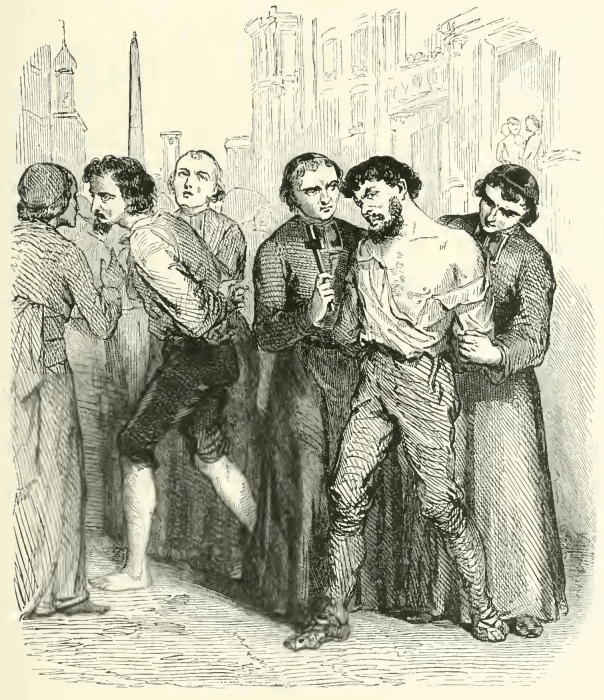
Suddenly the tumult ceased, as if by magic, and the doors of the church
opened. A brotherhood of penitents, clothed from head to foot in robes
of gray sackcloth, with holes for the eyes, and holding in their hands
lighted tapers, appeared first; the chief marched at the head.
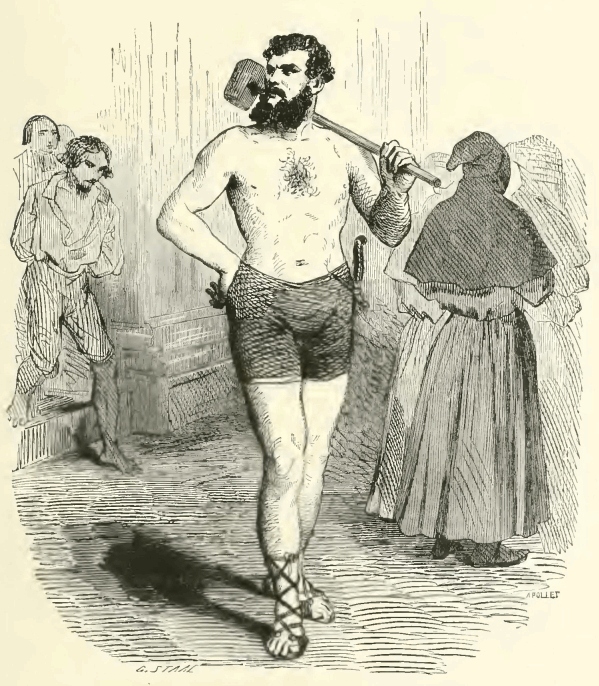
Behind the penitents came a man of vast stature and proportions. He was
naked, with the exception of cloth drawers at the left side of which
hung a large knife in a sheath, and he bore on his right shoulder a
heavy iron sledge-hammer.
This man was the executioner.
He had, moreover, sandals bound on his feet by cords.
Behind the executioner came, in the order in which they were to die,
first Peppino and then Andrea. Each was accompanied by two priests.
Neither had his eyes bandaged.
Peppino walked with a firm step, doubtless aware of what awaited him.
Andrea was supported by two priests. Each of them, from time to time,
kissed the crucifix a confessor held out to them.
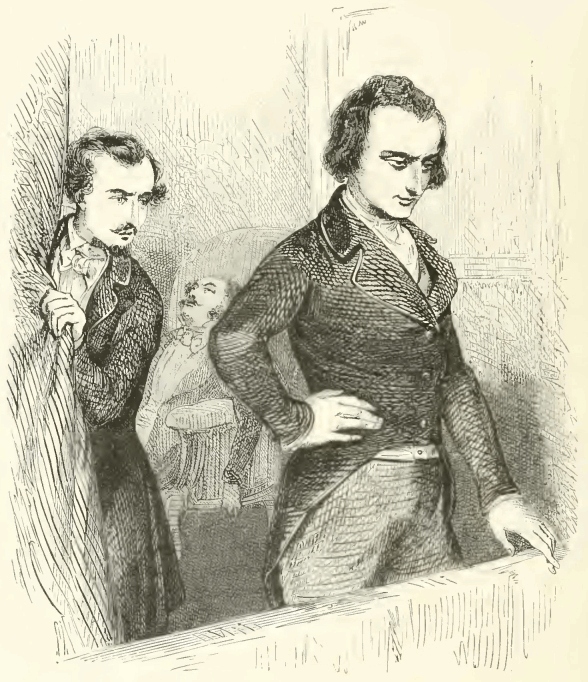
At this sight alone Franz felt his legs tremble under him. He looked at
Albert—he was as white as his shirt, and mechanically cast away his
cigar, although he had not half smoked it. The count alone seemed
unmoved—nay, more, a slight color seemed striving to rise in his pale
cheeks. His nostrils dilated like those of a wild beast that scents its
prey, and his lips, half opened, disclosed his white teeth, small and
sharp like those of a jackal. And yet his features wore an expression
of smiling tenderness, such as Franz had never before witnessed in
them; his black eyes especially were full of kindness and pity.
However, the two culprits advanced, and as they approached their faces
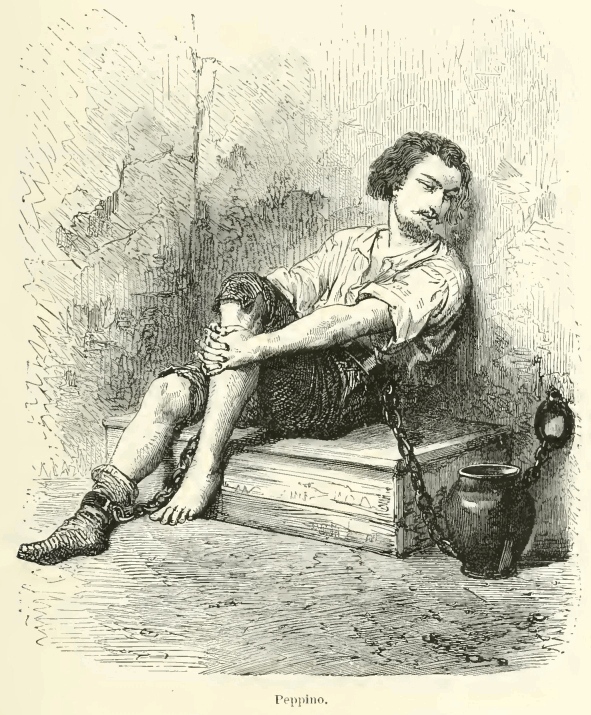
became visible. Peppino was a handsome young man of four or
five-and-twenty, bronzed by the sun; he carried his head erect, and
seemed on the watch to see on which side his liberator would appear.
Andrea was short and fat; his visage, marked with brutal cruelty, did
not indicate age; he might be thirty. In prison he had suffered his
beard to grow; his head fell on his shoulder, his legs bent beneath
him, and his movements were apparently automatic and unconscious.
“I thought,” said Franz to the count, “that you told me there would be
but one execution.”
“I told you true,” replied he coldly.
“And yet here are two culprits.”
“Yes; but only one of these two is about to die; the other has many
years to live.”
“If the pardon is to come, there is no time to lose.”
“And see, here it is,” said the count. At the moment when Peppino
reached the foot of the mandaïa, a priest arrived in some haste,
forced his way through the soldiers, and, advancing to the chief of the
brotherhood, gave him a folded paper. The piercing eye of Peppino had
noticed all. The chief took the paper, unfolded it, and, raising his
hand, “Heaven be praised, and his Holiness also,” said he in a loud
voice; “here is a pardon for one of the prisoners!”
“A pardon!” cried the people with one voice; “a pardon!”
At this cry Andrea raised his head.
“Pardon for whom?” cried he.
Peppino remained breathless.
“A pardon for Peppino, called Rocca Priori,” said the principal friar.
And he passed the paper to the officer commanding the carbineers, who
read and returned it to him.
“For Peppino!” cried Andrea, who seemed roused from the torpor in which
he had been plunged. “Why for him and not for me? We ought to die
together. I was promised he should die with me. You have no right to
put me to death alone. I will not die alone—I will not!”
And he broke from the priests struggling and raving like a wild beast,
and striving desperately to break the cords that bound his hands. The
executioner made a sign, and his two assistants leaped from the
scaffold and seized him.
“What is going on?” asked Franz of the count; for, as all the talk was
in the Roman dialect, he had not perfectly understood it.
“Do you not see?” returned the count, “that this human creature who is
about to die is furious that his fellow-sufferer does not perish with
him? and, were he able, he would rather tear him to pieces with his
teeth and nails than let him enjoy the life he himself is about to be
deprived of. Oh, man, man—race of crocodiles,” cried the count,
extending his clenched hands towards the crowd, “how well do I
recognize you there, and that at all times you are worthy of
yourselves!”
Meanwhile Andrea and the two executioners were struggling on the
ground, and he kept exclaiming, “He ought to die!—he shall die!—I will
not die alone!”
“Look, look,” cried the count, seizing the young men’s hands; “look,
for on my soul it is curious. Here is a man who had resigned himself to
his fate, who was going to the scaffold to die—like a coward, it is
true, but he was about to die without resistance. Do you know what gave
him strength? do you know what consoled him? It was, that another
partook of his punishment—that another partook of his anguish—that
another was to die before him! Lead two sheep to the butcher’s, two
oxen to the slaughterhouse, and make one of them understand that his
companion will not die; the sheep will bleat for pleasure, the ox will
bellow with joy. But man—man, whom God created in his own image—man,
upon whom God has laid his first, his sole commandment, to love his
neighbor—man, to whom God has given a voice to express his
thoughts—what is his first cry when he hears his fellow-man is saved? A
blasphemy. Honor to man, this masterpiece of nature, this king of the
creation!”
And the count burst into a laugh; a terrible laugh, that showed he must
have suffered horribly to be able thus to laugh.
However, the struggle still continued, and it was dreadful to witness.
The two assistants carried Andrea up to the scaffold; the people all
took part against Andrea, and twenty thousand voices cried, “Put him to
death! put him to death!”
Franz sprang back, but the count seized his arm, and held him before
the window.
“What are you doing?” said he. “Do you pity him? If you heard the cry
of ‘Mad dog!’ you would take your gun—you would unhesitatingly shoot
the poor beast, who, after all, was only guilty of having been bitten
by another dog. And yet you pity a man who, without being bitten by one
of his race, has yet murdered his benefactor; and who, now unable to
kill anyone, because his hands are bound, wishes to see his companion
in captivity perish. No, no—look, look!”
The recommendation was needless. Franz was fascinated by the horrible
spectacle.
The two assistants had borne Andrea to the scaffold, and there, in
spite of his struggles, his bites, and his cries, had forced him to his
knees. During this time the executioner had raised his mace, and signed
to them to get out of the way; the criminal strove to rise, but, ere he
had time, the mace fell on his left temple. A dull and heavy sound was
heard, and the man dropped like an ox on his face, and then turned over
on his back.
The executioner let fall his mace, drew his knife, and with one stroke
opened his throat, and mounting on his stomach, stamped violently on it
with his feet. At every stroke a jet of blood sprang from the wound.
This time Franz could contain himself no longer, but sank, half
fainting, into a seat.
Albert, with his eyes closed, was standing grasping the
window-curtains.
The count was erect and triumphant, like the Avenging Angel!
Chapter XXXIII
Roman Bandits
The next morning Franz woke first, and instantly rang the bell. The
sound had not yet died away when Signor Pastrini himself entered.
“Well, excellency,” said the landlord triumphantly, and without waiting
for Franz to question him, “I feared yesterday, when I would not
promise you anything, that you were too late—there is not a single
carriage to be had—that is, for the three last days”
“Yes,” returned Franz, “for the very three days it is most needed.”
“What is the matter?” said Albert, entering; “no carriage to be had?”
“Just so,” returned Franz, “you have guessed it.”
“Well, your Eternal City is a nice sort of place.”
“That is to say, excellency,” replied Pastrini, who was desirous of
keeping up the dignity of the capital of the Christian world in the
eyes of his guest, “that there are no carriages to be had from Sunday
to Tuesday evening, but from now till Sunday you can have fifty if you
please.”
“Ah, that is something,” said Albert; “today is Thursday, and who knows
what may arrive between this and Sunday?”
“Ten or twelve thousand travellers will arrive,” replied Franz, “which
will make it still more difficult.”
“My friend,” said Morcerf, “let us enjoy the present without gloomy
forebodings for the future.”
“At least we can have a window?”
“Where?”
“In the Corso.”
“Ah, a window!” exclaimed Signor Pastrini,—“utterly impossible; there
was only one left on the fifth floor of the Doria Palace, and that has
been let to a Russian prince for twenty sequins a day.”
The two young men looked at each other with an air of stupefaction.
“Well,” said Franz to Albert, “do you know what is the best thing we
can do? It is to pass the Carnival at Venice; there we are sure of
obtaining gondolas if we cannot have carriages.”
“Ah, the devil, no,” cried Albert; “I came to Rome to see the Carnival,
and I will, though I see it on stilts.”
“Bravo! an excellent idea. We will disguise ourselves as monster
pulchinellos or shepherds of the Landes, and we shall have complete
success.”
“Do your excellencies still wish for a carriage from now to Sunday
morning?”
“Parbleu!” said Albert, “do you think we are going to run about on
foot in the streets of Rome, like lawyers’ clerks?”
“I hasten to comply with your excellencies’ wishes; only, I tell you
beforehand, the carriage will cost you six piastres a day.”
“And, as I am not a millionaire, like the gentleman in the next
apartments,” said Franz, “I warn you, that as I have been four times
before at Rome, I know the prices of all the carriages; we will give
you twelve piastres for today, tomorrow, and the day after, and then
you will make a good profit.”
“But, excellency”—said Pastrini, still striving to gain his point.
“Now go,” returned Franz, “or I shall go myself and bargain with your
affettatore, who is mine also; he is an old friend of mine, who has
plundered me pretty well already, and, in the hope of making more out
of me, he will take a less price than the one I offer you; you will
lose the preference, and that will be your fault.”
“Do not give yourselves the trouble, excellency,” returned Signor
Pastrini, with the smile peculiar to the Italian speculator when he
confesses defeat; “I will do all I can, and I hope you will be
satisfied.”
“And now we understand each other.”
“When do you wish the carriage to be here?”
“In an hour.”
“In an hour it will be at the door.”
An hour after the vehicle was at the door; it was a hack conveyance
which was elevated to the rank of a private carriage in honor of the
occasion, but, in spite of its humble exterior, the young men would
have thought themselves happy to have secured it for the last three
days of the Carnival.
“Excellency,” cried the cicerone, seeing Franz approach the window,
“shall I bring the carriage nearer to the palace?”
Accustomed as Franz was to the Italian phraseology, his first impulse
was to look round him, but these words were addressed to him. Franz was
the “excellency,” the vehicle was the “carriage,” and the Hôtel de
Londres was the “palace.” The genius for laudation characteristic of
the race was in that phrase.
Franz and Albert descended, the carriage approached the palace; their
excellencies stretched their legs along the seats; the cicerone
sprang into the seat behind.
“Where do your excellencies wish to go?” asked he.
“To Saint Peter’s first, and then to the Colosseum,” returned Albert.
But Albert did not know that it takes a day to see Saint Peter’s, and a
month to study it. The day was passed at Saint Peter’s alone.
Suddenly the daylight began to fade away; Franz took out his watch—it
was half-past four. They returned to the hotel; at the door Franz
ordered the coachman to be ready at eight. He wished to show Albert the
Colosseum by moonlight, as he had shown him Saint Peter’s by daylight.
When we show a friend a city one has already visited, we feel the same
pride as when we point out a woman whose lover we have been.
He was to leave the city by the Porta del Popolo, skirt the outer wall,
and re-enter by the Porta San Giovanni; thus they would behold the
Colosseum without finding their impressions dulled by first looking on
the Capitol, the Forum, the Arch of Septimus Severus, the Temple of
Antoninus and Faustina, and the Via Sacra.
They sat down to dinner. Signor Pastrini had promised them a banquet;
he gave them a tolerable repast. At the end of the dinner he entered in
person. Franz thought that he came to hear his dinner praised, and
began accordingly, but at the first words he was interrupted.
“Excellency,” said Pastrini, “I am delighted to have your approbation,
but it was not for that I came.”
“Did you come to tell us you have procured a carriage?” asked Albert,
lighting his cigar.
“No; and your excellencies will do well not to think of that any
longer; at Rome things can or cannot be done; when you are told
anything cannot be done, there is an end of it.”
“It is much more convenient at Paris,—when anything cannot be done, you
pay double, and it is done directly.”
“That is what all the French say,” returned Signor Pastrini, somewhat
piqued; “for that reason, I do not understand why they travel.”
“But,” said Albert, emitting a volume of smoke and balancing his chair
on its hind legs, “only madmen, or blockheads like us, ever do travel.
Men in their senses do not quit their hotel in the Rue du Helder, their
walk on the Boulevard de Gand, and the Café de Paris.”
It is of course understood that Albert resided in the aforesaid street,
appeared every day on the fashionable walk, and dined frequently at the
only restaurant where you can really dine, that is, if you are on good
terms with its waiters.
Signor Pastrini remained silent a short time; it was evident that he
was musing over this answer, which did not seem very clear.
“But,” said Franz, in his turn interrupting his host’s meditations,
“you had some motive for coming here, may I beg to know what it was?”
“Ah, yes; you have ordered your carriage at eight o’clock precisely?”
“I have.”
“You intend visiting Il Colosseo.”
“You mean the Colosseum?”
“It is the same thing. You have told your coachman to leave the city by
the Porta del Popolo, to drive round the walls, and re-enter by the
Porta San Giovanni?”
“These are my words exactly.”
“Well, this route is impossible.”
“Impossible!”
“Very dangerous, to say the least.”
“Dangerous!—and why?”
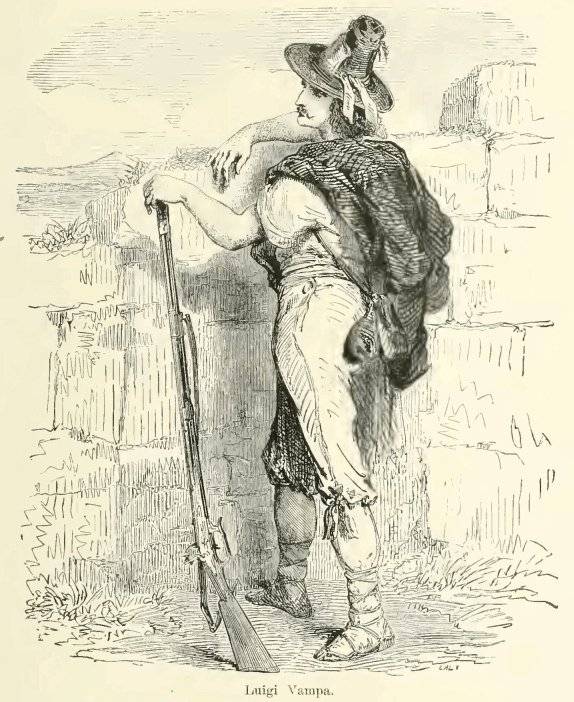
“On account of the famous Luigi Vampa.”
“Pray, who may this famous Luigi Vampa be?” inquired Albert; “he may be
very famous at Rome, but I can assure you he is quite unknown at
Paris.”
“What! do you not know him?”
“I have not that honor.”
“You have never heard his name?”
“Never.”
“Well, then, he is a bandit, compared to whom the Decesaris and the
Gasparones were mere children.”
“Now then, Albert,” cried Franz, “here is a bandit for you at last.”
“I forewarn you, Signor Pastrini, that I shall not believe one word of
what you are going to tell us; having told you this, begin. ‘Once upon
a time——’ Well, go on.”
Signor Pastrini turned toward Franz, who seemed to him the more
reasonable of the two; we must do him justice,—he had had a great many
Frenchmen in his house, but had never been able to comprehend them.
“Excellency,” said he gravely, addressing Franz, “if you look upon me
as a liar, it is useless for me to say anything; it was for your
interest I——”
“Albert does not say you are a liar, Signor Pastrini,” said Franz, “but
that he will not believe what you are going to tell us,—but I will
believe all you say; so proceed.”
“But if your excellency doubt my veracity——”
“Signor Pastrini,” returned Franz, “you are more susceptible than
Cassandra, who was a prophetess, and yet no one believed her; while
you, at least, are sure of the credence of half your audience. Come,
sit down, and tell us all about this Signor Vampa.”
“I had told your excellency he is the most famous bandit we have had
since the days of Mastrilla.”
“Well, what has this bandit to do with the order I have given the
coachman to leave the city by the Porta del Popolo, and to re-enter by
the Porta San Giovanni?”
“This,” replied Signor Pastrini, “that you will go out by one, but I
very much doubt your returning by the other.”
“Why?” asked Franz.
“Because, after nightfall, you are not safe fifty yards from the
gates.”
“On your honor, is that true?” cried Albert.
“Count,” returned Signor Pastrini, hurt at Albert’s repeated doubts of
the truth of his assertions, “I do not say this to you, but to your
companion, who knows Rome, and knows, too, that these things are not to
be laughed at.”
“My dear fellow,” said Albert, turning to Franz, “here is an admirable
adventure; we will fill our carriage with pistols, blunderbusses, and
double-barrelled guns. Luigi Vampa comes to take us, and we take him—we
bring him back to Rome, and present him to his holiness the Pope, who
asks how he can repay so great a service; then we merely ask for a
carriage and a pair of horses, and we see the Carnival in the carriage,
and doubtless the Roman people will crown us at the Capitol, and
proclaim us, like Curtius and Horatius Cocles, the preservers of their
country.”
Whilst Albert proposed this scheme, Signor Pastrini’s face assumed an
expression impossible to describe.
“And pray,” asked Franz, “where are these pistols, blunderbusses, and
other deadly weapons with which you intend filling the carriage?”
“Not out of my armory, for at Terracina I was plundered even of my
hunting-knife. And you?”
“I shared the same fate at Aquapendente.”
“Do you know, Signor Pastrini,” said Albert, lighting a second cigar at
the first, “that this practice is very convenient for bandits, and that
it seems to be due to an arrangement of their own.”
Doubtless Signor Pastrini found this pleasantry compromising, for he
only answered half the question, and then he spoke to Franz, as the
only one likely to listen with attention. “Your excellency knows that
it is not customary to defend yourself when attacked by bandits.”
“What!” cried Albert, whose courage revolted at the idea of being
plundered tamely, “not make any resistance!”
“No, for it would be useless. What could you do against a dozen bandits
who spring out of some pit, ruin, or aqueduct, and level their pieces
at you?”
“Eh, parbleu!—they should kill me.”
The innkeeper turned to Franz with an air that seemed to say, “Your
friend is decidedly mad.”
“My dear Albert,” returned Franz, “your answer is sublime, and worthy
the ‘Let him die,’ of Corneille, only, when Horace made that answer,
the safety of Rome was concerned; but, as for us, it is only to gratify
a whim, and it would be ridiculous to risk our lives for so foolish a
motive.”
Albert poured himself out a glass of lacryma Christi, which he sipped
at intervals, muttering some unintelligible words.
“Well, Signor Pastrini,” said Franz, “now that my companion is quieted,
and you have seen how peaceful my intentions are, tell me who is this
Luigi Vampa. Is he a shepherd or a nobleman?—young or old?—tall or
short? Describe him, in order that, if we meet him by chance, like Jean
Sbogar or Lara, we may recognize him.”
“You could not apply to anyone better able to inform you on all these
points, for I knew him when he was a child, and one day that I fell
into his hands, going from Ferentino to Alatri, he, fortunately for me,
recollected me, and set me free, not only without ransom, but made me a
present of a very splendid watch, and related his history to me.”
“Let us see the watch,” said Albert.
Signor Pastrini drew from his fob a magnificent Bréguet, bearing the
name of its maker, of Parisian manufacture, and a count’s coronet.
“Here it is,” said he.
“Peste!” returned Albert, “I compliment you on it; I have its
fellow”—he took his watch from his waistcoat pocket—“and it cost me
3,000 francs.”
“Let us hear the history,” said Franz, motioning Signor Pastrini to
seat himself.
“Your excellencies permit it?” asked the host.
“Pardieu!” cried Albert, “you are not a preacher, to remain
standing!”
The host sat down, after having made each of them a respectful bow,
which meant that he was ready to tell them all they wished to know
concerning Luigi Vampa.
“You tell me,” said Franz, at the moment Signor Pastrini was about to
open his mouth, “that you knew Luigi Vampa when he was a child—he is
still a young man, then?”
“A young man? he is only two-and-twenty;—he will gain himself a
reputation.”
“What do you think of that, Albert?—at two-and-twenty to be thus
famous?”
“Yes, and at his age, Alexander, Cæsar, and Napoleon, who have all made
some noise in the world, were quite behind him.”
“So,” continued Franz, “the hero of this history is only
two-and-twenty?”
“Scarcely so much.”
“Is he tall or short?”
“Of the middle height—about the same stature as his excellency,”
returned the host, pointing to Albert.
“Thanks for the comparison,” said Albert, with a bow.
“Go on, Signor Pastrini,” continued Franz, smiling at his friend’s
susceptibility. “To what class of society does he belong?”
“He was a shepherd-boy attached to the farm of the Count of San-Felice,
situated between Palestrina and the Lake of Gabri; he was born at
Pampinara, and entered the count’s service when he was five years old;
his father was also a shepherd, who owned a small flock, and lived by
the wool and the milk, which he sold at Rome. When quite a child, the
little Vampa displayed a most extraordinary precocity. One day, when he
was seven years old, he came to the curate of Palestrina, and asked to
be taught to read; it was somewhat difficult, for he could not quit his
flock; but the good curate went every day to say mass at a little
hamlet too poor to pay a priest and which, having no other name, was
called Borgo; he told Luigi that he might meet him on his return, and
that then he would give him a lesson, warning him that it would be
short, and that he must profit as much as possible by it. The child
accepted joyfully. Every day Luigi led his flock to graze on the road
that leads from Palestrina to Borgo; every day, at nine o’clock in the
morning, the priest and the boy sat down on a bank by the wayside, and
the little shepherd took his lesson out of the priest’s breviary. At
the end of three months he had learned to read. This was not enough—he
must now learn to write. The priest had a writing teacher at Rome make
three alphabets—one large, one middling, and one small; and pointed out
to him that by the help of a sharp instrument he could trace the
letters on a slate, and thus learn to write. The same evening, when the
flock was safe at the farm, the little Luigi hastened to the smith at
Palestrina, took a large nail, heated and sharpened it, and formed a
sort of stylus. The next morning he gathered an armful of pieces of
slate and began. At the end of three months he had learned to write.
The curate, astonished at his quickness and intelligence, made him a
present of pens, paper, and a penknife. This demanded new effort, but
nothing compared to the first; at the end of a week he wrote as well
with this pen as with the stylus. The curate related the incident to
the Count of San-Felice, who sent for the little shepherd, made him
read and write before him, ordered his attendant to let him eat with
the domestics, and to give him two piastres a month. With this, Luigi
purchased books and pencils. He applied his imitative powers to
everything, and, like Giotto, when young, he drew on his slate sheep,
houses, and trees. Then, with his knife, he began to carve all sorts of
objects in wood; it was thus that Pinelli, the famous sculptor, had
commenced.
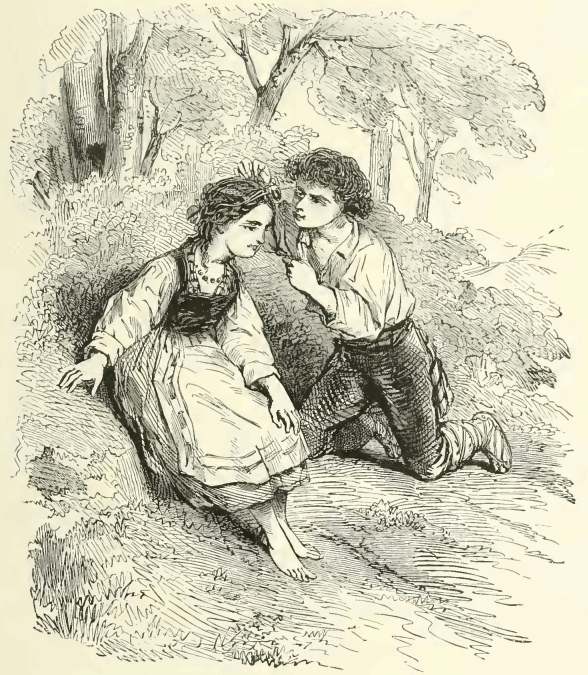
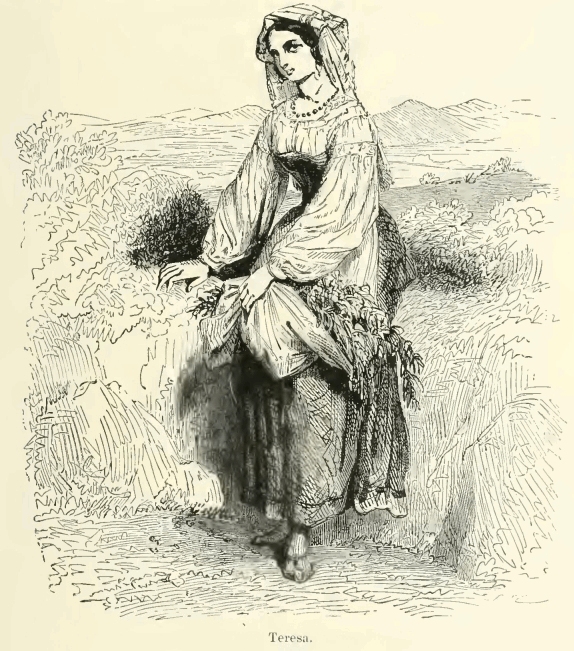
“A girl of six or seven—that is, a little younger than Vampa—tended
sheep on a farm near Palestrina; she was an orphan, born at Valmontone
and was named Teresa. The two children met, sat down near each other,
let their flocks mingle together, played, laughed, and conversed
together; in the evening they separated the Count of San-Felice’s flock
from those of Baron Cervetri, and the children returned to their
respective farms, promising to meet the next morning. The next day they
kept their word, and thus they grew up together. Vampa was twelve, and
Teresa eleven. And yet their natural disposition revealed itself.
Beside his taste for the fine arts, which Luigi had carried as far as
he could in his solitude, he was given to alternating fits of sadness
and enthusiasm, was often angry and capricious, and always sarcastic.
None of the lads of Pampinara, Palestrina, or Valmontone had been able
to gain any influence over him or even to become his companion. His
disposition (always inclined to exact concessions rather than to make
them) kept him aloof from all friendships. Teresa alone ruled by a
look, a word, a gesture, this impetuous character, which yielded
beneath the hand of a woman, and which beneath the hand of a man might
have broken, but could never have been bended. Teresa was lively and
gay, but coquettish to excess. The two piastres that Luigi received
every month from the Count of San-Felice’s steward, and the price of
all the little carvings in wood he sold at Rome, were expended in
ear-rings, necklaces, and gold hairpins. So that, thanks to her
friend’s generosity, Teresa was the most beautiful and the best-attired
peasant near Rome.
“The two children grew up together, passing all their time with each
other, and giving themselves up to the wild ideas of their different
characters. Thus, in all their dreams, their wishes, and their
conversations, Vampa saw himself the captain of a vessel, general of an
army, or governor of a province. Teresa saw herself rich, superbly
attired, and attended by a train of liveried domestics. Then, when they
had thus passed the day in building castles in the air, they separated
their flocks, and descended from the elevation of their dreams to the
reality of their humble position.
“One day the young shepherd told the count’s steward that he had seen a
wolf come out of the Sabine mountains, and prowl around his flock. The
steward gave him a gun; this was what Vampa longed for. This gun had an
excellent barrel, made at Brescia, and carrying a ball with the
precision of an English rifle; but one day the count broke the stock,
and had then cast the gun aside. This, however, was nothing to a
sculptor like Vampa; he examined the broken stock, calculated what
change it would require to adapt the gun to his shoulder, and made a
fresh stock, so beautifully carved that it would have fetched fifteen
or twenty piastres, had he chosen to sell it. But nothing could be
farther from his thoughts.
“For a long time a gun had been the young man’s greatest ambition. In
every country where independence has taken the place of liberty, the
first desire of a manly heart is to possess a weapon, which at once
renders him capable of defence or attack, and, by rendering its owner
terrible, often makes him feared. From this moment Vampa devoted all
his leisure time to perfecting himself in the use of his precious
weapon; he purchased powder and ball, and everything served him for a
mark—the trunk of some old and moss-grown olive-tree, that grew on the
Sabine mountains; the fox, as he quitted his earth on some marauding
excursion; the eagle that soared above their heads: and thus he soon
became so expert, that Teresa overcame the terror she at first felt at
the report, and amused herself by watching him direct the ball wherever
he pleased, with as much accuracy as if he placed it by hand.
“One evening a wolf emerged from a pine-wood near which they were
usually stationed, but the wolf had scarcely advanced ten yards ere he
was dead. Proud of this exploit, Vampa took the dead animal on his
shoulders, and carried him to the farm. These exploits had gained Luigi
considerable reputation. The man of superior abilities always finds
admirers, go where he will. He was spoken of as the most adroit, the
strongest, and the most courageous contadino for ten leagues around;
and although Teresa was universally allowed to be the most beautiful
girl of the Sabines, no one had ever spoken to her of love, because it
was known that she was beloved by Vampa. And yet the two young people
had never declared their affection; they had grown together like two
trees whose roots are mingled, whose branches intertwined, and whose
intermingled perfume rises to the heavens. Only their wish to see each
other had become a necessity, and they would have preferred death to a
day’s separation.
“Teresa was sixteen, and Vampa seventeen. About this time, a band of
brigands that had established itself in the Lepini mountains began to
be much spoken of. The brigands have never been really extirpated from
the neighborhood of Rome. Sometimes a chief is wanted, but when a chief
presents himself he rarely has to wait long for a band of followers.
“The celebrated Cucumetto, pursued in the Abruzzo, driven out of the
kingdom of Naples, where he had carried on a regular war, had crossed
the Garigliano, like Manfred, and had taken refuge on the banks of the
Amasine between Sonnino and Juperno. He strove to collect a band of
followers, and followed the footsteps of Decesaris and Gasparone, whom
he hoped to surpass. Many young men of Palestrina, Frascati, and
Pampinara had disappeared. Their disappearance at first caused much
disquietude; but it was soon known that they had joined Cucumetto.
After some time Cucumetto became the object of universal attention; the
most extraordinary traits of ferocious daring and brutality were
related of him.
“One day he carried off a young girl, the daughter of a surveyor of
Frosinone. The bandit’s laws are positive; a young girl belongs first
to him who carries her off, then the rest draw lots for her, and she is
abandoned to their brutality until death relieves her sufferings. When
their parents are sufficiently rich to pay a ransom, a messenger is
sent to negotiate; the prisoner is hostage for the security of the
messenger; should the ransom be refused, the prisoner is irrevocably
lost. The young girl’s lover was in Cucumetto’s troop; his name was
Carlini. When she recognized her lover, the poor girl extended her arms
to him, and believed herself safe; but Carlini felt his heart sink, for
he but too well knew the fate that awaited her. However, as he was a
favorite with Cucumetto, as he had for three years faithfully served
him, and as he had saved his life by shooting a dragoon who was about
to cut him down, he hoped the chief would have pity on him. He took
Cucumetto one side, while the young girl, seated at the foot of a huge
pine that stood in the centre of the forest, made a veil of her
picturesque head-dress to hide her face from the lascivious gaze of the
bandits. There he told the chief all—his affection for the prisoner,
their promises of mutual fidelity, and how every night, since he had
been near, they had met in some neighboring ruins.
“It so happened that night that Cucumetto had sent Carlini to a
village, so that he had been unable to go to the place of meeting.
Cucumetto had been there, however, by accident, as he said, and had
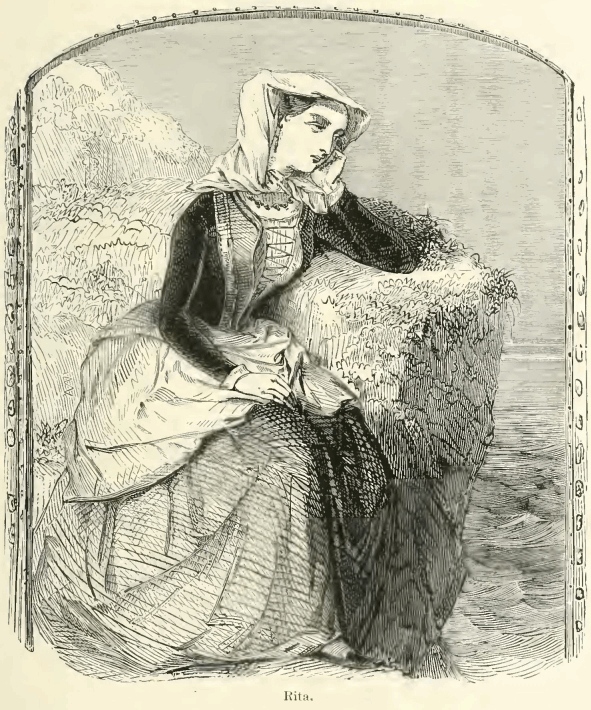
carried the maiden off. Carlini besought his chief to make an exception
in Rita’s favor, as her father was rich, and could pay a large ransom.
Cucumetto seemed to yield to his friend’s entreaties, and bade him find
a shepherd to send to Rita’s father at Frosinone.
“Carlini flew joyfully to Rita, telling her she was saved, and bidding
her write to her father, to inform him what had occurred, and that her
ransom was fixed at three hundred piastres. Twelve hours’ delay was all
that was granted—that is, until nine the next morning. The instant the
letter was written, Carlini seized it, and hastened to the plain to
find a messenger. He found a young shepherd watching his flock. The
natural messengers of the bandits are the shepherds who live between
the city and the mountains, between civilized and savage life. The boy
undertook the commission, promising to be in Frosinone in less than an
hour. Carlini returned, anxious to see his mistress, and announce the
joyful intelligence. He found the troop in the glade, supping off the
provisions exacted as contributions from the peasants; but his eye
vainly sought Rita and Cucumetto among them.
“He inquired where they were, and was answered by a burst of laughter.
A cold perspiration burst from every pore, and his hair stood on end.
He repeated his question. One of the bandits rose, and offered him a
glass filled with Orvietto, saying, ‘To the health of the brave
Cucumetto and the fair Rita.’ At this moment Carlini heard a woman’s
cry; he divined the truth, seized the glass, broke it across the face
of him who presented it, and rushed towards the spot whence the cry
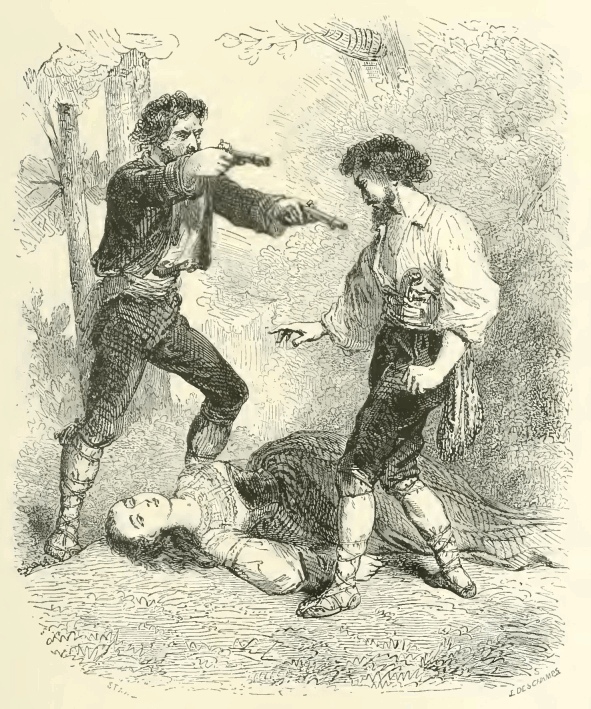
came. After a hundred yards he turned the corner of the thicket; he
found Rita senseless in the arms of Cucumetto. At the sight of Carlini,
Cucumetto rose, a pistol in each hand. The two brigands looked at each
other for a moment—the one with a smile of lasciviousness on his lips,
the other with the pallor of death on his brow. A terrible battle
between the two men seemed imminent; but by degrees Carlini’s features
relaxed, his hand, which had grasped one of the pistols in his belt,
fell to his side. Rita lay between them. The moon lighted the group.
“‘Well,’ said Cucumetto, ‘have you executed your commission?’
“‘Yes, captain,’ returned Carlini. ‘At nine o’clock tomorrow Rita’s
father will be here with the money.’
“‘It is well; in the meantime, we will have a merry night; this young
girl is charming, and does credit to your taste. Now, as I am not
egotistical, we will return to our comrades and draw lots for her.’
“‘You have determined, then, to abandon her to the common law?’ said
Carlini.
“‘Why should an exception be made in her favor?’
“‘I thought that my entreaties——’
“‘What right have you, any more than the rest, to ask for an
exception?’
“‘It is true.’
“‘But never mind,’ continued Cucumetto, laughing, ‘sooner or later your
turn will come.’ Carlini’s teeth clenched convulsively.
“‘Now, then,’ said Cucumetto, advancing towards the other bandits, ‘are
you coming?’
“‘I follow you.’
“Cucumetto departed, without losing sight of Carlini, for, doubtless,
he feared lest he should strike him unawares; but nothing betrayed a
hostile design on Carlini’s part. He was standing, his arms folded,
near Rita, who was still insensible. Cucumetto fancied for a moment the
young man was about to take her in his arms and fly; but this mattered
little to him now Rita had been his; and as for the money, three
hundred piastres distributed among the band was so small a sum that he
cared little about it. He continued to follow the path to the glade;
but, to his great surprise, Carlini arrived almost as soon as himself.
“‘Let us draw lots! let us draw lots!’ cried all the brigands, when
they saw the chief.
“Their demand was fair, and the chief inclined his head in sign of
acquiescence. The eyes of all shone fiercely as they made their demand,
and the red light of the fire made them look like demons. The names of
all, including Carlini, were placed in a hat, and the youngest of the
band drew forth a ticket; the ticket bore the name of Diavolaccio. He
was the man who had proposed to Carlini the health of their chief, and
to whom Carlini replied by breaking the glass across his face. A large
wound, extending from the temple to the mouth, was bleeding profusely.
Diavolaccio, seeing himself thus favored by fortune, burst into a loud
laugh.
“‘Captain,’ said he, ‘just now Carlini would not drink your health when
I proposed it to him; propose mine to him, and let us see if he will be
more condescending to you than to me.’
“Everyone expected an explosion on Carlini’s part; but to their great
surprise, he took a glass in one hand and a flask in the other, and
filling it,—
“‘Your health, Diavolaccio,’ said he calmly, and he drank it off,
without his hand trembling in the least. Then sitting down by the fire,
‘My supper,’ said he; ‘my expedition has given me an appetite.’
“‘Well done, Carlini!’ cried the brigands; ‘that is acting like a good
fellow;’ and they all formed a circle round the fire, while Diavolaccio
disappeared.
“Carlini ate and drank as if nothing had happened. The bandits looked
on with astonishment at this singular conduct until they heard
footsteps. They turned round, and saw Diavolaccio bearing the young
girl in his arms. Her head hung back, and her long hair swept the
ground. As they entered the circle, the bandits could perceive, by the
firelight, the unearthly pallor of the young girl and of Diavolaccio.
This apparition was so strange and so solemn, that everyone rose, with
the exception of Carlini, who remained seated, and ate and drank
calmly. Diavolaccio advanced amidst the most profound silence, and laid
Rita at the captain’s feet. Then everyone could understand the cause of
the unearthly pallor in the young girl and the bandit. A knife was
plunged up to the hilt in Rita’s left breast. Everyone looked at
Carlini; the sheath at his belt was empty.
“‘Ah, ah,’ said the chief, ‘I now understand why Carlini stayed
behind.’
“All savage natures appreciate a desperate deed. No other of the
bandits would, perhaps, have done the same; but they all understood
what Carlini had done.
“‘Now, then,’ cried Carlini, rising in his turn, and approaching the
corpse, his hand on the butt of one of his pistols, ‘does anyone
dispute the possession of this woman with me?’
“‘No,’ returned the chief, ‘she is thine.’
“Carlini raised her in his arms, and carried her out of the circle of
firelight. Cucumetto placed his sentinels for the night, and the
bandits wrapped themselves in their cloaks, and lay down before the
fire. At midnight the sentinel gave the alarm, and in an instant all
were on the alert. It was Rita’s father, who brought his daughter’s
ransom in person.
“‘Here,’ said he, to Cucumetto, ‘here are three hundred piastres; give
me back my child.
“But the chief, without taking the money, made a sign to him to follow.
The old man obeyed. They both advanced beneath the trees, through whose
branches streamed the moonlight. Cucumetto stopped at last, and pointed
to two persons grouped at the foot of a tree.
“‘There,’ said he, ‘demand thy child of Carlini; he will tell thee what
has become of her;’ and he returned to his companions.
“The old man remained motionless; he felt that some great and
unforeseen misfortune hung over his head. At length he advanced toward
the group, the meaning of which he could not comprehend. As he
approached, Carlini raised his head, and the forms of two persons
became visible to the old man’s eyes. A woman lay on the ground, her
head resting on the knees of a man, who was seated by her; as he raised
his head, the woman’s face became visible. The old man recognized his
child, and Carlini recognized the old man.
“‘I expected thee,’ said the bandit to Rita’s father.
“‘Wretch!’ returned the old man, ‘what hast thou done?’ and he gazed
with terror on Rita, pale and bloody, a knife buried in her bosom. A
ray of moonlight poured through the trees, and lighted up the face of
the dead.
“‘Cucumetto had violated thy daughter,’ said the bandit; ‘I loved her,
therefore I slew her; for she would have served as the sport of the
whole band.’ The old man spoke not, and grew pale as death. ‘Now,’
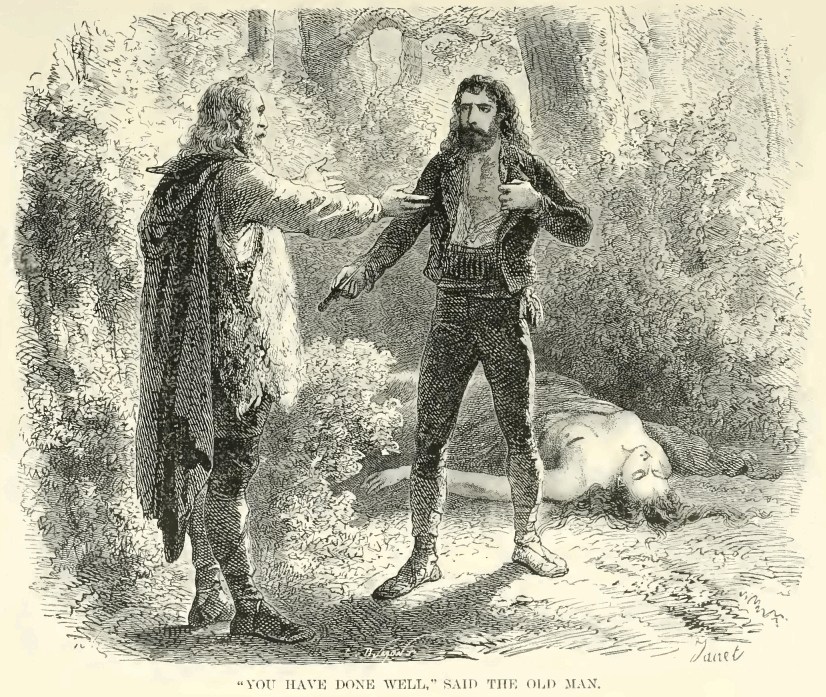
continued Carlini, ‘if I have done wrongly, avenge her;’ and
withdrawing the knife from the wound in Rita’s bosom, he held it out to
the old man with one hand, while with the other he tore open his vest.
“‘Thou hast done well!’ returned the old man in a hoarse voice;
‘embrace me, my son.’
Carlini threw himself, sobbing like a child, into the arms of his
mistress’s father. These were the first tears the man of blood had ever
wept.
“‘Now,’ said the old man, ‘aid me to bury my child.’ Carlini fetched
two pickaxes; and the father and the lover began to dig at the foot of
a huge oak, beneath which the young girl was to repose. When the grave
was formed, the father embraced her first, and then the lover;
afterwards, one taking the head, the other the feet, they placed her in
the grave. Then they knelt on each side of the grave, and said the
prayers of the dead. Then, when they had finished, they cast the earth
over the corpse, until the grave was filled. Then, extending his hand,
the old man said; ‘I thank you, my son; and now leave me alone.’
“‘Yet——’ replied Carlini.
“‘Leave me, I command you.’
“Carlini obeyed, rejoined his comrades, folded himself in his cloak,
and soon appeared to sleep as soundly as the rest. It had been resolved
the night before to change their encampment. An hour before daybreak,
Cucumetto aroused his men, and gave the word to march. But Carlini
would not quit the forest, without knowing what had become of Rita’s
father. He went toward the place where he had left him. He found the
old man suspended from one of the branches of the oak which shaded his
daughter’s grave. He then took an oath of bitter vengeance over the
dead body of the one and the tomb of the other. But he was unable to
complete this oath, for two days afterwards, in an encounter with the
Roman carbineers, Carlini was killed. There was some surprise, however,
that, as he was with his face to the enemy, he should have received a
ball between his shoulders. That astonishment ceased when one of the
brigands remarked to his comrades that Cucumetto was stationed ten
paces in Carlini’s rear when he fell. On the morning of the departure
from the forest of Frosinone he had followed Carlini in the darkness,
and heard this oath of vengeance, and, like a wise man, anticipated it.
“They told ten other stories of this bandit chief, each more singular
than the other. Thus, from Fondi to Perusia, everyone trembles at the
name of Cucumetto.
“These narratives were frequently the theme of conversation between
Luigi and Teresa. The young girl trembled very much at hearing the
stories; but Vampa reassured her with a smile, tapping the butt of his
good fowling-piece, which threw its ball so well; and if that did not
restore her courage, he pointed to a crow, perched on some dead branch,
took aim, touched the trigger, and the bird fell dead at the foot of
the tree. Time passed on, and the two young people had agreed to be
married when Vampa should be twenty and Teresa nineteen years of age.
They were both orphans, and had only their employers’ leave to ask,
which had been already sought and obtained. One day when they were
talking over their plans for the future, they heard two or three
reports of firearms, and then suddenly a man came out of the wood, near
which the two young persons used to graze their flocks, and hurried
towards them. When he came within hearing, he exclaimed:
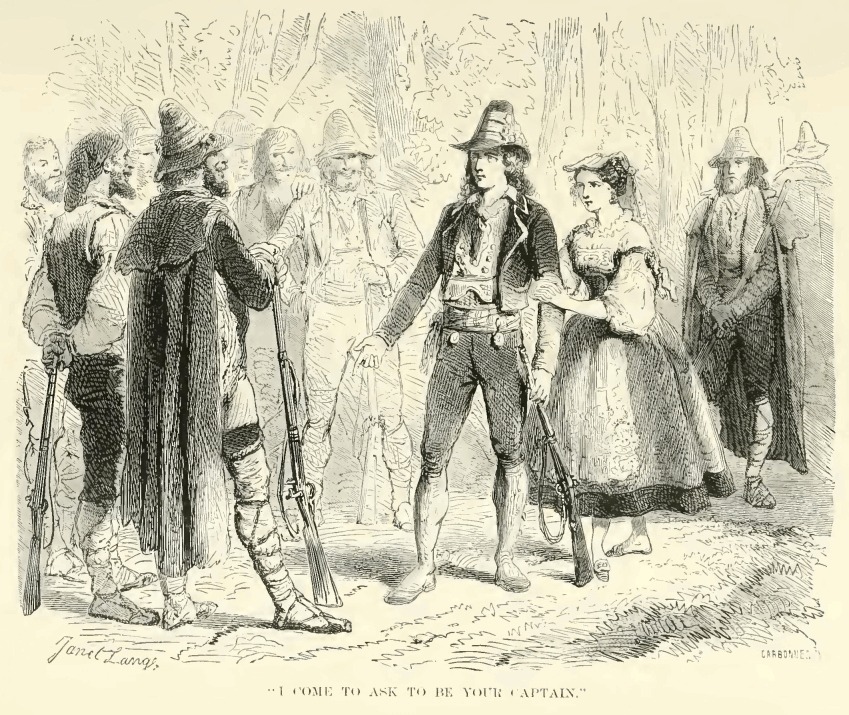
‘I am pursued; can you conceal me?’
“They knew full well that this fugitive must be a bandit; but there is
an innate sympathy between the Roman brigand and the Roman peasant and
the latter is always ready to aid the former. Vampa, without saying a
word, hastened to the stone that closed up the entrance to their
grotto, drew it away, made a sign to the fugitive to take refuge there,
in a retreat unknown to everyone, closed the stone upon him, and then
went and resumed his seat by Teresa. Instantly afterwards four
carbineers, on horseback, appeared on the edge of the wood; three of
them appeared to be looking for the fugitive, while the fourth dragged
a brigand prisoner by the neck. The three carbineers looked about
carefully on every side, saw the young peasants, and galloping up,
began to question them. They had seen no one.
“‘That is very annoying,’ said the brigadier; for the man we are
looking for is the chief.’
“‘Cucumetto?’ cried Luigi and Teresa at the same moment.
“‘Yes,’ replied the brigadier; ‘and as his head is valued at a thousand
Roman crowns, there would have been five hundred for you, if you had
helped us to catch him.’ The two young persons exchanged looks. The
brigadier had a moment’s hope. Five hundred Roman crowns are three
thousand lire, and three thousand lire are a fortune for two poor
orphans who are going to be married.
“‘Yes, it is very annoying,’ said Vampa; ‘but we have not seen him.’
“Then the carbineers scoured the country in different directions, but
in vain; then, after a time, they disappeared. Vampa then removed the
stone, and Cucumetto came out. Through the crevices in the granite he
had seen the two young peasants talking with the carbineers, and
guessed the subject of their parley. He had read in the countenances of
Luigi and Teresa their steadfast resolution not to surrender him, and
he drew from his pocket a purse full of gold, which he offered to them.
But Vampa raised his head proudly; as to Teresa, her eyes sparkled when
she thought of all the fine gowns and gay jewellery she could buy with
this purse of gold.
“Cucumetto was a cunning fiend, and had assumed the form of a brigand
instead of a serpent, and this look from Teresa showed to him that she
was a worthy daughter of Eve, and he returned to the forest, pausing
several times on his way, under the pretext of saluting his protectors.
“Several days elapsed, and they neither saw nor heard of Cucumetto. The
time of the Carnival was at hand. The Count of San-Felice announced a
grand masked ball, to which all that were distinguished in Rome were
invited. Teresa had a great desire to see this ball. Luigi asked
permission of his protector, the steward, that she and he might be
present amongst the servants of the house. This was granted. The ball
was given by the Count for the particular pleasure of his daughter
Carmela, whom he adored. Carmela was precisely the age and figure of
Teresa, and Teresa was as handsome as Carmela. On the evening of the
ball Teresa was attired in her best, her most brilliant ornaments in
her hair, and gayest glass beads,—she was in the costume of the women
of Frascati. Luigi wore the very picturesque garb of the Roman peasant
at holiday time. They both mingled, as they had leave to do, with the
servants and peasants.
“The festa was magnificent; not only was the villa brilliantly
illuminated, but thousands of colored lanterns were suspended from the
trees in the garden; and very soon the palace overflowed to the
terraces, and the terraces to the garden-walks. At each cross-path was
an orchestra, and tables spread with refreshments; the guests stopped,
formed quadrilles, and danced in any part of the grounds they pleased.
Carmela was attired like a woman of Sonnino. Her cap was embroidered
with pearls, the pins in her hair were of gold and diamonds, her girdle
was of Turkey silk, with large embroidered flowers, her bodice and
skirt were of cashmere, her apron of Indian muslin, and the buttons of
her corset were of jewels. Two of her companions were dressed, the one
as a woman of Nettuno, and the other as a woman of La Riccia. Four
young men of the richest and noblest families of Rome accompanied them
with that Italian freedom which has not its parallel in any other
country in the world. They were attired as peasants of Albano,
Velletri, Civita-Castellana, and Sora. We need hardly add that these
peasant costumes, like those of the young women, were brilliant with
gold and jewels.
“Carmela wished to form a quadrille, but there was one lady wanting.
Carmela looked all around her, but not one of the guests had a costume
similar to her own, or those of her companions. The Count of San-Felice
pointed out Teresa, who was hanging on Luigi’s arm in a group of
peasants.
“‘Will you allow me, father?’ said Carmela.
“‘Certainly,’ replied the count, ‘are we not in Carnival time?’
“Carmela turned towards the young man who was talking with her, and
saying a few words to him, pointed with her finger to Teresa. The young
man looked, bowed in obedience, and then went to Teresa, and invited
her to dance in a quadrille directed by the count’s daughter. Teresa
felt a flush pass over her face; she looked at Luigi, who could not
refuse his assent. Luigi slowly relinquished Teresa’s arm, which he had
held beneath his own, and Teresa, accompanied by her elegant cavalier,
took her appointed place with much agitation in the aristocratic
quadrille. Certainly, in the eyes of an artist, the exact and strict
costume of Teresa had a very different character from that of Carmela
and her companions; and Teresa was frivolous and coquettish, and thus
the embroidery and muslins, the cashmere waist-girdles, all dazzled
her, and the reflection of sapphires and diamonds almost turned her
giddy brain.
“Luigi felt a sensation hitherto unknown arising in his mind. It was
like an acute pain which gnawed at his heart, and then thrilled through
his whole body. He followed with his eye each movement of Teresa and
her cavalier; when their hands touched, he felt as though he should
swoon; every pulse beat with violence, and it seemed as though a bell
were ringing in his ears. When they spoke, although Teresa listened
timidly and with downcast eyes to the conversation of her cavalier, as
Luigi could read in the ardent looks of the good-looking young man that
his language was that of praise, it seemed as if the whole world was
turning round with him, and all the voices of hell were whispering in
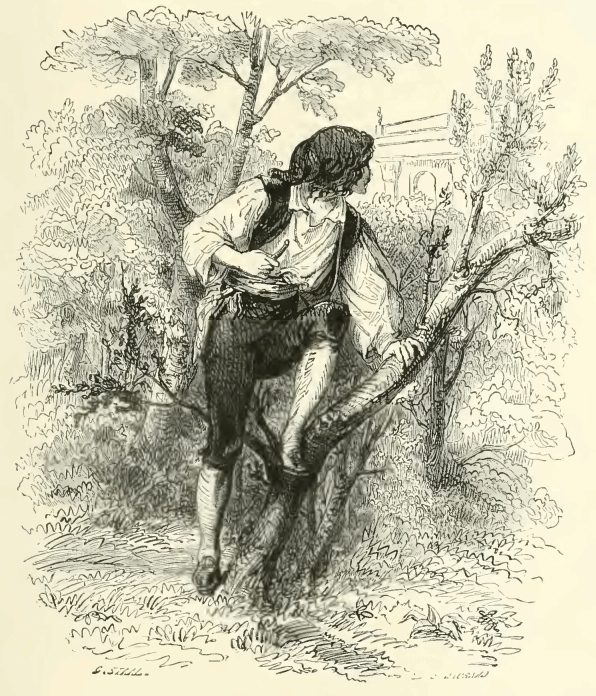
his ears ideas of murder and assassination. Then fearing that his
paroxysm might get the better of him, he clutched with one hand the
branch of a tree against which he was leaning, and with the other
convulsively grasped the dagger with a carved handle which was in his
belt, and which, unwittingly, he drew from the scabbard from time to
time.
“Luigi was jealous!
“He felt that, influenced by her ambitions and coquettish disposition,
Teresa might escape him.
“The young peasant girl, at first timid and scared, soon recovered
herself. We have said that Teresa was handsome, but this is not all;
Teresa was endowed with all those wild graces which are so much more
potent than our affected and studied elegancies. She had almost all the
honors of the quadrille, and if she were envious of the Count of
San-Felice’s daughter, we will not undertake to say that Carmela was
not jealous of her. And with overpowering compliments her handsome
cavalier led her back to the place whence he had taken her, and where
Luigi awaited her. Twice or thrice during the dance the young girl had
glanced at Luigi, and each time she saw that he was pale and that his
features were agitated, once even the blade of his knife, half drawn
from its sheath, had dazzled her eyes with its sinister glare. Thus, it
was almost tremblingly that she resumed her lover’s arm. The quadrille
had been most perfect, and it was evident there was a great demand for
a repetition, Carmela alone objecting to it, but the Count of
San-Felice besought his daughter so earnestly, that she acceded.
“One of the cavaliers then hastened to invite Teresa, without whom it
was impossible for the quadrille to be formed, but the young girl had
disappeared.
“The truth was, that Luigi had not felt the strength to support another
such trial, and, half by persuasion and half by force, he had removed
Teresa toward another part of the garden. Teresa had yielded in spite
of herself, but when she looked at the agitated countenance of the
young man, she understood by his silence and trembling voice that
something strange was passing within him. She herself was not exempt
from internal emotion, and without having done anything wrong, yet
fully comprehended that Luigi was right in reproaching her. Why, she
did not know, but yet she did not the less feel that these reproaches
were merited.
“However, to Teresa’s great astonishment, Luigi remained mute, and not
a word escaped his lips the rest of the evening. When the chill of the
night had driven away the guests from the gardens, and the gates of the
villa were closed on them for the festa in-doors, he took Teresa
quite away, and as he left her at her home, he said:
“‘Teresa, what were you thinking of as you danced opposite the young
Countess of San-Felice?’
“‘I thought,’ replied the young girl, with all the frankness of her
nature, ‘that I would give half my life for a costume such as she
wore.’
“‘And what said your cavalier to you?’
“‘He said it only depended on myself to have it, and I had only one
word to say.’
“‘He was right,’ said Luigi. ‘Do you desire it as ardently as you say?’
“‘Yes.’
“‘Well, then, you shall have it!’
“The young girl, much astonished, raised her head to look at him, but
his face was so gloomy and terrible that her words froze to her lips.
As Luigi spoke thus, he left her. Teresa followed him with her eyes
into the darkness as long as she could, and when he had quite
disappeared, she went into the house with a sigh.
“That night a memorable event occurred, due, no doubt, to the
imprudence of some servant who had neglected to extinguish the lights.
The Villa of San-Felice took fire in the rooms adjoining the very
apartment of the lovely Carmela. Awakened in the night by the light of
the flames, she sprang out of bed, wrapped herself in a dressing-gown,
and attempted to escape by the door, but the corridor by which she
hoped to fly was already a prey to the flames. She then returned to her
room, calling for help as loudly as she could, when suddenly her
window, which was twenty feet from the ground, was opened, a young
peasant jumped into the chamber, seized her in his arms, and with
superhuman skill and strength conveyed her to the turf of the
grass-plot, where she fainted. When she recovered, her father was by
her side. All the servants surrounded her, offering her assistance. An
entire wing of the villa was burnt down; but what of that, as long as
Carmela was safe and uninjured?
“Her preserver was everywhere sought for, but he did not appear; he was
inquired after, but no one had seen him. Carmela was greatly troubled
that she had not recognized him.
“As the count was immensely rich, excepting the danger Carmela had
run,—and the marvellous manner in which she had escaped, made that
appear to him rather a favor of Providence than a real misfortune,—the
loss occasioned by the conflagration was to him but a trifle.
“The next day, at the usual hour, the two young peasants were on the
borders of the forest. Luigi arrived first. He came toward Teresa in
high spirits, and seemed to have completely forgotten the events of the
previous evening. The young girl was very pensive, but seeing Luigi so
cheerful, she on her part assumed a smiling air, which was natural to
her when she was not excited or in a passion.
“Luigi took her arm beneath his own, and led her to the door of the
grotto. Then he paused. The young girl, perceiving that there was
something extraordinary, looked at him steadfastly.
“‘Teresa,’ said Luigi, ‘yesterday evening you told me you would give
all the world to have a costume similar to that of the count’s
daughter.’
“‘Yes,’ replied Teresa with astonishment; ‘but I was mad to utter such
a wish.’
“‘And I replied, “Very well, you shall have it.”’
“‘Yes,’ replied the young girl, whose astonishment increased at every
word uttered by Luigi, ‘but of course your reply was only to please
me.’
“‘I have promised no more than I have given you, Teresa,’ said Luigi
proudly. ‘Go into the grotto and dress yourself.’
“At these words he drew away the stone, and showed Teresa the grotto,
lighted up by two wax lights, which burnt on each side of a splendid
mirror; on a rustic table, made by Luigi, were spread out the pearl
necklace and the diamond pins, and on a chair at the side was laid the
rest of the costume.
“Teresa uttered a cry of joy, and, without inquiring whence this attire
came, or even thanking Luigi, darted into the grotto, transformed into
a dressing-room.
“Luigi pushed the stone behind her, for on the crest of a small
adjacent hill which cut off the view toward Palestrina, he saw a
traveller on horseback, stopping a moment, as if uncertain of his road,
and thus presenting against the blue sky that perfect outline which is
peculiar to distant objects in southern climes. When he saw Luigi, he
put his horse into a gallop and advanced toward him.
“Luigi was not mistaken. The traveller, who was going from Palestrina
to Tivoli, had mistaken his way; the young man directed him; but as at
a distance of a quarter of a mile the road again divided into three
ways, and on reaching these the traveller might again stray from his
route, he begged Luigi to be his guide.
“Luigi threw his cloak on the ground, placed his carbine on his
shoulder, and freed from his heavy covering, preceded the traveller
with the rapid step of a mountaineer, which a horse can scarcely keep
up with. In ten minutes Luigi and the traveller reached the
cross-roads. On arriving there, with an air as majestic as that of an
emperor, he stretched his hand towards that one of the roads which the
traveller was to follow.
“‘That is your road, excellency, and now you cannot again mistake.’
“‘And here is your recompense,’ said the traveller, offering the young
herdsman some small pieces of money.
“‘Thank you,’ said Luigi, drawing back his hand; ‘I render a service, I
do not sell it.’
“‘Well,’ replied the traveller, who seemed used to this difference
between the servility of a man of the cities and the pride of the
mountaineer, ‘if you refuse wages, you will, perhaps, accept a gift.’
“‘Ah, yes, that is another thing.’
“‘Then,’ said the traveller, ‘take these two Venetian sequins and give
them to your bride, to make herself a pair of earrings.’
“‘And then do you take this poniard,’ said the young herdsman; ‘you
will not find one better carved between Albano and Civita-Castellana.’
“‘I accept it,’ answered the traveller, ‘but then the obligation will
be on my side, for this poniard is worth more than two sequins.’
“‘For a dealer perhaps; but for me, who engraved it myself, it is
hardly worth a piastre.’
“‘What is your name?’ inquired the traveller.
“‘Luigi Vampa,’ replied the shepherd, with the same air as he would
have replied, Alexander, King of Macedon. ‘And yours?’
“‘I,’ said the traveller, ‘am called Sinbad the Sailor.’”
Franz d’Épinay started with surprise.
“Sinbad the Sailor?” he said.
“Yes,” replied the narrator; “that was the name which the traveller
gave to Vampa as his own.”
“Well, and what may you have to say against this name?” inquired
Albert; “it is a very pretty name, and the adventures of the gentleman
of that name amused me very much in my youth, I must confess.”
Franz said no more. The name of Sinbad the Sailor, as may well be
supposed, awakened in him a world of recollections, as had the name of
the Count of Monte Cristo on the previous evening.
“Proceed!” said he to the host.
“Vampa put the two sequins haughtily into his pocket, and slowly
returned by the way he had gone. As he came within two or three hundred
paces of the grotto, he thought he heard a cry. He listened to know
whence this sound could proceed. A moment afterwards he thought he
heard his own name pronounced distinctly.
“The cry proceeded from the grotto. He bounded like a chamois, cocking
his carbine as he went, and in a moment reached the summit of a hill
opposite to that on which he had perceived the traveller. Three cries
for help came more distinctly to his ear. He cast his eyes around him
and saw a man carrying off Teresa, as Nessus, the centaur, carried
Deianira.
“This man, who was hastening towards the wood, was already
three-quarters of the way on the road from the grotto to the forest.
Vampa measured the distance; the man was at least two hundred paces in
advance of him, and there was not a chance of overtaking him. The young
shepherd stopped, as if his feet had been rooted to the ground; then he
put the butt of his carbine to his shoulder, took aim at the ravisher,
followed him for a second in his track, and then fired.
“The ravisher stopped suddenly, his knees bent under him, and he fell
with Teresa in his arms. The young girl rose instantly, but the man lay
on the earth struggling in the agonies of death. Vampa then rushed
towards Teresa; for at ten paces from the dying man her legs had failed
her, and she had dropped on her knees, so that the young man feared
that the ball that had brought down his enemy, had also wounded his
betrothed.
“Fortunately, she was unscathed, and it was fright alone that had
overcome Teresa. When Luigi had assured himself that she was safe and
unharmed, he turned towards the wounded man. He had just expired, with
clenched hands, his mouth in a spasm of agony, and his hair on end in
the sweat of death. His eyes remained open and menacing. Vampa
approached the corpse, and recognized Cucumetto.
“From the day on which the bandit had been saved by the two young
peasants, he had been enamoured of Teresa, and had sworn she should be
his. From that time he had watched them, and profiting by the moment
when her lover had left her alone, had carried her off, and believed he
at length had her in his power, when the ball, directed by the unerring
skill of the young herdsman, had pierced his heart. Vampa gazed on him
for a moment without betraying the slightest emotion; while, on the
contrary, Teresa, shuddering in every limb, dared not approach the
slain ruffian but by degrees, and threw a hesitating glance at the dead
body over the shoulder of her lover. Suddenly Vampa turned toward his
mistress:
“‘Ah,’ said he—‘good, good! You are dressed; it is now my turn to dress
myself.’
“Teresa was clothed from head to foot in the garb of the Count of
San-Felice’s daughter. Vampa took Cucumetto’s body in his arms and
conveyed it to the grotto, while in her turn Teresa remained outside.
If a second traveller had passed, he would have seen a strange thing,—a
shepherdess watching her flock, clad in a cashmere grown, with
ear-rings and necklace of pearls, diamond pins, and buttons of
sapphires, emeralds, and rubies. He would, no doubt, have believed that
he had returned to the times of Florian, and would have declared, on
reaching Paris, that he had met an Alpine shepherdess seated at the
foot of the Sabine Hill.
“At the end of a quarter of an hour Vampa quitted the grotto; his
costume was no less elegant than that of Teresa. He wore a vest of
garnet-colored velvet, with buttons of cut gold; a silk waistcoat
covered with embroidery; a Roman scarf tied round his neck; a
cartridge-box worked with gold, and red and green silk; sky-blue velvet
breeches, fastened above the knee with diamond buckles; garters of
deerskin, worked with a thousand arabesques, and a hat whereon hung
ribbons of all colors; two watches hung from his girdle, and a splendid
poniard was in his belt.
“Teresa uttered a cry of admiration. Vampa in this attire resembled a
painting by Léopold Robert or Schnetz. He had assumed the entire
costume of Cucumetto. The young man saw the effect produced on his
betrothed, and a smile of pride passed over his lips.
“‘Now,’ he said to Teresa, ‘are you ready to share my fortune, whatever
it may be?’
“‘Oh, yes!’ exclaimed the young girl enthusiastically.
“‘And follow me wherever I go?’
“‘To the world’s end.’
“‘Then take my arm, and let us on; we have no time to lose.’
“The young girl did so without questioning her lover as to where he was
conducting her, for he appeared to her at this moment as handsome,
proud, and powerful as a god. They went towards the forest, and soon
entered it.
“We need scarcely say that all the paths of the mountain were known to
Vampa; he therefore went forward without a moment’s hesitation,
although there was no beaten track, but he knew his path by looking at
the trees and bushes, and thus they kept on advancing for nearly an
hour and a half. At the end of this time they had reached the thickest
part of the forest. A torrent, whose bed was dry, led into a deep
gorge. Vampa took this wild road, which, enclosed between two ridges,
and shadowed by the tufted umbrage of the pines, seemed, but for the
difficulties of its descent, that path to Avernus of which Virgil
speaks. Teresa had become alarmed at the wild and deserted look of the
plain around her, and pressed closely against her guide, not uttering a
syllable; but as she saw him advance with even step and composed
countenance, she endeavored to repress her emotion.
“Suddenly, about ten paces from them, a man advanced from behind a tree
and aimed at Vampa.
“‘Not another step,’ he said, ‘or you are a dead man.’
“‘What, then,’ said Vampa, raising his hand with a gesture of disdain,
while Teresa, no longer able to restrain her alarm, clung closely to
him, ‘do wolves rend each other?’
“‘Who are you?’ inquired the sentinel.
“‘I am Luigi Vampa, shepherd of the San-Felice farm.’
“‘What do you want?’
“‘I would speak with your companions who are in the glade at Rocca
Bianca.’
“‘Follow me, then,’ said the sentinel; ‘or, as you know your way, go
first.’
“Vampa smiled disdainfully at this precaution on the part of the
bandit, went before Teresa, and continued to advance with the same firm
and easy step as before. At the end of ten minutes the bandit made them
a sign to stop. The two young persons obeyed. Then the bandit thrice
imitated the cry of a crow; a croak answered this signal.
“‘Good!’ said the sentry, ‘you may now go on.’
“Luigi and Teresa again set forward; as they went on Teresa clung
tremblingly to her lover at the sight of weapons and the glistening of
carbines through the trees. The retreat of Rocca Bianca was at the top
of a small mountain, which no doubt in former days had been a
volcano—an extinct volcano before the days when Remus and Romulus had
deserted Alba to come and found the city of Rome.
“Teresa and Luigi reached the summit, and all at once found themselves
in the presence of twenty bandits.
“‘Here is a young man who seeks and wishes to speak to you,’ said the
sentinel.
“‘What has he to say?’ inquired the young man who was in command in the
chief’s absence.
“‘I wish to say that I am tired of a shepherd’s life,’ was Vampa’s
reply.
“‘Ah, I understand,’ said the lieutenant; ‘and you seek admittance into
our ranks?’
“‘Welcome!’ cried several bandits from Ferrusino, Pampinara, and
Anagni, who had recognized Luigi Vampa.
“‘Yes, but I came to ask something more than to be your companion.’
“‘And what may that be?’ inquired the bandits with astonishment.
“‘I come to ask to be your captain,’ said the young man.
“The bandits shouted with laughter.
“‘And what have you done to aspire to this honor?’ demanded the
lieutenant.
“‘I have killed your chief, Cucumetto, whose dress I now wear; and I
set fire to the villa San-Felice to procure a wedding-dress for my
betrothed.’
“An hour afterwards Luigi Vampa was chosen captain, vice Cucumetto,
deceased.”
“Well, my dear Albert,” said Franz, turning towards his friend; “what
think you of citizen Luigi Vampa?”
“I say he is a myth,” replied Albert, “and never had an existence.”
“And what may a myth be?” inquired Pastrini.
“The explanation would be too long, my dear landlord,” replied Franz.
“And you say that Signor Vampa exercises his profession at this moment
in the environs of Rome?”
“And with a boldness of which no bandit before him ever gave an
example.”
“Then the police have vainly tried to lay hands on him?”
“Why, you see, he has a good understanding with the shepherds in the
plains, the fishermen of the Tiber, and the smugglers of the coast.
They seek for him in the mountains, and he is on the waters; they
follow him on the waters, and he is on the open sea; then they pursue
him, and he has suddenly taken refuge in the islands, at Giglio,
Giannutri, or Monte Cristo; and when they hunt for him there, he
reappears suddenly at Albano, Tivoli, or La Riccia.”
“And how does he behave towards travellers?”
“Alas! his plan is very simple. It depends on the distance he may be
from the city, whether he gives eight hours, twelve hours, or a day
wherein to pay their ransom; and when that time has elapsed he allows
another hour’s grace. At the sixtieth minute of this hour, if the money
is not forthcoming, he blows out the prisoner’s brains with a
pistol-shot, or plants his dagger in his heart, and that settles the
account.”
“Well, Albert,” inquired Franz of his companion, “are you still
disposed to go to the Colosseum by the outer wall?”
“Quite so,” said Albert, “if the way be picturesque.”
The clock struck nine as the door opened, and a coachman appeared.
“Excellencies,” said he, “the coach is ready.”
“Well, then,” said Franz, “let us to the Colosseum.”
“By the Porta del Popolo or by the streets, your excellencies?”
“By the streets, morbleu! by the streets!” cried Franz.
“Ah, my dear fellow,” said Albert, rising, and lighting his third
cigar, “really, I thought you had more courage.”
So saying, the two young men went down the staircase, and got into the
carriage.
20131m
Chapter XXXIV
The Apparition
Franz had so managed his route, that during the ride to the Colosseum
they passed not a single ancient ruin, so that no preliminary
impression interfered to mitigate the colossal proportions of the
gigantic building they came to admire. The road selected was a
continuation of the Via Sistina; then by cutting off the right angle of
the street in which stands Santa Maria Maggiore and proceeding by the
Via Urbana and San Pietro in Vincoli, the travellers would find
themselves directly opposite the Colosseum.
This itinerary possessed another great advantage,—that of leaving Franz
at full liberty to indulge his deep reverie upon the subject of Signor
Pastrini’s story, in which his mysterious host of Monte Cristo was so
strangely mixed up. Seated with folded arms in a corner of the
carriage, he continued to ponder over the singular history he had so
lately listened to, and to ask himself an interminable number of
questions touching its various circumstances without, however, arriving
at a satisfactory reply to any of them.
One fact more than the rest brought his friend “Sinbad the Sailor” back
to his recollection, and that was the mysterious sort of intimacy that
seemed to exist between the brigands and the sailors; and Pastrini’s
account of Vampa’s having found refuge on board the vessels of
smugglers and fishermen, reminded Franz of the two Corsican bandits he
had found supping so amicably with the crew of the little yacht, which
had even deviated from its course and touched at Porto-Vecchio for the
sole purpose of landing them. The very name assumed by his host of
Monte Cristo and again repeated by the landlord of the Hôtel de
Londres, abundantly proved to him that his island friend was playing
his philanthropic part on the shores of Piombino, Civita Vecchia,
Ostia, and Gaëta, as on those of Corsica, Tuscany, and Spain; and
further, Franz bethought him of having heard his singular entertainer
speak both of Tunis and Palermo, proving thereby how largely his circle
of acquaintances extended.
But however the mind of the young man might be absorbed in these
reflections, they were at once dispersed at the sight of the dark
frowning ruins of the stupendous Colosseum, through the various
openings of which the pale moonlight played and flickered like the
unearthly gleam from the eyes of the wandering dead. The carriage
stopped near the Meta Sudans; the door was opened, and the young men,
eagerly alighting, found themselves opposite a cicerone, who appeared
to have sprung up from the ground, so unexpected was his appearance.
The usual guide from the hotel having followed them, they had paid two
conductors, nor is it possible, at Rome, to avoid this abundant supply
of guides; besides the ordinary cicerone, who seizes upon you
directly you set foot in your hotel, and never quits you while you
remain in the city, there is also a special cicerone belonging to
each monument—nay, almost to each part of a monument. It may,
therefore, be easily imagined there is no scarcity of guides at the
Colosseum, that wonder of all ages, which Martial thus eulogizes:
“Let Memphis cease to boast the barbarous miracles of her pyramids, and
the wonders of Babylon be talked of no more among us; all must bow to
the superiority of the gigantic labor of the Cæsars, and the many
voices of Fame spread far and wide the surpassing merits of this
incomparable monument.”
As for Albert and Franz, they essayed not to escape from their
ciceronian tyrants; and, indeed, it would have been so much the more
difficult to break their bondage, as the guides alone are permitted to
visit these monuments with torches in their hands. Thus, then, the
young men made no attempt at resistance, but blindly and confidingly
surrendered themselves into the care and custody of their conductors.
Franz had already made seven or eight similar excursions to the
Colosseum, while his less favored companion trod for the first time in
his life the classic ground forming the monument of Flavius Vespasian;
and, to his credit be it spoken, his mind, even amid the glib loquacity
of the guides, was duly and deeply touched with awe and enthusiastic
admiration of all he saw; and certainly no adequate notion of these
stupendous ruins can be formed save by such as have visited them, and
more especially by moonlight, at which time the vast proportions of the
building appear twice as large when viewed by the mysterious beams of a
southern moonlit sky, whose rays are sufficiently clear and vivid to
light the horizon with a glow equal to the soft twilight of a western
clime.
Scarcely, therefore, had the reflective Franz walked a hundred steps
beneath the interior porticoes of the ruin, when, abandoning Albert to
the guides (who would by no means yield their prescriptive right of
carrying their victims through the routine regularly laid down, and as
regularly followed by them, but dragged the unconscious visitor to the
various objects with a pertinacity that admitted of no appeal,
beginning, as a matter of course, with the “Lions’ Den”, the “Hall of
the Gladiators” and finishing with “Cæsar’s Podium”), to escape a
jargon and mechanical survey of the wonders by which he was surrounded,
Franz ascended a half-dilapidated staircase, and, leaving them to
follow their monotonous round, seated himself at the foot of a column,
and immediately opposite a large aperture, which permitted him to enjoy
a full and undisturbed view of the gigantic dimensions of the majestic
ruin.
Franz had remained for nearly a quarter of an hour perfectly hidden by
the shadow of the vast column at whose base he had found a
resting-place, and from whence his eyes followed the motions of Albert
and his guides, who, holding torches in their hands, had emerged from a
vomitorium at the opposite extremity of the Colosseum, and then again
disappeared down the steps conducting to the seats reserved for the
Vestal virgins, resembling, as they glided along, some restless shades
following the flickering glare of so many ignes fatui. All at once
his ear caught a sound resembling that of a stone rolling down the
staircase opposite the one by which he had himself ascended. There was
nothing remarkable in the circumstance of a fragment of granite giving
way and falling heavily below; but it seemed to him that the substance
that fell gave way beneath the pressure of a foot, and also that
someone, who endeavored as much as possible to prevent his footsteps
from being heard, was approaching the spot where he sat.
Conjecture soon became certainty, for the figure of a man was
distinctly visible to Franz, gradually emerging from the staircase
opposite, upon which the moon was at that moment pouring a full tide of
silvery brightness.
The stranger thus presenting himself was probably a person who, like
Franz, preferred the enjoyment of solitude and his own thoughts to the
frivolous gabble of the guides. And his appearance had nothing
extraordinary in it; but the hesitation with which he proceeded,
stopping and listening with anxious attention at every step he took,
convinced Franz that he expected the arrival of some person.
By a sort of instinctive impulse, Franz withdrew as much as possible
behind his pillar.
About ten feet from the spot where he and the stranger were, the roof
had given way, leaving a large round opening, through which might be
seen the blue vault of heaven, thickly studded with stars.
Around this opening, which had, possibly, for ages permitted a free
entrance to the brilliant moonbeams that now illumined the vast pile,
grew a quantity of creeping plants, whose delicate green branches stood
out in bold relief against the clear azure of the firmament, while
large masses of thick, strong fibrous shoots forced their way through
the chasm, and hung floating to and fro, like so many waving strings.
The person whose mysterious arrival had attracted the attention of
Franz stood in a kind of half-light, that rendered it impossible to
distinguish his features, although his dress was easily made out. He
wore a large brown mantle, one fold of which, thrown over his left
shoulder, served likewise to mask the lower part of his countenance,
while the upper part was completely hidden by his broad-brimmed hat.
The lower part of his dress was more distinctly visible by the bright
rays of the moon, which, entering through the broken ceiling, shed
their refulgent beams on feet cased in elegantly made boots of polished
leather, over which descended fashionably cut trousers of black cloth.
From the imperfect means Franz had of judging, he could only come to
one conclusion,—that the person whom he was thus watching certainly
belonged to no inferior station of life.
Some few minutes had elapsed, and the stranger began to show manifest
signs of impatience, when a slight noise was heard outside the aperture
in the roof, and almost immediately a dark shadow seemed to obstruct
the flood of light that had entered it, and the figure of a man was
clearly seen gazing with eager scrutiny on the immense space beneath
him; then, as his eye caught sight of him in the mantle, he grasped a
floating mass of thickly matted boughs, and glided down by their help
to within three or four feet of the ground, and then leaped lightly on
his feet. The man who had performed this daring act with so much
indifference wore the Transtevere costume.
“I beg your excellency’s pardon for keeping you waiting,” said the man,
in the Roman dialect, “but I don’t think I’m many minutes after my
time, ten o’clock has just struck by the clock of Saint John Lateran.”
“Say not a word about being late,” replied the stranger in purest
Tuscan; “’tis I who am too soon. But even if you had caused me to wait
a little while, I should have felt quite sure that the delay was not
occasioned by any fault of yours.”
“Your excellency is perfectly right in so thinking,” said the man; “I
came here direct from the Castle of St. Angelo, and I had an immense
deal of trouble before I could get a chance to speak to Beppo.”
“And who is Beppo?”
“Oh, Beppo is employed in the prison, and I give him so much a year to
let me know what is going on within his holiness’s castle.”
“Indeed! You are a provident person, I see.”
“Why, you see, no one knows what may happen. Perhaps some of these days
I may be entrapped, like poor Peppino and may be very glad to have some
little nibbling mouse to gnaw the meshes of my net, and so help me out
of prison.”
“Briefly, what did you learn?”
“That two executions of considerable interest will take place the day
after tomorrow at two o’clock, as is customary at Rome at the
commencement of all great festivals. One of the culprits will be
mazzolato;3 he is an atrocious villain, who murdered the priest who
brought him up, and deserves not the smallest pity. The other sufferer
is sentenced to be decapitato;4 and he, your excellency, is poor
Peppino.”
“The fact is, that you have inspired not only the pontifical
government, but also the neighboring states, with such extreme fear,
that they are glad of all opportunity of making an example.”
“But Peppino did not even belong to my band; he was merely a poor
shepherd, whose only crime consisted in furnishing us with provisions.”
“Which makes him your accomplice to all intents and purposes. But mark
the distinction with which he is treated; instead of being knocked on
the head as you would be if once they caught hold of you, he is simply
sentenced to be guillotined, by which means, too, the amusements of the
day are diversified, and there is a spectacle to please every
spectator.”
“Without reckoning the wholly unexpected one I am preparing to surprise
them with.”
“My good friend,” said the man in the cloak, “excuse me for saying that
you seem to me precisely in the mood to commit some wild or extravagant
act.”
“Perhaps I am; but one thing I have resolved on, and that is, to stop
at nothing to restore a poor devil to liberty, who has got into this
scrape solely from having served me. I should hate and despise myself
as a coward did I desert the brave fellow in his present extremity.”
“And what do you mean to do?”
“To surround the scaffold with twenty of my best men, who, at a signal
from me, will rush forward directly Peppino is brought for execution,
and, by the assistance of their stilettos, drive back the guard, and
carry off the prisoner.”
“That seems to me as hazardous as uncertain, and convinces me that my
scheme is far better than yours.”
“And what is your excellency’s project?”
“Just this. I will so advantageously bestow 2,000 piastres, that the
person receiving them shall obtain a respite till next year for
Peppino; and during that year, another skilfully placed 1,000 piastres
will afford him the means of escaping from his prison.”
“And do you feel sure of succeeding?”
“Pardieu!” exclaimed the man in the cloak, suddenly expressing
himself in French.
“What did your excellency say?” inquired the other.
“I said, my good fellow, that I would do more single-handed by the
means of gold than you and all your troop could effect with stilettos,
pistols, carbines, and blunderbusses included. Leave me, then, to act,
and have no fears for the result.”
“At least, there can be no harm in myself and party being in readiness,
in case your excellency should fail.”
“None whatever. Take what precautions you please, if it is any
satisfaction to you to do so; but rely upon my obtaining the reprieve I
seek.”
“Remember, the execution is fixed for the day after tomorrow, and that
you have but one day to work in.”
“And what of that? Is not a day divided into twenty-four hours, each
hour into sixty minutes, and every minute sub-divided into sixty
seconds? Now in 86,400 seconds very many things can be done.”
“And how shall I know whether your excellency has succeeded or not.”
“Oh, that is very easily arranged. I have engaged the three lower
windows at the Café Rospoli; should I have obtained the requisite
pardon for Peppino, the two outside windows will be hung with yellow
damasks, and the centre with white, having a large cross in red marked
on it.”
“And whom will you employ to carry the reprieve to the officer
directing the execution?”
“Send one of your men, disguised as a penitent friar, and I will give
it to him. His dress will procure him the means of approaching the
scaffold itself, and he will deliver the official order to the officer,
who, in his turn, will hand it to the executioner; in the meantime, it
will be as well to acquaint Peppino with what we have determined on, if
it be only to prevent his dying of fear or losing his senses, because
in either case a very useless expense will have been incurred.”
“Your excellency,” said the man, “you are fully persuaded of my entire
devotion to you, are you not?”
“Nay, I flatter myself that there can be no doubt of it,” replied the
cavalier in the cloak.
“Well, then, only fulfil your promise of rescuing Peppino, and
henceforward you shall receive not only devotion, but the most absolute
obedience from myself and those under me that one human being can
render to another.”
“Have a care how far you pledge yourself, my good friend, for I may
remind you of your promise at some, perhaps, not very distant period,
when I, in my turn, may require your aid and influence.”
“Let that day come sooner or later, your excellency will find me what I
have found you in this my heavy trouble; and if from the other end of
the world you but write me word to do such or such a thing, you may
regard it as done, for done it shall be, on the word and faith of——”
“Hush!” interrupted the stranger; “I hear a noise.”
“’Tis some travellers, who are visiting the Colosseum by torchlight.”
“’Twere better we should not be seen together; those guides are nothing
but spies, and might possibly recognize you; and, however I may be
honored by your friendship, my worthy friend, if once the extent of our
intimacy were known, I am sadly afraid both my reputation and credit
would suffer thereby.”
“Well, then, if you obtain the reprieve?”
“The middle window at the Café Rospoli will be hung with white damask,
bearing a red cross.”
“And if you fail?”
“Then all three windows will have yellow draperies.”
“And then?”
“And then, my good fellow, use your daggers in any way you please, and
I further promise you to be there as a spectator of your prowess.”
“We understand each other perfectly, then. Adieu, your excellency;
depend upon me as firmly as I do upon you.”
Saying these words, the Transteverin disappeared down the staircase,
while his companion, muffling his features more closely than before in
the folds of his mantle, passed almost close to Franz, and descended to
the arena by an outward flight of steps. The next minute Franz heard
himself called by Albert, who made the lofty building re-echo with the
sound of his friend’s name. Franz, however, did not obey the summons
till he had satisfied himself that the two men whose conversation he
had overheard were at a sufficient distance to prevent his encountering
them in his descent. In ten minutes after the strangers had departed,
Franz was on the road to the Piazza di Spagna, listening with studied
indifference to the learned dissertation delivered by Albert, after the
manner of Pliny and Calpurnius, touching the iron-pointed nets used to
prevent the ferocious beasts from springing on the spectators.
Franz let him proceed without interruption, and, in fact, did not hear
what was said; he longed to be alone, and free to ponder over all that
had occurred. One of the two men, whose mysterious meeting in the
Colosseum he had so unintentionally witnessed, was an entire stranger
to him, but not so the other; and though Franz had been unable to
distinguish his features, from his being either wrapped in his mantle
or obscured by the shadow, the tones of his voice had made too powerful
an impression on him the first time he had heard them for him ever
again to forget them, hear them when or where he might. It was more
especially when this man was speaking in a manner half jesting, half
bitter, that Franz’s ear recalled most vividly the deep sonorous, yet
well-pitched voice that had addressed him in the grotto of Monte
Cristo, and which he heard for the second time amid the darkness and
ruined grandeur of the Colosseum. And the more he thought, the more
entire was his conviction, that the person who wore the mantle was no
other than his former host and entertainer, “Sinbad the Sailor.”
Under any other circumstances, Franz would have found it impossible to
resist his extreme curiosity to know more of so singular a personage,
and with that intent have sought to renew their short acquaintance; but
in the present instance, the confidential nature of the conversation he
had overheard made him, with propriety, judge that his appearance at
such a time would be anything but agreeable. As we have seen,
therefore, he permitted his former host to retire without attempting a
recognition, but fully promising himself a rich indemnity for his
present forbearance should chance afford him another opportunity.
In vain did Franz endeavor to forget the many perplexing thoughts which
assailed him; in vain did he court the refreshment of sleep. Slumber
refused to visit his eyelids and the night was passed in feverish
contemplation of the chain of circumstances tending to prove the
identity of the mysterious visitant to the Colosseum with the
inhabitant of the grotto of Monte Cristo; and the more he thought, the
firmer grew his opinion on the subject.
Worn out at length, he fell asleep at daybreak, and did not awake till
late. Like a genuine Frenchman, Albert had employed his time in
arranging for the evening’s diversion; he had sent to engage a box at
the Teatro Argentina; and Franz, having a number of letters to write,
relinquished the carriage to Albert for the whole of the day.
At five o’clock Albert returned, delighted with his day’s work; he had
been occupied in leaving his letters of introduction, and had received
in return more invitations to balls and routs than it would be possible
for him to accept; besides this, he had seen (as he called it) all the
remarkable sights at Rome. Yes, in a single day he had accomplished
what his more serious-minded companion would have taken weeks to
effect. Neither had he neglected to ascertain the name of the piece to
be played that night at the Teatro Argentina, and also what performers
appeared in it. The opera of Parisina was announced for
representation, and the principal actors were Coselli, Moriani, and La
Specchia.
The young men, therefore, had reason to consider themselves fortunate
in having the opportunity of hearing one of the best works by the
composer of Lucia di Lammermoor, supported by three of the most
renowned vocalists of Italy.
Albert had never been able to endure the Italian theatres, with their
orchestras from which it is impossible to see, and the absence of
balconies, or open boxes; all these defects pressed hard on a man who
had had his stall at the Bouffes, and had shared a lower box at the
Opera. Still, in spite of this, Albert displayed his most dazzling and
effective costumes each time he visited the theatres; but, alas, his
elegant toilet was wholly thrown away, and one of the most worthy
representatives of Parisian fashion had to carry with him the
mortifying reflection that he had nearly overrun Italy without meeting
with a single adventure.
Sometimes Albert would affect to make a joke of his want of success;
but internally he was deeply wounded, and his self-love immensely
piqued, to think that Albert de Morcerf, the most admired and most
sought after of any young person of his day, should thus be passed
over, and merely have his labor for his pains. And the thing was so
much the more annoying, as, according to the characteristic modesty of
a Frenchman, Albert had quitted Paris with the full conviction that he
had only to show himself in Italy to carry all before him, and that
upon his return he should astonish the Parisian world with the recital
of his numerous love-affairs.
Alas, poor Albert! None of those interesting adventures fell in his
way; the lovely Genoese, Florentines, and Neapolitans were all
faithful, if not to their husbands, at least to their lovers, and
thought not of changing even for the splendid appearance of Albert de
Morcerf; and all he gained was the painful conviction that the ladies
of Italy have this advantage over those of France, that they are
faithful even in their infidelity.
Yet he could not restrain a hope that in Italy, as elsewhere, there
might be an exception to the general rule.
Albert, besides being an elegant, well-looking young man, was also
possessed of considerable talent and ability; moreover, he was a
viscount—a recently created one, certainly, but in the present day it
is not necessary to go as far back as Noah in tracing a descent, and a
genealogical tree is equally estimated, whether dated from 1399 or
merely 1815; but to crown all these advantages, Albert de Morcerf
commanded an income of 50,000 livres, a more than sufficient sum to
render him a personage of considerable importance in Paris. It was
therefore no small mortification to him to have visited most of the
principal cities in Italy without having excited the most trifling
observation.
Albert, however, hoped to indemnify himself for all these slights and
indifferences during the Carnival, knowing full well that among the
different states and kingdoms in which this festivity is celebrated,
Rome is the spot where even the wisest and gravest throw off the usual
rigidity of their lives, and deign to mingle in the follies of this
time of liberty and relaxation. The Carnival was to commence on the
morrow; therefore Albert had not an instant to lose in setting forth
the programme of his hopes, expectations, and claims to notice.
With this design he had engaged a box in the most conspicuous part of
the theatre, and exerted himself to set off his personal attractions by
the aid of the most rich and elaborate toilet. The box taken by Albert
was in the first circle; although each of the three tiers of boxes is
deemed equally aristocratic, and is, for this reason, generally styled
the “nobility’s boxes,” and although the box engaged for the two
friends was sufficiently capacious to contain at least a dozen persons,
it had cost less than would be paid at some of the French theatres for
one admitting merely four occupants.
Another motive had influenced Albert’s selection of his seat,—who knew
but that, thus advantageously placed, he might not in truth attract the
notice of some fair Roman, and an introduction might ensue that would
procure him the offer of a seat in a carriage, or a place in a princely
balcony, from which he might behold the gayeties of the Carnival?
These united considerations made Albert more lively and anxious to
please than he had hitherto been. Totally disregarding the business of
the stage, he leaned from his box and began attentively scrutinizing
the beauty of each pretty woman, aided by a powerful opera-glass; but,
alas, this attempt to attract notice wholly failed; not even curiosity
had been excited, and it was but too apparent that the lovely
creatures, into whose good graces he was desirous of stealing, were all
so much engrossed with themselves, their lovers, or their own thoughts,
that they had not so much as noticed him or the manipulation of his
glass.
The truth was, that the anticipated pleasures of the Carnival, with the
“Holy Week” that was to succeed it, so filled every fair breast, as to
prevent the least attention being bestowed even on the business of the
stage. The actors made their entries and exits unobserved or unthought
of; at certain conventional moments, the spectators would suddenly
cease their conversation, or rouse themselves from their musings, to
listen to some brilliant effort of Moriani’s, a well-executed
recitative by Coselli, or to join in loud applause at the wonderful
powers of La Specchia; but that momentary excitement over, they quickly
relapsed into their former state of preoccupation or interesting
conversation.
Towards the close of the first act, the door of a box which had been
hitherto vacant was opened; a lady entered to whom Franz had been
introduced in Paris, where indeed, he had imagined she still was. The
quick eye of Albert caught the involuntary start with which his friend
beheld the new arrival, and, turning to him, he said hastily:
“Do you know the woman who has just entered that box?”
“Yes; what do you think of her?”
“Oh, she is perfectly lovely—what a complexion! And such magnificent
hair! Is she French?”
“No; a Venetian.”
“And her name is——”
“Countess G——.”
“Ah, I know her by name!” exclaimed Albert; “she is said to possess as
much wit and cleverness as beauty. I was to have been presented to her
when I met her at Madame Villefort’s ball.”
“Shall I assist you in repairing your negligence?” asked Franz.
“My dear fellow, are you really on such good terms with her as to
venture to take me to her box?”
“Why, I have only had the honor of being in her society and conversing
with her three or four times in my life; but you know that even such an
acquaintance as that might warrant my doing what you ask.”
At that instant, the countess perceived Franz, and graciously waved her
hand to him, to which he replied by a respectful inclination of the
head. “Upon my word,” said Albert, “you seem to be on excellent terms
with the beautiful countess.”
“You are mistaken in thinking so,” returned Franz calmly; “but you
merely fall into the same error which leads so many of our countrymen
to commit the most egregious blunders,—I mean that of judging the
habits and customs of Italy and Spain by our Parisian notions; believe
me, nothing is more fallacious than to form any estimate of the degree
of intimacy you may suppose existing among persons by the familiar
terms they seem upon; there is a similarity of feeling at this instant
between ourselves and the countess—nothing more.”
“Is there, indeed, my good fellow? Pray tell me, is it sympathy of
heart?”
“No; of taste,” continued Franz gravely.
“And in what manner has this congeniality of mind been evinced?”
“By the countess’s visiting the Colosseum, as we did last night, by
moonlight, and nearly alone.”
“You were with her, then?”
“I was.”
“And what did you say to her?”
“Oh, we talked of the illustrious dead of whom that magnificent ruin is
a glorious monument!”
“Upon my word,” cried Albert, “you must have been a very entertaining
companion alone, or all but alone, with a beautiful woman in such a
place of sentiment as the Colosseum, and yet to find nothing better to
talk about than the dead! All I can say is, if ever I should get such a
chance, the living should be my theme.”
“And you will probably find your theme ill-chosen.”
“But,” said Albert, breaking in upon his discourse, “never mind the
past; let us only remember the present. Are you not going to keep your
promise of introducing me to the fair subject of our remarks?”
“Certainly, directly the curtain falls on the stage.”
“What a confounded long time this first act lasts. I believe, on my
soul, that they never mean to finish it.”
“Oh, yes, they will; only listen to that charming finale. How
exquisitely Coselli sings his part.”
“But what an awkward, inelegant fellow he is.”
“Well, then, what do you say to La Specchia? Did you ever see anything
more perfect than her acting?”
“Why, you know, my dear fellow, when one has been accustomed to
Malibran and Sontag, such singers as these don’t make the same
impression on you they perhaps do on others.”
“At least, you must admire Moriani’s style and execution.”
“I never fancied men of his dark, ponderous appearance singing with a
voice like a woman’s.”
“My good friend,” said Franz, turning to him, while Albert continued to
point his glass at every box in the theatre, “you seem determined not
to approve; you are really too difficult to please.”
The curtain at length fell on the performances, to the infinite
satisfaction of the Viscount of Morcerf, who seized his hat, rapidly
passed his fingers through his hair, arranged his cravat and
wristbands, and signified to Franz that he was waiting for him to lead
the way.
Franz, who had mutely interrogated the countess, and received from her
a gracious smile in token that he would be welcome, sought not to
retard the gratification of Albert’s eager impatience, but began at
once the tour of the house, closely followed by Albert, who availed
himself of the few minutes required to reach the opposite side of the
theatre to settle the height and smoothness of his collar, and to
arrange the lappets of his coat. This important task was just completed
as they arrived at the countess’s box.
At the knock, the door was immediately opened, and the young man who
was seated beside the countess, in obedience to the Italian custom,
instantly rose and surrendered his place to the strangers, who, in
turn, would be expected to retire upon the arrival of other visitors.
Franz presented Albert as one of the most distinguished young men of
the day, both as regarded his position in society and extraordinary
talents; nor did he say more than the truth, for in Paris and the
circle in which the viscount moved, he was looked upon and cited as a
model of perfection. Franz added that his companion, deeply grieved at
having been prevented the honor of being presented to the countess
during her sojourn in Paris, was most anxious to make up for it, and
had requested him (Franz) to remedy the past misfortune by conducting
him to her box, and concluded by asking pardon for his presumption in
having taken it upon himself to do so.
The countess, in reply, bowed gracefully to Albert, and extended her
hand with cordial kindness to Franz; then, inviting Albert to take the
vacant seat beside her, she recommended Franz to take the next best, if
he wished to view the ballet, and pointed to the one behind her own
chair.
Albert was soon deeply engrossed in discoursing upon Paris and Parisian
matters, speaking to the countess of the various persons they both knew
there. Franz perceived how completely he was in his element; and,
unwilling to interfere with the pleasure he so evidently felt, took up
Albert’s glass, and began in his turn to survey the audience.
Sitting alone, in the front of a box immediately opposite, but situated
on the third row, was a woman of exquisite beauty, dressed in a Greek
costume, which evidently, from the ease and grace with which she wore
it, was her national attire. Behind her, but in deep shadow, was the
outline of a masculine figure; but the features of this latter
personage it was not possible to distinguish. Franz could not forbear
breaking in upon the apparently interesting conversation passing
between the countess and Albert, to inquire of the former if she knew
who was the fair Albanian opposite, since beauty such as hers was well
worthy of being observed by either sex.
“All I can tell about her,” replied the countess, “is, that she has
been at Rome since the beginning of the season; for I saw her where she
now sits the very first night of the season, and since then she has
never missed a performance. Sometimes she is accompanied by the person
who is now with her, and at others she is merely attended by a black
servant.”
“And what do you think of her personal appearance?”
“Oh, I consider her perfectly lovely—she is just my idea of what Medora
must have been.”
Franz and the countess exchanged a smile, and then the latter resumed
her conversation with Albert, while Franz returned to his previous
survey of the house and company. The curtain rose on the ballet, which
was one of those excellent specimens of the Italian school, admirably
arranged and put on the stage by Henri, who has established for himself
a great reputation throughout Italy for his taste and skill in the
choreographic art—one of those masterly productions of grace, method,
and elegance in which the whole corps de ballet, from the principal
dancers to the humblest supernumerary, are all engaged on the stage at
the same time; and a hundred and fifty persons may be seen exhibiting
the same attitude, or elevating the same arm or leg with a simultaneous
movement, that would lead you to suppose that but one mind, one act of
volition, influenced the moving mass.
The ballet was called Poliska.
However much the ballet might have claimed his attention, Franz was too
deeply occupied with the beautiful Greek to take any note of it; while
she seemed to experience an almost childlike delight in watching it,
her eager, animated looks contrasting strongly with the utter
indifference of her companion, who, during the whole time the piece
lasted, never even moved, not even when the furious, crashing din
produced by the trumpets, cymbals, and Chinese bells sounded their
loudest from the orchestra. Of this he took no heed, but was, as far as
appearances might be trusted, enjoying soft repose and bright celestial
dreams.
The ballet at length came to a close, and the curtain fell amid the
loud, unanimous plaudits of an enthusiastic and delighted audience.
Owing to the very judicious plan of dividing the two acts of the opera
with a ballet, the pauses between the performances are very short, the
singers in the opera having time to repose themselves and change their
costume, when necessary, while the dancers are executing their
pirouettes and exhibiting their graceful steps.
The overture to the second act began; and, at the first sound of the
leader’s bow across his violin, Franz observed the sleeper slowly arise
and approach the Greek girl, who turned around to say a few words to
him, and then, leaning forward again on the railing of her box, she
became as absorbed as before in what was going on.
The countenance of the person who had addressed her remained so
completely in the shade, that, though Franz tried his utmost, he could
not distinguish a single feature. The curtain rose, and the attention
of Franz was attracted by the actors; and his eyes turned from the box
containing the Greek girl and her strange companion to watch the
business of the stage.
Most of my readers are aware that the second act of Parisina opens
with the celebrated and effective duet in which Parisina, while
sleeping, betrays to Azzo the secret of her love for Ugo. The injured
husband goes through all the emotions of jealousy, until conviction
seizes on his mind, and then, in a frenzy of rage and indignation, he
awakens his guilty wife to tell her that he knows her guilt and to
threaten her with his vengeance.
This duet is one of the most beautiful, expressive and terrible
conceptions that has ever emanated from the fruitful pen of Donizetti.
Franz now listened to it for the third time; yet its notes, so tenderly
expressive and fearfully grand as the wretched husband and wife give
vent to their different griefs and passions, thrilled through the soul
of Franz with an effect equal to his first emotions upon hearing it.
Excited beyond his usual calm demeanor, Franz rose with the audience,
and was about to join the loud, enthusiastic applause that followed;
but suddenly his purpose was arrested, his hands fell by his sides, and
the half-uttered “bravos” expired on his lips.
The occupant of the box in which the Greek girl sat appeared to share
the universal admiration that prevailed; for he left his seat to stand
up in front, so that, his countenance being fully revealed, Franz had
no difficulty in recognizing him as the mysterious inhabitant of Monte
Cristo, and the very same person he had encountered the preceding
evening in the ruins of the Colosseum, and whose voice and figure had
seemed so familiar to him.
All doubt of his identity was now at an end; his singular host
evidently resided at Rome. The surprise and agitation occasioned by
this full confirmation of Franz’s former suspicion had no doubt
imparted a corresponding expression to his features; for the countess,
after gazing with a puzzled look at his face, burst into a fit of
laughter, and begged to know what had happened.
“Countess,” returned Franz, totally unheeding her raillery, “I asked
you a short time since if you knew any particulars respecting the
Albanian lady opposite; I must now beseech you to inform me who and
what is her husband?”
“Nay,” answered the countess, “I know no more of him than yourself.”
“Perhaps you never before noticed him?”
“What a question—so truly French! Do you not know that we Italians have
eyes only for the man we love?”
“True,” replied Franz.
“All I can say is,” continued the countess, taking up the lorgnette,
and directing it toward the box in question, “that the gentleman, whose
history I am unable to furnish, seems to me as though he had just been
dug up; he looks more like a corpse permitted by some friendly
grave-digger to quit his tomb for a while, and revisit this earth of
ours, than anything human. How ghastly pale he is!”
“Oh, he is always as colorless as you now see him,” said Franz.
“Then you know him?” almost screamed the countess. “Oh, pray do, for
heaven’s sake, tell us all about—is he a vampire, or a resuscitated
corpse, or what?”
“I fancy I have seen him before; and I even think he recognizes me.”
“And I can well understand,” said the countess, shrugging up her
beautiful shoulders, as though an involuntary shudder passed through
her veins, “that those who have once seen that man will never be likely
to forget him.”
The sensation experienced by Franz was evidently not peculiar to
himself; another, and wholly uninterested person, felt the same
unaccountable awe and misgiving.
“Well.” inquired Franz, after the countess had a second time directed
her lorgnette at the box, “what do you think of our opposite
neighbor?”
“Why, that he is no other than Lord Ruthven himself in a living form.”
This fresh allusion to Byron5 drew a smile to Franz’s countenance;
although he could but allow that if anything was likely to induce
belief in the existence of vampires, it would be the presence of such a
man as the mysterious personage before him.
“I must positively find out who and what he is,” said Franz, rising
from his seat.
“No, no,” cried the countess; “you must not leave me. I depend upon you
to escort me home. Oh, indeed, I cannot permit you to go.”
“Is it possible,” whispered Franz, “that you entertain any fear?”
“I’ll tell you,” answered the countess. “Byron had the most perfect
belief in the existence of vampires, and even assured me that he had
seen them. The description he gave me perfectly corresponds with the
features and character of the man before us. Oh, he is the exact
personification of what I have been led to expect! The coal-black hair,
large bright, glittering eyes, in which a wild, unearthly fire seems
burning,—the same ghastly paleness. Then observe, too, that the woman
with him is altogether unlike all others of her sex. She is a
foreigner—a stranger. Nobody knows who she is, or where she comes from.
No doubt she belongs to the same horrible race he does, and is, like
himself, a dealer in magical arts. I entreat of you not to go near
him—at least tonight; and if tomorrow your curiosity still continues as
great, pursue your researches if you will; but tonight you neither can
nor shall. For that purpose I mean to keep you all to myself.”
Franz protested he could not defer his pursuit till the following day,
for many reasons.
“Listen to me,” said the countess, “and do not be so very headstrong. I
am going home. I have a party at my house tonight, and therefore cannot
possibly remain till the end of the opera. Now, I cannot for one
instant believe you so devoid of gallantry as to refuse a lady your
escort when she even condescends to ask you for it.”
There was nothing else left for Franz to do but to take up his hat,
open the door of the box, and offer the countess his arm. It was quite
evident, by her manner, that her uneasiness was not feigned; and Franz
himself could not resist a feeling of superstitious dread—so much the
stronger in him, as it arose from a variety of corroborative
recollections, while the terror of the countess sprang from an
instinctive belief, originally created in her mind by the wild tales
she had listened to till she believed them truths. Franz could even
feel her arm tremble as he assisted her into the carriage. Upon
arriving at her hotel, Franz perceived that she had deceived him when
she spoke of expecting company; on the contrary, her own return before
the appointed hour seemed greatly to astonish the servants.
“Excuse my little subterfuge,” said the countess, in reply to her
companion’s half-reproachful observation on the subject; “but that
horrid man had made me feel quite uncomfortable, and I longed to be
alone, that I might compose my startled mind.”
Franz essayed to smile.
“Nay,” said she, “do not smile; it ill accords with the expression of
your countenance, and I am sure it does not spring from your heart.
However, promise me one thing.”
“What is it?”
“Promise me, I say.”
“I will do anything you desire, except relinquish my determination of
finding out who this man is. I have more reasons than you can imagine
for desiring to know who he is, from whence he came, and whither he is
going.”
“Where he comes from I am ignorant; but I can readily tell you where he
is going to, and that is down below, without the least doubt.”
“Let us only speak of the promise you wished me to make,” said Franz.
“Well, then, you must give me your word to return immediately to your
hotel, and make no attempt to follow this man tonight. There are
certain affinities between the persons we quit and those we meet
afterwards. For heaven’s sake, do not serve as a conductor between that
man and me. Pursue your chase after him tomorrow as eagerly as you
please; but never bring him near me, if you would not see me die of
terror. And now, good-night; go to your rooms, and try to sleep away
all recollections of this evening. For my own part, I am quite sure I
shall not be able to close my eyes.”
So saying, the countess quitted Franz, leaving him unable to decide
whether she were merely amusing herself at his expense, or whether her
fears and agitations were genuine.
Upon his return to the hotel, Franz found Albert in his dressing-gown
and slippers, listlessly extended on a sofa, smoking a cigar.
“My dear fellow!” cried he, springing up, “is it really you? Why, I did
not expect to see you before tomorrow.”
“My dear Albert,” replied Franz, “I am glad of this opportunity to tell
you, once and forever, that you entertain a most erroneous notion
concerning Italian women. I should have thought the continual failures
you have met with in all your own love affairs might have taught you
better by this time.”
“Upon my soul, these women would puzzle the very Devil to read them
aright. Why, here—they give you their hand—they press yours in
return—they keep up a whispering conversation—permit you to accompany
them home. Why, if a Parisian were to indulge in a quarter of these
marks of flattering attention, her reputation would be gone forever.”
“And the very reason why the women of this fine country, ‘where sounds
the si,’ as Dante writes, put so little restraint on their words and
actions, is because they live so much in public, and have really
nothing to conceal. Besides, you must have perceived that the countess
was really alarmed.”
“At what? At the sight of that respectable gentleman sitting opposite
to us in the same box with the lovely Greek girl? Now, for my part, I
met them in the lobby after the conclusion of the piece; and hang me,
if I can guess where you took your notions of the other world from. I
can assure you that this hobgoblin of yours is a deuced fine-looking
fellow—admirably dressed. Indeed, I feel quite sure, from the cut of
his clothes, they are made by a first-rate Paris tailor—probably Blin
or Humann. He was rather too pale, certainly; but then, you know,
paleness is always looked upon as a strong proof of aristocratic
descent and distinguished breeding.”
Franz smiled; for he well remembered that Albert particularly prided
himself on the entire absence of color in his own complexion.
“Well, that tends to confirm my own ideas,” said Franz, “that the
countess’s suspicions were destitute alike of sense and reason. Did he
speak in your hearing? and did you catch any of his words?”
“I did; but they were uttered in the Romaic dialect. I knew that from
the mixture of Greek words. I don’t know whether I ever told you that
when I was at college I was rather—rather strong in Greek.”
“He spoke the Romaic language, did he?”
“I think so.”
“That settles it,” murmured Franz. “’Tis he, past all doubt.”
“What do you say?”
“Nothing, nothing. But tell me, what were you thinking about when I
came in?”
“Oh, I was arranging a little surprise for you.”
“Indeed. Of what nature?”
“Why, you know it is quite impossible to procure a carriage.”
“Certainly; and I also know that we have done all that human means
afforded to endeavor to get one.”
“Now, then, in this difficulty a bright idea has flashed across my
brain.”
Franz looked at Albert as though he had not much confidence in the
suggestions of his imagination.
“I tell you what, M. Franz,” cried Albert, “you deserve to be called
out for such a misgiving and incredulous glance as that you were
pleased to bestow on me just now.”
“And I promise to give you the satisfaction of a gentleman if your
scheme turns out as ingenious as you assert.”
“Well, then, hearken to me.”
“I listen.”
“You agree, do you not, that obtaining a carriage is out of the
question?”
“I do.”
“Neither can we procure horses?”
“True; we have offered any sum, but have failed.”
“Well, now, what do you say to a cart? I dare say such a thing might be
had.”
“Very possibly.”
“And a pair of oxen?”
“As easily found as the cart.”
“Then you see, my good fellow, with a cart and a couple of oxen our
business can be managed. The cart must be tastefully ornamented; and if
you and I dress ourselves as Neapolitan reapers, we may get up a
striking tableau, after the manner of that splendid picture by Léopold
Robert. It would add greatly to the effect if the countess would join
us in the costume of a peasant from Puzzoli or Sorrento. Our group
would then be quite complete, more especially as the countess is quite
beautiful enough to represent a Madonna.”
“Well,” said Franz, “this time, M. Albert, I am bound to give you
credit for having hit upon a most capital idea.”
“And quite a national one, too,” replied Albert with gratified pride.
“A mere masque borrowed from our own festivities. Ha, ha, ye Romans!
you thought to make us, unhappy strangers, trot at the heels of your
processions, like so many lazzaroni, because no carriages or horses are
to be had in your beggarly city. But you don’t know us; when we can’t
have one thing we invent another.”
“And have you communicated your triumphant idea to anybody?”
“Only to our host. Upon my return home I sent for him, and I then
explained to him what I wished to procure. He assured me that nothing
would be easier than to furnish all I desired. One thing I was sorry
for; when I bade him have the horns of the oxen gilded, he told me
there would not be time, as it would require three days to do that; so
you see we must do without this little superfluity.”
“And where is he now?”
“Who?”
“Our host.”
“Gone out in search of our equipage, by tomorrow it might be too late.”
“Then he will be able to give us an answer tonight.”
“Oh, I expect him every minute.”
At this instant the door opened, and the head of Signor Pastrini
appeared. “Permesso?” inquired he.
“Certainly—certainly,” cried Franz. “Come in, my host.”
“Now, then,” asked Albert eagerly, “have you found the desired cart and
oxen?”
“Better than that!” replied Signor Pastrini, with the air of a man
perfectly well satisfied with himself.
“Take care, my worthy host,” said Albert, “better is a sure enemy to
well.”
“Let your excellencies only leave the matter to me,” returned Signor
Pastrini in a tone indicative of unbounded self-confidence.
“But what have you done?” asked Franz. “Speak out, there’s a worthy
fellow.”
“Your excellencies are aware,” responded the landlord, swelling with
importance, “that the Count of Monte Cristo is living on the same floor
with yourselves!”
“I should think we did know it,” exclaimed Albert, “since it is owing
to that circumstance that we are packed into these small rooms, like
two poor students in the back streets of Paris.”
“When, then, the Count of Monte Cristo, hearing of the dilemma in which
you are placed, has sent to offer you seats in his carriage and two
places at his windows in the Palazzo Rospoli.” The friends looked at
each other with unutterable surprise.
“But do you think,” asked Albert, “that we ought to accept such offers
from a perfect stranger?”
“What sort of person is this Count of Monte Cristo?” asked Franz of his
host.
“A very great nobleman, but whether Maltese or Sicilian I cannot
exactly say; but this I know, that he is noble as a Borghese and rich
as a gold mine.”
“It seems to me,” said Franz, speaking in an undertone to Albert, “that
if this person merited the high panegyrics of our landlord, he would
have conveyed his invitation through another channel, and not permitted
it to be brought to us in this unceremonious way. He would have
written—or——”
At this instant someone knocked at the door.
“Come in,” said Franz.
A servant, wearing a livery of considerable style and richness,
appeared at the threshold, and, placing two cards in the landlord’s
hands, who forthwith presented them to the two young men, he said:
“Please to deliver these, from the Count of Monte Cristo to Vicomte
Albert de Morcerf and M. Franz d’Épinay. The Count of Monte Cristo,”
continued the servant, “begs these gentlemen’s permission to wait upon
them as their neighbor, and he will be honored by an intimation of what
time they will please to receive him.”
“Faith, Franz,” whispered Albert, “there is not much to find fault with
here.”
“Tell the count,” replied Franz, “that we will do ourselves the
pleasure of calling on him.”
The servant bowed and retired.
“That is what I call an elegant mode of attack,” said Albert, “You were
quite correct in what you said, Signor Pastrini. The Count of Monte
Cristo is unquestionably a man of first-rate breeding and knowledge of
the world.”
“Then you accept his offer?” said the host.
“Of course we do,” replied Albert. “Still, I must own I am sorry to be
obliged to give up the cart and the group of reapers—it would have
produced such an effect! And were it not for the windows at the Palazzo
Rospoli, by way of recompense for the loss of our beautiful scheme, I
don’t know but what I should have held on by my original plan. What say
you, Franz?”
“Oh, I agree with you; the windows in the Palazzo Rospoli alone decided
me.”
The truth was, that the mention of two places in the Palazzo Rospoli
had recalled to Franz the conversation he had overheard the preceding
evening in the ruins of the Colosseum between the mysterious unknown
and the Transteverin, in which the stranger in the cloak had undertaken
to obtain the freedom of a condemned criminal; and if this muffled-up
individual proved (as Franz felt sure he would) the same as the person
he had just seen in the Teatro Argentina, then he should be able to
establish his identity, and also to prosecute his researches respecting
him with perfect facility and freedom.
Franz passed the night in confused dreams respecting the two meetings
he had already had with his mysterious tormentor, and in waking
speculations as to what the morrow would produce. The next day must
clear up every doubt; and unless his near neighbor and would-be friend,
the Count of Monte Cristo, possessed the ring of Gyges, and by its
power was able to render himself invisible, it was very certain he
could not escape this time.
Eight o’clock found Franz up and dressed, while Albert, who had not the
same motives for early rising, was still soundly asleep. The first act
of Franz was to summon his landlord, who presented himself with his
accustomed obsequiousness.
“Pray, Signor Pastrini,” asked Franz, “is not some execution appointed
to take place today?”
“Yes, your excellency; but if your reason for inquiry is that you may
procure a window to view it from, you are much too late.”
“Oh, no,” answered Franz, “I had no such intention; and even if I had
felt a wish to witness the spectacle, I might have done so from Monte
Pincio; could I not?”
“Ah!” exclaimed mine host, “I did not think it likely your excellency
would have chosen to mingle with such a rabble as are always collected
on that hill, which, indeed, they consider as exclusively belonging to
themselves.”
“Very possibly I may not go,” answered Franz; “but in case I feel
disposed, give me some particulars of today’s executions.”
“What particulars would your excellency like to hear?”
“Why, the number of persons condemned to suffer, their names, and
description of the death they are to die.”
“That happens just lucky, your excellency! Only a few minutes ago they
brought me the tavolettas.”
“What are they?”
“Sort of wooden tablets hung up at the corners of streets the evening
before an execution, on which is pasted up a paper containing the names
of the condemned persons, their crimes, and mode of punishment. The
reason for so publicly announcing all this is, that all good and
faithful Catholics may offer up their prayers for the unfortunate
culprits, and, above all, beseech of Heaven to grant them a sincere
repentance.”
“And these tablets are brought to you that you may add your prayers to
those of the faithful, are they?” asked Franz somewhat incredulously.
“Oh, dear, no, your excellency! I have not time for anybody’s affairs
but my own and those of my honorable guests; but I make an agreement
with the man who pastes up the papers, and he brings them to me as he
would the playbills, that in case any person staying at my hotel should
like to witness an execution, he may obtain every requisite information
concerning the time and place etc.”
“Upon my word, that is a most delicate attention on your part, Signor
Pastrini,” cried Franz.
“Why, your excellency,” returned the landlord, chuckling and rubbing
his hands with infinite complacency, “I think I may take upon myself to
say I neglect nothing to deserve the support and patronage of the noble
visitors to this poor hotel.”
“I see that plainly enough, my most excellent host, and you may rely
upon me to proclaim so striking a proof of your attention to your
guests wherever I go. Meanwhile, oblige me by a sight of one of these
tavolettas.”
“Nothing can be easier than to comply with your excellency’s wish,”
said the landlord, opening the door of the chamber; “I have caused one
to be placed on the landing, close by your apartment.”
Then, taking the tablet from the wall, he handed it to Franz, who read
as follows:
“‘The public is informed that on Wednesday, February 23rd, being the
first day of the Carnival, executions will take place in the Piazza del
Popolo, by order of the Tribunal of the Rota, of two persons, named
Andrea Rondolo, and Peppino, otherwise called Rocca Priori; the former
found guilty of the murder of a venerable and exemplary priest, named
Don César Torlini, canon of the church of St. John Lateran; and the
latter convicted of being an accomplice of the atrocious and sanguinary
bandit, Luigi Vampa, and his band. The first-named malefactor will be
mazzolato, the second culprit decapitato.
“‘The prayers of all good Christians are entreated for these
unfortunate men, that it may please God to awaken them to a sense of
their guilt, and to grant them a hearty and sincere repentance for
their crimes.’”
This was precisely what Franz had heard the evening before in the ruins
of the Colosseum. No part of the programme differed,—the names of the
condemned persons, their crimes, and mode of punishment, all agreed
with his previous information. In all probability, therefore, the
Transteverin was no other than the bandit Luigi Vampa himself, and the
man shrouded in the mantle the same he had known as “Sinbad the
Sailor,” but who, no doubt, was still pursuing his philanthropic
expedition in Rome, as he had already done at Porto-Vecchio and Tunis.
Time was getting on, however, and Franz deemed it advisable to awaken
Albert; but at the moment he prepared to proceed to his chamber, his
friend entered the room in perfect costume for the day. The anticipated
delights of the Carnival had so run in his head as to make him leave
his pillow long before his usual hour.
“Now, my excellent Signor Pastrini,” said Franz, addressing his
landlord, “since we are both ready, do you think we may proceed at once
to visit the Count of Monte Cristo?”
“Most assuredly,” replied he. “The Count of Monte Cristo is always an
early riser; and I can answer for his having been up these two hours.”
“Then you really consider we shall not be intruding if we pay our
respects to him directly?”
“Oh, I am quite sure. I will take all the blame on myself if you find I
have led you into an error.”
“Well, then, if it be so, are you ready, Albert?”
“Perfectly.”
“Let us go and return our best thanks for his courtesy.”
“Yes, let us do so.”
The landlord preceded the friends across the landing, which was all
that separated them from the apartments of the count, rang at the bell,
and, upon the door being opened by a servant, said:
“I signori Francesi.”
The domestic bowed respectfully, and invited them to enter. They passed
through two rooms, furnished in a luxurious manner they had not
expected to see under the roof of Signor Pastrini, and were shown into
an elegantly fitted-up drawing-room. The richest Turkey carpets covered
the floor, and the softest and most inviting couches, easy-chairs, and
sofas, offered their high-piled and yielding cushions to such as
desired repose or refreshment. Splendid paintings by the first masters
were ranged against the walls, intermingled with magnificent trophies
of war, while heavy curtains of costly tapestry were suspended before
the different doors of the room.
“If your excellencies will please to be seated,” said the man, “I will
let the count know that you are here.”
And with these words he disappeared behind one of the tapestried
portières. As the door opened, the sound of a guzla reached the
ears of the young men, but was almost immediately lost, for the rapid
closing of the door merely allowed one rich swell of harmony to enter.
Franz and Albert looked inquiringly at each other, then at the gorgeous
furnishings of the apartment. Everything seemed more magnificent at a
second view than it had done at their first rapid survey.
“Well,” said Franz to his friend, “what think you of all this?”
“Why, upon my soul, my dear fellow, it strikes me that our elegant and
attentive neighbor must either be some successful stock-jobber who has
speculated in the fall of the Spanish funds, or some prince travelling
incog.”
“Hush, hush!” replied Franz; “we shall ascertain who and what he is—he
comes!”
As Franz spoke, he heard the sound of a door turning on its hinges, and
almost immediately afterwards the tapestry was drawn aside, and the
owner of all these riches stood before the two young men. Albert
instantly rose to meet him, but Franz remained, in a manner, spellbound
on his chair; for in the person of him who had just entered he
recognized not only the mysterious visitant to the Colosseum, and the
occupant of the box at the Teatro Argentina, but also his extraordinary
host of Monte Cristo.