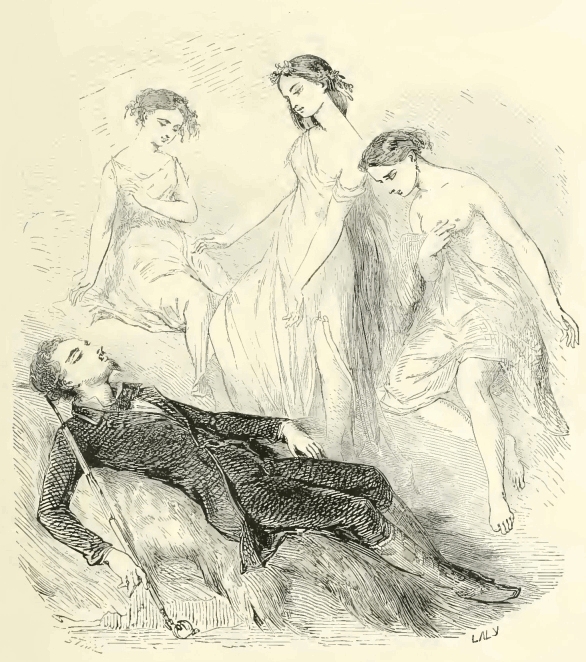
When Franz returned to himself, he seemed still to be in a dream. He
thought himself in a sepulchre, into which a ray of sunlight in pity
scarcely penetrated. He stretched forth his hand, and touched stone; he
rose to his seat, and found himself lying on his bournous in a bed of
dry heather, very soft and odoriferous. The vision had fled; and as if
the statues had been but shadows from the tomb, they had vanished at
his waking.
He advanced several paces towards the point whence the light came, and
to all the excitement of his dream succeeded the calmness of reality.
He found that he was in a grotto, went towards the opening, and through
a kind of fanlight saw a blue sea and an azure sky. The air and water
were shining in the beams of the morning sun; on the shore the sailors
were sitting, chatting and laughing; and at ten yards from them the
boat was at anchor, undulating gracefully on the water.
There for some time he enjoyed the fresh breeze which played on his
brow, and listened to the dash of the waves on the beach, that left
against the rocks a lace of foam as white as silver. He was for some
time without reflection or thought for the divine charm which is in the
things of nature, specially after a fantastic dream; then gradually
this view of the outer world, so calm, so pure, so grand, reminded him
of the illusiveness of his vision, and once more awakened memory. He
recalled his arrival on the island, his presentation to a smuggler
chief, a subterranean palace full of splendor, an excellent supper, and
a spoonful of hashish.
It seemed, however, even in the very face of open day, that at least a
year had elapsed since all these things had passed, so deep was the
impression made in his mind by the dream, and so strong a hold had it
taken of his imagination. Thus every now and then he saw in fancy amid
the sailors, seated on a rock, or undulating in the vessel, one of the
shadows which had shared his dream with looks and kisses. Otherwise,
his head was perfectly clear, and his body refreshed; he was free from
the slightest headache; on the contrary, he felt a certain degree of
lightness, a faculty for absorbing the pure air, and enjoying the
bright sunshine more vividly than ever.
He went gayly up to the sailors, who rose as soon as they perceived
him; and the patron, accosting him, said:
“The Signor Sinbad has left his compliments for your excellency, and
desires us to express the regret he feels at not being able to take his
leave in person; but he trusts you will excuse him, as very important
business calls him to Malaga.”
“So, then, Gaetano,” said Franz, “this is, then, all reality; there
exists a man who has received me in this island, entertained me right
royally, and has departed while I was asleep?”
“He exists as certainly as that you may see his small yacht with all
her sails spread; and if you will use your glass, you will, in all
probability, recognize your host in the midst of his crew.”
So saying, Gaetano pointed in a direction in which a small vessel was
making sail towards the southern point of Corsica. Franz adjusted his
telescope, and directed it towards the yacht. Gaetano was not mistaken.
At the stern the mysterious stranger was standing up looking towards
the shore, and holding a spy-glass in his hand. He was attired as he
had been on the previous evening, and waved his pocket-handkerchief to
his guest in token of adieu. Franz returned the salute by shaking his
handkerchief as an exchange of signals. After a second, a slight cloud
of smoke was seen at the stern of the vessel, which rose gracefully as
it expanded in the air, and then Franz heard a slight report.
“There, do you hear?” observed Gaetano; “he is bidding you adieu.”
The young man took his carbine and fired it in the air, but without any
idea that the noise could be heard at the distance which separated the
yacht from the shore.
“What are your excellency’s orders?” inquired Gaetano.
“In the first place, light me a torch.”
“Ah, yes, I understand,” replied the patron, “to find the entrance to
the enchanted apartment. With much pleasure, your excellency, if it
would amuse you; and I will get you the torch you ask for. But I too
have had the idea you have, and two or three times the same fancy has
come over me; but I have always given it up. Giovanni, light a torch,”
he added, “and give it to his excellency.”
Giovanni obeyed. Franz took the lamp, and entered the subterranean
grotto, followed by Gaetano. He recognized the place where he had
awaked by the bed of heather that was there; but it was in vain that he
carried his torch all round the exterior surface of the grotto. He saw
nothing, unless that, by traces of smoke, others had before him
attempted the same thing, and, like him, in vain. Yet he did not leave
a foot of this granite wall, as impenetrable as futurity, without
strict scrutiny; he did not see a fissure without introducing the blade
of his hunting sword into it, or a projecting point on which he did not
lean and press in the hopes it would give way. All was vain; and he
lost two hours in his attempts, which were at last utterly useless. At
the end of this time he gave up his search, and Gaetano smiled.
When Franz appeared again on the shore, the yacht only seemed like a
small white speck on the horizon. He looked again through his glass,
but even then he could not distinguish anything.
Gaetano reminded him that he had come for the purpose of shooting
goats, which he had utterly forgotten. He took his fowling-piece, and
began to hunt over the island with the air of a man who is fulfilling a
duty, rather than enjoying a pleasure; and at the end of a quarter of
an hour he had killed a goat and two kids. These animals, though wild
and agile as chamois, were too much like domestic goats, and Franz
could not consider them as game. Moreover, other ideas, much more
enthralling, occupied his mind. Since, the evening before, he had
really been the hero of one of the tales of the _Thousand and One
Nights_, and he was irresistibly attracted towards the grotto.
Then, in spite of the failure of his first search, he began a second,
after having told Gaetano to roast one of the two kids. The second
visit was a long one, and when he returned the kid was roasted and the
repast ready. Franz was sitting on the spot where he was on the
previous evening when his mysterious host had invited him to supper;
and he saw the little yacht, now like a sea-gull on the wave,
continuing her flight towards Corsica.
“Why,” he remarked to Gaetano, “you told me that Signor Sinbad was
going to Malaga, while it seems he is in the direction of
Porto-Vecchio.”
“Don’t you remember,” said the patron, “I told you that among the crew
there were two Corsican brigands?”
“True; and he is going to land them,” added Franz.
“Precisely so,” replied Gaetano. “Ah, he is one who fears neither God
nor Satan, they say, and would at any time run fifty leagues out of his
course to do a poor devil a service.”
“But such services as these might involve him with the authorities of
the country in which he practices this kind of philanthropy,” said
Franz.
“And what cares he for that,” replied Gaetano with a laugh, “or any
authorities? He smiles at them. Let them try to pursue him! Why, in the
first place, his yacht is not a ship, but a bird, and he would beat any
frigate three knots in every nine; and if he were to throw himself on
the coast, why, is he not certain of finding friends everywhere?”
It was perfectly clear that the Signor Sinbad, Franz’s host, had the
honor of being on excellent terms with the smugglers and bandits along
the whole coast of the Mediterranean, and so enjoyed exceptional
privileges. As to Franz, he had no longer any inducement to remain at
Monte Cristo. He had lost all hope of detecting the secret of the
grotto; he consequently despatched his breakfast, and, his boat being
ready, he hastened on board, and they were soon under way. At the
moment the boat began her course they lost sight of the yacht, as it
disappeared in the gulf of Porto-Vecchio. With it was effaced the last
trace of the preceding night; and then supper, Sinbad, hashish,
statues,—all became a dream for Franz.
The boat sailed on all day and all night, and next morning, when the
sun rose, they had lost sight of Monte Cristo.
When Franz had once again set foot on shore, he forgot, for the moment
at least, the events which had just passed, while he finished his
affairs of pleasure at Florence, and then thought of nothing but how he
should rejoin his companion, who was awaiting him at Rome.
He set out, and on the Saturday evening reached the Place de la Douane
by the mail-coach. An apartment, as we have said, had been retained
beforehand, and thus he had but to go to Signor Pastrini’s hotel. But
this was not so easy a matter, for the streets were thronged with
people, and Rome was already a prey to that low and feverish murmur
which precedes all great events; and at Rome there are four great
events in every year,—the Carnival, Holy Week, Corpus Christi, and the
Feast of St. Peter.
All the rest of the year the city is in that state of dull apathy,
between life and death, which renders it similar to a kind of station
between this world and the next—a sublime spot, a resting-place full of
poetry and character, and at which Franz had already halted five or six
times, and at each time found it more marvellous and striking.
At last he made his way through the mob, which was continually
increasing and getting more and more turbulent, and reached the hotel.
On his first inquiry he was told, with the impertinence peculiar to
hired hackney-coachmen and innkeepers with their houses full, that
there was no room for him at the Hôtel de Londres. Then he sent his
card to Signor Pastrini, and asked for Albert de Morcerf. This plan
succeeded; and Signor Pastrini himself ran to him, excusing himself for
having made his excellency wait, scolding the waiters, taking the
candlestick from the porter, who was ready to pounce on the traveller
and was about to lead him to Albert, when Morcerf himself appeared.
The apartment consisted of two small rooms and a parlor. The two rooms
looked on to the street—a fact which Signor Pastrini commented upon as
an inappreciable advantage. The rest of the floor was hired by a very
rich gentleman who was supposed to be a Sicilian or Maltese; but the
host was unable to decide to which of the two nations the traveller
belonged.
“Very good, signor Pastrini,” said Franz; “but we must have some supper
instantly, and a carriage for tomorrow and the following days.”
“As to supper,” replied the landlord, “you shall be served immediately;
but as for the carriage——”
“What as to the carriage?” exclaimed Albert. “Come, come, Signor
Pastrini, no joking; we must have a carriage.”
“Sir,” replied the host, “we will do all in our power to procure you
one—this is all I can say.”
“And when shall we know?” inquired Franz.
“Tomorrow morning,” answered the innkeeper.
“Oh, the deuce! then we shall pay the more, that’s all, I see plainly
enough. At Drake’s or Aaron’s one pays twenty-five lire for common
days, and thirty or thirty-five lire a day more for Sundays and feast
days; add five lire a day more for extras, that will make forty, and
there’s an end of it.”
“I am afraid if we offer them double that we shall not procure a
carriage.”
“Then they must put horses to mine. It is a little worse for the
journey, but that’s no matter.”
“There are no horses.”
Albert looked at Franz like a man who hears a reply he does not
understand.
“Do you understand that, my dear Franz—no horses?” he said, “but can’t
we have post-horses?”
“They have been all hired this fortnight, and there are none left but
those absolutely requisite for posting.”
“What are we to say to this?” asked Franz.
“I say, that when a thing completely surpasses my comprehension, I am
accustomed not to dwell on that thing, but to pass to another. Is
supper ready, Signor Pastrini?”
“Yes, your excellency.”
“Well, then, let us sup.”
“But the carriage and horses?” said Franz.
“Be easy, my dear boy; they will come in due season; it is only a
question of how much shall be charged for them.” Morcerf then, with
that delighted philosophy which believes that nothing is impossible to
a full purse or well-lined pocketbook, supped, went to bed, slept
soundly, and dreamed he was racing all over Rome at Carnival time in a
coach with six horses.
Chapter XXX
September the Fifth
The extension provided for by the agent of Thomson & French, at the
moment when Morrel expected it least, was to the poor shipowner so
decided a stroke of good fortune that he almost dared to believe that
fate was at length grown weary of wasting her spite upon him. The same
day he told his wife, Emmanuel, and his daughter all that had occurred;
and a ray of hope, if not of tranquillity, returned to the family.
Unfortunately, however, Morrel had not only engagements with the house
of Thomson & French, who had shown themselves so considerate towards
him; and, as he had said, in business he had correspondents, and not
friends. When he thought the matter over, he could by no means account
for this generous conduct on the part of Thomson & French towards him;
and could only attribute it to some such selfish argument as this: “We
had better help a man who owes us nearly 300,000 francs, and have those
300,000 francs at the end of three months than hasten his ruin, and get
only six or eight per cent of our money back again.”
Unfortunately, whether through envy or stupidity, all Morrel’s
correspondents did not take this view; and some even came to a contrary
decision. The bills signed by Morrel were presented at his office with
scrupulous exactitude, and, thanks to the delay granted by the
Englishman, were paid by Cocles with equal punctuality. Cocles thus
remained in his accustomed tranquillity. It was Morrel alone who
remembered with alarm, that if he had to repay on the 15th the 50,000
francs of M. de Boville, and on the 30th the 32,500 francs of bills,
for which, as well as the debt due to the inspector of prisons, he had
time granted, he must be a ruined man.
The opinion of all the commercial men was that, under the reverses
which had successively weighed down Morrel, it was impossible for him
to remain solvent. Great, therefore, was the astonishment when at the
end of the month, he cancelled all his obligations with his usual
punctuality. Still confidence was not restored to all minds, and the
general opinion was that the complete ruin of the unfortunate shipowner
had been postponed only until the end of the month.
The month passed, and Morrel made extraordinary efforts to get in all
his resources. Formerly his paper, at any date, was taken with
confidence, and was even in request. Morrel now tried to negotiate
bills at ninety days only, and none of the banks would give him credit.
Fortunately, Morrel had some funds coming in on which he could rely;
and, as they reached him, he found himself in a condition to meet his
engagements when the end of July came.
The agent of Thomson & French had not been again seen at Marseilles;
the day after, or two days after his visit to Morrel, he had
disappeared; and as in that city he had had no intercourse but with the
mayor, the inspector of prisons, and M. Morrel, his departure left no
trace except in the memories of these three persons. As to the sailors
of the Pharaon, they must have found snug berths elsewhere, for they
also had disappeared.
Captain Gaumard, recovered from his illness, had returned from Palma.
He delayed presenting himself at Morrel’s, but the owner, hearing of
his arrival, went to see him. The worthy shipowner knew, from Penelon’s
recital, of the captain’s brave conduct during the storm, and tried to
console him. He brought him also the amount of his wages, which Captain
Gaumard had not dared to apply for.
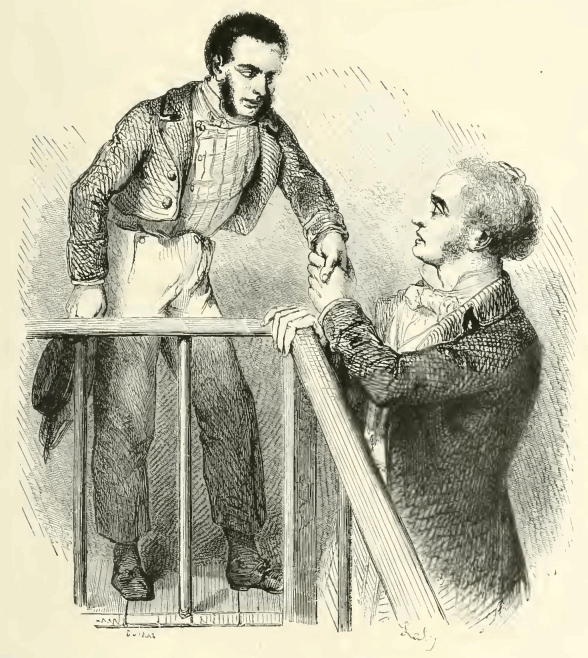
As he descended the staircase, Morrel met Penelon, who was going up.
Penelon had, it would seem, made good use of his money, for he was
newly clad. When he saw his employer, the worthy tar seemed much
embarrassed, drew on one side into the corner of the landing-place,
passed his quid from one cheek to the other, stared stupidly with his
great eyes, and only acknowledged the squeeze of the hand which Morrel
as usual gave him by a slight pressure in return. Morrel attributed
Penelon’s embarrassment to the elegance of his attire; it was evident
the good fellow had not gone to such an expense on his own account; he
was, no doubt, engaged on board some other vessel, and thus his
bashfulness arose from the fact of his not having, if we may so express
ourselves, worn mourning for the Pharaon longer. Perhaps he had come
to tell Captain Gaumard of his good luck, and to offer him employment
from his new master.
“Worthy fellows!” said Morrel, as he went away, “may your new master
love you as I loved you, and be more fortunate than I have been!”
August rolled by in unceasing efforts on the part of Morrel to renew
his credit or revive the old. On the 20th of August it was known at
Marseilles that he had left town in the mailcoach, and then it was said
that the bills would go to protest at the end of the month, and that
Morrel had gone away and left his chief clerk Emmanuel, and his cashier
Cocles, to meet the creditors. But, contrary to all expectation, when
the 31st of August came, the house opened as usual, and Cocles appeared
behind the grating of the counter, examined all bills presented with
the usual scrutiny, and, from first to last, paid all with the usual
precision. There came in, moreover, two drafts which M. Morrel had
fully anticipated, and which Cocles paid as punctually as the bills
which the shipowner had accepted. All this was incomprehensible, and
then, with the tenacity peculiar to prophets of bad news, the failure
was put off until the end of September.
On the 1st, Morrel returned; he was awaited by his family with extreme
anxiety, for from this journey to Paris they hoped great things. Morrel
had thought of Danglars, who was now immensely rich, and had lain under
great obligations to Morrel in former days, since to him it was owing
that Danglars entered the service of the Spanish banker, with whom he
had laid the foundations of his vast wealth. It was said at this moment
that Danglars was worth from six to eight millions of francs, and had
unlimited credit. Danglars, then, without taking a crown from his
pocket, could save Morrel; he had but to pass his word for a loan, and
Morrel was saved. Morrel had long thought of Danglars, but had kept
away from some instinctive motive, and had delayed as long as possible
availing himself of this last resource. And Morrel was right, for he
returned home crushed by the humiliation of a refusal.
Yet, on his arrival, Morrel did not utter a complaint, or say one harsh
word. He embraced his weeping wife and daughter, pressed Emmanuel’s
hand with friendly warmth, and then going to his private room on the
second floor had sent for Cocles.
“Then,” said the two women to Emmanuel, “we are indeed ruined.”
It was agreed in a brief council held among them, that Julie should
write to her brother, who was in garrison at Nîmes, to come to them as
speedily as possible. The poor women felt instinctively that they
required all their strength to support the blow that impended. Besides,
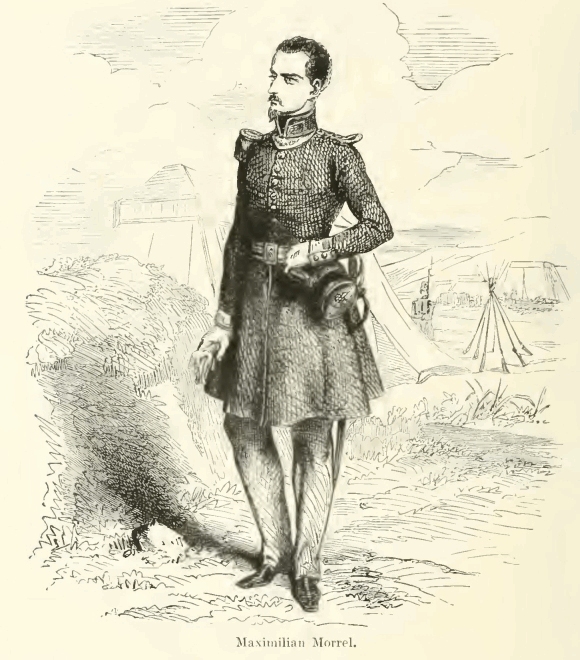
Maximilian Morrel, though hardly two-and-twenty, had great influence
over his father.
He was a strong-minded, upright young man. At the time when he decided
on his profession his father had no desire to choose for him, but had
consulted young Maximilian’s taste. He had at once declared for a
military life, and had in consequence studied hard, passed brilliantly
through the Polytechnic School, and left it as sub-lieutenant of the
53rd of the line. For a year he had held this rank, and expected
promotion on the first vacancy. In his regiment Maximilian Morrel was
noted for his rigid observance, not only of the obligations imposed on
a soldier, but also of the duties of a man; and he thus gained the name
of “the stoic.” We need hardly say that many of those who gave him this
epithet repeated it because they had heard it, and did not even know
what it meant.
This was the young man whom his mother and sister called to their aid
to sustain them under the serious trial which they felt they would soon
have to endure. They had not mistaken the gravity of this event, for
the moment after Morrel had entered his private office with Cocles,
Julie saw the latter leave it pale, trembling, and his features
betraying the utmost consternation. She would have questioned him as he
passed by her, but the worthy creature hastened down the staircase with
unusual precipitation, and only raised his hands to heaven and
exclaimed:
“Oh, mademoiselle, mademoiselle, what a dreadful misfortune! Who could
ever have believed it!”
A moment afterwards Julie saw him go upstairs carrying two or three
heavy ledgers, a portfolio, and a bag of money.
Morrel examined the ledgers, opened the portfolio, and counted the
money. All his funds amounted to 6,000 or 8,000 francs, his bills
receivable up to the 5th to 4,000 or 5,000, which, making the best of
everything, gave him 14,000 francs to meet debts amounting to 287,500
francs. He had not even the means for making a possible settlement on
account.
However, when Morrel went down to his dinner, he appeared very calm.
This calmness was more alarming to the two women than the deepest
dejection would have been. After dinner Morrel usually went out and
used to take his coffee at the club of the Phocéens, and read the
Semaphore; this day he did not leave the house, but returned to his
office.
As to Cocles, he seemed completely bewildered. For part of the day he
went into the courtyard, seated himself on a stone with his head bare
and exposed to the blazing sun. Emmanuel tried to comfort the women,
but his eloquence faltered. The young man was too well acquainted with
the business of the house, not to feel that a great catastrophe hung
over the Morrel family. Night came, the two women had watched, hoping
that when he left his room Morrel would come to them, but they heard
him pass before their door, and trying to conceal the noise of his
footsteps. They listened; he went into his sleeping-room, and fastened
the door inside. Madame Morrel sent her daughter to bed, and half an
hour after Julie had retired, she rose, took off her shoes, and went
stealthily along the passage, to see through the keyhole what her
husband was doing.
In the passage she saw a retreating shadow; it was Julie, who, uneasy
herself, had anticipated her mother. The young lady went towards Madame
Morrel.
“He is writing,” she said.
They had understood each other without speaking. Madame Morrel looked
again through the keyhole, Morrel was writing; but Madame Morrel
remarked, what her daughter had not observed, that her husband was
writing on stamped paper. The terrible idea that he was writing his
will flashed across her; she shuddered, and yet had not strength to
utter a word.
Next day M. Morrel seemed as calm as ever, went into his office as
usual, came to his breakfast punctually, and then, after dinner, he
placed his daughter beside him, took her head in his arms, and held her
for a long time against his bosom. In the evening, Julie told her
mother, that although he was apparently so calm, she had noticed that
her father’s heart beat violently.
The next two days passed in much the same way. On the evening of the
4th of September, M. Morrel asked his daughter for the key of his
study. Julie trembled at this request, which seemed to her of bad omen.
Why did her father ask for this key which she always kept, and which
was only taken from her in childhood as a punishment? The young girl
looked at Morrel.
“What have I done wrong, father,” she said, “that you should take this
key from me?”
“Nothing, my dear,” replied the unhappy man, the tears starting to his
eyes at this simple question,—“nothing, only I want it.”
Julie made a pretence to feel for the key. “I must have left it in my
room,” she said.
And she went out, but instead of going to her apartment she hastened to
consult Emmanuel.
“Do not give this key to your father,” said he, “and tomorrow morning,
if possible, do not quit him for a moment.”
She questioned Emmanuel, but he knew nothing, or would not say what he
knew.
During the night, between the 4th and 5th of September, Madame Morrel
remained listening for every sound, and, until three o’clock in the
morning, she heard her husband pacing the room in great agitation. It
was three o’clock when he threw himself on the bed. The mother and
daughter passed the night together. They had expected Maximilian since
the previous evening. At eight o’clock in the morning Morrel entered
their chamber. He was calm; but the agitation of the night was legible
in his pale and careworn visage. They did not dare to ask him how he
had slept. Morrel was kinder to his wife, more affectionate to his
daughter, than he had ever been. He could not cease gazing at and
kissing the sweet girl. Julie, mindful of Emmanuel’s request, was
following her father when he quitted the room, but he said to her
quickly:
“Remain with your mother, dearest.” Julie wished to accompany him. “I
wish you to do so,” said he.
This was the first time Morrel had ever so spoken, but he said it in a
tone of paternal kindness, and Julie did not dare to disobey. She
remained at the same spot standing mute and motionless. An instant
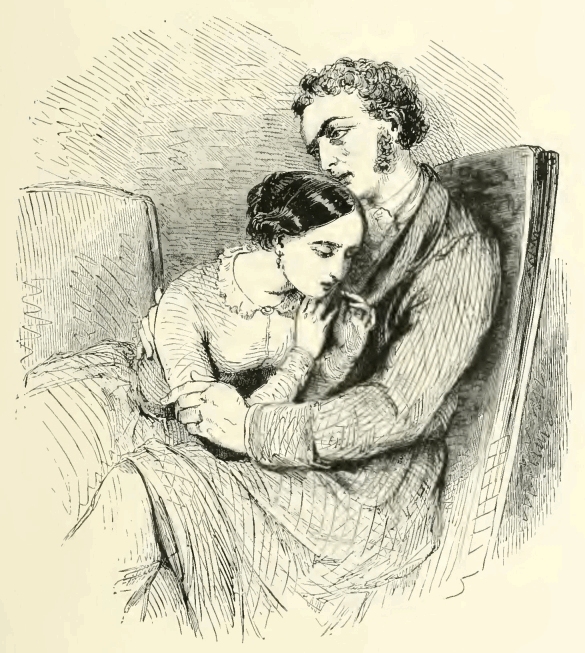
afterwards the door opened, she felt two arms encircle her, and a mouth
pressed her forehead. She looked up and uttered an exclamation of joy.
“Maximilian, my dearest brother!” she cried.
At these words Madame Morrel rose, and threw herself into her son’s
arms.
“Mother,” said the young man, looking alternately at Madame Morrel and
her daughter, “what has occurred—what has happened? Your letter has
frightened me, and I have come hither with all speed.”
“Julie,” said Madame Morrel, making a sign to the young man, “go and
tell your father that Maximilian has just arrived.”
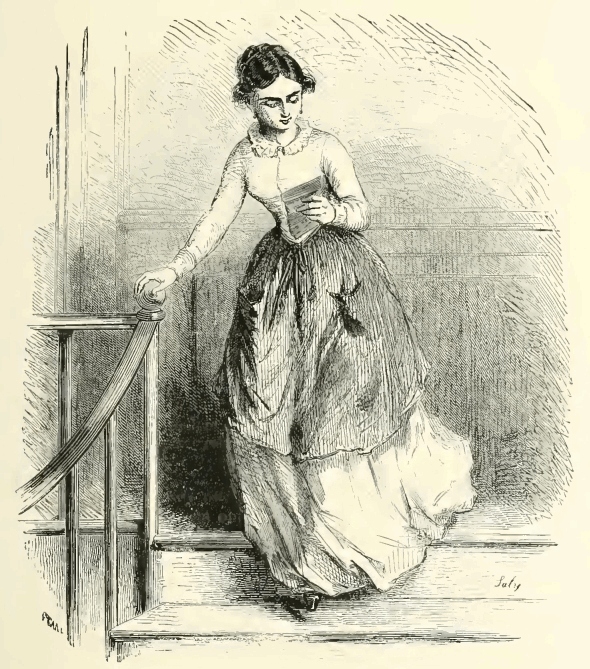
The young lady rushed out of the apartment, but on the first step of
the staircase she found a man holding a letter in his hand.
“Are you not Mademoiselle Julie Morrel?” inquired the man, with a
strong Italian accent.
“Yes, sir,” replied Julie with hesitation; “what is your pleasure? I do
not know you.”
“Read this letter,” he said, handing it to her. Julie hesitated. “It
concerns the best interests of your father,” said the messenger.
The young girl hastily took the letter from him. She opened it quickly
and read:
“Go this moment to the Allées de Meilhan, enter the house No. 15, ask
the porter for the key of the room on the fifth floor, enter the
apartment, take from the corner of the mantelpiece a purse netted in
red silk, and give it to your father. It is important that he should
receive it before eleven o’clock. You promised to obey me implicitly.
Remember your oath.
“Sinbad the Sailor.”
The young girl uttered a joyful cry, raised her eyes, looked round to
question the messenger, but he had disappeared. She cast her eyes again
over the note to peruse it a second time, and saw there was a
postscript. She read:
“It is important that you should fulfil this mission in person and
alone. If you go accompanied by any other person, or should anyone else
go in your place, the porter will reply that he does not know anything
about it.”
This postscript decreased greatly the young girl’s happiness. Was there
nothing to fear? was there not some snare laid for her? Her innocence
had kept her in ignorance of the dangers that might assail a young girl
of her age. But there is no need to know danger in order to fear it;
indeed, it may be observed, that it is usually unknown perils that
inspire the greatest terror.
Julie hesitated, and resolved to take counsel. Yet, through a singular
impulse, it was neither to her mother nor her brother that she applied,
but to Emmanuel. She hastened down and told him what had occurred on
the day when the agent of Thomson & French had come to her father’s,
related the scene on the staircase, repeated the promise she had made,
and showed him the letter.
“You must go, then, mademoiselle,” said Emmanuel.
“Go there?” murmured Julie.
“Yes; I will accompany you.”
“But did you not read that I must be alone?” said Julie.
“And you shall be alone,” replied the young man. “I will await you at
the corner of the Rue du Musée, and if you are so long absent as to
make me uneasy, I will hasten to rejoin you, and woe to him of whom you
shall have cause to complain to me!”
“Then, Emmanuel?” said the young girl with hesitation, “it is your
opinion that I should obey this invitation?”
“Yes. Did not the messenger say your father’s safety depended upon it?”
“But what danger threatens him, then, Emmanuel?” she asked.
Emmanuel hesitated a moment, but his desire to make Julie decide
immediately made him reply.
“Listen,” he said; “today is the 5th of September, is it not?”
“Yes.”
“Today, then, at eleven o’clock, your father has nearly three hundred
thousand francs to pay?”
“Yes, we know that.”
“Well, then,” continued Emmanuel, “we have not fifteen thousand francs
in the house.”
“What will happen then?”
“Why, if today before eleven o’clock your father has not found someone
who will come to his aid, he will be compelled at twelve o’clock to
declare himself a bankrupt.”
“Oh, come, then, come!” cried she, hastening away with the young man.
During this time, Madame Morrel had told her son everything. The young
man knew quite well that, after the succession of misfortunes which had
befallen his father, great changes had taken place in the style of
living and housekeeping; but he did not know that matters had reached
such a point. He was thunderstruck. Then, rushing hastily out of the
apartment, he ran upstairs, expecting to find his father in his study,
but he rapped there in vain.
While he was yet at the door of the study he heard the bedroom door
open, turned, and saw his father. Instead of going direct to his study,
M. Morrel had returned to his bedchamber, which he was only this moment
quitting. Morrel uttered a cry of surprise at the sight of his son, of
whose arrival he was ignorant. He remained motionless on the spot,
pressing with his left hand something he had concealed under his coat.
Maximilian sprang down the staircase, and threw his arms round his
father’s neck; but suddenly he recoiled, and placed his right hand on
Morrel’s breast.
“Father,” he exclaimed, turning pale as death, “what are you going to
do with that brace of pistols under your coat?”
“Oh, this is what I feared!” said Morrel.
“Father, father, in Heaven’s name,” exclaimed the young man, “what are
these weapons for?”
“Maximilian,” replied Morrel, looking fixedly at his son, “you are a
man, and a man of honor. Come, and I will explain to you.”
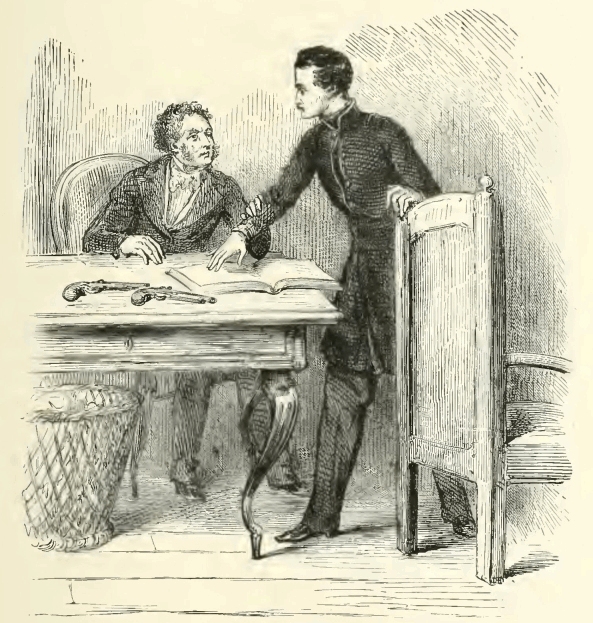
And with a firm step Morrel went up to his study, while Maximilian
followed him, trembling as he went. Morrel opened the door, and closed
it behind his son; then, crossing the anteroom, went to his desk on
which he placed the pistols, and pointed with his finger to an open
ledger. In this ledger was made out an exact balance-sheet of his
affairs. Morrel had to pay, within half an hour, 287,500 francs. All he
possessed was 15,257 francs.
“Read!” said Morrel.
The young man was overwhelmed as he read. Morrel said not a word. What
could he say? What need he add to such a desperate proof in figures?
“And have you done all that is possible, father, to meet this
disastrous result?” asked the young man, after a moment’s pause.
“I have,” replied Morrel.
“You have no money coming in on which you can rely?”
“None.”
“You have exhausted every resource?”
“All.”
“And in half an hour,” said Maximilian in a gloomy voice, “our name is
dishonored!”
“Blood washes out dishonor,” said Morrel.
“You are right, father; I understand you.” Then extending his hand
towards one of the pistols, he said, “There is one for you and one for
me—thanks!”
Morrel caught his hand. “Your mother—your sister! Who will support
them?”
A shudder ran through the young man’s frame. “Father,” he said, “do you
reflect that you are bidding me to live?”
“Yes, I do so bid you,” answered Morrel, “it is your duty. You have a
calm, strong mind, Maximilian. Maximilian, you are no ordinary man. I
make no requests or commands; I only ask you to examine my position as
if it were your own, and then judge for yourself.”
The young man reflected for a moment, then an expression of sublime
resignation appeared in his eyes, and with a slow and sad gesture he
took off his two epaulets, the insignia of his rank.
“Be it so, then, my father,” he said, extending his hand to Morrel,
“die in peace, my father; I will live.”
Morrel was about to cast himself on his knees before his son, but
Maximilian caught him in his arms, and those two noble hearts were
pressed against each other for a moment.
“You know it is not my fault,” said Morrel.
Maximilian smiled. “I know, father, you are the most honorable man I
have ever known.”
“Good, my son. And now there is no more to be said; go and rejoin your
mother and sister.”
“My father,” said the young man, bending his knee, “bless me!” Morrel
took the head of his son between his two hands, drew him forward, and
kissing his forehead several times said:
“Oh, yes, yes, I bless you in my own name, and in the name of three
generations of irreproachable men, who say through me, ‘The edifice
which misfortune has destroyed, Providence may build up again.’ On
seeing me die such a death, the most inexorable will have pity on you.
To you, perhaps, they will accord the time they have refused to me.
Then do your best to keep our name free from dishonor. Go to work,
labor, young man, struggle ardently and courageously; live, yourself,
your mother and sister, with the most rigid economy, so that from day
to day the property of those whom I leave in your hands may augment and
fructify. Reflect how glorious a day it will be, how grand, how solemn,
that day of complete restoration, on which you will say in this very
office, ‘My father died because he could not do what I have this day
done; but he died calmly and peaceably, because in dying he knew what I
should do.’”
“My father, my father!” cried the young man, “why should you not live?”
“If I live, all would be changed; if I live, interest would be
converted into doubt, pity into hostility; if I live I am only a man
who has broken his word, failed in his engagements—in fact, only a
bankrupt. If, on the contrary, I die, remember, Maximilian, my corpse
is that of an honest but unfortunate man. Living, my best friends would
avoid my house; dead, all Marseilles will follow me in tears to my last
home. Living, you would feel shame at my name; dead, you may raise your
head and say, ‘I am the son of him you killed, because, for the first
time, he has been compelled to break his word.’”
The young man uttered a groan, but appeared resigned.
“And now,” said Morrel, “leave me alone, and endeavor to keep your
mother and sister away.”
“Will you not see my sister once more?” asked Maximilian. A last but
final hope was concealed by the young man in the effect of this
interview, and therefore he had suggested it. Morrel shook his head. “I
saw her this morning, and bade her adieu.”
“Have you no particular commands to leave with me, my father?” inquired
Maximilian in a faltering voice.
“Yes; my son, and a sacred command.”
“Say it, my father.”
“The house of Thomson & French is the only one who, from humanity, or,
it may be, selfishness—it is not for me to read men’s hearts—has had
any pity for me. Its agent, who will in ten minutes present himself to
receive the amount of a bill of 287,500 francs, I will not say granted,
but offered me three months. Let this house be the first repaid, my
son, and respect this man.”
“Father, I will,” said Maximilian.
“And now, once more, adieu,” said Morrel. “Go, leave me; I would be
alone. You will find my will in the secretaire in my bedroom.”
The young man remained standing and motionless, having but the force of
will and not the power of execution.
“Hear me, Maximilian,” said his father. “Suppose I were a soldier like
you, and ordered to carry a certain redoubt, and you knew I must be
killed in the assault, would you not say to me, as you said just now,
‘Go, father; for you are dishonored by delay, and death is preferable
to shame!’”
“Yes, yes,” said the young man, “yes;” and once again embracing his
father with convulsive pressure, he said, “Be it so, my father.”
And he rushed out of the study. When his son had left him, Morrel
remained an instant standing with his eyes fixed on the door; then
putting forth his arm, he pulled the bell. After a moment’s interval,
Cocles appeared.
It was no longer the same man—the fearful revelations of the three last
days had crushed him. This thought—the house of Morrel is about to stop
payment—bent him to the earth more than twenty years would otherwise
have done.
“My worthy Cocles,” said Morrel in a tone impossible to describe, “do
you remain in the antechamber. When the gentleman who came three months
ago—the agent of Thomson & French—arrives, announce his arrival to me.”
Cocles made no reply; he made a sign with his head, went into the
anteroom, and seated himself. Morrel fell back in his chair, his eyes
fixed on the clock; there were seven minutes left, that was all. The
hand moved on with incredible rapidity, he seemed to see its motion.
What passed in the mind of this man at the supreme moment of his agony
cannot be told in words. He was still comparatively young, he was
surrounded by the loving care of a devoted family, but he had convinced
himself by a course of reasoning, illogical perhaps, yet certainly
plausible, that he must separate himself from all he held dear in the
world, even life itself. To form the slightest idea of his feelings,
one must have seen his face with its expression of enforced resignation
and its tear-moistened eyes raised to heaven. The minute hand moved on.
The pistols were loaded; he stretched forth his hand, took one up, and
murmured his daughter’s name. Then he laid it down, seized his pen, and
wrote a few words. It seemed to him as if he had not taken a sufficient
farewell of his beloved daughter. Then he turned again to the clock,
counting time now not by minutes, but by seconds.
He took up the deadly weapon again, his lips parted and his eyes fixed
on the clock, and then shuddered at the click of the trigger as he
cocked the pistol. At this moment of mortal anguish the cold sweat came
forth upon his brow, a pang stronger than death clutched at his
heart-strings. He heard the door of the staircase creak on its
hinges—the clock gave its warning to strike eleven—the door of his
study opened. Morrel did not turn round—he expected these words of
Cocles, “The agent of Thomson & French.”
He placed the muzzle of the pistol between his teeth. Suddenly he heard
a cry—it was his daughter’s voice. He turned and saw Julie. The pistol
fell from his hands.
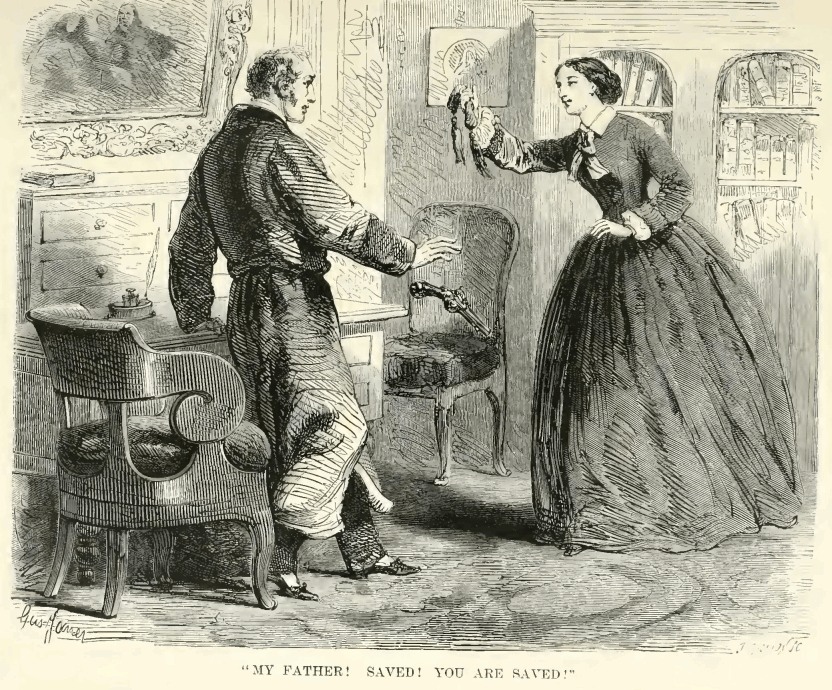
“My father!” cried the young girl, out of breath, and half dead with
joy—“saved, you are saved!” And she threw herself into his arms,
holding in her extended hand a red, netted silk purse.
“Saved, my child!” said Morrel; “what do you mean?”
“Yes, saved—saved! See, see!” said the young girl.
Morrel took the purse, and started as he did so, for a vague
remembrance reminded him that it once belonged to himself. At one end
was the receipted bill for the 287,000 francs, and at the other was a
diamond as large as a hazel-nut, with these words on a small slip of
parchment: Julie’s Dowry.
Morrel passed his hand over his brow; it seemed to him a dream. At this
moment the clock struck eleven. He felt as if each stroke of the hammer
fell upon his heart.
“Explain, my child,” he said, “Explain, my child,” he said,
“explain—where did you find this purse?”
“In a house in the Allées de Meilhan, No. 15, on the corner of a
mantelpiece in a small room on the fifth floor.”
“But,” cried Morrel, “this purse is not yours!” Julie handed to her
father the letter she had received in the morning.
“And did you go alone?” asked Morrel, after he had read it.
“Emmanuel accompanied me, father. He was to have waited for me at the
corner of the Rue du Musée, but, strange to say, he was not there when
I returned.”
“Monsieur Morrel!” exclaimed a voice on the stairs; “Monsieur Morrel!”
“It is his voice!” said Julie. At this moment Emmanuel entered, his
countenance full of animation and joy.
“The Pharaon!” he cried; “the Pharaon!”
“What!—what!—the Pharaon! Are you mad, Emmanuel? You know the vessel
is lost.”
“The Pharaon, sir—they signal the Pharaon! The Pharaon is
entering the harbor!”
Morrel fell back in his chair, his strength was failing him; his
understanding weakened by such events, refused to comprehend such
incredible, unheard-of, fabulous facts. But his son came in.
“Father,” cried Maximilian, “how could you say the Pharaon was lost?
The lookout has signalled her, and they say she is now coming into
port.”
“My dear friends,” said Morrel, “if this be so, it must be a miracle of
heaven! Impossible, impossible!”
But what was real and not less incredible was the purse he held in his
hand, the acceptance receipted—the splendid diamond.
“Ah, sir,” exclaimed Cocles, “what can it mean?—the Pharaon?”
“Come, dear ones,” said Morrel, rising from his seat, “let us go and
see, and Heaven have pity upon us if it be false intelligence!”
They all went out, and on the stairs met Madame Morrel, who had been
afraid to go up into the study. In a moment they were at the Canebière.
There was a crowd on the pier. All the crowd gave way before Morrel.
“The Pharaon! the Pharaon!” said every voice.
And, wonderful to see, in front of the tower of Saint-Jean, was a ship
bearing on her stern these words, printed in white letters, “The
Pharaon, Morrel & Son, of Marseilles.” She was the exact duplicate of
the other Pharaon, and loaded, as that had been, with cochineal and
indigo. She cast anchor, clued up sails, and on the deck was Captain
Gaumard giving orders, and good old Penelon making signals to M.
Morrel. To doubt any longer was impossible; there was the evidence of
the senses, and ten thousand persons who came to corroborate the
testimony.
As Morrel and his son embraced on the pier-head, in the presence and
amid the applause of the whole city witnessing this event, a man, with
his face half-covered by a black beard, and who, concealed behind the
sentry-box, watched the scene with delight, uttered these words in a
low tone:
“Be happy, noble heart, be blessed for all the good thou hast done and
wilt do hereafter, and let my gratitude remain in obscurity like your
good deeds.”
And with a smile expressive of supreme content, he left his
hiding-place, and without being observed, descended one of the flights
of steps provided for debarkation, and hailing three times, shouted
“Jacopo, Jacopo, Jacopo!”
Then a launch came to shore, took him on board, and conveyed him to a
yacht splendidly fitted up, on whose deck he sprung with the activity
of a sailor; thence he once again looked towards Morrel, who, weeping
with joy, was shaking hands most cordially with all the crowd around
him, and thanking with a look the unknown benefactor whom he seemed to
be seeking in the skies.
“And now,” said the unknown, “farewell kindness, humanity, and
gratitude! Farewell to all the feelings that expand the heart! I have
been Heaven’s substitute to recompense the good—now the god of
vengeance yields to me his power to punish the wicked!”
At these words he gave a signal, and, as if only awaiting this signal,
the yacht instantly put out to sea.
Chapter XXXI
Italy — Sinbad the Sailor
Towards the beginning of the year 1838, two young men belonging to the
first society of Paris, the Viscount Albert de Morcerf and the Baron
Franz d’Épinay, were at Florence. They had agreed to see the Carnival
at Rome that year, and that Franz, who for the last three or four years
had inhabited Italy, should act as cicerone to Albert.
As it is no inconsiderable affair to spend the Carnival at Rome,
especially when you have no great desire to sleep on the Piazza del
Popolo, or the Campo Vaccino, they wrote to Signor Pastrini, the
proprietor of the Hôtel de Londres, Piazza di Spagna, to reserve
comfortable apartments for them. Signor Pastrini replied that he had
only two rooms and a parlor on the third floor, which he offered at the
low charge of a louis per diem. They accepted his offer; but wishing to
make the best use of the time that was left, Albert started for Naples.
As for Franz, he remained at Florence, and after having passed a few
days in exploring the paradise of the Cascine, and spending two or
three evenings at the houses of the Florentine nobility, he took a
fancy into his head (having already visited Corsica, the cradle of
Bonaparte) to visit Elba, the waiting-place of Napoleon.
One evening he cast off the painter of a sailboat from the iron ring
that secured it to the dock at Leghorn, wrapped himself in his coat and
lay down, and said to the crew,—“To the Island of Elba!”
The boat shot out of the harbor like a bird and the next morning Franz
disembarked at Porto-Ferrajo. He traversed the island, after having
followed the traces which the footsteps of the giant have left, and
re-embarked for Marciana.
Two hours after he again landed at Pianosa, where he was assured that
red partridges abounded. The sport was bad; Franz only succeeded in
killing a few partridges, and, like every unsuccessful sportsman, he
returned to the boat very much out of temper.
“Ah, if your excellency chose,” said the captain, “you might have
capital sport.”
“Where?”
“Do you see that island?” continued the captain, pointing to a conical
pile rising from the indigo sea.
“Well, what is this island?”
“The Island of Monte Cristo.”
“But I have no permission to shoot over this island.”
“Your excellency does not require a permit, for the island is
uninhabited.”
“Ah, indeed!” said the young man. “A desert island in the midst of the
Mediterranean must be a curiosity.”
“It is very natural; this island is a mass of rocks, and does not
contain an acre of land capable of cultivation.”
“To whom does this island belong?”
“To Tuscany.”
“What game shall I find there!”
“Thousands of wild goats.”
“Who live upon the stones, I suppose,” said Franz with an incredulous
smile.
“No, but by browsing the shrubs and trees that grow out of the crevices
of the rocks.”
“Where can I sleep?”
“On shore in the grottos, or on board in your cloak; besides, if your
excellency pleases, we can leave as soon as you like—we can sail as
well by night as by day, and if the wind drops we can use our oars.”
As Franz had sufficient time, and his apartments at Rome were not yet
available, he accepted the proposition. Upon his answer in the
affirmative, the sailors exchanged a few words together in a low tone.
“Well,” asked he, “what now? Is there any difficulty in the way?”
“No.” replied the captain, “but we must warn your excellency that the
island is an infected port.”
“What do you mean?”
“Monte Cristo although uninhabited, yet serves occasionally as a refuge
for the smugglers and pirates who come from Corsica, Sardinia, and
Africa, and if it becomes known that we have been there, we shall have
to perform quarantine for six days on our return to Leghorn.”
“The deuce! That puts a different face on the matter. Six days! Why,
that’s as long as the Almighty took to make the world! Too long a
wait—too long.”
“But who will say your excellency has been to Monte Cristo?”
“Oh, I shall not,” cried Franz.
“Nor I, nor I,” chorused the sailors.
“Then steer for Monte Cristo.”
The captain gave his orders, the helm was put up, and the boat was soon
sailing in the direction of the island. Franz waited until all was in
order, and when the sail was filled, and the four sailors had taken
their places—three forward, and one at the helm—he resumed the
conversation. “Gaetano,” said he to the captain, “you tell me Monte
Cristo serves as a refuge for pirates, who are, it seems to me, a very
different kind of game from the goats.”
“Yes, your excellency, and it is true.”
“I knew there were smugglers, but I thought that since the capture of
Algiers, and the destruction of the regency, pirates existed only in
the romances of Cooper and Captain Marryat.”
“Your excellency is mistaken; there are pirates, like the bandits who
were believed to have been exterminated by Pope Leo XII., and who yet,
every day, rob travellers at the gates of Rome. Has not your excellency
heard that the French chargé d’affaires was robbed six months ago
within five hundred paces of Velletri?”
“Oh, yes, I heard that.”
“Well, then, if, like us, your excellency lived at Leghorn, you would
hear, from time to time, that a little merchant vessel, or an English
yacht that was expected at Bastia, at Porto-Ferrajo, or at Civita
Vecchia, has not arrived; no one knows what has become of it, but,
doubtless, it has struck on a rock and foundered. Now this rock it has
met has been a long and narrow boat, manned by six or eight men, who
have surprised and plundered it, some dark and stormy night, near some
desert and gloomy island, as bandits plunder a carriage in the recesses
of a forest.”
“But,” asked Franz, who lay wrapped in his cloak at the bottom of the
boat, “why do not those who have been plundered complain to the French,
Sardinian, or Tuscan governments?”
“Why?” said Gaetano with a smile.
“Yes, why?”
“Because, in the first place, they transfer from the vessel to their
own boat whatever they think worth taking, then they bind the crew hand
and foot, they attach to everyone’s neck a four-and-twenty-pound ball,
a large hole is chopped in the vessel’s bottom, and then they leave
her. At the end of ten minutes the vessel begins to roll heavily and
settle down. First one gun’l goes under, then the other. Then they lift
and sink again, and both go under at once. All at once there’s a noise
like a cannon—that’s the air blowing up the deck. Soon the water rushes
out of the scupper-holes like a whale spouting, the vessel gives a last
groan, spins round and round, and disappears, forming a vast whirlpool
in the ocean, and then all is over, so that in five minutes nothing but
the eye of God can see the vessel where she lies at the bottom of the
sea. Do you understand now,” said the captain, “why no complaints are
made to the government, and why the vessel never reaches port?”
It is probable that if Gaetano had related this previous to proposing
the expedition, Franz would have hesitated, but now that they had
started, he thought it would be cowardly to draw back. He was one of
those men who do not rashly court danger, but if danger presents
itself, combat it with the most unalterable coolness. Calm and
resolute, he treated any peril as he would an adversary in a
duel,—calculated its probable method of approach; retreated, if at all,
as a point of strategy and not from cowardice; was quick to see an
opening for attack, and won victory at a single thrust.
“Bah!” said he, “I have travelled through Sicily and Calabria—I have
sailed two months in the Archipelago, and yet I never saw even the
shadow of a bandit or a pirate.”
“I did not tell your excellency this to deter you from your project,”
replied Gaetano, “but you questioned me, and I have answered; that’s
all.”
“Yes, and your conversation is most interesting; and as I wish to enjoy
it as long as possible, steer for Monte Cristo.”
The wind blew strongly, the boat made six or seven knots an hour, and
they were rapidly reaching the end of their voyage. As they drew near
the island seemed to lift from the sea, and the air was so clear that
they could already distinguish the rocks heaped on one another, like
cannon balls in an arsenal, with green bushes and trees growing in the
crevices. As for the sailors, although they appeared perfectly tranquil
yet it was evident that they were on the alert, and that they carefully
watched the glassy surface over which they were sailing, and on which a
few fishing-boats, with their white sails, were alone visible.
They were within fifteen miles of Monte Cristo when the sun began to
set behind Corsica, whose mountains appeared against the sky, showing
their rugged peaks in bold relief; this mass of rock, like the giant
Adamastor, rose dead ahead, a formidable barrier, and intercepting the
light that gilded its massive peaks so that the voyagers were in
shadow. Little by little the shadow rose higher and seemed to drive
before it the last rays of the expiring day; at last the reflection
rested on the summit of the mountain, where it paused an instant, like
the fiery crest of a volcano, then gloom gradually covered the summit
as it had covered the base, and the island now only appeared to be a
gray mountain that grew continually darker; half an hour after, the
night was quite dark.
Fortunately, the mariners were used to these latitudes, and knew every
rock in the Tuscan Archipelago; for in the midst of this obscurity
Franz was not without uneasiness—Corsica had long since disappeared,
and Monte Cristo itself was invisible; but the sailors seemed, like the
lynx, to see in the dark, and the pilot who steered did not evince the
slightest hesitation.
An hour had passed since the sun had set, when Franz fancied he saw, at
a quarter of a mile to the left, a dark mass, but he could not
precisely make out what it was, and fearing to excite the mirth of the
sailors by mistaking a floating cloud for land, he remained silent;
suddenly a great light appeared on the strand; land might resemble a
cloud, but the fire was not a meteor.
“What is this light?” asked he.
“Hush!” said the captain; “it is a fire.”
“But you told me the island was uninhabited?”
“I said there were no fixed habitations on it, but I said also that it
served sometimes as a harbor for smugglers.”
“And for pirates?”
“And for pirates,” returned Gaetano, repeating Franz’s words. “It is
for that reason I have given orders to pass the island, for, as you
see, the fire is behind us.”
“But this fire?” continued Franz. “It seems to me rather reassuring
than otherwise; men who did not wish to be seen would not light a
fire.”
“Oh, that goes for nothing,” said Gaetano. “If you can guess the
position of the island in the darkness, you will see that the fire
cannot be seen from the side or from Pianosa, but only from the sea.”
“You think, then, this fire indicates the presence of unpleasant
neighbors?”
“That is what we must find out,” returned Gaetano, fixing his eyes on
this terrestrial star.
“How can you find out?”
“You shall see.”
Gaetano consulted with his companions, and after five minutes’
discussion a manœuvre was executed which caused the vessel to tack
about, they returned the way they had come, and in a few minutes the
fire disappeared, hidden by an elevation of the land. The pilot again
changed the course of the boat, which rapidly approached the island,
and was soon within fifty paces of it. Gaetano lowered the sail, and
the boat came to rest. All this was done in silence, and from the
moment that their course was changed not a word was spoken.
Gaetano, who had proposed the expedition, had taken all the
responsibility on himself; the four sailors fixed their eyes on him,
while they got out their oars and held themselves in readiness to row
away, which, thanks to the darkness, would not be difficult. As for
Franz, he examined his arms with the utmost coolness; he had two
double-barrelled guns and a rifle; he loaded them, looked at the
priming, and waited quietly.
During this time the captain had thrown off his vest and shirt, and
secured his trousers round his waist; his feet were naked, so he had no
shoes and stockings to take off; after these preparations he placed his
finger on his lips, and lowering himself noiselessly into the sea, swam
towards the shore with such precaution that it was impossible to hear
the slightest sound; he could only be traced by the phosphorescent line
in his wake. This track soon disappeared; it was evident that he had
touched the shore.
Everyone on board remained motionless for half an hour, when the same
luminous track was again observed, and the swimmer was soon on board.
“Well?” exclaimed Franz and the sailors in unison.
“They are Spanish smugglers,” said he; “they have with them two
Corsican bandits.”
“And what are these Corsican bandits doing here with Spanish
smugglers?”
“Alas,” returned the captain with an accent of the most profound pity,
“we ought always to help one another. Very often the bandits are hard
pressed by gendarmes or carbineers; well, they see a vessel, and good
fellows like us on board, they come and demand hospitality of us; you
can’t refuse help to a poor hunted devil; we receive them, and for
greater security we stand out to sea. This costs us nothing, and saves
the life, or at least the liberty, of a fellow-creature, who on the
first occasion returns the service by pointing out some safe spot where
we can land our goods without interruption.”
“Ah!” said Franz, “then you are a smuggler occasionally, Gaetano?”
“Your excellency, we must live somehow,” returned the other, smiling
impenetrably.
“Then you know the men who are now on Monte Cristo?”
“Oh, yes, we sailors are like freemasons, and recognize each other by
signs.”
“And do you think we have nothing to fear if we land?”
“Nothing at all; smugglers are not thieves.”
“But these two Corsican bandits?” said Franz, calculating the chances
of peril.
“It is not their fault that they are bandits, but that of the
authorities.”
“How so?”
“Because they are pursued for having made a stiff, as if it was not in
a Corsican’s nature to revenge himself.”
“What do you mean by having made a stiff?—having assassinated a man?”
said Franz, continuing his investigation.
“I mean that they have killed an enemy, which is a very different
thing,” returned the captain.
“Well,” said the young man, “let us demand hospitality of these
smugglers and bandits. Do you think they will grant it?”
“Without doubt.”
“How many are they?”
“Four, and the two bandits make six.”
“Just our number, so that if they prove troublesome, we shall be able
to hold them in check; so, for the last time, steer to Monte Cristo.”
“Yes, but your excellency will permit us to take all due precautions.”
“By all means, be as wise as Nestor and as prudent as Ulysses; I do
more than permit, I exhort you.”
“Silence, then!” said Gaetano.
Everyone obeyed. For a man who, like Franz, viewed his position in its
true light, it was a grave one. He was alone in the darkness with
sailors whom he did not know, and who had no reason to be devoted to
him; who knew that he had several thousand francs in his belt, and who
had often examined his weapons,—which were very beautiful,—if not with
envy, at least with curiosity. On the other hand, he was about to land,
without any other escort than these men, on an island which had,
indeed, a very religious name, but which did not seem to Franz likely
to afford him much hospitality, thanks to the smugglers and bandits.
The history of the scuttled vessels, which had appeared improbable
during the day, seemed very probable at night; placed as he was between
two possible sources of danger, he kept his eye on the crew, and his
gun in his hand.
The sailors had again hoisted sail, and the vessel was once more
cleaving the waves. Through the darkness Franz, whose eyes were now
more accustomed to it, could see the looming shore along which the boat
was sailing, and then, as they rounded a rocky point, he saw the fire
more brilliant than ever, and about it five or six persons seated. The
blaze illumined the sea for a hundred paces around. Gaetano skirted the
light, carefully keeping the boat in the shadow; then, when they were
opposite the fire, he steered to the centre of the circle, singing a
fishing song, of which his companions sung the chorus.
At the first words of the song the men seated round the fire arose and
approached the landing-place, their eyes fixed on the boat, evidently
seeking to know who the new-comers were and what were their intentions.
They soon appeared satisfied and returned (with the exception of one,
who remained at the shore) to their fire, at which the carcass of a
goat was roasting. When the boat was within twenty paces of the shore,
the man on the beach, who carried a carbine, presented arms after the
manner of a sentinel, and cried, “Who comes there?” in Sardinian.
Franz coolly cocked both barrels. Gaetano then exchanged a few words
with this man which the traveller did not understand, but which
evidently concerned him.
“Will your excellency give your name, or remain incognito?” asked the
captain.
“My name must rest unknown,” replied Franz; “merely say I am a
Frenchman travelling for pleasure.”
As soon as Gaetano had transmitted this answer, the sentinel gave an
order to one of the men seated round the fire, who rose and disappeared
among the rocks. Not a word was spoken, everyone seemed occupied, Franz
with his disembarkment, the sailors with their sails, the smugglers
with their goat; but in the midst of all this carelessness it was
evident that they mutually observed each other.
The man who had disappeared returned suddenly on the opposite side to
that by which he had left; he made a sign with his head to the
sentinel, who, turning to the boat, said, “S’accommodi.” The Italian
s’accommodi is untranslatable; it means at once, “Come, enter, you
are welcome; make yourself at home; you are the master.” It is like
that Turkish phrase of Molière’s that so astonished the bourgeois
gentleman by the number of things implied in its utterance.
The sailors did not wait for a second invitation; four strokes of the
oar brought them to land; Gaetano sprang to shore, exchanged a few
words with the sentinel, then his comrades disembarked, and lastly came
Franz. One of his guns was swung over his shoulder, Gaetano had the
other, and a sailor held his rifle; his dress, half artist, half dandy,
did not excite any suspicion, and, consequently, no disquietude. The
boat was moored to the shore, and they advanced a few paces to find a
comfortable bivouac; but, doubtless, the spot they chose did not suit
the smuggler who filled the post of sentinel, for he cried out:
“Not that way, if you please.”
Gaetano faltered an excuse, and advanced to the opposite side, while
two sailors kindled torches at the fire to light them on their way.
They advanced about thirty paces, and then stopped at a small esplanade
surrounded with rocks, in which seats had been cut, not unlike
sentry-boxes. Around in the crevices of the rocks grew a few dwarf oaks
and thick bushes of myrtles. Franz lowered a torch, and saw by the mass
of cinders that had accumulated that he was not the first to discover
this retreat, which was, doubtless, one of the halting-places of the
wandering visitors of Monte Cristo.
As for his suspicions, once on terra firma, once that he had seen the
indifferent, if not friendly, appearance of his hosts, his anxiety had
quite disappeared, or rather, at sight of the goat, had turned to
appetite. He mentioned this to Gaetano, who replied that nothing could
be more easy than to prepare a supper when they had in their boat,
bread, wine, half a dozen partridges, and a good fire to roast them by.
“Besides,” added he, “if the smell of their roast meat tempts you, I
will go and offer them two of our birds for a slice.”
“You are a born diplomat,” returned Franz; “go and try.”
Meanwhile the sailors had collected dried sticks and branches with
which they made a fire. Franz waited impatiently, inhaling the aroma of
the roasted meat, when the captain returned with a mysterious air.
“Well,” said Franz, “anything new?—do they refuse?”
“On the contrary,” returned Gaetano, “the chief, who was told you were
a young Frenchman, invites you to sup with him.”
“Well,” observed Franz, “this chief is very polite, and I see no
objection—the more so as I bring my share of the supper.”
“Oh, it is not that; he has plenty, and to spare, for supper; but he
makes one condition, and rather a peculiar one, before he will receive
you at his house.”
“His house? Has he built one here, then?”
“No, but he has a very comfortable one all the same, so they say.”
“You know this chief, then?”
“I have heard talk of him.”
“Favorably or otherwise?”
“Both.”
“The deuce!—and what is this condition?”
“That you are blindfolded, and do not take off the bandage until he
himself bids you.”
Franz looked at Gaetano, to see, if possible, what he thought of this
proposal. “Ah,” replied he, guessing Franz’s thought, “I know this is a
serious matter.”
“What should you do in my place?”
“I, who have nothing to lose,—I should go.”
“You would accept?”
“Yes, were it only out of curiosity.”
“There is something very peculiar about this chief, then?”
“Listen,” said Gaetano, lowering his voice, “I do not know if what they
say is true”—he stopped to see if anyone was near.
“What do they say?”
“That this chief inhabits a cavern to which the Pitti Palace is
nothing.”
“What nonsense!” said Franz, reseating himself.
“It is no nonsense; it is quite true. Cama, the pilot of the _Saint
Ferdinand_, went in once, and he came back amazed, vowing that such
treasures were only to be heard of in fairy tales.”
“Do you know,” observed Franz, “that with such stories you make me
think of Ali Baba’s enchanted cavern?”
“I tell you what I have been told.”
“Then you advise me to accept?”
“Oh, I don’t say that; your excellency will do as you please; I should
be sorry to advise you in the matter.”
Franz pondered the matter for a few moments, concluded that a man so
rich could not have any intention of plundering him of what little he
had, and seeing only the prospect of a good supper, accepted. Gaetano
departed with the reply. Franz was prudent, and wished to learn all he
possibly could concerning his host. He turned towards the sailor, who,
during this dialogue, had sat gravely plucking the partridges with the
air of a man proud of his office, and asked him how these men had
landed, as no vessel of any kind was visible.
“Never mind that,” returned the sailor, “I know their vessel.”
“Is it a very beautiful vessel?”
“I would not wish for a better to sail round the world.”
“Of what burden is she?”
“About a hundred tons; but she is built to stand any weather. She is
what the English call a yacht.”
“Where was she built?”
“I know not; but my own opinion is she is a Genoese.”
“And how did a leader of smugglers,” continued Franz, “venture to build
a vessel designed for such a purpose at Genoa?”
“I did not say that the owner was a smuggler,” replied the sailor.
“No; but Gaetano did, I thought.”
“Gaetano had only seen the vessel from a distance, he had not then
spoken to anyone.”
“And if this person be not a smuggler, who is he?”
“A wealthy signor, who travels for his pleasure.”
“Come,” thought Franz, “he is still more mysterious, since the two
accounts do not agree.”
“What is his name?”
“If you ask him, he says Sinbad the Sailor; but I doubt if it be his
real name.”
“Sinbad the Sailor?”
“Yes.”
“And where does he reside?”
“On the sea.”
“What country does he come from?”
“I do not know.”
“Have you ever seen him?”
“Sometimes.”
“What sort of a man is he?”
“Your excellency will judge for yourself.”
“Where will he receive me?”
“No doubt in the subterranean palace Gaetano told you of.”
“Have you never had the curiosity, when you have landed and found this
island deserted, to seek for this enchanted palace?”
“Oh, yes, more than once, but always in vain; we examined the grotto
all over, but we never could find the slightest trace of any opening;
they say that the door is not opened by a key, but a magic word.”
“Decidedly,” muttered Franz, “this is an Arabian Nights’ adventure.”
“His excellency waits for you,” said a voice, which he recognized as
that of the sentinel. He was accompanied by two of the yacht’s crew.
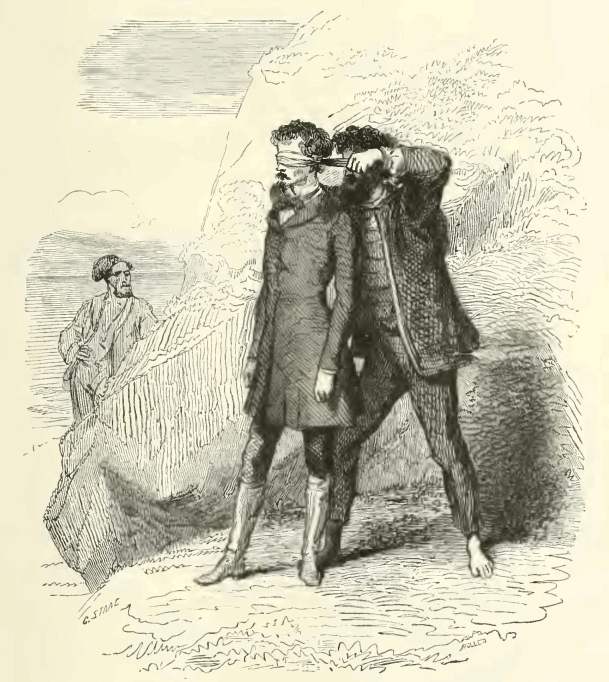
Franz drew his handkerchief from his pocket, and presented it to the
man who had spoken to him. Without uttering a word, they bandaged his
eyes with a care that showed their apprehensions of his committing some
indiscretion. Afterwards he was made to promise that he would not make
the least attempt to raise the bandage. He promised.
Then his two guides took his arms, and he went on, guided by them, and
preceded by the sentinel. After going about thirty paces, he smelt the
appetizing odor of the kid that was roasting, and knew thus that he was
passing the bivouac; they then led him on about fifty paces farther,
evidently advancing towards that part of the shore where they would not
allow Gaetano to go—a refusal he could now comprehend.
Presently, by a change in the atmosphere, he knew that they were
entering a cave; after going on for a few seconds more he heard a
crackling, and it seemed to him as though the atmosphere again changed,
and became balmy and perfumed. At length his feet touched on a thick
and soft carpet, and his guides let go their hold of him. There was a
moment’s silence, and then a voice, in excellent French, although, with
a foreign accent, said:
“Welcome, sir. I beg you will remove your bandage.”
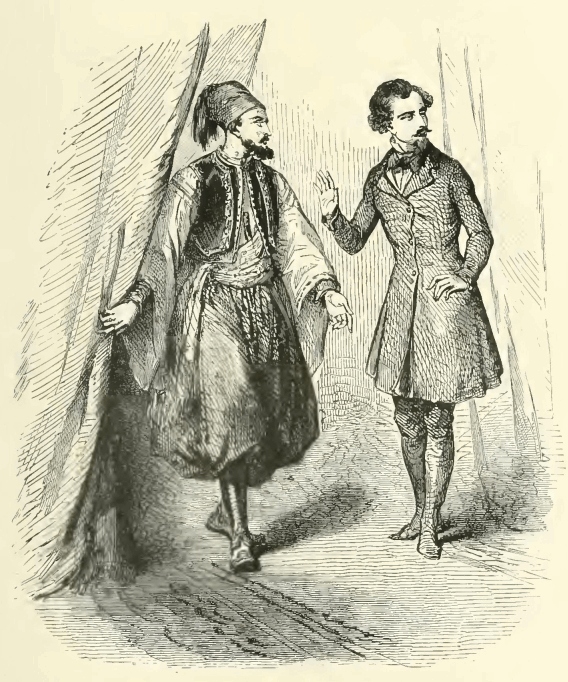
It may be supposed, then, Franz did not wait for a repetition of this
permission, but took off the handkerchief, and found himself in the
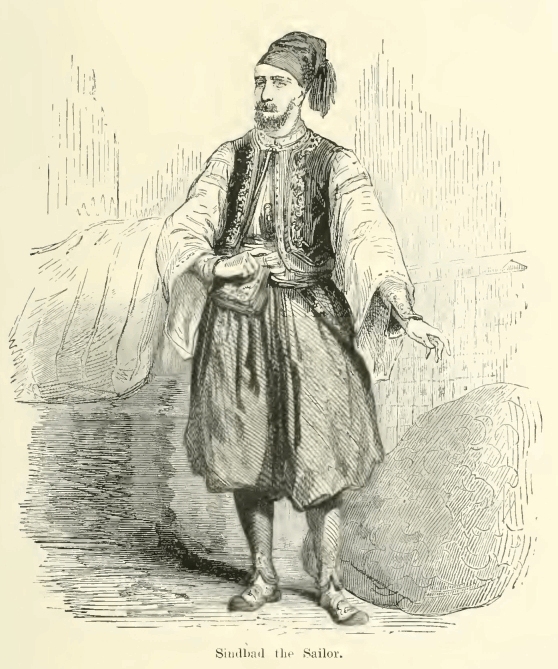
presence of a man from thirty-eight to forty years of age, dressed in a
Tunisian costume, that is to say, a red cap with a long blue silk
tassel, a vest of black cloth embroidered with gold, pantaloons of deep
red, large and full gaiters of the same color, embroidered with gold
like the vest, and yellow slippers; he had a splendid cashmere round
his waist, and a small sharp and crooked cangiar was passed through his
girdle.
Although of a paleness that was almost livid, this man had a remarkably
handsome face; his eyes were penetrating and sparkling; his nose, quite
straight, and projecting direct from the brow, was of the pure Greek
type, while his teeth, as white as pearls, were set off to admiration
by the black moustache that encircled them.
His pallor was so peculiar, that it seemed to pertain to one who had
been long entombed, and who was incapable of resuming the healthy glow
and hue of life. He was not particularly tall, but extremely well made,
and, like the men of the South, had small hands and feet. But what
astonished Franz, who had treated Gaetano’s description as a fable, was
the splendor of the apartment in which he found himself.
The entire chamber was lined with crimson brocade, worked with flowers
of gold. In a recess was a kind of divan, surmounted with a stand of
Arabian swords in silver scabbards, and the handles resplendent with
gems; from the ceiling hung a lamp of Venetian glass, of beautiful
shape and color, while the feet rested on a Turkey carpet, in which
they sunk to the instep; tapestry hung before the door by which Franz
had entered, and also in front of another door, leading into a second
apartment which seemed to be brilliantly illuminated.
The host gave Franz time to recover from his surprise, and, moreover,
returned look for look, not even taking his eyes off him.
“Sir,” he said, after a pause, “a thousand excuses for the precaution
taken in your introduction hither; but as, during the greater portion
of the year, this island is deserted, if the secret of this abode were
discovered, I should doubtless, find on my return my temporary
retirement in a state of great disorder, which would be exceedingly
annoying, not for the loss it occasioned me, but because I should not
have the certainty I now possess of separating myself from all the rest
of mankind at pleasure. Let me now endeavor to make you forget this
temporary unpleasantness, and offer you what no doubt you did not
expect to find here—that is to say, a tolerable supper and pretty
comfortable beds.”
“Ma foi, my dear sir,” replied Franz, “make no apologies. I have
always observed that they bandage people’s eyes who penetrate enchanted
palaces, for instance, those of Raoul in the Huguenots, and really I
have nothing to complain of, for what I see makes me think of the
wonders of the Arabian Nights.”
“Alas! I may say with Lucullus, if I could have anticipated the honor
of your visit, I would have prepared for it. But such as is my
hermitage, it is at your disposal; such as is my supper, it is yours to
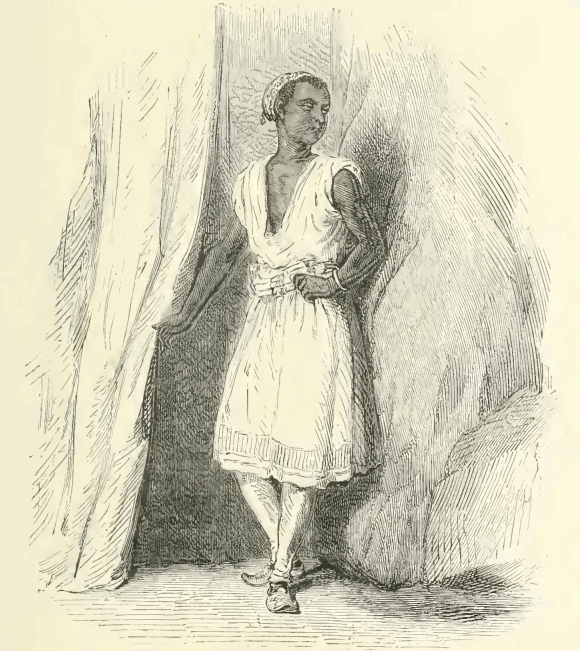
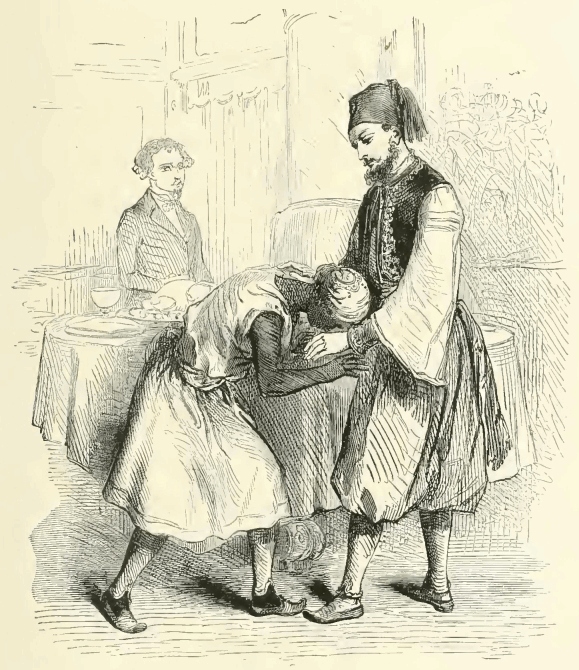
share, if you will. Ali, is the supper ready?”
At this moment the tapestry moved aside, and a Nubian, black as ebony,
and dressed in a plain white tunic, made a sign to his master that all
was prepared in the dining-room.
“Now,” said the unknown to Franz, “I do not know if you are of my
opinion, but I think nothing is more annoying than to remain two or
three hours together without knowing by name or appellation how to
address one another. Pray observe, that I too much respect the laws of
hospitality to ask your name or title. I only request you to give me
one by which I may have the pleasure of addressing you. As for myself,
that I may put you at your ease, I tell you that I am generally called
‘Sinbad the Sailor.’”
“And I,” replied Franz, “will tell you, as I only require his wonderful
lamp to make me precisely like Aladdin, that I see no reason why at
this moment I should not be called Aladdin. That will keep us from
going away from the East whither I am tempted to think I have been
conveyed by some good genius.”
“Well, then, Signor Aladdin,” replied the singular Amphitryon, “you
heard our repast announced, will you now take the trouble to enter the
dining-room, your humble servant going first to show the way?”
At these words, moving aside the tapestry, Sinbad preceded his guest.
Franz now looked upon another scene of enchantment; the table was
splendidly covered, and once convinced of this important point he cast
his eyes around him. The dining-room was scarcely less striking than
the room he had just left; it was entirely of marble, with antique
bas-reliefs of priceless value; and at the four corners of this
apartment, which was oblong, were four magnificent statues, having
baskets in their hands. These baskets contained four pyramids of most
splendid fruit; there were Sicily pine-apples, pomegranates from
Malaga, oranges from the Balearic Isles, peaches from France, and dates
from Tunis.
The supper consisted of a roast pheasant garnished with Corsican
blackbirds; a boar’s ham with jelly, a quarter of a kid with tartar
sauce, a glorious turbot, and a gigantic lobster. Between these large
dishes were smaller ones containing various dainties. The dishes were
of silver, and the plates of Japanese china.
Franz rubbed his eyes in order to assure himself that this was not a
dream. Ali alone was present to wait at table, and acquitted himself so
admirably, that the guest complimented his host thereupon.
“Yes,” replied he, while he did the honors of the supper with much ease
and grace—“yes, he is a poor devil who is much devoted to me, and does
all he can to prove it. He remembers that I saved his life, and as he
has a regard for his head, he feels some gratitude towards me for
having kept it on his shoulders.”
Ali approached his master, took his hand, and kissed it.
“Would it be impertinent, Signor Sinbad,” said Franz, “to ask you the
particulars of this kindness?”
“Oh, they are simple enough,” replied the host. “It seems the fellow
had been caught wandering nearer to the harem of the Bey of Tunis than
etiquette permits to one of his color, and he was condemned by the Bey
to have his tongue cut out, and his hand and head cut off; the tongue
the first day, the hand the second, and the head the third. I always
had a desire to have a mute in my service, so learning the day his
tongue was cut out, I went to the Bey, and proposed to give him for Ali
a splendid double-barreled gun, which I knew he was very desirous of
having. He hesitated a moment, he was so very desirous to complete the
poor devil’s punishment. But when I added to the gun an English cutlass
with which I had shivered his highness’s yataghan to pieces, the Bey
yielded, and agreed to forgive the hand and head, but on condition that
the poor fellow never again set foot in Tunis. This was a useless
clause in the bargain, for whenever the coward sees the first glimpse
of the shores of Africa, he runs down below, and can only be induced to
appear again when we are out of sight of that quarter of the globe.”
Franz remained a moment silent and pensive, hardly knowing what to
think of the half-kindness, half-cruelty, with which his host related
the brief narrative.
“And like the celebrated sailor whose name you have assumed,” he said,
by way of changing the conversation, “you pass your life in
travelling?”
“Yes. I made a vow at a time when I little thought I should ever be
able to accomplish it,” said the unknown with a singular smile; “and I
made some others also which I hope I may fulfil in due season.”
Although Sinbad pronounced these words with much calmness, his eyes
gave forth gleams of extraordinary ferocity.
“You have suffered a great deal, sir?” said Franz inquiringly.
Sinbad started and looked fixedly at him, as he replied, “What makes
you suppose so?”
“Everything,” answered Franz,—“your voice, your look, your pallid
complexion, and even the life you lead.”
“I?—I live the happiest life possible, the real life of a pasha. I am
king of all creation. I am pleased with one place, and stay there; I
get tired of it, and leave it; I am free as a bird and have wings like
one; my attendants obey my slightest wish. Sometimes I amuse myself by
delivering some bandit or criminal from the bonds of the law. Then I
have my mode of dispensing justice, silent and sure, without respite or
appeal, which condemns or pardons, and which no one sees. Ah, if you
had tasted my life, you would not desire any other, and would never
return to the world unless you had some great project to accomplish
there.”
“Revenge, for instance!” observed Franz.
The unknown fixed on the young man one of those looks which penetrate
into the depth of the heart and thoughts. “And why revenge?” he asked.
“Because,” replied Franz, “you seem to me like a man who, persecuted by
society, has a fearful account to settle with it.”
“Ah!” responded Sinbad, laughing with his singular laugh, which
displayed his white and sharp teeth. “You have not guessed rightly.
Such as you see me I am, a sort of philosopher, and one day perhaps I
shall go to Paris to rival Monsieur Appert, and the man in the little
blue cloak.”
“And will that be the first time you ever took that journey?”
“Yes; it will. I must seem to you by no means curious, but I assure you
that it is not my fault I have delayed it so long—it will happen one
day or the other.”
“And do you propose to make this journey very shortly?”
“I do not know; it depends on circumstances which depend on certain
arrangements.”
“I should like to be there at the time you come, and I will endeavor to
repay you, as far as lies in my power, for your liberal hospitality
displayed to me at Monte Cristo.”
“I should avail myself of your offer with pleasure,” replied the host,
“but, unfortunately, if I go there, it will be, in all probability,
incognito.”
The supper appeared to have been supplied solely for Franz, for the
unknown scarcely touched one or two dishes of the splendid banquet to
which his guest did ample justice. Then Ali brought on the dessert, or
rather took the baskets from the hands of the statues and placed them
on the table. Between the two baskets he placed a small silver cup with
a silver cover. The care with which Ali placed this cup on the table
roused Franz’s curiosity. He raised the cover and saw a kind of
greenish paste, something like preserved angelica, but which was
perfectly unknown to him. He replaced the lid, as ignorant of what the
cup contained as he was before he had looked at it, and then casting
his eyes towards his host he saw him smile at his disappointment.
“You cannot guess,” said he, “what there is in that small vase, can
you?”
“No, I really cannot.”
“Well, then, that green preserve is nothing less than the ambrosia
which Hebe served at the table of Jupiter.”
“But,” replied Franz, “this ambrosia, no doubt, in passing through
mortal hands has lost its heavenly appellation and assumed a human
name; in vulgar phrase, what may you term this composition, for which,
to tell the truth, I do not feel any particular desire?”
“Ah, thus it is that our material origin is revealed,” cried Sinbad;
“we frequently pass so near to happiness without seeing, without
regarding it, or if we do see and regard it, yet without recognizing
it. Are you a man for the substantials, and is gold your god? taste
this, and the mines of Peru, Guzerat, and Golconda are opened to you.
Are you a man of imagination—a poet? taste this, and the boundaries of
possibility disappear; the fields of infinite space open to you, you
advance free in heart, free in mind, into the boundless realms of
unfettered reverie. Are you ambitious, and do you seek after the
greatnesses of the earth? taste this, and in an hour you will be a
king, not a king of a petty kingdom hidden in some corner of Europe
like France, Spain, or England, but king of the world, king of the
universe, king of creation; without bowing at the feet of Satan, you
will be king and master of all the kingdoms of the earth. Is it not
tempting what I offer you, and is it not an easy thing, since it is
only to do thus? look!”
At these words he uncovered the small cup which contained the substance
so lauded, took a teaspoonful of the magic sweetmeat, raised it to his
lips, and swallowed it slowly with his eyes half shut and his head bent
backwards. Franz did not disturb him whilst he absorbed his favorite
sweetmeat, but when he had finished, he inquired:
“What, then, is this precious stuff?”
“Did you ever hear,” he replied, “of the Old Man of the Mountain, who
attempted to assassinate Philippe Auguste?”
“Of course I have.”
“Well, you know he reigned over a rich valley which was overhung by the
mountain whence he derived his picturesque name. In this valley were
magnificent gardens planted by Hassen-ben-Sabah, and in these gardens
isolated pavilions. Into these pavilions he admitted the elect, and
there, says Marco Polo, gave them to eat a certain herb, which
transported them to Paradise, in the midst of ever-blooming shrubs,
ever-ripe fruit, and ever-lovely virgins. What these happy persons took
for reality was but a dream; but it was a dream so soft, so voluptuous,
so enthralling, that they sold themselves body and soul to him who gave
it to them, and obedient to his orders as to those of a deity, struck
down the designated victim, died in torture without a murmur, believing
that the death they underwent was but a quick transition to that life
of delights of which the holy herb, now before you, had given them a
slight foretaste.”
“Then,” cried Franz, “it is hashish! I know that—by name at least.”
“That is it precisely, Signor Aladdin; it is hashish—the purest and
most unadulterated hashish of Alexandria,—the hashish of Abou-Gor, the
celebrated maker, the only man, the man to whom there should be built a
palace, inscribed with these words, _A grateful world to the dealer in
happiness_.”
“Do you know,” said Franz, “I have a very great inclination to judge
for myself of the truth or exaggeration of your eulogies.”
“Judge for yourself, Signor Aladdin—judge, but do not confine yourself
to one trial. Like everything else, we must habituate the senses to a
fresh impression, gentle or violent, sad or joyous. There is a struggle
in nature against this divine substance,—in nature which is not made
for joy and clings to pain. Nature subdued must yield in the combat,
the dream must succeed to reality, and then the dream reigns supreme,
then the dream becomes life, and life becomes the dream. But what
changes occur! It is only by comparing the pains of actual being with
the joys of the assumed existence, that you would desire to live no
longer, but to dream thus forever. When you return to this mundane
sphere from your visionary world, you would seem to leave a Neapolitan
spring for a Lapland winter—to quit paradise for earth—heaven for hell!
Taste the hashish, guest of mine—taste the hashish.”
Franz’s only reply was to take a teaspoonful of the marvellous
preparation, about as much in quantity as his host had eaten, and lift
it to his mouth.
“Diable!” he said, after having swallowed the divine preserve. “I do
not know if the result will be as agreeable as you describe, but the
thing does not appear to me as palatable as you say.”
“Because your palate his not yet been attuned to the sublimity of the
substances it flavors. Tell me, the first time you tasted oysters, tea,
porter, truffles, and sundry other dainties which you now adore, did
you like them? Could you comprehend how the Romans stuffed their
pheasants with assafœtida, and the Chinese eat swallows’ nests? Eh? no!
Well, it is the same with hashish; only eat for a week, and nothing in
the world will seem to you to equal the delicacy of its flavor, which
now appears to you flat and distasteful. Let us now go into the
adjoining chamber, which is your apartment, and Ali will bring us
coffee and pipes.”
They both arose, and while he who called himself Sinbad—and whom we
have occasionally named so, that we might, like his guest, have some
title by which to distinguish him—gave some orders to the servant,
Franz entered still another apartment.
It was simply yet richly furnished. It was round, and a large divan
completely encircled it. Divan, walls, ceiling, floor, were all covered
with magnificent skins as soft and downy as the richest carpets; there
were heavy-maned lion-skins from Atlas, striped tiger-skins from
Bengal; panther-skins from the Cape, spotted beautifully, like those
that appeared to Dante; bear-skins from Siberia, fox-skins from Norway,
and so on; and all these skins were strewn in profusion one on the
other, so that it seemed like walking over the most mossy turf, or
reclining on the most luxurious bed.
Both laid themselves down on the divan; chibouques with jasmine tubes
and amber mouthpieces were within reach, and all prepared so that there
was no need to smoke the same pipe twice. Each of them took one, which
Ali lighted and then retired to prepare the coffee.
There was a moment’s silence, during which Sinbad gave himself up to
thoughts that seemed to occupy him incessantly, even in the midst of
his conversation; and Franz abandoned himself to that mute reverie,
into which we always sink when smoking excellent tobacco, which seems
to remove with its fume all the troubles of the mind, and to give the
smoker in exchange all the visions of the soul. Ali brought in the
coffee.
“How do you take it?” inquired the unknown; “in the French or Turkish
style, strong or weak, sugar or none, cool or boiling? As you please;
it is ready in all ways.”
“I will take it in the Turkish style,” replied Franz.
“And you are right,” said his host; “it shows you have a tendency for
an Oriental life. Ah, those Orientals; they are the only men who know
how to live. As for me,” he added, with one of those singular smiles
which did not escape the young man, “when I have completed my affairs
in Paris, I shall go and die in the East; and should you wish to see me
again, you must seek me at Cairo, Bagdad, or Ispahan.”
“Ma foi,” said Franz, “it would be the easiest thing in the world;
for I feel eagle’s wings springing out at my shoulders, and with those
wings I could make a tour of the world in four-and-twenty hours.”
“Ah, yes, the hashish is beginning its work. Well, unfurl your wings,
and fly into superhuman regions; fear nothing, there is a watch over
you; and if your wings, like those of Icarus, melt before the sun, we
are here to ease your fall.”
He then said something in Arabic to Ali, who made a sign of obedience
and withdrew, but not to any distance.
As to Franz a strange transformation had taken place in him. All the
bodily fatigue of the day, all the preoccupation of mind which the
events of the evening had brought on, disappeared as they do at the
first approach of sleep, when we are still sufficiently conscious to be
aware of the coming of slumber. His body seemed to acquire an airy
lightness, his perception brightened in a remarkable manner, his senses
seemed to redouble their power, the horizon continued to expand; but it
was not the gloomy horizon of vague alarms, and which he had seen
before he slept, but a blue, transparent, unbounded horizon, with all
the blue of the ocean, all the spangles of the sun, all the perfumes of
the summer breeze; then, in the midst of the songs of his
sailors,—songs so clear and sonorous, that they would have made a
divine harmony had their notes been taken down,—he saw the Island of
Monte Cristo, no longer as a threatening rock in the midst of the
waves, but as an oasis in the desert; then, as his boat drew nearer,
the songs became louder, for an enchanting and mysterious harmony rose
to heaven, as if some Loreley had decreed to attract a soul thither, or
Amphion, the enchanter, intended there to build a city.
At length the boat touched the shore, but without effort, without
shock, as lips touch lips; and he entered the grotto amidst continued
strains of most delicious melody. He descended, or rather seemed to
descend, several steps, inhaling the fresh and balmy air, like that
which may be supposed to reign around the grotto of Circe, formed from
such perfumes as set the mind a-dreaming, and such fires as burn the
very senses; and he saw again all he had seen before his sleep, from
Sinbad, his singular host, to Ali, the mute attendant; then all seemed
to fade away and become confused before his eyes, like the last shadows
of the magic lantern before it is extinguished, and he was again in the
chamber of statues, lighted only by one of those pale and antique lamps
which watch in the dead of the night over the sleep of pleasure.
They were the same statues, rich in form, in attraction, and poesy,
with eyes of fascination, smiles of love, and bright and flowing hair.
They were Phryne, Cleopatra, Messalina, those three celebrated
courtesans. Then among them glided like a pure ray, like a Christian
angel in the midst of Olympus, one of those chaste figures, those calm
shadows, those soft visions, which seemed to veil its virgin brow
before these marble wantons.
Then the three statues advanced towards him with looks of love, and
approached the couch on which he was reposing, their feet hidden in
their long white tunics, their throats bare, hair flowing like waves,
and assuming attitudes which the gods could not resist, but which
saints withstood, and looks inflexible and ardent like those with which
the serpent charms the bird; and then he gave way before looks that
held him in a torturing grasp and delighted his senses as with a
voluptuous kiss.
It seemed to Franz that he closed his eyes, and in a last look about
him saw the vision of modesty completely veiled; and then followed a
dream of passion like that promised by the Prophet to the elect. Lips
of stone turned to flame, breasts of ice became like heated lava, so
that to Franz, yielding for the first time to the sway of the drug,
love was a sorrow and voluptuousness a torture, as burning mouths were
pressed to his thirsty lips, and he was held in cool serpent-like
embraces. The more he strove against this unhallowed passion the more
his senses yielded to its thrall, and at length, weary of a struggle
that taxed his very soul, he gave way and sank back breathless and
exhausted beneath the kisses of these marble goddesses, and the
enchantment of his marvellous dream.