The day after that in which the scene we have just described had taken
place on the road between Bellegarde and Beaucaire, a man of about
thirty or two-and-thirty, dressed in a bright blue frock coat, nankeen
trousers, and a white waistcoat, having the appearance and accent of an
Englishman, presented himself before the mayor of Marseilles.
“Sir,” said he, “I am chief clerk of the house of Thomson & French, of
Rome. We are, and have been these ten years, connected with the house
of Morrel & Son, of Marseilles. We have a hundred thousand francs or
thereabouts loaned on their securities, and we are a little uneasy at
reports that have reached us that the firm is on the brink of ruin. I
have come, therefore, express from Rome, to ask you for information.”
“Sir,” replied the mayor. “I know very well that during the last four
or five years misfortune has seemed to pursue M. Morrel. He has lost
four or five vessels, and suffered by three or four bankruptcies; but
it is not for me, although I am a creditor myself to the amount of ten
thousand francs, to give any information as to the state of his
finances. Ask of me, as mayor, what is my opinion of M. Morrel, and I
shall say that he is a man honorable to the last degree, and who has up
to this time fulfilled every engagement with scrupulous punctuality.
This is all I can say, sir; if you wish to learn more, address yourself
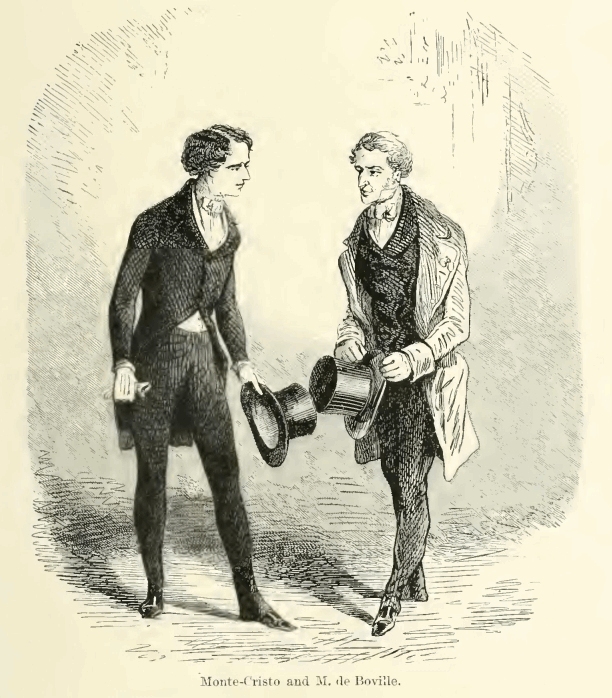
to M. de Boville, the inspector of prisons, No. 15, Rue de Nouailles;
he has, I believe, two hundred thousand francs in Morrel’s hands, and
if there be any grounds for apprehension, as this is a greater amount
than mine, you will most probably find him better informed than
myself.”
The Englishman seemed to appreciate this extreme delicacy, made his bow
and went away, proceeding with a characteristic British stride towards
the street mentioned.
M. de Boville was in his private room, and the Englishman, on
perceiving him, made a gesture of surprise, which seemed to indicate
that it was not the first time he had been in his presence. As to M. de
Boville, he was in such a state of despair, that it was evident all the
faculties of his mind, absorbed in the thought which occupied him at
the moment, did not allow either his memory or his imagination to stray
to the past.
The Englishman, with the coolness of his nation, addressed him in terms
nearly similar to those with which he had accosted the mayor of
Marseilles.
“Oh, sir,” exclaimed M. de Boville, “your fears are unfortunately but
too well founded, and you see before you a man in despair. I had two
hundred thousand francs placed in the hands of Morrel & Son; these two
hundred thousand francs were the dowry of my daughter, who was to be
married in a fortnight, and these two hundred thousand francs were
payable, half on the 15th of this month, and the other half on the 15th
of next month. I had informed M. Morrel of my desire to have these
payments punctually, and he has been here within the last half-hour to
tell me that if his ship, the Pharaon, did not come into port on the
15th, he would be wholly unable to make this payment.”
“But,” said the Englishman, “this looks very much like a suspension of
payment.”
“It looks more like bankruptcy!” exclaimed M. de Boville despairingly.
The Englishman appeared to reflect a moment, and then said, “From which
it would appear, sir, that this credit inspires you with considerable
apprehension?”
“To tell you the truth, I consider it lost.”
“Well, then, I will buy it of you!”
“You?”
“Yes, I!”
“But at a tremendous discount, of course?”
“No, for two hundred thousand francs. Our house,” added the Englishman
with a laugh, “does not do things in that way.”
“And you will pay——”
“Ready money.”
And the Englishman drew from his pocket a bundle of bank-notes, which
might have been twice the sum M. de Boville feared to lose. A ray of
joy passed across M. de Boville’s countenance, yet he made an effort at
self-control, and said:
“Sir, I ought to tell you that, in all probability, you will not
realize six per cent of this sum.”
“That’s no affair of mine,” replied the Englishman, “that is the affair
of the house of Thomson & French, in whose name I act. They have,
perhaps, some motive to serve in hastening the ruin of a rival firm.
But all I know, sir, is, that I am ready to hand you over this sum in
exchange for your assignment of the debt. I only ask a brokerage.”
“Of course, that is perfectly just,” cried M. de Boville. “The
commission is usually one and a half; will you have two—three—five per
cent, or even more? Whatever you say.”
“Sir,” replied the Englishman, laughing, “I am like my house, and do
not do such things—no, the commission I ask is quite different.”
“Name it, sir, I beg.”
“You are the inspector of prisons?”
“I have been so these fourteen years.”
“You keep the registers of entries and departures?”
“I do.”
“To these registers there are added notes relative to the prisoners?”
“There are special reports on every prisoner.”
“Well, sir, I was educated at Rome by a poor devil of an abbé, who
disappeared suddenly. I have since learned that he was confined in the
Château d’If, and I should like to learn some particulars of his
death.”
“What was his name?”
“The Abbé Faria.”
“Oh, I recollect him perfectly,” cried M. de Boville; “he was crazy.”
“So they said.”
“Oh, he was, decidedly.”
“Very possibly; but what sort of madness was it?”
“He pretended to know of an immense treasure, and offered vast sums to
the government if they would liberate him.”
“Poor devil!—and he is dead?”
“Yes, sir, five or six months ago, last February.”
“You have a good memory, sir, to recollect dates so well.”
“I recollect this, because the poor devil’s death was accompanied by a
singular incident.”
“May I ask what that was?” said the Englishman with an expression of
curiosity, which a close observer would have been astonished at
discovering in his phlegmatic countenance.
“Oh dear, yes, sir; the abbé’s dungeon was forty or fifty feet distant
from that of one of Bonaparte’s emissaries,—one of those who had
contributed the most to the return of the usurper in 1815, a very
resolute and very dangerous man.”
“Indeed!” said the Englishman.
“Yes,” replied M. de Boville; “I myself had occasion to see this man in
1816 or 1817, and we could only go into his dungeon with a file of
soldiers. That man made a deep impression on me; I shall never forget
his countenance!”
The Englishman smiled imperceptibly.
“And you say, sir,” he interposed, “that the two dungeons——”
“Were separated by a distance of fifty feet; but it appears that this
Edmond Dantès——”
“This dangerous man’s name was——”
“Edmond Dantès. It appears, sir, that this Edmond Dantès had procured
tools, or made them, for they found a tunnel through which the
prisoners held communication with one another.”
“This tunnel was dug, no doubt, with an intention of escape?”
“No doubt; but unfortunately for the prisoners, the Abbé Faria had an
attack of catalepsy, and died.”
“That must have cut short the projects of escape.”
“For the dead man, yes,” replied M. de Boville, “but not for the
survivor; on the contrary, this Dantès saw a means of accelerating his
escape. He, no doubt, thought that prisoners who died in the Château
d’If were interred in an ordinary burial-ground, and he conveyed the
dead man into his own cell, took his place in the sack in which they
had sewed up the corpse, and awaited the moment of interment.”
“It was a bold step, and one that showed some courage,” remarked the
Englishman.
“As I have already told you, sir, he was a very dangerous man; and,
fortunately, by his own act disembarrassed the government of the fears
it had on his account.”
“How was that?”
“How? Do you not comprehend?”
“No.”
“The Château d’If has no cemetery, and they simply throw the dead into
the sea, after fastening a thirty-six-pound cannon-ball to their feet.”
“Well?” observed the Englishman as if he were slow of comprehension.
“Well, they fastened a thirty-six-pound ball to his feet, and threw him
into the sea.”
“Really!” exclaimed the Englishman.
“Yes, sir,” continued the inspector of prisons. “You may imagine the
amazement of the fugitive when he found himself flung headlong over the
rocks! I should like to have seen his face at that moment.”
“That would have been difficult.”
“No matter,” replied De Boville, in supreme good-humor at the certainty
of recovering his two hundred thousand francs,—“no matter, I can fancy
it.” And he shouted with laughter.
“So can I,” said the Englishman, and he laughed too; but he laughed as
the English do, “at the end of his teeth.”
“And so,” continued the Englishman who first gained his composure, “he
was drowned?”
“Unquestionably.”
“So that the governor got rid of the dangerous and the crazy prisoner
at the same time?”
“Precisely.”
“But some official document was drawn up as to this affair, I suppose?”
inquired the Englishman.
“Yes, yes, the mortuary deposition. You understand, Dantès’ relations,
if he had any, might have some interest in knowing if he were dead or
alive.”
“So that now, if there were anything to inherit from him, they may do
so with easy conscience. He is dead, and no mistake about it.”
“Oh, yes; and they may have the fact attested whenever they please.”
“So be it,” said the Englishman. “But to return to these registers.”
“True, this story has diverted our attention from them. Excuse me.”
“Excuse you for what? For the story? By no means; it really seems to me
very curious.”
“Yes, indeed. So, sir, you wish to see all relating to the poor abbé,
who really was gentleness itself.”
“Yes, you will much oblige me.”
“Go into my study here, and I will show it to you.”
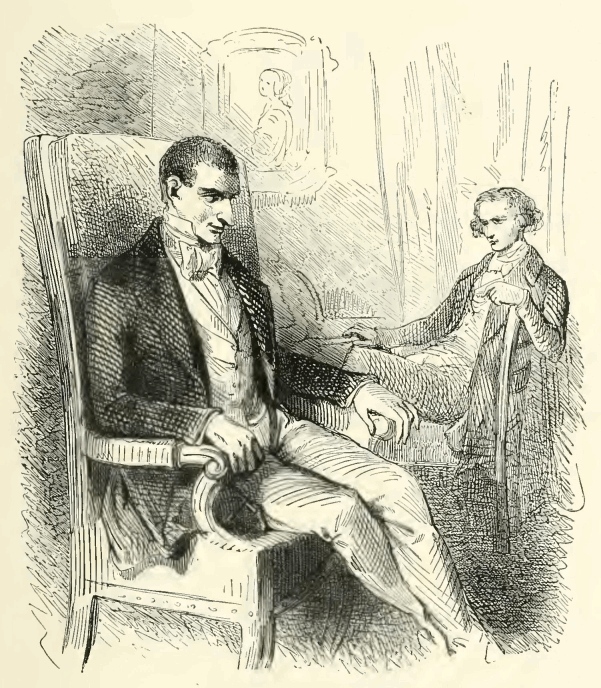
And they both entered M. de Boville’s study. Everything was here
arranged in perfect order; each register had its number, each file of
papers its place. The inspector begged the Englishman to seat himself
in an armchair, and placed before him the register and documents
relative to the Château d’If, giving him all the time he desired for
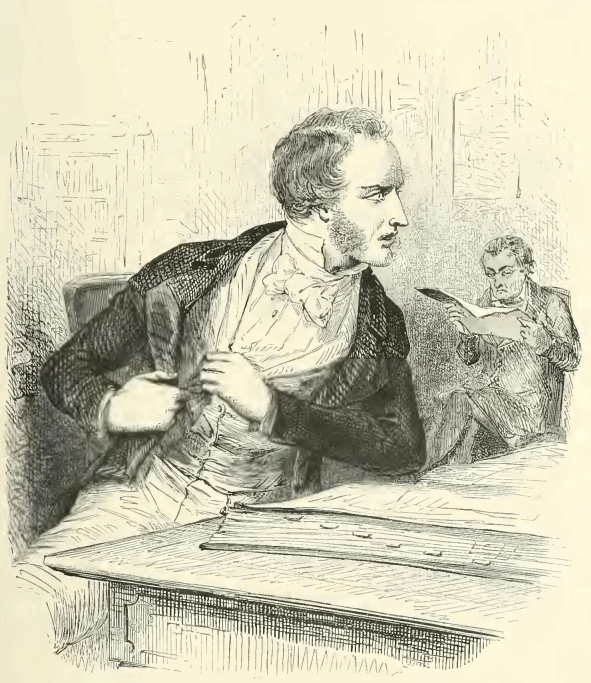
the examination, while De Boville seated himself in a corner, and began
to read his newspaper. The Englishman easily found the entries relative
to the Abbé Faria; but it seemed that the history which the inspector
had related interested him greatly, for after having perused the first
documents he turned over the leaves until he reached the deposition
respecting Edmond Dantès. There he found everything arranged in due
order,—the accusation, examination, Morrel’s petition, M. de
Villefort’s marginal notes. He folded up the accusation quietly, and
put it as quietly in his pocket; read the examination, and saw that the
name of Noirtier was not mentioned in it; perused, too, the application
dated 10th April, 1815, in which Morrel, by the deputy procureur’s
advice, exaggerated with the best intentions (for Napoleon was then on
the throne) the services Dantès had rendered to the imperial
cause—services which Villefort’s certificates rendered indisputable.
Then he saw through the whole thing. This petition to Napoleon, kept
back by Villefort, had become, under the second restoration, a terrible
weapon against him in the hands of the king’s attorney. He was no
longer astonished when he searched on to find in the register this
note, placed in a bracket against his name:
Edmond Dantès.
An inveterate Bonapartist; took an active part in the return from the
Island of Elba.
To be kept in strict solitary confinement, and to be closely watched
and guarded.
Beneath these lines was written in another hand: “See note
above—nothing can be done.”
He compared the writing in the bracket with the writing of the
certificate placed beneath Morrel’s petition, and discovered that the
note in the bracket was the same writing as the certificate—that is to
say, was in Villefort’s handwriting.
As to the note which accompanied this, the Englishman understood that
it might have been added by some inspector who had taken a momentary
interest in Dantès’ situation, but who had, from the remarks we have
quoted, found it impossible to give any effect to the interest he had
felt.
As we have said, the inspector, from discretion, and that he might not
disturb the Abbé Faria’s pupil in his researches, had seated himself in
a corner, and was reading Le Drapeau Blanc. He did not see the
Englishman fold up and place in his pocket the accusation written by
Danglars under the arbor of La Réserve, and which had the postmark,
“Marseilles, 27th February, delivery 6 o’clock, P.M.”
But it must be said that if he had seen it, he attached so little
importance to this scrap of paper, and so much importance to his two
hundred thousand francs, that he would not have opposed whatever the
Englishman might do, however irregular it might be.
“Thanks,” said the latter, closing the register with a slam, “I have
all I want; now it is for me to perform my promise. Give me a simple
assignment of your debt; acknowledge therein the receipt of the cash,
and I will hand you over the money.”
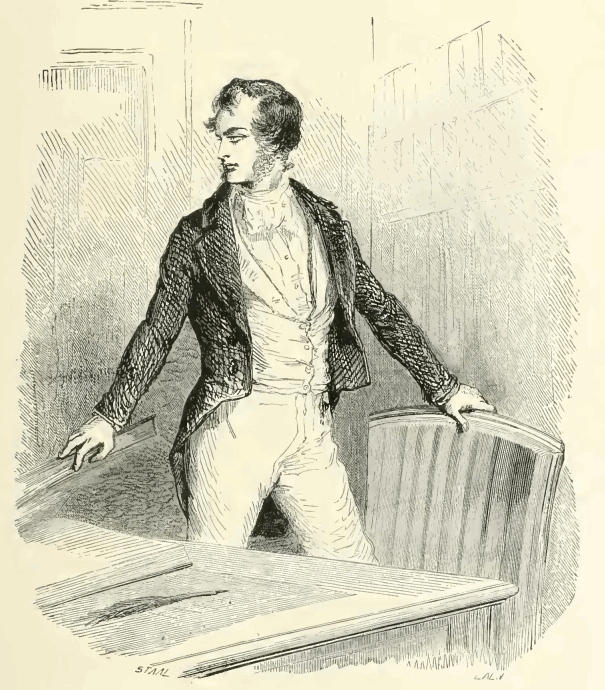
He rose, gave his seat to M. de Boville, who took it without ceremony,
and quickly drew up the required assignment, while the Englishman
counted out the bank-notes on the other side of the desk.
Chapter XXVI
At the Sign of the Pont du Gard
Such of my readers as have made a pedestrian excursion to the south of
France may perchance have noticed, about midway between the town of
Beaucaire and the village of Bellegarde,—a little nearer to the former
than to the latter,—a small roadside inn, from the front of which hung,
creaking and flapping in the wind, a sheet of tin covered with a
grotesque representation of the Pont du Gard. This modern place of
entertainment stood on the left-hand side of the post road, and backed
upon the Rhône. It also boasted of what in Languedoc is styled a
garden, consisting of a small plot of ground, on the side opposite to
the main entrance reserved for the reception of guests. A few dingy
olives and stunted fig-trees struggled hard for existence, but their
withered dusty foliage abundantly proved how unequal was the conflict.
Between these sickly shrubs grew a scanty supply of garlic, tomatoes,
and eschalots; while, lone and solitary, like a forgotten sentinel, a
tall pine raised its melancholy head in one of the corners of this
unattractive spot, and displayed its flexible stem and fan-shaped
summit dried and cracked by the fierce heat of the sub-tropical sun.
All these trees, great or small, were turned in the direction to which
the Mistral blows, one of the three curses of Provence, the others
being the Durance and the Parliament.
In the surrounding plain, which more resembled a dusty lake than solid
ground, were scattered a few miserable stalks of wheat, the effect, no
doubt, of a curious desire on the part of the agriculturists of the
country to see whether such a thing as the raising of grain in those
parched regions was practicable. Each stalk served as a perch for a
grasshopper, which regaled the passers-by through this Egyptian scene
with its strident, monotonous note.
For about seven or eight years the little tavern had been kept by a man
and his wife, with two servants,—a chambermaid named Trinette, and a
hostler called Pecaud. This small staff was quite equal to all the
requirements, for a canal between Beaucaire and Aiguemortes had
revolutionized transportation by substituting boats for the cart and
the stagecoach. And, as though to add to the daily misery which this
prosperous canal inflicted on the unfortunate innkeeper, whose utter
ruin it was fast accomplishing, it was situated between the Rhône from
which it had its source and the post-road it had depleted, not a
hundred steps from the inn, of which we have given a brief but faithful
description.
The innkeeper himself was a man of from forty to fifty-five years of
age, tall, strong, and bony, a perfect specimen of the natives of those
southern latitudes; he had dark, sparkling, and deep-set eyes, hooked
nose, and teeth white as those of a carnivorous animal; his hair, like
his beard, which he wore under his chin, was thick and curly, and in
spite of his age but slightly interspersed with a few silvery threads.
His naturally dark complexion had assumed a still further shade of
brown from the habit the unfortunate man had acquired of stationing
himself from morning till eve at the threshold of his door, on the
lookout for guests who seldom came, yet there he stood, day after day,
exposed to the meridional rays of a burning sun, with no other
protection for his head than a red handkerchief twisted around it,
after the manner of the Spanish muleteers. This man was our old
acquaintance, Gaspard Caderousse.
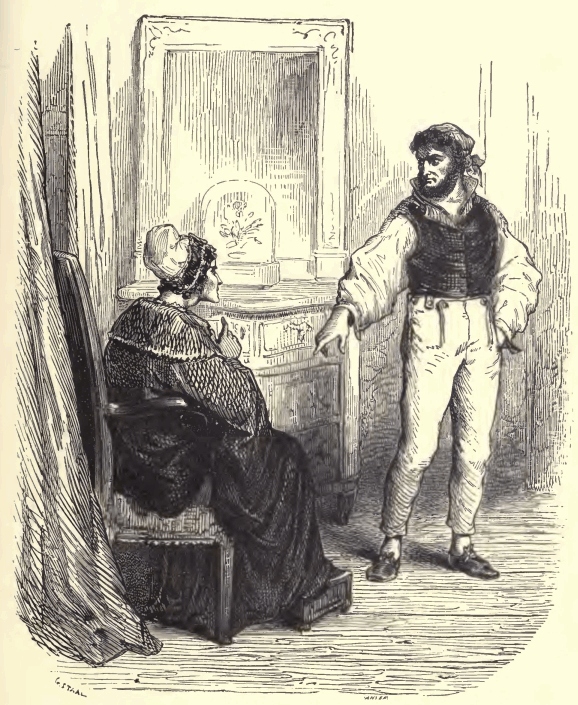
His wife, on the contrary, whose maiden name had been Madeleine
Radelle, was pale, meagre, and sickly-looking. Born in the neighborhood
of Arles, she had shared in the beauty for which its women are
proverbial; but that beauty had gradually withered beneath the
devastating influence of the slow fever so prevalent among dwellers by
the ponds of Aiguemortes and the marshes of Camargue. She remained
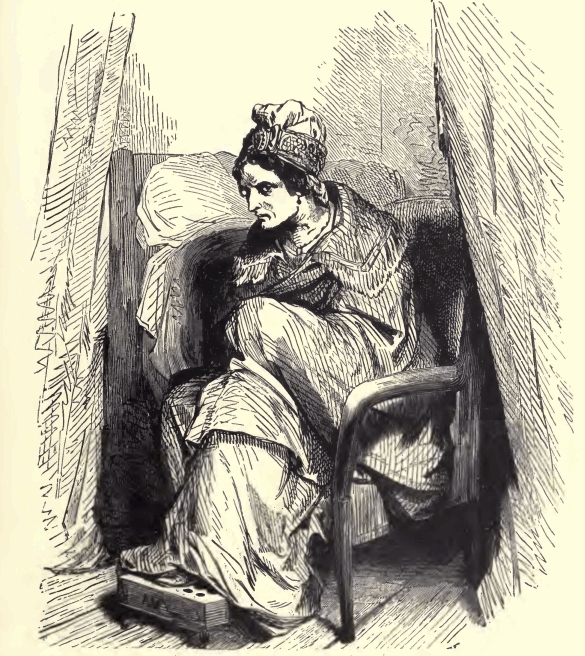
nearly always in her second-floor chamber, shivering in her chair, or
stretched languid and feeble on her bed, while her husband kept his
daily watch at the door—a duty he performed with so much the greater
willingness, as it saved him the necessity of listening to the endless
plaints and murmurs of his helpmate, who never saw him without breaking
out into bitter invectives against fate; to all of which her husband
would calmly return an unvarying reply, in these philosophic words:
“Hush, La Carconte. It is God’s pleasure that things should be so.”
The sobriquet of La Carconte had been bestowed on Madeleine Radelle
from the fact that she had been born in a village, so called, situated
between Salon and Lambesc; and as a custom existed among the
inhabitants of that part of France where Caderousse lived of styling
every person by some particular and distinctive appellation, her
husband had bestowed on her the name of La Carconte in place of her
sweet and euphonious name of Madeleine, which, in all probability, his
rude guttural language would not have enabled him to pronounce.
Still, let it not be supposed that amid this affected resignation to
the will of Providence, the unfortunate innkeeper did not writhe under
the double misery of seeing the hateful canal carry off his customers
and his profits, and the daily infliction of his peevish partner’s
murmurs and lamentations.
Like other dwellers in the south, he was a man of sober habits and
moderate desires, but fond of external show, vain, and addicted to
display. During the days of his prosperity, not a festivity took place
without himself and wife being among the spectators. He dressed in the
picturesque costume worn upon grand occasions by the inhabitants of the
south of France, bearing equal resemblance to the style adopted both by
the Catalans and Andalusians; while La Carconte displayed the charming
fashion prevalent among the women of Arles, a mode of attire borrowed
equally from Greece and Arabia. But, by degrees, watch-chains,
necklaces, parti-colored scarves, embroidered bodices, velvet vests,
elegantly worked stockings, striped gaiters, and silver buckles for the
shoes, all disappeared; and Gaspard Caderousse, unable to appear abroad
in his pristine splendor, had given up any further participation in the
pomps and vanities, both for himself and wife, although a bitter
feeling of envious discontent filled his mind as the sound of mirth and
merry music from the joyous revellers reached even the miserable
hostelry to which he still clung, more for the shelter than the profit
it afforded.
Caderousse, then, was, as usual, at his place of observation before the
door, his eyes glancing listlessly from a piece of closely shaven
grass—on which some fowls were industriously, though fruitlessly,
endeavoring to turn up some grain or insect suited to their palate—to
the deserted road, which led away to the north and south, when he was
aroused by the shrill voice of his wife, and grumbling to himself as he
went, he mounted to her chamber, first taking care, however, to set the
entrance door wide open, as an invitation to any chance traveller who
might be passing.
At the moment Caderousse quitted his sentry-like watch before the door,
the road on which he so eagerly strained his sight was void and lonely
as a desert at midday. There it lay stretching out into one
interminable line of dust and sand, with its sides bordered by tall,
meagre trees, altogether presenting so uninviting an appearance, that
no one in his senses could have imagined that any traveller, at liberty
to regulate his hours for journeying, would choose to expose himself in
such a formidable Sahara.
Nevertheless, had Caderousse but retained his post a few minutes
longer, he might have caught a dim outline of something approaching
from the direction of Bellegarde; as the moving object drew nearer,
he would easily have perceived that it consisted of a man and horse,
between whom the kindest and most amiable understanding appeared
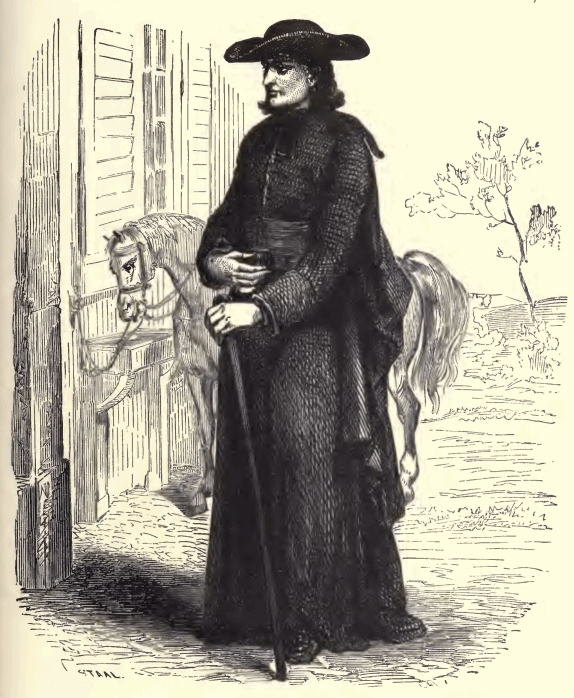
to exist. The horse was of Hungarian breed, and ambled along at an
easy pace. His rider was a priest, dressed in black, and wearing a
three-cornered hat; and, despite of the ardent rays of a noonday sun,
the pair came on with a fair degree of rapidity.
Having arrived before the Pont du Gard, the horse stopped, but whether
for his own pleasure or that of his rider would have been difficult to
say. However that might have been, the priest, dismounting, led his
steed by the bridle in search of some place to which he could secure
him. Availing himself of a handle that projected from a half-fallen
door, he tied the animal safely and having drawn a red cotton
handkerchief, from his pocket, wiped away the perspiration that
streamed from his brow, then, advancing to the door, struck thrice with
the end of his iron-shod stick.
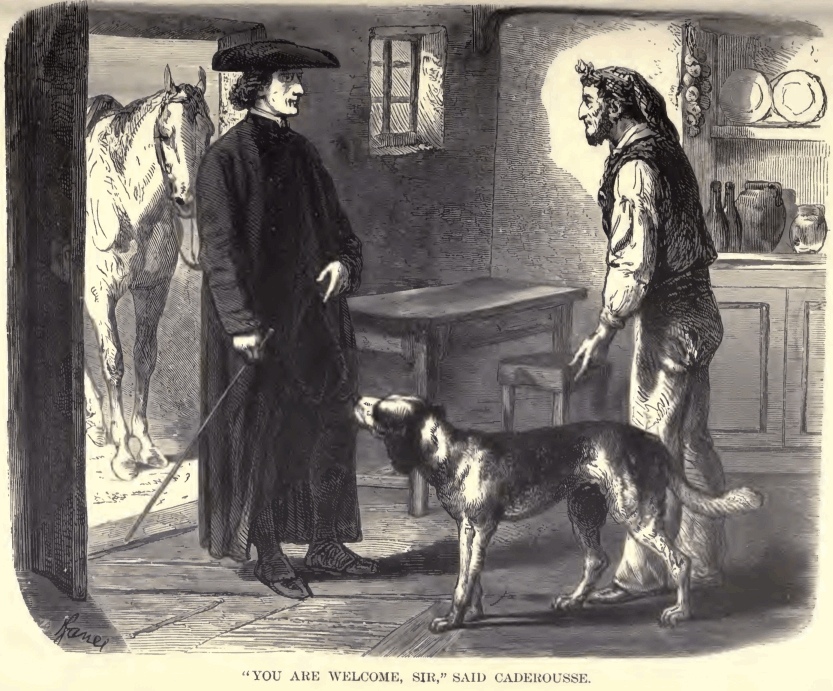
At this unusual sound, a huge black dog came rushing to meet the daring
assailant of his ordinarily tranquil abode, snarling and displaying his
sharp white teeth with a determined hostility that abundantly proved
how little he was accustomed to society. At that moment a heavy
footstep was heard descending the wooden staircase that led from the
upper floor, and, with many bows and courteous smiles, the host of the
Pont du Gard besought his guest to enter.
“You are welcome, sir, most welcome!” repeated the astonished
Caderousse. “Now, then, Margotin,” cried he, speaking to the dog, “will
you be quiet? Pray don’t heed him, sir!—he only barks, he never bites.
I make no doubt a glass of good wine would be acceptable this
dreadfully hot day.” Then perceiving for the first time the garb of the
traveller he had to entertain, Caderousse hastily exclaimed: “A
thousand pardons! I really did not observe whom I had the honor to
receive under my poor roof. What would the abbé please to have? What
refreshment can I offer? All I have is at his service.”
The priest gazed on the person addressing him with a long and searching
gaze—there even seemed a disposition on his part to court a similar
scrutiny on the part of the innkeeper; then, observing in the
countenance of the latter no other expression than extreme surprise at
his own want of attention to an inquiry so courteously worded, he
deemed it as well to terminate this dumb show, and therefore said,
speaking with a strong Italian accent, “You are, I presume, M.
Caderousse?”
“Yes, sir,” answered the host, even more surprised at the question than
he had been by the silence which had preceded it; “I am Gaspard
Caderousse, at your service.”
“Gaspard Caderousse,” rejoined the priest. “Yes,—Christian and surname
are the same. You formerly lived, I believe in the Allées de Meilhan,
on the fourth floor?”
“I did.”
“And you followed the business of a tailor?”
“True, I was a tailor, till the trade fell off. It is so hot at
Marseilles, that really I believe that the respectable inhabitants will
in time go without any clothing whatever. But talking of heat, is there
nothing I can offer you by way of refreshment?”
“Yes; let me have a bottle of your best wine, and then, with your
permission, we will resume our conversation from where we left off.”
“As you please, sir,” said Caderousse, who, anxious not to lose the
present opportunity of finding a customer for one of the few bottles of
Cahors still remaining in his possession, hastily raised a trap-door in
the floor of the apartment they were in, which served both as parlor
and kitchen.
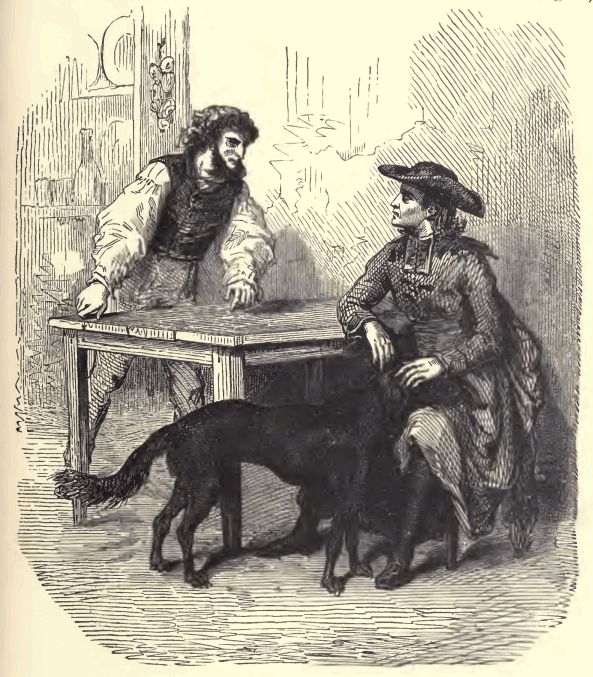
Upon issuing forth from his subterranean retreat at the expiration of
five minutes, he found the abbé seated upon a wooden stool, leaning his
elbow on a table, while Margotin, whose animosity seemed appeased by
the unusual command of the traveller for refreshments, had crept up to
him, and had established himself very comfortably between his knees,
his long, skinny neck resting on his lap, while his dim eye was fixed
earnestly on the traveller’s face.
“Are you quite alone?” inquired the guest, as Caderousse placed before
him the bottle of wine and a glass.
“Quite, quite alone,” replied the man—“or, at least, practically so,
for my poor wife, who is the only person in the house besides myself,
is laid up with illness, and unable to render me the least assistance,
poor thing!”
“You are married, then?” said the priest, with a show of interest,
glancing round as he spoke at the scanty furnishings of the apartment.
“Ah, sir,” said Caderousse with a sigh, “it is easy to perceive I am
not a rich man; but in this world a man does not thrive the better for
being honest.” The abbé fixed on him a searching, penetrating glance.
“Yes, honest—I can certainly say that much for myself,” continued the
innkeeper, fairly sustaining the scrutiny of the abbé’s gaze; “I can
boast with truth of being an honest man; and,” continued he
significantly, with a hand on his breast and shaking his head, “that is
more than everyone can say nowadays.”
“So much the better for you, if what you assert be true,” said the
abbé; “for I am firmly persuaded that, sooner or later, the good will
be rewarded, and the wicked punished.”
“Such words as those belong to your profession,” answered Caderousse,
“and you do well to repeat them; but,” added he, with a bitter
expression of countenance, “one is free to believe them or not, as one
pleases.”
“You are wrong to speak thus,” said the abbé; “and perhaps I may, in my
own person, be able to prove to you how completely you are in error.”
“What mean you?” inquired Caderousse with a look of surprise.
“In the first place, I must be satisfied that you are the person I am
in search of.”
“What proofs do you require?”
“Did you, in the year 1814 or 1815, know anything of a young sailor
named Dantès?”
“Dantès? Did I know poor dear Edmond? Why, Edmond Dantès and myself
were intimate friends!” exclaimed Caderousse, whose countenance flushed
darkly as he caught the penetrating gaze of the abbé fixed on him,
while the clear, calm eye of the questioner seemed to dilate with
feverish scrutiny.
“You remind me,” said the priest, “that the young man concerning whom I
asked you was said to bear the name of Edmond.”
“Said to bear the name!” repeated Caderousse, becoming excited and
eager. “Why, he was so called as truly as I myself bore the appellation
of Gaspard Caderousse; but tell me, I pray, what has become of poor
Edmond? Did you know him? Is he alive and at liberty? Is he prosperous
and happy?”
“He died a more wretched, hopeless, heart-broken prisoner than the
felons who pay the penalty of their crimes at the galleys of Toulon.”
A deadly pallor followed the flush on the countenance of Caderousse,
who turned away, and the priest saw him wiping the tears from his eyes
with the corner of the red handkerchief twisted round his head.
“Poor fellow, poor fellow!” murmured Caderousse. “Well, there, sir, is
another proof that good people are never rewarded on this earth, and
that none but the wicked prosper. Ah,” continued Caderousse, speaking
in the highly colored language of the South, “the world grows worse and
worse. Why does not God, if he really hates the wicked, as he is said
to do, send down brimstone and fire, and consume them altogether?”
“You speak as though you had loved this young Dantès,” observed the
abbé, without taking any notice of his companion’s vehemence.
“And so I did,” replied Caderousse; “though once, I confess, I envied
him his good fortune. But I swear to you, sir, I swear to you, by
everything a man holds dear, I have, since then, deeply and sincerely
lamented his unhappy fate.”
There was a brief silence, during which the fixed, searching eye of the
abbé was employed in scrutinizing the agitated features of the
innkeeper.
“You knew the poor lad, then?” continued Caderousse.
“I was called to see him on his dying bed, that I might administer to
him the consolations of religion.”
“And of what did he die?” asked Caderousse in a choking voice.
“Of what, think you, do young and strong men die in prison, when they
have scarcely numbered their thirtieth year, unless it be of
imprisonment?” Caderousse wiped away the large beads of perspiration
that gathered on his brow.
“But the strangest part of the story is,” resumed the abbé, “that
Dantès, even in his dying moments, swore by his crucified Redeemer,
that he was utterly ignorant of the cause of his detention.”
“And so he was,” murmured Caderousse. “How should he have been
otherwise? Ah, sir, the poor fellow told you the truth.”
“And for that reason, he besought me to try and clear up a mystery he
had never been able to penetrate, and to clear his memory should any
foul spot or stain have fallen on it.”
And here the look of the abbé, becoming more and more fixed, seemed to
rest with ill-concealed satisfaction on the gloomy depression which was
rapidly spreading over the countenance of Caderousse.
“A rich Englishman,” continued the abbé, “who had been his companion in
misfortune, but had been released from prison during the second
restoration, was possessed of a diamond of immense value; this jewel he
bestowed on Dantès upon himself quitting the prison, as a mark of his
gratitude for the kindness and brotherly care with which Dantès had
nursed him in a severe illness he underwent during his confinement.
Instead of employing this diamond in attempting to bribe his jailers,
who might only have taken it and then betrayed him to the governor,
Dantès carefully preserved it, that in the event of his getting out of
prison he might have wherewithal to live, for the sale of such a
diamond would have quite sufficed to make his fortune.”
“Then, I suppose,” asked Caderousse, with eager, glowing looks, “that
it was a stone of immense value?”
“Why, everything is relative,” answered the abbé. “To one in Edmond’s
position the diamond certainly was of great value. It was estimated at
fifty thousand francs.”
“Bless me!” exclaimed Caderousse, “fifty thousand francs! Surely the
diamond was as large as a nut to be worth all that.”
“No,” replied the abbé, “it was not of such a size as that; but you
shall judge for yourself. I have it with me.”
The sharp gaze of Caderousse was instantly directed towards the
priest’s garments, as though hoping to discover the location of the
treasure. Calmly drawing forth from his pocket a small box covered with
black shagreen, the abbé opened it, and displayed to the dazzled eyes
of Caderousse the sparkling jewel it contained, set in a ring of
admirable workmanship.
“And that diamond,” cried Caderousse, almost breathless with eager
admiration, “you say, is worth fifty thousand francs?”
“It is, without the setting, which is also valuable,” replied the abbé,
as he closed the box, and returned it to his pocket, while its
brilliant hues seemed still to dance before the eyes of the fascinated
innkeeper.
“But how comes the diamond in your possession, sir? Did Edmond make you
his heir?”
“No, merely his testamentary executor. ‘I once possessed four dear and
faithful friends, besides the maiden to whom I was betrothed’ he said;
‘and I feel convinced they have all unfeignedly grieved over my loss.
The name of one of the four friends is Caderousse.’” The innkeeper
shivered.
“‘Another of the number,’” continued the abbé, without seeming to
notice the emotion of Caderousse, “‘is called Danglars; and the third,
in spite of being my rival, entertained a very sincere affection for
me.’”
A fiendish smile played over the features of Caderousse, who was about
to break in upon the abbé’s speech, when the latter, waving his hand,
said, “Allow me to finish first, and then if you have any observations
to make, you can do so afterwards. ‘The third of my friends, although
my rival, was much attached to me,—his name was Fernand; that of my
betrothed was’—Stay, stay,” continued the abbé, “I have forgotten what
he called her.”
“Mercédès,” said Caderousse eagerly.
“True,” said the abbé, with a stifled sigh, “Mercédès it was.”
“Go on,” urged Caderousse.
“Bring me a carafe of water,” said the abbé.
Caderousse quickly performed the stranger’s bidding; and after pouring
some into a glass, and slowly swallowing its contents, the abbé,
resuming his usual placidity of manner, said, as he placed his empty
glass on the table:
“Where did we leave off?”
“The name of Edmond’s betrothed was Mercédès.”
“To be sure. ‘You will go to Marseilles,’ said Dantès,—for you
understand, I repeat his words just as he uttered them. Do you
understand?”
“Perfectly.”
“‘You will sell this diamond; you will divide the money into five equal
parts, and give an equal portion to these good friends, the only
persons who have loved me upon earth.’”
“But why into five parts?” asked Caderousse; “you only mentioned four
persons.”
“Because the fifth is dead, as I hear. The fifth sharer in Edmond’s
bequest, was his own father.”
“Too true, too true!” ejaculated Caderousse, almost suffocated by the
contending passions which assailed him, “the poor old man did die.”
“I learned so much at Marseilles,” replied the abbé, making a strong
effort to appear indifferent; “but from the length of time that has
elapsed since the death of the elder Dantès, I was unable to obtain any
particulars of his end. Can you enlighten me on that point?”
“I do not know who could if I could not,” said Caderousse. “Why, I
lived almost on the same floor with the poor old man. Ah, yes, about a
year after the disappearance of his son the poor old man died.”
“Of what did he die?”
“Why, the doctors called his complaint gastro-enteritis, I believe; his
acquaintances say he died of grief; but I, who saw him in his dying
moments, I say he died of——”
Caderousse paused.
“Of what?” asked the priest, anxiously and eagerly.
“Why, of downright starvation.”
“Starvation!” exclaimed the abbé, springing from his seat. “Why, the
vilest animals are not suffered to die by such a death as that. The
very dogs that wander houseless and homeless in the streets find some
pitying hand to cast them a mouthful of bread; and that a man, a
Christian, should be allowed to perish of hunger in the midst of other
men who call themselves Christians, is too horrible for belief. Oh, it
is impossible!—utterly impossible!”
“What I have said, I have said,” answered Caderousse.
“And you are a fool for having said anything about it,” said a voice
from the top of the stairs. “Why should you meddle with what does not
concern you?”
The two men turned quickly, and saw the sickly countenance of La
Carconte peering between the baluster rails; attracted by the sound of
voices, she had feebly dragged herself down the stairs, and, seated on
the lower step, head on knees, she had listened to the foregoing
conversation.
“Mind your own business, wife,” replied Caderousse sharply. “This
gentleman asks me for information, which common politeness will not
permit me to refuse.”
“Politeness, you simpleton!” retorted La Carconte. “What have you to do
with politeness, I should like to know? Better study a little common
prudence. How do you know the motives that person may have for trying
to extract all he can from you?”
“I pledge you my word, madam,” said the abbé, “that my intentions are
good; and that your husband can incur no risk, provided he answers me
candidly.”
“Ah, that’s all very fine,” retorted the woman. “Nothing is easier than
to begin with fair promises and assurances of nothing to fear; but when
poor, silly folks, like my husband there, have been persuaded to tell
all they know, the promises and assurances of safety are quickly
forgotten; and at some moment when nobody is expecting it, behold
trouble and misery, and all sorts of persecutions, are heaped on the
unfortunate wretches, who cannot even see whence all their afflictions
come.”
“Nay, nay, my good woman, make yourself perfectly easy, I beg of you.
Whatever evils may befall you, they will not be occasioned by my
instrumentality, that I solemnly promise you.”
La Carconte muttered a few inarticulate words, then let her head again
drop upon her knees, and went into a fit of ague, leaving the two
speakers to resume the conversation, but remaining so as to be able to
hear every word they uttered. Again the abbé had been obliged to
swallow a draught of water to calm the emotions that threatened to
overpower him.
When he had sufficiently recovered himself, he said, “It appears, then,
that the miserable old man you were telling me of was forsaken by
everyone. Surely, had not such been the case, he would not have
perished by so dreadful a death.”
“Why, he was not altogether forsaken,” continued Caderousse, “for
Mercédès the Catalan and Monsieur Morrel were very kind to him; but
somehow the poor old man had contracted a profound hatred for
Fernand—the very person,” added Caderousse with a bitter smile, “that
you named just now as being one of Dantès’ faithful and attached
friends.”
“And was he not so?” asked the abbé.
“Gaspard, Gaspard!” murmured the woman, from her seat on the stairs,
“mind what you are saying!”
Caderousse made no reply to these words, though evidently irritated and
annoyed by the interruption, but, addressing the abbé, said, “Can a man
be faithful to another whose wife he covets and desires for himself?
But Dantès was so honorable and true in his own nature, that he
believed everybody’s professions of friendship. Poor Edmond, he was
cruelly deceived; but it was fortunate that he never knew, or he might
have found it more difficult, when on his deathbed, to pardon his
enemies. And, whatever people may say,” continued Caderousse, in his
native language, which was not altogether devoid of rude poetry, “I
cannot help being more frightened at the idea of the malediction of the
dead than the hatred of the living.”
“Imbecile!” exclaimed La Carconte.
“Do you, then, know in what manner Fernand injured Dantès?” inquired
the abbé of Caderousse.
“Do I? No one better.”
“Speak out then, say what it was!”
“Gaspard!” cried La Carconte, “do as you will; you are master—but if
you take my advice you’ll hold your tongue.”
“Well, wife,” replied Caderousse, “I don’t know but what you’re right!”
“So you will say nothing?” asked the abbé.
“Why, what good would it do?” asked Caderousse. “If the poor lad were
living, and came to me and begged that I would candidly tell which were
his true and which his false friends, why, perhaps, I should not
hesitate. But you tell me he is no more, and therefore can have nothing
to do with hatred or revenge, so let all such feeling be buried with
him.”
“You prefer, then,” said the abbé, “that I should bestow on men you say
are false and treacherous, the reward intended for faithful
friendship?”
“That is true enough,” returned Caderousse. “You say truly, the gift of
poor Edmond was not meant for such traitors as Fernand and Danglars;
besides, what would it be to them? no more than a drop of water in the
ocean.”
“Remember,” chimed in La Carconte, “those two could crush you at a
single blow!”
“How so?” inquired the abbé. “Are these persons, then, so rich and
powerful?”
“Do you not know their history?”
“I do not. Pray relate it to me!”
Caderousse seemed to reflect for a few moments, then said, “No, truly,
it would take up too much time.”
“Well, my good friend,” returned the abbé, in a tone that indicated
utter indifference on his part, “you are at liberty, either to speak or
be silent, just as you please; for my own part, I respect your scruples
and admire your sentiments; so let the matter end. I shall do my duty
as conscientiously as I can, and fulfil my promise to the dying man. My
first business will be to dispose of this diamond.”
So saying, the abbé again drew the small box from his pocket, opened
it, and contrived to hold it in such a light, that a bright flash of
brilliant hues passed before the dazzled gaze of Caderousse.
“Wife, wife!” cried he in a hoarse voice, “come here!”
“Diamond!” exclaimed La Carconte, rising and descending to the chamber
with a tolerably firm step; “what diamond are you talking about?”
“Why, did you not hear all we said?” inquired Caderousse. “It is a
beautiful diamond left by poor Edmond Dantès, to be sold, and the money
divided between his father, Mercédès, his betrothed bride, Fernand,
Danglars, and myself. The jewel is worth at least fifty thousand
francs.”
“Oh, what a magnificent jewel!” cried the astonished woman.
“The fifth part of the profits from this stone belongs to us then, does
it not?” asked Caderousse.
“It does,” replied the abbé; “with the addition of an equal division of
that part intended for the elder Dantès, which I believe myself at
liberty to divide equally with the four survivors.”
“And why among us four?” inquired Caderousse.
“As being the friends Edmond esteemed most faithful and devoted to
him.”
“I don’t call those friends who betray and ruin you,” murmured the wife
in her turn, in a low, muttering voice.
“Of course not!” rejoined Caderousse quickly; “no more do I, and that
was what I was observing to this gentleman just now. I said I looked
upon it as a sacrilegious profanation to reward treachery, perhaps
crime.”
“Remember,” answered the abbé calmly, as he replaced the jewel and its
case in the pocket of his cassock, “it is your fault, not mine, that I
do so. You will have the goodness to furnish me with the address of
both Fernand and Danglars, in order that I may execute Edmond’s last
wishes.”
The agitation of Caderousse became extreme, and large drops of
perspiration rolled from his heated brow. As he saw the abbé rise from
his seat and go towards the door, as though to ascertain if his horse
were sufficiently refreshed to continue his journey, Caderousse and his
wife exchanged looks of deep meaning.
“There, you see, wife,” said the former, “this splendid diamond might
all be ours, if we chose!”
“Do you believe it?”
“Why, surely a man of his holy profession would not deceive us!”
“Well,” replied La Carconte, “do as you like. For my part, I wash my
hands of the affair.”
So saying, she once more climbed the staircase leading to her chamber,
her body convulsed with chills, and her teeth rattling in her head, in
spite of the intense heat of the weather. Arrived at the top stair, she
turned round, and called out, in a warning tone, to her husband,
“Gaspard, consider well what you are about to do!”
“I have both reflected and decided,” answered he.
La Carconte then entered her chamber, the flooring of which creaked
beneath her heavy, uncertain tread, as she proceeded towards her
armchair, into which she fell as though exhausted.
“Well,” asked the abbé, as he returned to the apartment below, “what
have you made up your mind to do?”
“To tell you all I know,” was the reply.
“I certainly think you act wisely in so doing,” said the priest. “Not
because I have the least desire to learn anything you may please to
conceal from me, but simply that if, through your assistance, I could
distribute the legacy according to the wishes of the testator, why, so
much the better, that is all.”
“I hope it may be so,” replied Caderousse, his face flushed with
cupidity.
“I am all attention,” said the abbé.
“Stop a minute,” answered Caderousse; “we might be interrupted in the
most interesting part of my story, which would be a pity; and it is as
well that your visit hither should be made known only to ourselves.”
With these words he went stealthily to the door, which he closed, and,
by way of still greater precaution, bolted and barred it, as he was
accustomed to do at night.
During this time the abbé had chosen his place for listening at his
ease. He removed his seat into a corner of the room, where he himself
would be in deep shadow, while the light would be fully thrown on the
narrator; then, with head bent down and hands clasped, or rather
clenched together, he prepared to give his whole attention to
Caderousse, who seated himself on the little stool, exactly opposite to
him.
“Remember, this is no affair of mine,” said the trembling voice of La
Carconte, as though through the flooring of her chamber she viewed the
scene that was enacting below.
“Enough, enough!” replied Caderousse; “say no more about it; I will
take all the consequences upon myself.”
And he began his story.
Chapter XXVII
Caderousse's Story
“First, sir,” said Caderousse, “you must make me a promise.”
“What is that?” inquired the abbé.
“Why, if you ever make use of the details I am about to give you, that
you will never let anyone know that it was I who supplied them; for the
persons of whom I am about to talk are rich and powerful, and if they
only laid the tips of their fingers on me, I should break to pieces
like glass.”
“Make yourself easy, my friend,” replied the abbé. “I am a priest, and
confessions die in my breast. Recollect, our only desire is to carry
out, in a fitting manner, the last wishes of our friend. Speak, then,
without reserve, as without hatred; tell the truth, the whole truth; I
do not know, never may know, the persons of whom you are about to
speak; besides, I am an Italian, and not a Frenchman, and belong to
God, and not to man, and I shall shortly retire to my convent, which I
have only quitted to fulfil the last wishes of a dying man.”
This positive assurance seemed to give Caderousse a little courage.
“Well, then, under these circumstances,” said Caderousse, “I will, I
even believe I ought to undeceive you as to the friendship which poor
Edmond thought so sincere and unquestionable.”
“Begin with his father, if you please.” said the abbé; “Edmond talked
to me a great deal about the old man for whom he had the deepest love.”
“The history is a sad one, sir,” said Caderousse, shaking his head;
“perhaps you know all the earlier part of it?”
“Yes.” answered the abbé; “Edmond related to me everything until the
moment when he was arrested in a small cabaret close to Marseilles.”
“At La Réserve! Oh, yes; I can see it all before me this moment.”
“Was it not his betrothal feast?”
“It was and the feast that began so gayly had a very sorrowful ending;
a police commissary, followed by four soldiers, entered, and Dantès was
arrested.”
“Yes, and up to this point I know all,” said the priest. “Dantès
himself only knew that which personally concerned him, for he never
beheld again the five persons I have named to you, or heard mention of
anyone of them.”
“Well, when Dantès was arrested, Monsieur Morrel hastened to obtain the
particulars, and they were very sad. The old man returned alone to his
home, folded up his wedding suit with tears in his eyes, and paced up
and down his chamber the whole day, and would not go to bed at all, for
I was underneath him and heard him walking the whole night; and for
myself, I assure you I could not sleep either, for the grief of the
poor father gave me great uneasiness, and every step he took went to my
heart as really as if his foot had pressed against my breast.
“The next day Mercédès came to implore the protection of M. de
Villefort; she did not obtain it, however, and went to visit the old
man; when she saw him so miserable and heart-broken, having passed a
sleepless night, and not touched food since the previous day, she
wished him to go with her that she might take care of him; but the old
man would not consent. ‘No,’ was the old man’s reply, ‘I will not leave
this house, for my poor dear boy loves me better than anything in the
world; and if he gets out of prison he will come and see me the first
thing, and what would he think if I did not wait here for him?’ I heard
all this from the window, for I was anxious that Mercédès should
persuade the old man to accompany her, for his footsteps over my head
night and day did not leave me a moment’s repose.”
“But did you not go upstairs and try to console the poor old man?”
asked the abbé.
“Ah, sir,” replied Caderousse, “we cannot console those who will not be
consoled, and he was one of these; besides, I know not why, but he
seemed to dislike seeing me. One night, however, I heard his sobs, and
I could not resist my desire to go up to him, but when I reached his
door he was no longer weeping but praying. I cannot now repeat to you,
sir, all the eloquent words and imploring language he made use of; it
was more than piety, it was more than grief, and I, who am no canter,
and hate the Jesuits, said then to myself, ‘It is really well, and I am
very glad that I have not any children; for if I were a father and felt
such excessive grief as the old man does, and did not find in my memory
or heart all he is now saying, I should throw myself into the sea at
once, for I could not bear it.’”
“Poor father!” murmured the priest.
“From day to day he lived on alone, and more and more solitary. M.
Morrel and Mercédès came to see him, but his door was closed; and,
although I was certain he was at home, he would not make any answer.
One day, when, contrary to his custom, he had admitted Mercédès, and
the poor girl, in spite of her own grief and despair, endeavored to
console him, he said to her,—‘Be assured, my dear daughter, he is dead;
and instead of expecting him, it is he who is awaiting us; I am quite
happy, for I am the oldest, and of course shall see him first.’
“However well disposed a person may be, why, you see we leave off after
a time seeing persons who are in sorrow, they make one melancholy; and
so at last old Dantès was left all to himself, and I only saw from time
to time strangers go up to him and come down again with some bundle
they tried to hide; but I guessed what these bundles were, and that he
sold by degrees what he had to pay for his subsistence. At length the
poor old fellow reached the end of all he had; he owed three quarters’
rent, and they threatened to turn him out; he begged for another week,
which was granted to him. I know this, because the landlord came into
my apartment when he left his.
“For the first three days I heard him walking about as usual, but, on
the fourth I heard nothing. I then resolved to go up to him at all
risks. The door was closed, but I looked through the keyhole, and saw
him so pale and haggard, that believing him very ill, I went and told
M. Morrel and then ran on to Mercédès. They both came immediately, M.
Morrel bringing a doctor, and the doctor said it was inflammation of
the bowels, and ordered him a limited diet. I was there, too, and I
never shall forget the old man’s smile at this prescription.
“From that time he received all who came; he had an excuse for not
eating any more; the doctor had put him on a diet.”
The abbé uttered a kind of groan.
“The story interests you, does it not, sir?” inquired Caderousse.
“Yes,” replied the abbé, “it is very affecting.”
“Mercédès came again, and she found him so altered that she was even
more anxious than before to have him taken to her own home. This was M.
Morrel’s wish also, who would fain have conveyed the old man against
his consent; but the old man resisted, and cried so that they were
actually frightened. Mercédès remained, therefore, by his bedside, and
M. Morrel went away, making a sign to the Catalan that he had left his
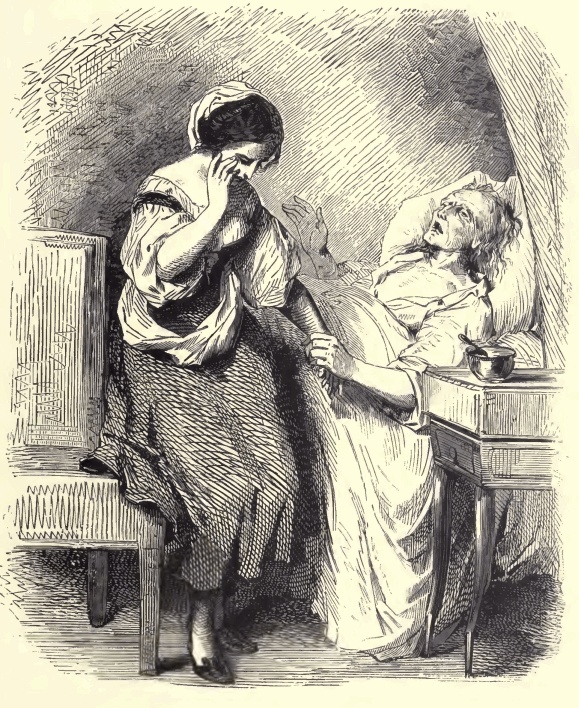
purse on the chimney-piece; but, availing himself of the doctor’s
order, the old man would not take any sustenance; at length (after nine
days of despair and fasting), the old man died, cursing those who had
caused his misery, and saying to Mercédès, ‘If you ever see my Edmond
again, tell him I die blessing him.’”
The abbé rose from his chair, made two turns round the chamber, and
pressed his trembling hand against his parched throat.
“And you believe he died——”
“Of hunger, sir, of hunger,” said Caderousse. “I am as certain of it as
that we two are Christians.”
The abbé, with a shaking hand, seized a glass of water that was
standing by him half-full, swallowed it at one gulp, and then resumed
his seat, with red eyes and pale cheeks.
“This was, indeed, a horrid event,” said he in a hoarse voice.
“The more so, sir, as it was men’s and not God’s doing.”
“Tell me of those men,” said the abbé, “and remember too,” he added in
an almost menacing tone, “you have promised to tell me everything. Tell
me, therefore, who are these men who killed the son with despair, and
the father with famine?”
“Two men jealous of him, sir; one from love, and the other from
ambition,—Fernand and Danglars.”
“How was this jealousy manifested? Speak on.”
“They denounced Edmond as a Bonapartist agent.”
“Which of the two denounced him? Which was the real delinquent?”
“Both, sir; one with a letter, and the other put it in the post.”
“And where was this letter written?”
“At La Réserve, the day before the betrothal feast.”
“’Twas so, then—’twas so, then,” murmured the abbé. “Oh, Faria, Faria,
how well did you judge men and things!”
“What did you please to say, sir?” asked Caderousse.
“Nothing, nothing,” replied the priest; “go on.”
“It was Danglars who wrote the denunciation with his left hand, that
his writing might not be recognized, and Fernand who put it in the
post.”
“But,” exclaimed the abbé suddenly, “you were there yourself.”
“I!” said Caderousse, astonished; “who told you I was there?”
The abbé saw he had overshot the mark, and he added quickly,—“No one;
but in order to have known everything so well, you must have been an
eye-witness.”
“True, true!” said Caderousse in a choking voice, “I was there.”
“And did you not remonstrate against such infamy?” asked the abbé; “if
not, you were an accomplice.”
“Sir,” replied Caderousse, “they had made me drink to such an excess
that I nearly lost all perception. I had only an indistinct
understanding of what was passing around me. I said all that a man in
such a state could say; but they both assured me that it was a jest
they were carrying on, and perfectly harmless.”
“Next day—next day, sir, you must have seen plain enough what they had
been doing, yet you said nothing, though you were present when Dantès
was arrested.”
“Yes, sir, I was there, and very anxious to speak; but Danglars
restrained me. ‘If he should really be guilty,’ said he, ‘and did
really put in to the Island of Elba; if he is really charged with a
letter for the Bonapartist committee at Paris, and if they find this
letter upon him, those who have supported him will pass for his
accomplices.’ I confess I had my fears, in the state in which politics
then were, and I held my tongue. It was cowardly, I confess, but it was
not criminal.”
“I understand—you allowed matters to take their course, that was all.”
“Yes, sir,” answered Caderousse; “and remorse preys on me night and
day. I often ask pardon of God, I swear to you, because this action,
the only one with which I have seriously to reproach myself in all my
life, is no doubt the cause of my abject condition. I am expiating a
moment of selfishness, and so I always say to La Carconte, when she
complains, ‘Hold your tongue, woman; it is the will of God.’” And
Caderousse bowed his head with every sign of real repentance.
“Well, sir,” said the abbé, “you have spoken unreservedly; and thus to
accuse yourself is to deserve pardon.”
“Unfortunately, Edmond is dead, and has not pardoned me.”
“He did not know,” said the abbé.
“But he knows it all now,” interrupted Caderousse; “they say the dead
know everything.”
There was a brief silence; the abbé rose and paced up and down
pensively, and then resumed his seat.
“You have two or three times mentioned a M. Morrel,” he said; “who was
he?”
“The owner of the Pharaon and patron of Dantès.”
“And what part did he play in this sad drama?” inquired the abbé.
“The part of an honest man, full of courage and real regard. Twenty
times he interceded for Edmond. When the emperor returned, he wrote,
implored, threatened, and so energetically, that on the second
restoration he was persecuted as a Bonapartist. Ten times, as I told
you, he came to see Dantès’ father, and offered to receive him in his
own house; and the night or two before his death, as I have already
said, he left his purse on the mantelpiece, with which they paid the
old man’s debts, and buried him decently; and so Edmond’s father died,
as he had lived, without doing harm to anyone. I have the purse still
by me—a large one, made of red silk.”
“And,” asked the abbé, “is M. Morrel still alive?”
“Yes,” replied Caderousse.
“In that case,” replied the abbé, “he should be a man blessed of God,
rich, happy.”
Caderousse smiled bitterly. “Yes, happy as myself,” said he.
“What! M. Morrel unhappy?” exclaimed the abbé.
“He is reduced almost to the last extremity—nay, he is almost at the
point of dishonor.”
“How?”
“Yes,” continued Caderousse, “so it is; after five-and-twenty years of
labor, after having acquired a most honorable name in the trade of
Marseilles, M. Morrel is utterly ruined; he has lost five ships in two
years, has suffered by the bankruptcy of three large houses, and his
only hope now is in that very Pharaon which poor Dantès commanded,
and which is expected from the Indies with a cargo of cochineal and
indigo. If this ship founders, like the others, he is a ruined man.”
“And has the unfortunate man wife or children?” inquired the abbé.
“Yes, he has a wife, who through everything has behaved like an angel;
he has a daughter, who was about to marry the man she loved, but whose
family now will not allow him to wed the daughter of a ruined man; he
has, besides, a son, a lieutenant in the army; and, as you may suppose,
all this, instead of lessening, only augments his sorrows. If he were
alone in the world he would blow out his brains, and there would be an
end.”
“Horrible!” ejaculated the priest.
“And it is thus heaven recompenses virtue, sir,” added Caderousse. “You
see, I, who never did a bad action but that I have told you of—am in
destitution, with my poor wife dying of fever before my very eyes, and
I unable to do anything in the world for her; I shall die of hunger, as
old Dantès did, while Fernand and Danglars are rolling in wealth.”
“How is that?”
“Because their deeds have brought them good fortune, while honest men
have been reduced to misery.”
“What has become of Danglars, the instigator, and therefore the most
guilty?”
“What has become of him? Why, he left Marseilles, and was taken, on the
recommendation of M. Morrel, who did not know his crime, as cashier
into a Spanish bank. During the war with Spain he was employed in the
commissariat of the French army, and made a fortune; then with that
money he speculated in the funds, and trebled or quadrupled his
capital; and, having first married his banker’s daughter, who left him
a widower, he has married a second time, a widow, a Madame de Nargonne,
daughter of M. de Servieux, the king’s chamberlain, who is in high
favor at court. He is a millionaire, and they have made him a baron,
and now he is the Baron Danglars, with a fine residence in the Rue du
Mont-Blanc, with ten horses in his stables, six footmen in his
antechamber, and I know not how many millions in his strongbox.”
“Ah!” said the abbé, in a peculiar tone, “he is happy.”
“Happy? Who can answer for that? Happiness or unhappiness is the secret
known but to one’s self and the walls—walls have ears but no tongue;
but if a large fortune produces happiness, Danglars is happy.”
“And Fernand?”
“Fernand? Why, much the same story.”
“But how could a poor Catalan fisher-boy, without education or
resources, make a fortune? I confess this staggers me.”
“And it has staggered everybody. There must have been in his life some
strange secret that no one knows.”
“But, then, by what visible steps has he attained this high fortune or
high position?”
“Both, sir—he has both fortune and position—both.”
“This must be impossible!”
“It would seem so; but listen, and you will understand. Some days
before the return of the emperor, Fernand was drafted. The Bourbons
left him quietly enough at the Catalans, but Napoleon returned, a
special levy was made, and Fernand was compelled to join. I went too;
but as I was older than Fernand, and had just married my poor wife, I
was only sent to the coast. Fernand was enrolled in the active army,
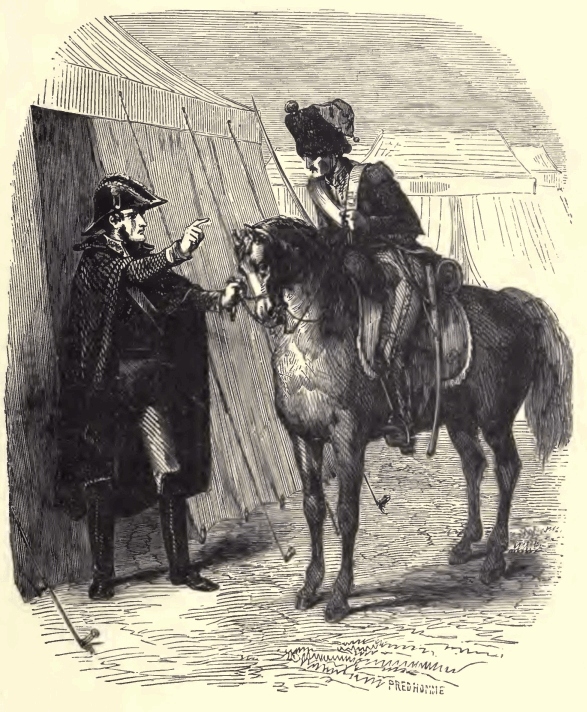
went to the frontier with his regiment, and was at the battle of Ligny.
The night after that battle he was sentry at the door of a general who
carried on a secret correspondence with the enemy. That same night the
general was to go over to the English. He proposed to Fernand to
accompany him; Fernand agreed to do so, deserted his post, and followed
the general.
“Fernand would have been court-martialed if Napoleon had remained on
the throne, but his action was rewarded by the Bourbons. He returned to
France with the epaulet of sub-lieutenant, and as the protection of the
general, who is in the highest favor, was accorded to him, he was a
captain in 1823, during the Spanish war—that is to say, at the time
when Danglars made his early speculations. Fernand was a Spaniard, and
being sent to Spain to ascertain the feeling of his fellow-countrymen,
found Danglars there, got on very intimate terms with him, won over the
support of the royalists at the capital and in the provinces, received
promises and made pledges on his own part, guided his regiment by paths
known to himself alone through the mountain gorges which were held by
the royalists, and, in fact, rendered such services in this brief
campaign that, after the taking of Trocadero, he was made colonel, and
received the title of count and the cross of an officer of the Legion
of Honor.”
“Destiny! destiny!” murmured the abbé.
“Yes, but listen: this was not all. The war with Spain being ended,
Fernand’s career was checked by the long peace which seemed likely to
endure throughout Europe. Greece only had risen against Turkey, and had
begun her war of independence; all eyes were turned towards Athens—it
was the fashion to pity and support the Greeks. The French government,
without protecting them openly, as you know, gave countenance to
volunteer assistance. Fernand sought and obtained leave to go and serve
in Greece, still having his name kept on the army roll.
Some time after, it was stated that the Comte de Morcerf (this was the
name he bore) had entered the service of Ali Pasha with the rank of
instructor-general. Ali Pasha was killed, as you know, but before he
died he recompensed the services of Fernand by leaving him a
considerable sum, with which he returned to France, when he was
gazetted lieutenant-general.”
“So that now——?” inquired the abbé.
“So that now,” continued Caderousse, “he owns a magnificent house—No.
27, Rue du Helder, Paris.”
The abbé opened his mouth, hesitated for a moment, then, making an
effort at self-control, he said, “And Mercédès—they tell me that she
has disappeared?”
“Disappeared,” said Caderousse, “yes, as the sun disappears, to rise
the next day with still more splendor.”
“Has she made a fortune also?” inquired the abbé, with an ironical
smile.
“Mercédès is at this moment one of the greatest ladies in Paris,”
replied Caderousse.
“Go on,” said the abbé; “it seems as if I were listening to the story
of a dream. But I have seen things so extraordinary, that what you tell
me seems less astonishing than it otherwise might.”
“Mercédès was at first in the deepest despair at the blow which
deprived her of Edmond. I have told you of her attempts to propitiate
M. de Villefort, her devotion to the elder Dantès. In the midst of her
despair, a new affliction overtook her. This was the departure of
Fernand—of Fernand, whose crime she did not know, and whom she regarded
as her brother. Fernand went, and Mercédès remained alone.
“Three months passed and still she wept—no news of Edmond, no news of
Fernand, no companionship save that of an old man who was dying with
despair. One evening, after a day of accustomed vigil at the angle of
two roads leading to Marseilles from the Catalans, she returned to her
home more depressed than ever. Suddenly she heard a step she knew,
turned anxiously around, the door opened, and Fernand, dressed in the
uniform of a sub-lieutenant, stood before her.
“It was not the one she wished for most, but it seemed as if a part of
her past life had returned to her.
“Mercédès seized Fernand’s hands with a transport which he took for
love, but which was only joy at being no longer alone in the world, and
seeing at last a friend, after long hours of solitary sorrow. And then,
it must be confessed, Fernand had never been hated—he was only not
precisely loved. Another possessed all Mercédès’ heart; that other was
absent, had disappeared, perhaps was dead. At this last thought
Mercédès burst into a flood of tears, and wrung her hands in agony; but
the thought, which she had always repelled before when it was suggested
to her by another, came now in full force upon her mind; and then, too,
old Dantès incessantly said to her, ‘Our Edmond is dead; if he were
not, he would return to us.’
“The old man died, as I have told you; had he lived, Mercédès,
perchance, had not become the wife of another, for he would have been
there to reproach her infidelity. Fernand saw this, and when he learned
of the old man’s death he returned. He was now a lieutenant. At his
first coming he had not said a word of love to Mercédès; at the second
he reminded her that he loved her.
“Mercédès begged for six months more in which to await and mourn for
Edmond.”
“So that,” said the abbé, with a bitter smile, “that makes eighteen
months in all. What more could the most devoted lover desire?” Then he
murmured the words of the English poet, “‘Frailty, thy name is woman.’”
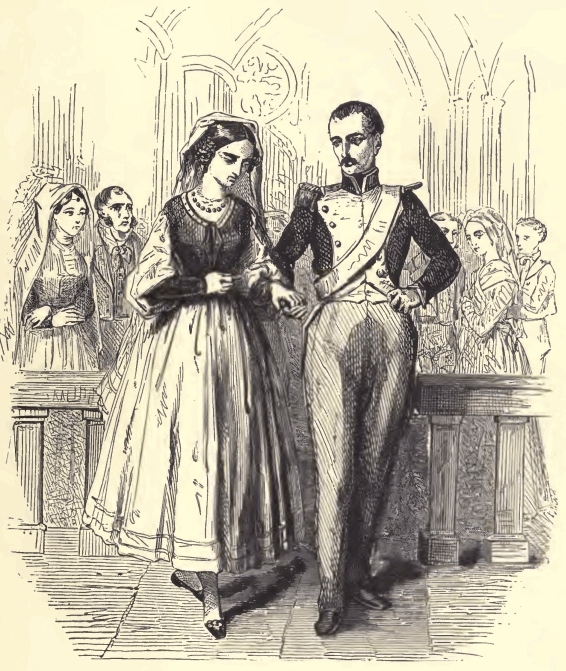
“Six months afterwards,” continued Caderousse, “the marriage took place
in the church of Accoules.”
“The very church in which she was to have married Edmond,” murmured the
priest; “there was only a change of bridegrooms.”
“Well, Mercédès was married,” proceeded Caderousse; “but although in
the eyes of the world she appeared calm, she nearly fainted as she
passed La Réserve, where, eighteen months before, the betrothal had
been celebrated with him whom she might have known she still loved, had
she looked to the bottom of her heart. Fernand, more happy, but not
more at his ease—for I saw at this time he was in constant dread of
Edmond’s return—Fernand was very anxious to get his wife away, and to
depart himself. There were too many unpleasant possibilities associated
with the Catalans, and eight days after the wedding they left
Marseilles.”
“Did you ever see Mercédès again?” inquired the priest.
“Yes, during the Spanish war, at Perpignan, where Fernand had left her;
she was attending to the education of her son.”
The abbé started. “Her son?” said he.
“Yes,” replied Caderousse, “little Albert.”
“But, then, to be able to instruct her child,” continued the abbé, “she
must have received an education herself. I understood from Edmond that
she was the daughter of a simple fisherman, beautiful but uneducated.”
“Oh,” replied Caderousse, “did he know so little of his lovely
betrothed? Mercédès might have been a queen, sir, if the crown were to
be placed on the heads of the loveliest and most intelligent. Fernand’s
fortune was already waxing great, and she developed with his growing
fortune. She learned drawing, music—everything. Besides, I believe,
between ourselves, she did this in order to distract her mind, that she
might forget; and she only filled her head in order to alleviate the
weight on her heart. But now her position in life is assured,”
continued Caderousse; “no doubt fortune and honors have comforted her;
she is rich, a countess, and yet——”
Caderousse paused.
“And yet what?” asked the abbé.
“Yet, I am sure, she is not happy,” said Caderousse.
“What makes you believe this?”
“Why, when I found myself utterly destitute, I thought my old friends
would, perhaps, assist me. So I went to Danglars, who would not even
receive me. I called on Fernand, who sent me a hundred francs by his
valet-de-chambre.”
“Then you did not see either of them?”
“No, but Madame de Morcerf saw me.”
“How was that?”
“As I went away a purse fell at my feet—it contained five-and-twenty
louis; I raised my head quickly, and saw Mercédès, who at once shut the
blind.”
“And M. de Villefort?” asked the abbé.
“Oh, he never was a friend of mine, I did not know him, and I had
nothing to ask of him.”
“Do you not know what became of him, and the share he had in Edmond’s
misfortunes?”
“No; I only know that some time after Edmond’s arrest, he married
Mademoiselle de Saint-Méran, and soon after left Marseilles; no doubt
he has been as lucky as the rest; no doubt he is as rich as Danglars,
as high in station as Fernand. I only, as you see, have remained poor,
wretched, and forgotten.”
“You are mistaken, my friend,” replied the abbé; “God may seem
sometimes to forget for a time, while his justice reposes, but there
always comes a moment when he remembers—and behold—a proof!”
As he spoke, the abbé took the diamond from his pocket, and giving it
to Caderousse, said, “Here, my friend, take this diamond, it is yours.”
“What, for me only?” cried Caderousse, “ah, sir, do not jest with me!”
“This diamond was to have been shared among his friends. Edmond had one
friend only, and thus it cannot be divided. Take the diamond, then, and
sell it; it is worth fifty thousand francs, and I repeat my wish that
this sum may suffice to release you from your wretchedness.”
“Oh, sir,” said Caderousse, putting out one hand timidly, and with the
other wiping away the perspiration which bedewed his brow,—“Oh, sir, do
not make a jest of the happiness or despair of a man.”
“I know what happiness and what despair are, and I never make a jest of
such feelings. Take it, then, but in exchange——”
Caderousse, who touched the diamond, withdrew his hand.
The abbé smiled.
“In exchange,” he continued, “give me the red silk purse that M. Morrel
left on old Dantès’ chimney-piece, and which you tell me is still in
your hands.”
Caderousse, more and more astonished, went toward a large oaken
cupboard, opened it, and gave the abbé a long purse of faded red silk,
round which were two copper runners that had once been gilt. The abbé
took it, and in return gave Caderousse the diamond.
“Oh, you are a man of God, sir,” cried Caderousse; “for no one knew
that Edmond had given you this diamond, and you might have kept it.”
“Which,” said the abbé to himself, “you would have done.” The abbé
rose, took his hat and gloves. “Well,” he said, “all you have told me
is perfectly true, then, and I may believe it in every particular.”
“See, sir,” replied Caderousse, “in this corner is a crucifix in holy
wood—here on this shelf is my wife’s testament; open this book, and I
will swear upon it with my hand on the crucifix. I will swear to you by
my soul’s salvation, my faith as a Christian, I have told everything to
you as it occurred, and as the recording angel will tell it to the ear
of God at the day of the last judgment!”
“’Tis well,” said the abbé, convinced by his manner and tone that
Caderousse spoke the truth. “’Tis well, and may this money profit you!
Adieu; I go far from men who thus so bitterly injure each other.”
The abbé with difficulty got away from the enthusiastic thanks of
Caderousse, opened the door himself, got out and mounted his horse,
once more saluted the innkeeper, who kept uttering his loud farewells,
and then returned by the road he had travelled in coming.
When Caderousse turned around, he saw behind him La Carconte, paler and
trembling more than ever.
“Is, then, all that I have heard really true?” she inquired.
“What? That he has given the diamond to us only?” inquired Caderousse,
half bewildered with joy; “yes, nothing more true! See, here it is.”
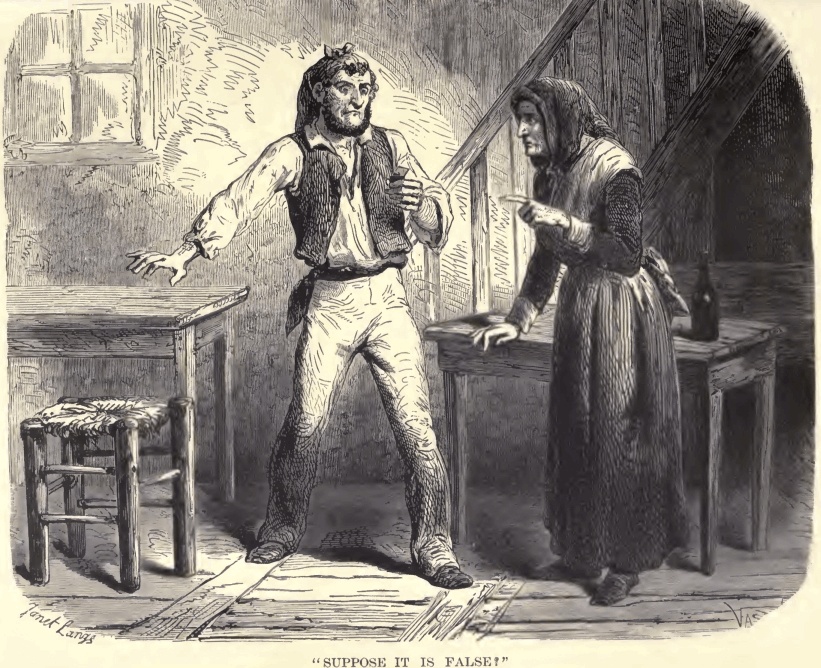
The woman gazed at it a moment, and then said, in a gloomy voice,
“Suppose it’s false?”
Caderousse started and turned pale.
“False!” he muttered. “False! Why should that man give me a false
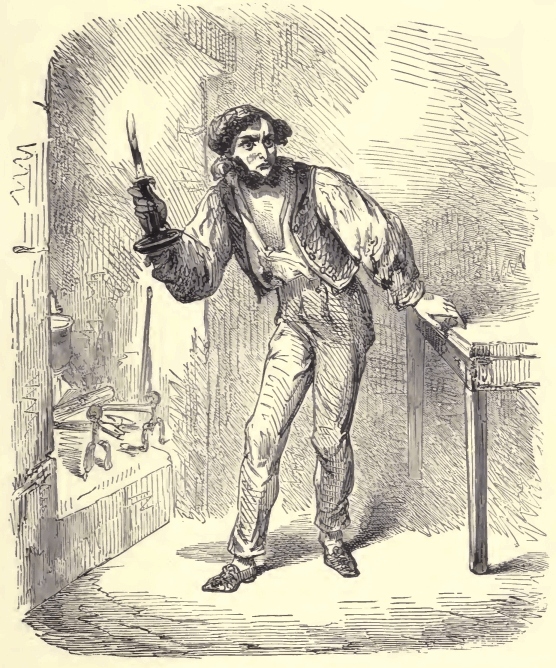
diamond?”
“To get your secret without paying for it, you blockhead!”
Caderousse remained for a moment aghast under the weight of such an
idea.
“Oh!” he said, taking up his hat, which he placed on the red
handkerchief tied round his head, “we will soon find out.”
“In what way?”
“Why, the fair is on at Beaucaire, there are always jewellers from
Paris there, and I will show it to them. Look after the house, wife,
and I shall be back in two hours,” and Caderousse left the house in
haste, and ran rapidly in the direction opposite to that which the
priest had taken.
“Fifty thousand francs!” muttered La Carconte when left alone; “it is a
large sum of money, but it is not a fortune.”