It will be recollected that the new, or rather old, acquaintances of
the Count of Monte Cristo, residing in the Rue Meslay, were no other
than Maximilian, Julie, and Emmanuel.
The very anticipations of delight to be enjoyed in his forthcoming
visits—the bright, pure gleam of heavenly happiness it diffused over
the almost deadly warfare in which he had voluntarily engaged,
illumined his whole countenance with a look of ineffable joy and
calmness, as, immediately after Villefort’s departure, his thoughts
flew back to the cheering prospect before him, of tasting, at least, a
brief respite from the fierce and stormy passions of his mind. Even
Ali, who had hastened to obey the Count’s summons, went forth from his
master’s presence in charmed amazement at the unusual animation and
pleasure depicted on features ordinarily so stern and cold; while, as
though dreading to put to flight the agreeable ideas hovering over his
patron’s meditations, whatever they were, the faithful Nubian walked on
tiptoe towards the door, holding his breath, lest its faintest sound
should dissipate his master’s happy reverie.
It was noon, and Monte Cristo had set apart one hour to be passed in
the apartments of Haydée, as though his oppressed spirit could not all
at once admit the feeling of pure and unmixed joy, but required a
gradual succession of calm and gentle emotions to prepare his mind to
receive full and perfect happiness, in the same manner as ordinary
natures demand to be inured by degrees to the reception of strong or
violent sensations.
The young Greek, as we have already said, occupied apartments wholly
unconnected with those of the count. The rooms had been fitted up in
strict accordance with Oriental ideas; the floors were covered with the
richest carpets Turkey could produce; the walls hung with brocaded silk
of the most magnificent designs and texture; while around each chamber
luxurious divans were placed, with piles of soft and yielding cushions,
that needed only to be arranged at the pleasure or convenience of such
as sought repose.
Haydée had three French maids, and one who was a Greek. The first three
remained constantly in a small waiting-room, ready to obey the summons
of a small golden bell, or to receive the orders of the Romaic slave,
who knew just enough French to be able to transmit her mistress’s
wishes to the three other waiting-women; the latter had received most
peremptory instructions from Monte Cristo to treat Haydée with all the
deference they would observe to a queen.
The young girl herself generally passed her time in the chamber at the
farther end of her apartments. This was a sort of boudoir, circular,
and lighted only from the roof, which consisted of rose-colored glass.
Haydée was reclining upon soft downy cushions, covered with blue satin
spotted with silver; her head, supported by one of her exquisitely
moulded arms, rested on the divan immediately behind her, while the
other was employed in adjusting to her lips the coral tube of a rich
narghile, through whose flexible pipe she drew the smoke fragrant by
its passage through perfumed water. Her attitude, though perfectly
natural for an Eastern woman would, in a European, have been deemed too
full of coquettish straining after effect.
Her dress, which was that of the women of Epirus, consisted of a pair
of white satin trousers, embroidered with pink roses, displaying feet
so exquisitely formed and so delicately fair, that they might well have
been taken for Parian marble, had not the eye been undeceived by their
movements as they constantly shifted in and out of a pair of little
slippers with upturned toes, beautifully ornamented with gold and
pearls. She wore a blue and white-striped vest, with long open sleeves,
trimmed with silver loops and buttons of pearls, and a sort of bodice,
which, closing only from the centre to the waist, exhibited the whole
of the ivory throat and upper part of the bosom; it was fastened with
three magnificent diamond clasps. The junction of the bodice and
drawers was entirely concealed by one of the many-colored scarves,
whose brilliant hues and rich silken fringe have rendered them so
precious in the eyes of Parisian belles.
Tilted on one side of her head she had a small cap of gold-colored
silk, embroidered with pearls; while on the other a purple rose mingled
its glowing colors with the luxuriant masses of her hair, of which the
blackness was so intense that it was tinged with blue.
The extreme beauty of the countenance, that shone forth in loveliness
that mocked the vain attempts of dress to augment it, was peculiarly
and purely Grecian; there were the large, dark, melting eyes, the
finely formed nose, the coral lips, and pearly teeth, that belonged to
her race and country.
And, to complete the whole, Haydée was in the very springtide and
fulness of youthful charms—she had not yet numbered more than nineteen
or twenty summers.
Monte Cristo summoned the Greek attendant, and bade her inquire whether
it would be agreeable to her mistress to receive his visit. Haydée’s
only reply was to direct her servant by a sign to withdraw the
tapestried curtain that hung before the door of her boudoir, the
framework of the opening thus made serving as a sort of border to the
graceful tableau presented by the young girl’s picturesque attitude and
appearance.
As Monte Cristo approached, she leaned upon the elbow of the arm that
held the narghile, and extending to him her other hand, said, with a
smile of captivating sweetness, in the sonorous language spoken by the
women of Athens and Sparta:
“Why demand permission ere you enter? Are you no longer my master, or
have I ceased to be your slave?”
Monte Cristo returned her smile.
“Haydée,” said he, “you well know.”
“Why do you address me so coldly—so distantly?” asked the young Greek.
“Have I by any means displeased you? Oh, if so, punish me as you will;
but do not—do not speak to me in tones and manner so formal and
constrained.”
“Haydée,” replied the count, “you know that you are now in France, and
are free.”
“Free to do what?” asked the young girl.
“Free to leave me.”
“Leave you? Why should I leave you?”
“That is not for me to say; but we are now about to mix in society—to
visit and be visited.”
“I don’t wish to see anybody but you.”
“And should you see one whom you could prefer, I would not be so
unjust——”
“I have never seen anyone I preferred to you, and I have never loved
anyone but you and my father.”
“My poor child,” replied Monte Cristo, “that is merely because your
father and myself are the only men who have ever talked to you.”
“I don’t want anybody else to talk to me. My father said I was his
‘joy’—you style me your ‘love,’—and both of you have called me ‘my
child.’”
“Do you remember your father, Haydée?”
The young Greek smiled.
“He is here, and here,” said she, touching her eyes and her heart.
“And where am I?” inquired Monte Cristo laughingly.
“You?” cried she, with tones of thrilling tenderness, “you are
everywhere!” Monte Cristo took the delicate hand of the young girl in
his, and was about to raise it to his lips, when the simple child of
nature hastily withdrew it, and presented her cheek.
“You now understand, Haydée,” said the count, “that from this moment
you are absolutely free; that here you exercise unlimited sway, and are
at liberty to lay aside or continue the costume of your country, as it
may suit your inclination. Within this mansion you are absolute
mistress of your actions, and may go abroad or remain in your
apartments as may seem most agreeable to you. A carriage waits your
orders, and Ali and Myrtho will accompany you whithersoever you desire
to go. There is but one favor I would entreat of you.”
“Speak.”
“Guard carefully the secret of your birth. Make no allusion to the
past; nor upon any occasion be induced to pronounce the names of your
illustrious father or ill-fated mother.”
“I have already told you, my lord, that I shall see no one.”
“It is possible, Haydée, that so perfect a seclusion, though
conformable with the habits and customs of the East, may not be
practicable in Paris. Endeavor, then, to accustom yourself to our
manner of living in these northern climes as you did to those of Rome,
Florence, Milan, and Madrid; it may be useful to you one of these days,
whether you remain here or return to the East.”
The young girl raised her tearful eyes towards Monte Cristo as she said
with touching earnestness, “Whether we return to the East, you mean
to say, my lord, do you not?”
“My child,” returned Monte Cristo “you know full well that whenever we
part, it will be no fault or wish of mine; the tree forsakes not the
flower—the flower falls from the tree.”
“My lord,” replied Haydée, “I never will leave you, for I am sure I
could not exist without you.”
“My poor girl, in ten years I shall be old, and you will be still
young.”
“My father had a long white beard, but I loved him; he was sixty years
old, but to me he was handsomer than all the fine youths I saw.”
“Then tell me, Haydée, do you believe you shall be able to accustom
yourself to our present mode of life?”
“Shall I see you?”
“Every day.”
“Then what do you fear, my lord?”
“You might find it dull.”
“No, my lord. In the morning, I shall rejoice in the prospect of your
coming, and in the evening dwell with delight on the happiness I have
enjoyed in your presence; then too, when alone, I can call forth mighty
pictures of the past, see vast horizons bounded only by the towering
mountains of Pindus and Olympus. Oh, believe me, that when three great
passions, such as sorrow, love, and gratitude fill the heart, ennui
can find no place.”
“You are a worthy daughter of Epirus, Haydée, and your charming and
poetical ideas prove well your descent from that race of goddesses who
claim your country as their birthplace. Depend on my care to see that
your youth is not blighted, or suffered to pass away in ungenial
solitude; and of this be well assured, that if you love me as a father,
I love you as a child.”
“You are wrong, my lord. The love I have for you is very different from
the love I had for my father. My father died, but I did not die. If you
were to die, I should die too.”
The count, with a smile of profound tenderness, extended his hand, and
she carried it to her lips.
Monte Cristo, thus attuned to the interview he proposed to hold with
Morrel and his family, departed, murmuring as he went these lines of
Pindar, “Youth is a flower of which love is the fruit; happy is he who,
after having watched its silent growth, is permitted to gather and call
it his own.” The carriage was prepared according to orders, and
stepping lightly into it, the count drove off at his usual rapid pace.
Chapter XLVII
The Dapple-Greys
The baron, followed by the count, traversed a long series of
apartments, in which the prevailing characteristics were heavy
magnificence and the gaudiness of ostentatious wealth, until he reached
the boudoir of Madame Danglars—a small octagonal-shaped room, hung with
pink satin, covered with white Indian muslin. The chairs were of
ancient workmanship and materials; over the doors were painted sketches
of shepherds and shepherdesses, after the style and manner of Boucher;
and at each side pretty medallions in crayons, harmonizing well with
the furnishings of this charming apartment, the only one throughout the
great mansion in which any distinctive taste prevailed. The truth was,
it had been entirely overlooked in the plan arranged and followed out
by M. Danglars and his architect, who had been selected to aid the
baron in the great work of improvement solely because he was the most
fashionable and celebrated decorator of the day. The decorations of the
boudoir had then been left entirely to Madame Danglars and Lucien
Debray. M. Danglars, however, while possessing a great admiration for
the antique, as it was understood during the time of the Directory,
entertained the most sovereign contempt for the simple elegance of his
wife’s favorite sitting-room, where, by the way, he was never permitted
to intrude, unless, indeed, he excused his own appearance by ushering
in some more agreeable visitor than himself; and even then he had
rather the air and manner of a person who was himself introduced, than
that of being the presenter of another, his reception being cordial or
frigid, in proportion as the person who accompanied him chanced to
please or displease the baroness.
Madame Danglars (who, although past the first bloom of youth, was still
strikingly handsome) was now seated at the piano, a most elaborate
piece of cabinet and inlaid work, while Lucien Debray, standing before
a small work-table, was turning over the pages of an album.
Lucien had found time, preparatory to the count’s arrival, to relate
many particulars respecting him to Madame Danglars. It will be
remembered that Monte Cristo had made a lively impression on the minds
of all the party assembled at the breakfast given by Albert de Morcerf;
and although Debray was not in the habit of yielding to such feelings,
he had never been able to shake off the powerful influence excited in
his mind by the impressive look and manner of the count, consequently
the description given by Lucien to the baroness bore the highly-colored
tinge of his own heated imagination. Already excited by the wonderful
stories related of the count by de Morcerf, it is no wonder that Madame
Danglars eagerly listened to, and fully credited, all the additional
circumstances detailed by Debray. This posing at the piano and over the
album was only a little ruse adopted by way of precaution. A most
gracious welcome and unusual smile were bestowed on M. Danglars; the
count, in return for his gentlemanly bow, received a formal though
graceful courtesy, while Lucien exchanged with the count a sort of
distant recognition, and with Danglars a free and easy nod.
“Baroness,” said Danglars, “give me leave to present to you the Count
of Monte Cristo, who has been most warmly recommended to me by my
correspondents at Rome. I need but mention one fact to make all the
ladies in Paris court his notice, and that is, that he has come to take
up his abode in Paris for a year, during which brief period he proposes
to spend six millions of money. That means balls, dinners, and lawn
parties without end, in all of which I trust the count will remember
us, as he may depend upon it we shall him, in our own humble
entertainments.”
In spite of the gross flattery and coarseness of this address, Madame
Danglars could not forbear gazing with considerable interest on a man
capable of expending six millions in twelve months, and who had
selected Paris for the scene of his princely extravagance.
“And when did you arrive here?” inquired she.
“Yesterday morning, madame.”
“Coming, as usual, I presume, from the extreme end of the globe? Pardon
me—at least, such I have heard is your custom.”
“Nay, madame. This time I have merely come from Cadiz.”
“You have selected a most unfavorable moment for your first visit.
Paris is a horrible place in summer. Balls, parties, and fêtes are
over; the Italian opera is in London; the French opera everywhere
except in Paris. As for the Théatre Français, you know, of course, that
it is nowhere. The only amusements left us are the indifferent races at
the Champ-de-Mars and Satory. Do you propose entering any horses at
either of these races, count?”
“I shall do whatever they do at Paris, madame, if I have the good
fortune to find someone who will initiate me into the prevalent ideas
of amusement.”
“Are you fond of horses, count?”
“I have passed a considerable part of my life in the East, madame, and
you are doubtless aware that the Orientals value only two things—the
fine breeding of their horses and the beauty of their women.”
“Nay, count,” said the baroness, “it would have been somewhat more
gallant to have placed the ladies first.”
“You see, madame, how rightly I spoke when I said I required a
preceptor to guide me in all my sayings and doings here.”
At this instant the favorite attendant of Madame Danglars entered the
boudoir; approaching her mistress, she spoke some words in an
undertone. Madame Danglars turned very pale, then exclaimed:
“I cannot believe it; the thing is impossible.”
“I assure you, madame,” replied the woman, “it is as I have said.”
Turning impatiently towards her husband, Madame Danglars demanded, “Is
this true?”
“Is what true, madame?” inquired Danglars, visibly agitated.
“What my maid tells me.”
“But what does she tell you?”
“That when my coachman was about to harness the horses to my carriage,
he discovered that they had been removed from the stables without his
knowledge. I desire to know what is the meaning of this?”
“Be kind enough, madame, to listen to me,” said Danglars.
“Oh, yes; I will listen, monsieur, for I am most curious to hear what
explanation you will give. These two gentlemen shall decide between us;
but, first, I will state the case to them. Gentlemen,” continued the
baroness, “among the ten horses in the stables of Baron Danglars, are
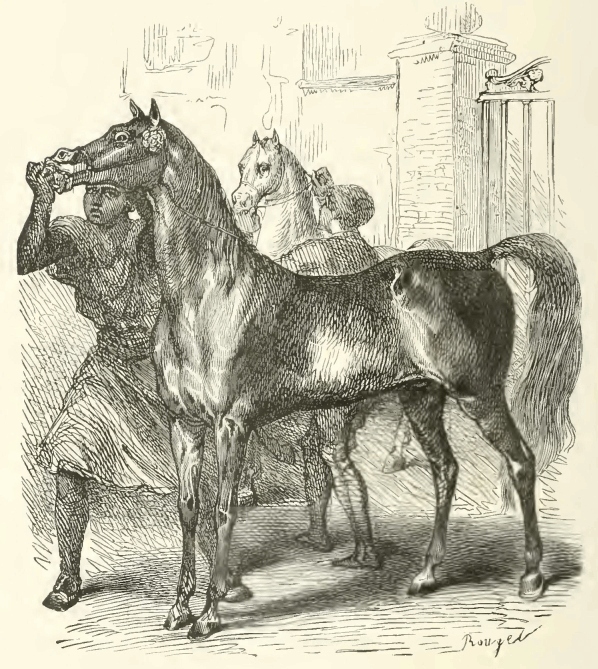
two that belong exclusively to me—a pair of the handsomest and most
spirited creatures to be found in Paris. But to you, at least, M.
Debray, I need not give a further description, because to you my
beautiful pair of dappled grays were well known. Well, I had promised
Madame de Villefort the loan of my carriage to drive tomorrow to the
Bois; but when my coachman goes to fetch the grays from the stables
they are gone—positively gone. No doubt M. Danglars has sacrificed them
to the selfish consideration of gaining some thousands of paltry
francs. Oh, what a detestable crew they are, these mercenary
speculators!”
“Madame,” replied Danglars, “the horses were not sufficiently quiet for
you; they were scarcely four years old, and they made me extremely
uneasy on your account.”
“Nonsense,” retorted the baroness; “you could not have entertained any
alarm on the subject, because you are perfectly well aware that I have
had for a month in my service the very best coachman in Paris. But,
perhaps, you have disposed of the coachman as well as the horses?”
“My dear love, pray do not say any more about them, and I promise you
another pair exactly like them in appearance, only more quiet and
steady.”
The baroness shrugged her shoulders with an air of ineffable contempt,
while her husband, affecting not to observe this unconjugal gesture,
turned towards Monte Cristo and said,—“Upon my word, count, I am quite
sorry not to have met you sooner. You are setting up an establishment,
of course?”
“Why, yes,” replied the count.
“I should have liked to have made you the offer of these horses. I have
almost given them away, as it is; but, as I before said, I was anxious
to get rid of them upon any terms. They were only fit for a young man.”
“I am much obliged by your kind intentions towards me,” said Monte
Cristo; “but this morning I purchased a very excellent pair of
carriage-horses, and I do not think they were dear. There they are.
Come, M. Debray, you are a connoisseur, I believe, let me have your
opinion upon them.”
As Debray walked towards the window, Danglars approached his wife.
“I could not tell you before others,” said he in a low tone, “the
reason of my parting with the horses; but a most enormous price was
offered me this morning for them. Some madman or fool, bent upon
ruining himself as fast as he can, actually sent his steward to me to
purchase them at any cost; and the fact is, I have gained 16,000 francs
by the sale of them. Come, don’t look so angry, and you shall have
4,000 francs of the money to do what you like with, and Eugénie shall
have 2,000. There, what do you think now of the affair? Wasn’t I right
to part with the horses?”
Madame Danglars surveyed her husband with a look of withering contempt.
“Great heavens?” suddenly exclaimed Debray.
“What is it?” asked the baroness.
“I cannot be mistaken; there are your horses! The very animals we were
speaking of, harnessed to the count’s carriage!”
“My dappled grays?” demanded the baroness, springing to the window.
“’Tis indeed they!” said she.
Danglars looked absolutely stupefied.
“How very singular,” cried Monte Cristo with well-feigned astonishment.
“I cannot believe it,” murmured the banker. Madame Danglars whispered a
few words in the ear of Debray, who approached Monte Cristo, saying,
“The baroness wishes to know what you paid her husband for the horses.”
“I scarcely know,” replied the count; “it was a little surprise
prepared for me by my steward, and cost me—well, somewhere about 30,000
francs.”
Debray conveyed the count’s reply to the baroness. Poor Danglars looked
so crest-fallen and discomfited that Monte Cristo assumed a pitying air
towards him.
“See,” said the count, “how very ungrateful women are. Your kind
attention, in providing for the safety of the baroness by disposing of
the horses, does not seem to have made the least impression on her. But
so it is; a woman will often, from mere wilfulness, prefer that which
is dangerous to that which is safe. Therefore, in my opinion, my dear
baron, the best and easiest way is to leave them to their fancies, and
allow them to act as they please, and then, if any mischief follows,
why, at least, they have no one to blame but themselves.”
Danglars made no reply; he was occupied in anticipations of the coming
scene between himself and the baroness, whose frowning brow, like that
of Olympic Jove, predicted a storm. Debray, who perceived the gathering
clouds, and felt no desire to witness the explosion of Madame Danglars’
rage, suddenly recollected an appointment, which compelled him to take
his leave; while Monte Cristo, unwilling by prolonging his stay to
destroy the advantages he hoped to obtain, made a farewell bow and
departed, leaving Danglars to endure the angry reproaches of his wife.
“Excellent,” murmured Monte Cristo to himself, as he came away. “All
has gone according to my wishes. The domestic peace of this family is
henceforth in my hands. Now, then, to play another master-stroke, by
which I shall gain the heart of both husband and wife—delightful!
Still,” added he, “amid all this, I have not yet been presented to
Mademoiselle Eugénie Danglars, whose acquaintance I should have been
glad to make. But,” he went on with his peculiar smile, “I am here in
Paris, and have plenty of time before me—by and by will do for that.”
With these reflections he entered his carriage and returned home. Two
hours afterwards, Madame Danglars received a most flattering epistle
from the count, in which he entreated her to receive back her favorite
“dappled grays,” protesting that he could not endure the idea of making
his entry into the Parisian world of fashion with the knowledge that
his splendid equipage had been obtained at the price of a lovely
woman’s regrets. The horses were sent back wearing the same harness she
had seen on them in the morning; only, by the count’s orders, in the
centre of each rosette that adorned either side of their heads, had
been fastened a large diamond.
To Danglars Monte Cristo also wrote, requesting him to excuse the
whimsical gift of a capricious millionaire, and to beg the baroness to
pardon the Eastern fashion adopted in the return of the horses.
During the evening, Monte Cristo quitted Paris for Auteuil, accompanied
by Ali. The following day, about three o’clock, a single blow struck on
the gong summoned Ali to the presence of the count.
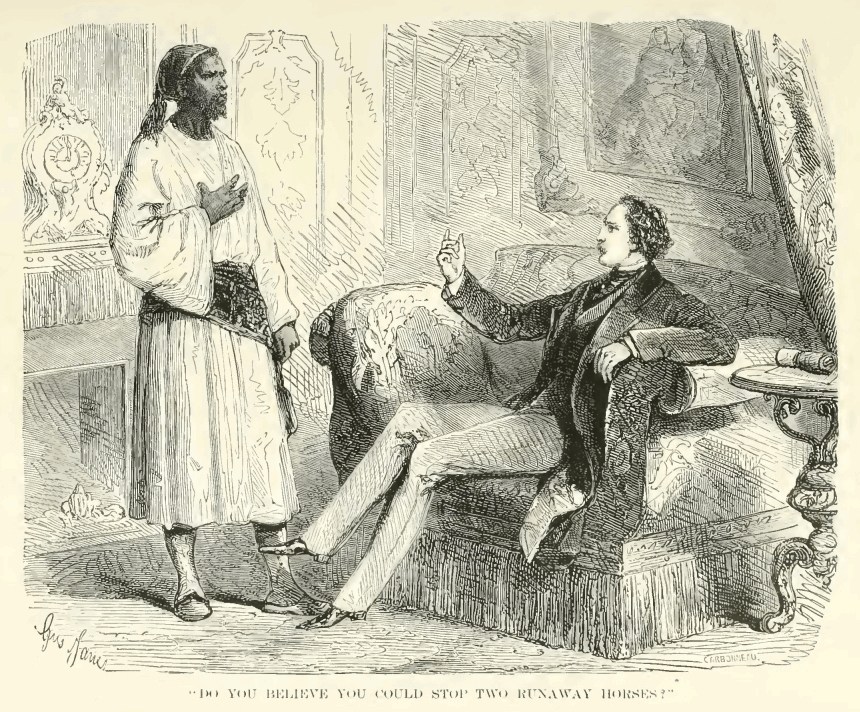
“Ali,” observed his master, as the Nubian entered the chamber, “you
have frequently explained to me how more than commonly skilful you are
in throwing the lasso, have you not?”
Ali drew himself up proudly, and then returned a sign in the
affirmative.
“I thought I did not mistake. With your lasso you could stop an ox?”
Again Ali repeated his affirmative gesture.
“Or a tiger?”
Ali bowed his head in token of assent.
“A lion even?”
Ali sprung forwards, imitating the action of one throwing the lasso,
then of a strangled lion.
“I understand,” said Monte Cristo; “you wish to tell me you have hunted
the lion?”
Ali smiled with triumphant pride as he signified that he had indeed
both chased and captured many lions.
“But do you believe you could arrest the progress of two horses rushing
forwards with ungovernable fury?”
The Nubian smiled.
“It is well,” said Monte Cristo. “Then listen to me. Ere long a
carriage will dash past here, drawn by the pair of dappled gray horses
you saw me with yesterday; now, at the risk of your own life, you must
manage to stop those horses before my door.”
Ali descended to the street, and marked a straight line on the pavement
immediately at the entrance of the house, and then pointed out the line
he had traced to the count, who was watching him. The count patted him
gently on the shoulder, his usual mode of praising Ali, who, pleased
and gratified with the commission assigned him, walked calmly towards a
projecting stone forming the angle of the street and house, and,
seating himself thereon, began to smoke his chibouque, while Monte
Cristo re-entered his dwelling, perfectly assured of the success of his
plan.
Still, as five o’clock approached, and the carriage was momentarily
expected by the count, the indication of more than common impatience
and uneasiness might be observed in his manner. He stationed himself in
a room commanding a view of the street, pacing the chamber with
restless steps, stopping merely to listen from time to time for the
sound of approaching wheels, then to cast an anxious glance on Ali; but
the regularity with which the Nubian puffed forth the smoke of his
chibouque proved that he at least was wholly absorbed in the enjoyment
of his favorite occupation.
Suddenly a distant sound of rapidly advancing wheels was heard, and
almost immediately a carriage appeared, drawn by a pair of wild,
ungovernable horses, while the terrified coachman strove in vain to
restrain their furious speed.
In the vehicle was a young woman and a child of about seven or eight
clasped in each other’s arms. Terror seemed to have deprived them even
of the power of uttering a cry. The carriage creaked and rattled as it
flew over the rough stones, and the slightest obstacle under the wheels
would have caused disaster; but it kept on in the middle of the road,
and those who saw it pass uttered cries of terror.
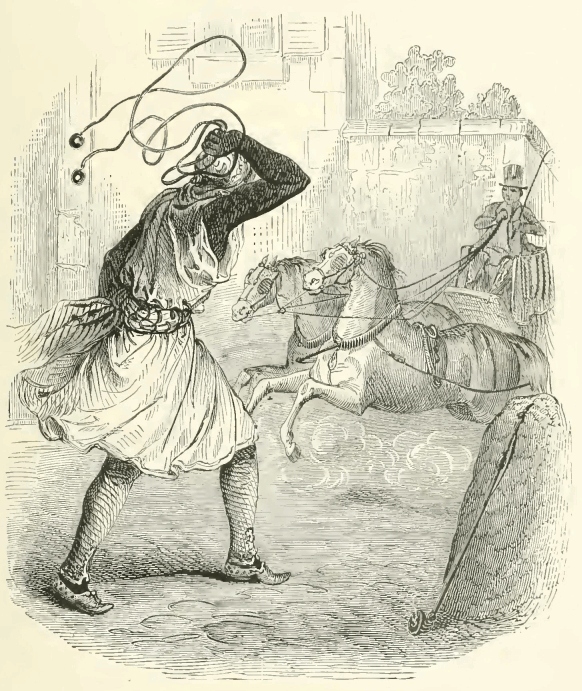
Ali suddenly cast aside his chibouque, drew the lasso from his pocket,
threw it so skilfully as to catch the forelegs of the near horse in its
triple fold, and suffered himself to be dragged on for a few steps by
the violence of the shock, then the animal fell over on the pole, which
snapped, and therefore prevented the other horse from pursuing its way.
Gladly availing himself of this opportunity, the coachman leaped from
his box; but Ali had promptly seized the nostrils of the second horse,
and held them in his iron grasp, till the beast, snorting with pain,
sunk beside his companion.
All this was achieved in much less time than is occupied in the
recital. The brief space had, however, been sufficient for a man,
followed by a number of servants, to rush from the house before which
the accident had occurred, and, as the coachman opened the door of the
carriage, to take from it a lady who was convulsively grasping the
cushions with one hand, while with the other she pressed to her bosom
the young boy, who had lost consciousness. Monte Cristo carried them
both to the salon, and deposited them on a sofa.
“Compose yourself, madame,” said he; “all danger is over.” The woman
looked up at these words, and, with a glance far more expressive than
any entreaties could have been, pointed to her child, who still
continued insensible. “I understand the nature of your alarms, madame,”
said the count, carefully examining the child, “but I assure you there
is not the slightest occasion for uneasiness; your little charge has
not received the least injury; his insensibility is merely the effects
of terror, and will soon pass.”
“Are you quite sure you do not say so to tranquillize my fears? See how
deadly pale he is! My child, my darling Edward; speak to your
mother—open your dear eyes and look on me once again! Oh, sir, in pity
send for a physician; my whole fortune shall not be thought too much
for the recovery of my boy.”
With a calm smile and a gentle wave of the hand, Monte Cristo signed to
the distracted mother to lay aside her apprehensions; then, opening a
casket that stood near, he drew forth a phial of Bohemian glass
incrusted with gold, containing a liquid of the color of blood, of
which he let fall a single drop on the child’s lips. Scarcely had it
reached them, ere the boy, though still pale as marble, opened his
eyes, and eagerly gazed around him. At this, the delight of the mother
was almost frantic.
“Where am I?” exclaimed she; “and to whom am I indebted for so happy a
termination to my late dreadful alarm?”
“Madame,” answered the count, “you are under the roof of one who
esteems himself most fortunate in having been able to save you from a
further continuance of your sufferings.”
“My wretched curiosity has brought all this about,” pursued the lady.
“All Paris rung with the praises of Madame Danglars’ beautiful horses,
and I had the folly to desire to know whether they really merited the
high praise given to them.”
“Is it possible,” exclaimed the count with well-feigned astonishment,
“that these horses belong to the baroness?”
“They do, indeed. May I inquire if you are acquainted with Madame
Danglars?”
“I have that honor; and my happiness at your escape from the danger
that threatened you is redoubled by the consciousness that I have been
the unwilling and the unintentional cause of all the peril you have
incurred. I yesterday purchased these horses of the baron; but as the
baroness evidently regretted parting with them, I ventured to send them
back to her, with a request that she would gratify me by accepting them
from my hands.”
“You are, then, doubtless, the Count of Monte Cristo, of whom Hermine
has talked to me so much?”
“You have rightly guessed, madame,” replied the count.
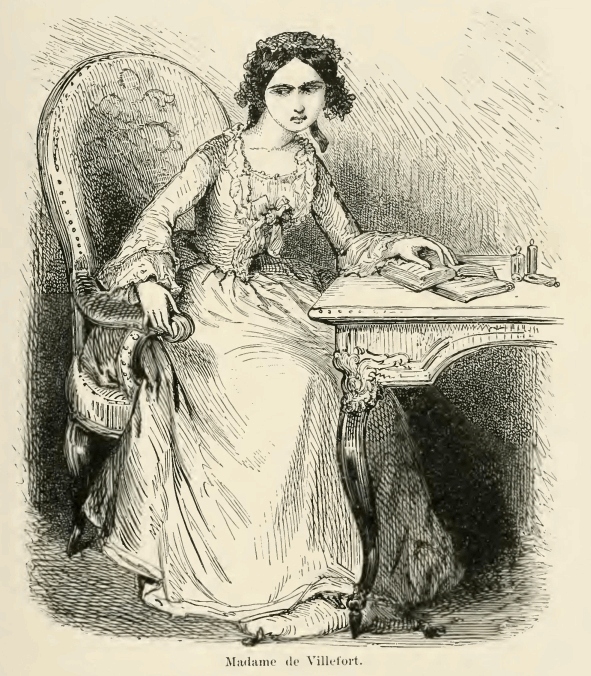
“And I am Madame Héloïse de Villefort.”
The count bowed with the air of a person who hears a name for the first
time.
“How grateful will M. de Villefort be for all your goodness; how
thankfully will he acknowledge that to you alone he owes the existence
of his wife and child! Most certainly, but for the prompt assistance of
your intrepid servant, this dear child and myself must both have
perished.”
“Indeed, I still shudder at the fearful danger you were placed in.”
“I trust you will allow me to recompense worthily the devotion of your
man.”
“I beseech you, madame,” replied Monte Cristo “not to spoil Ali, either
by too great praise or rewards. I cannot allow him to acquire the habit
of expecting to be recompensed for every trifling service he may
render. Ali is my slave, and in saving your life he was but discharging
his duty to me.”
“Nay,” interposed Madame de Villefort, on whom the authoritative style
adopted by the count made a deep impression, “nay, but consider that to
preserve my life he has risked his own.”
“His life, madame, belongs not to him; it is mine, in return for my
having myself saved him from death.”
Madame de Villefort made no further reply; her mind was utterly
absorbed in the contemplation of the person who, from the first instant
she saw him, had made so powerful an impression on her.
During the evident preoccupation of Madame de Villefort, Monte Cristo
scrutinized the features and appearance of the boy she kept folded in
her arms, lavishing on him the most tender endearments. The child was
small for his age, and unnaturally pale. A mass of straight black hair,
defying all attempts to train or curl it, fell over his projecting
forehead, and hung down to his shoulders, giving increased vivacity to
eyes already sparkling with a youthful love of mischief and fondness
for every forbidden enjoyment. His mouth was large, and the lips, which
had not yet regained their color, were particularly thin; in fact, the
deep and crafty look, giving a predominant expression to the child’s
face, belonged rather to a boy of twelve or fourteen than to one so
young. His first movement was to free himself by a violent push from
the encircling arms of his mother, and to rush forward to the casket
from whence the count had taken the phial of elixir; then, without
asking permission of anyone, he proceeded, in all the wilfulness of a
spoiled child unaccustomed to restrain either whims or caprices, to
pull the corks out of all the bottles.
“Touch nothing, my little friend,” cried the count eagerly; “some of
those liquids are not only dangerous to taste, but even to inhale.”
Madame de Villefort became very pale, and, seizing her son’s arm, drew
him anxiously toward her; but, once satisfied of his safety, she also
cast a brief but expressive glance on the casket, which was not lost
upon the count. At this moment Ali entered. At sight of him Madame de
Villefort uttered an expression of pleasure, and, holding the child
still closer towards her, she said:
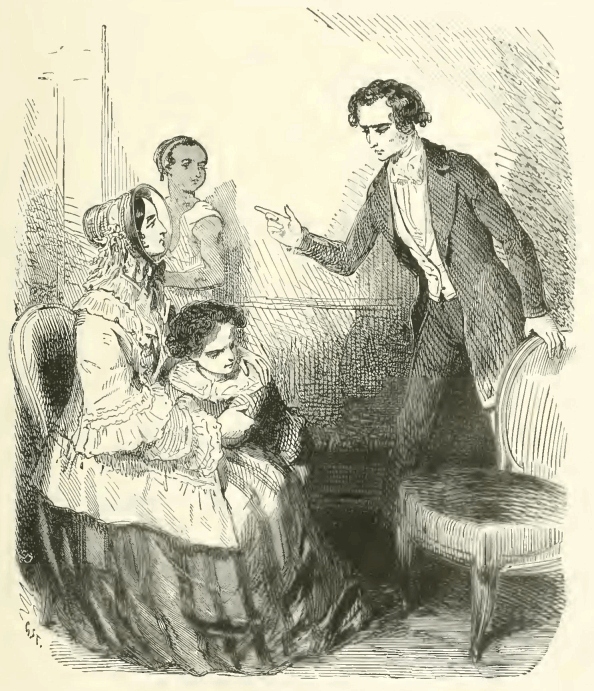
“Edward, dearest, do you see that good man? He has shown very great
courage and resolution, for he exposed his own life to stop the horses
that were running away with us, and would certainly have dashed the
carriage to pieces. Thank him, then, my child, in your very best
manner; for, had he not come to our aid, neither you nor I would have
been alive to speak our thanks.”
The child stuck out his lips and turned away his head in a disdainful
manner, saying, “He’s too ugly.”
The count smiled as if the child bade fair to realize his hopes, while
Madame de Villefort reprimanded her son with a gentleness and
moderation very far from conveying the least idea of a fault having
been committed.
“This lady,” said the Count, speaking to Ali in the Arabic language,
“is desirous that her son should thank you for saving both their lives;
but the boy refuses, saying you are too ugly.”
Ali turned his intelligent countenance towards the boy, on whom he
gazed without any apparent emotion; but the spasmodic working of the
nostrils showed to the practiced eye of Monte Cristo that the Arab had
been wounded to the heart.
“Will you permit me to inquire,” said Madame de Villefort, as she arose
to take her leave, “whether you usually reside here?”
“No, I do not,” replied Monte Cristo; “it is a small place I have
purchased quite lately. My place of abode is No. 30, Avenue des
Champs-Élysées; but I see you have quite recovered from your fright,
and are, no doubt, desirous of returning home. Anticipating your
wishes, I have desired the same horses you came with to be put to one
of my carriages, and Ali, he whom you think so very ugly,” continued
he, addressing the boy with a smiling air, “will have the honor of
driving you home, while your coachman remains here to attend to the
necessary repairs of your calash. As soon as that important business is
concluded, I will have a pair of my own horses harnessed to convey it
direct to Madame Danglars.”
“I dare not return with those dreadful horses,” said Madame de
Villefort.
“You will see,” replied Monte Cristo, “that they will be as different
as possible in the hands of Ali. With him they will be gentle and
docile as lambs.”
Ali had, indeed, given proof of this; for, approaching the animals, who
had been got upon their legs with considerable difficulty, he rubbed
their foreheads and nostrils with a sponge soaked in aromatic vinegar,
and wiped off the sweat and foam that covered their mouths. Then,
commencing a loud whistling noise, he rubbed them well all over their
bodies for several minutes; then, undisturbed by the noisy crowd
collected round the broken carriage, Ali quietly harnessed the pacified
animals to the count’s chariot, took the reins in his hands, and
mounted the box, when to the utter astonishment of those who had
witnessed the ungovernable spirit and maddened speed of the same
horses, he was actually compelled to apply his whip in no very gentle
manner before he could induce them to start; and even then all that
could be obtained from the celebrated “dappled grays,” now changed into
a couple of dull, sluggish, stupid brutes, was a slow, pottering pace,
kept up with so much difficulty that Madame de Villefort was more than
two hours returning to her residence in the Faubourg Saint-Honoré.
Scarcely had the first congratulations upon her marvellous escape been
gone through when she wrote the following letter to Madame Danglars:—
“Dear Hermine,—I have just had a wonderful escape from the most
imminent danger, and I owe my safety to the very Count of Monte Cristo
we were talking about yesterday, but whom I little expected to see
today. I remember how unmercifully I laughed at what I considered your
eulogistic and exaggerated praises of him; but I have now ample cause
to admit that your enthusiastic description of this wonderful man fell
far short of his merits. Your horses got as far as Ranelagh, when they
darted forward like mad things, and galloped away at so fearful a rate,
that there seemed no other prospect for myself and my poor Edward but
that of being dashed to pieces against the first object that impeded
their progress, when a strange-looking man,—an Arab, a negro, or a
Nubian, at least a black of some nation or other—at a signal from the
count, whose domestic he is, suddenly seized and stopped the infuriated
animals, even at the risk of being trampled to death himself; and
certainly he must have had a most wonderful escape. The count then
hastened to us, and took us into his house, where he speedily recalled
my poor Edward to life. He sent us home in his own carriage. Yours will
be returned to you tomorrow. You will find your horses in bad
condition, from the results of this accident; they seem thoroughly
stupefied, as if sulky and vexed at having been conquered by man. The
count, however, has commissioned me to assure you that two or three
days’ rest, with plenty of barley for their sole food during that time,
will bring them back to as fine, that is as terrifying, a condition as
they were in yesterday.
Adieu! I cannot return you many thanks for the drive of yesterday; but,
after all, I ought not to blame you for the misconduct of your horses,
more especially as it procured me the pleasure of an introduction to
the Count of Monte Cristo,—and certainly that illustrious personage,
apart from the millions he is said to be so very anxious to dispose of,
seemed to me one of those curiously interesting problems I, for one,
delight in solving at any risk, even if it were to necessitate another
drive to the Bois behind your horses.
Edward endured the accident with miraculous courage—he did not utter a
single cry, but fell lifeless into my arms; nor did a tear fall from
his eyes after it was over. I doubt not you will consider these praises
the result of blind maternal affection, but there is a soul of iron in
that delicate, fragile body. Valentine sends many affectionate
remembrances to your dear Eugénie. I embrace you with all my heart.
Héloïse de Villefort.
P.S.—Do pray contrive some means for me to meet the Count of Monte
Cristo at your house. I must and will see him again. I have just made
M. de Villefort promise to call on him, and I hope the visit will be
returned.
That night the adventure at Auteuil was talked of everywhere. Albert
related it to his mother; Château-Renaud recounted it at the Jockey
Club, and Debray detailed it at length in the salons of the minister;
even Beauchamp accorded twenty lines in his journal to the relation of
the count’s courage and gallantry, thereby celebrating him as the
greatest hero of the day in the eyes of all the feminine members of the
aristocracy.
Vast was the crowd of visitors and inquiring friends who left their
names at the residence of Madame de Villefort, with the design of
renewing their visit at the right moment, of hearing from her lips all
the interesting circumstances of this most romantic adventure.
As for M. de Villefort, he fulfilled the predictions of Héloïse to the
letter,—donned his dress suit, drew on a pair of white gloves, ordered
the servants to attend the carriage dressed in their full livery, and
drove that same night to No. 30 in the Avenue des Champs-Élysées.
30011m
Chapter XLVIII
Ideology
If the Count of Monte Cristo had been for a long time familiar with the
ways of Parisian society, he would have appreciated better the
significance of the step which M. de Villefort had taken. Standing well
at court, whether the king regnant was of the older or younger branch,
whether the government was doctrinaire liberal, or conservative; looked
upon by all as a man of talent, since those who have never experienced
a political check are generally so regarded; hated by many, but warmly
supported by others, without being really liked by anybody, M. de
Villefort held a high position in the magistracy, and maintained his
eminence like a Harlay or a Molé. His drawing-room, under the
regenerating influence of a young wife and a daughter by his first
marriage, scarcely eighteen, was still one of the well-regulated Paris
salons where the worship of traditional customs and the observance of
rigid etiquette were carefully maintained. A freezing politeness, a
strict fidelity to government principles, a profound contempt for
theories and theorists, a deep-seated hatred of ideality,—these were
the elements of private and public life displayed by M. de Villefort.
M. de Villefort was not only a magistrate, he was almost a diplomatist.
His relations with the former court, of which he always spoke with
dignity and respect, made him respected by the new one, and he knew so
many things, that not only was he always carefully considered, but
sometimes consulted. Perhaps this would not have been so had it been
possible to get rid of M. de Villefort; but, like the feudal barons who
rebelled against their sovereign, he dwelt in an impregnable fortress.
This fortress was his post as king’s attorney, all the advantages of
which he exploited with marvellous skill, and which he would not have
resigned but to be made deputy, and thus to replace neutrality by
opposition.
Ordinarily M. de Villefort made and returned very few visits. His wife
visited for him, and this was the received thing in the world, where
the weighty and multifarious occupations of the magistrate were
accepted as an excuse for what was really only calculated pride, a
manifestation of professed superiority—in fact, the application of the
axiom, _Pretend to think well of yourself, and the world will think
well of you_, an axiom a hundred times more useful in society nowadays
than that of the Greeks, “Know thyself,” a knowledge for which, in our
days, we have substituted the less difficult and more advantageous
science of knowing others.
To his friends M. de Villefort was a powerful protector; to his
enemies, he was a silent, but bitter opponent; for those who were
neither the one nor the other, he was a statue of the law-made man. He
had a haughty bearing, a look either steady and impenetrable or
insolently piercing and inquisitorial. Four successive revolutions had
built and cemented the pedestal upon which his fortune was based.
M. de Villefort had the reputation of being the least curious and the
least wearisome man in France. He gave a ball every year, at which he
appeared for a quarter of an hour only,—that is to say, five-and-forty
minutes less than the king is visible at his balls. He was never seen
at the theatres, at concerts, or in any place of public resort.
Occasionally, but seldom, he played at whist, and then care was taken
to select partners worthy of him—sometimes they were ambassadors,
sometimes archbishops, or sometimes a prince, or a president, or some
dowager duchess.
Such was the man whose carriage had just now stopped before the Count
of Monte Cristo’s door. The valet de chambre announced M. de Villefort
at the moment when the count, leaning over a large table, was tracing
on a map the route from St. Petersburg to China.
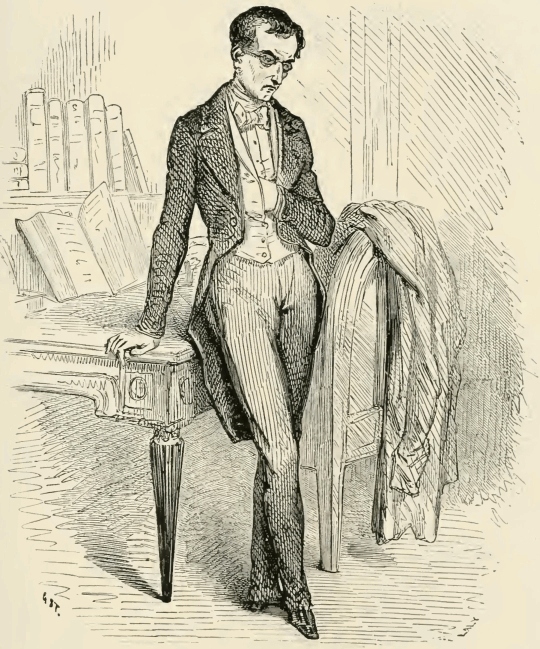
The procureur entered with the same grave and measured step he would
have employed in entering a court of justice. He was the same man, or
rather the development of the same man, whom we have heretofore seen as
assistant attorney at Marseilles. Nature, according to her way, had
made no deviation in the path he had marked out for himself. From being
slender he had now become meagre; once pale, he was now yellow; his
deep-set eyes were hollow, and the gold spectacles shielding his eyes
seemed to be an integral portion of his face. He dressed entirely in
black, with the exception of his white tie, and his funeral appearance
was only mitigated by the slight line of red ribbon which passed almost
imperceptibly through his button-hole, and appeared like a streak of
blood traced with a delicate brush.
Although master of himself, Monte Cristo, scrutinized with
irrepressible curiosity the magistrate whose salute he returned, and
who, distrustful by habit, and especially incredulous as to social
prodigies, was much more despised to look upon “the noble stranger,” as
Monte Cristo was already called, as an adventurer in search of new
fields, or an escaped criminal, rather than as a prince of the Holy
See, or a sultan of the Thousand and One Nights.
“Sir,” said Villefort, in the squeaky tone assumed by magistrates in
their oratorical periods, and of which they cannot, or will not, divest
themselves in society, “sir, the signal service which you yesterday
rendered to my wife and son has made it a duty for me to offer you my
thanks. I have come, therefore, to discharge this duty, and to express
to you my overwhelming gratitude.”
And as he said this, the “eye severe” of the magistrate had lost
nothing of its habitual arrogance. He spoke in a voice of the
procureur-general, with the rigid inflexibility of neck and shoulders
which caused his flatterers to say (as we have before observed) that he
was the living statue of the law.
“Monsieur,” replied the count, with a chilling air, “I am very happy to
have been the means of preserving a son to his mother, for they say
that the sentiment of maternity is the most holy of all; and the good
fortune which occurred to me, monsieur, might have enabled you to
dispense with a duty which, in its discharge, confers an undoubtedly
great honor; for I am aware that M. de Villefort is not usually lavish
of the favor which he now bestows on me,—a favor which, however
estimable, is unequal to the satisfaction which I have in my own
consciousness.”
Villefort, astonished at this reply, which he by no means expected,
started like a soldier who feels the blow levelled at him over the
armor he wears, and a curl of his disdainful lip indicated that from
that moment he noted in the tablets of his brain that the Count of
Monte Cristo was by no means a highly bred gentleman.
He glanced around, in order to seize on something on which the
conversation might turn, and seemed to fall easily on a topic. He saw
the map which Monte Cristo had been examining when he entered, and
said:
“You seem geographically engaged, sir? It is a rich study for you, who,
as I learn, have seen as many lands as are delineated on this map.”
“Yes, sir,” replied the count; “I have sought to make of the human
race, taken in the mass, what you practice every day on individuals—a
physiological study. I have believed it was much easier to descend from
the whole to a part than to ascend from a part to the whole. It is an
algebraic axiom, which makes us proceed from a known to an unknown
quantity, and not from an unknown to a known; but sit down, sir, I beg
of you.”
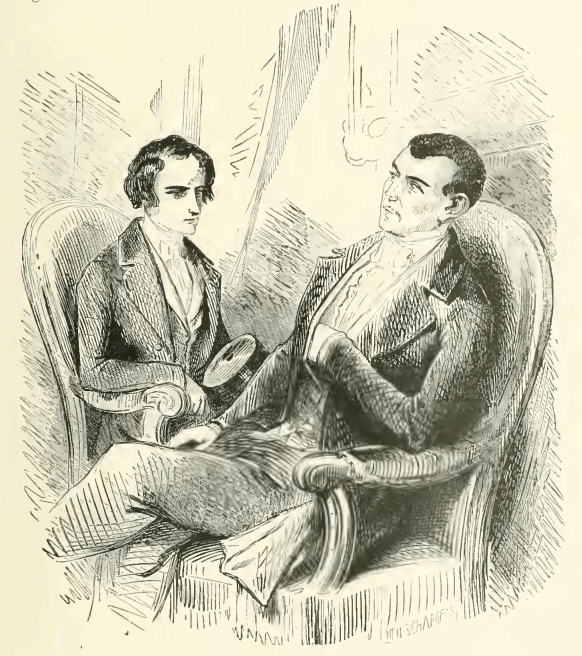
Monte Cristo pointed to a chair, which the procureur was obliged to
take the trouble to move forwards himself, while the count merely fell
back into his own, on which he had been kneeling when M. Villefort
entered. Thus the count was halfway turned towards his visitor, having
his back towards the window, his elbow resting on the geographical
chart which furnished the theme of conversation for the moment,—a
conversation which assumed, as in the case of the interviews with
Danglars and Morcerf, a turn analogous to the persons, if not to the
situation.
“Ah, you philosophize,” replied Villefort, after a moment’s silence,
during which, like a wrestler who encounters a powerful opponent, he
took breath; “well, sir, really, if, like you, I had nothing else to
do, I should seek a more amusing occupation.”
“Why, in truth, sir,” was Monte Cristo’s reply, “man is but an ugly
caterpillar for him who studies him through a solar microscope; but you
said, I think, that I had nothing else to do. Now, really, let me ask,
sir, have you?—do you believe you have anything to do? or to speak in
plain terms, do you really think that what you do deserves being called
anything?”
Villefort’s astonishment redoubled at this second thrust so forcibly
made by his strange adversary. It was a long time since the magistrate
had heard a paradox so strong, or rather, to say the truth more
exactly, it was the first time he had ever heard of it. The procureur
exerted himself to reply.
“Sir,” he responded, “you are a stranger, and I believe you say
yourself that a portion of your life has been spent in Oriental
countries, so you are not aware how human justice, so expeditious in
barbarous countries, takes with us a prudent and well-studied course.”
“Oh, yes—yes, I do, sir; it is the pede claudo of the ancients. I
know all that, for it is with the justice of all countries especially
that I have occupied myself—it is with the criminal procedure of all
nations that I have compared natural justice, and I must say, sir, that
it is the law of primitive nations, that is, the law of retaliation,
that I have most frequently found to be according to the law of God.”
“If this law were adopted, sir,” said the procureur, “it would greatly
simplify our legal codes, and in that case the magistrates would not
(as you just observed) have much to do.”
“It may, perhaps, come to this in time,” observed Monte Cristo; “you
know that human inventions march from the complex to the simple, and
simplicity is always perfection.”
“In the meanwhile,” continued the magistrate, “our codes are in full
force, with all their contradictory enactments derived from Gallic
customs, Roman laws, and Frank usages; the knowledge of all which, you
will agree, is not to be acquired without extended labor; it needs
tedious study to acquire this knowledge, and, when acquired, a strong
power of brain to retain it.”
“I agree with you entirely, sir; but all that even you know with
respect to the French code, I know, not only in reference to that code,
but as regards the codes of all nations. The English, Turkish,
Japanese, Hindu laws, are as familiar to me as the French laws, and
thus I was right, when I said to you, that relatively (you know that
everything is relative, sir)—that relatively to what I have done, you
have very little to do; but that relatively to all I have learned, you
have yet a great deal to learn.”
“But with what motive have you learned all this?” inquired Villefort,
in astonishment.
Monte Cristo smiled.
“Really, sir,” he observed, “I see that in spite of the reputation
which you have acquired as a superior man, you look at everything from
the material and vulgar view of society, beginning with man, and ending
with man—that is to say, in the most restricted, most narrow view which
it is possible for human understanding to embrace.”
“Pray, sir, explain yourself,” said Villefort, more and more
astonished, “I really do—not—understand you—perfectly.”
“I say, sir, that with the eyes fixed on the social organization of
nations, you see only the springs of the machine, and lose sight of the
sublime workman who makes them act; I say that you do not recognize
before you and around you any but those office-holders whose
commissions have been signed by a minister or king; and that the men
whom God has put above those office-holders, ministers, and kings, by
giving them a mission to follow out, instead of a post to fill—I say
that they escape your narrow, limited field of observation. It is thus
that human weakness fails, from its debilitated and imperfect organs.
Tobias took the angel who restored him to light for an ordinary young
man. The nations took Attila, who was doomed to destroy them, for a
conqueror similar to other conquerors, and it was necessary for both to
reveal their missions, that they might be known and acknowledged; one
was compelled to say, ‘I am the angel of the Lord’; and the other, ‘I
am the hammer of God,’ in order that the divine essence in both might
be revealed.”
“Then,” said Villefort, more and more amazed, and really supposing he
was speaking to a mystic or a madman, “you consider yourself as one of
those extraordinary beings whom you have mentioned?”
“And why not?” said Monte Cristo coldly.
“Your pardon, sir,” replied Villefort, quite astounded, “but you will
excuse me if, when I presented myself to you, I was unaware that I
should meet with a person whose knowledge and understanding so far
surpass the usual knowledge and understanding of men. It is not usual
with us corrupted wretches of civilization to find gentlemen like
yourself, possessors, as you are, of immense fortune—at least, so it is
said—and I beg you to observe that I do not inquire, I merely
repeat;—it is not usual, I say, for such privileged and wealthy beings
to waste their time in speculations on the state of society, in
philosophical reveries, intended at best to console those whom fate has
disinherited from the goods of this world.”
“Really, sir,” retorted the count, “have you attained the eminent
situation in which you are, without having admitted, or even without
having met with exceptions? and do you never use your eyes, which must
have acquired so much finesse and certainty, to divine, at a glance,
the kind of man by whom you are confronted? Should not a magistrate be
not merely the best administrator of the law, but the most crafty
expounder of the chicanery of his profession, a steel probe to search
hearts, a touchstone to try the gold which in each soul is mingled with
more or less of alloy?”
“Sir,” said Villefort, “upon my word, you overcome me. I really never
heard a person speak as you do.”
“Because you remain eternally encircled in a round of general
conditions, and have never dared to raise your wings into those upper
spheres which God has peopled with invisible or exceptional beings.”
“And you allow then, sir, that spheres exist, and that these marked and
invisible beings mingle amongst us?”
“Why should they not? Can you see the air you breathe, and yet without
which you could not for a moment exist?”
“Then we do not see those beings to whom you allude?”
“Yes, we do; you see them whenever God pleases to allow them to assume
a material form. You touch them, come in contact with them, speak to
them, and they reply to you.”
“Ah,” said Villefort, smiling, “I confess I should like to be warned
when one of these beings is in contact with me.”
“You have been served as you desire, monsieur, for you were warned just
now, and I now again warn you.”
“Then you yourself are one of these marked beings?”
“Yes, monsieur, I believe so; for until now, no man has found himself
in a position similar to mine. The dominions of kings are limited
either by mountains or rivers, or a change of manners, or an alteration
of language. My kingdom is bounded only by the world, for I am not an
Italian, or a Frenchman, or a Hindu, or an American, or a Spaniard—I am
a cosmopolite. No country can say it saw my birth. God alone knows what
country will see me die. I adopt all customs, speak all languages. You
believe me to be a Frenchman, for I speak French with the same facility
and purity as yourself. Well, Ali, my Nubian, believes me to be an
Arab; Bertuccio, my steward, takes me for a Roman; Haydée, my slave,
thinks me a Greek. You may, therefore, comprehend, that being of no
country, asking no protection from any government, acknowledging no man
as my brother, not one of the scruples that arrest the powerful, or the
obstacles which paralyze the weak, paralyzes or arrests me. I have only
two adversaries—I will not say two conquerors, for with perseverance I
subdue even them,—they are time and distance. There is a third, and the
most terrible—that is my condition as a mortal being. This alone can
stop me in my onward career, before I have attained the goal at which I
aim, for all the rest I have reduced to mathematical terms. What men
call the chances of fate—namely, ruin, change, circumstances—I have
fully anticipated, and if any of these should overtake me, yet it will
not overwhelm me. Unless I die, I shall always be what I am, and
therefore it is that I utter the things you have never heard, even from
the mouths of kings—for kings have need, and other persons have fear of
you. For who is there who does not say to himself, in a society as
incongruously organized as ours, ‘Perhaps some day I shall have to do
with the king’s attorney’?”
“But can you not say that, sir? The moment you become an inhabitant of
France, you are naturally subjected to the French law.”
“I know it sir,” replied Monte Cristo; “but when I visit a country I
begin to study, by all the means which are available, the men from whom
I may have anything to hope or to fear, till I know them as well as,
perhaps better than, they know themselves. It follows from this, that
the king’s attorney, be he who he may, with whom I should have to deal,
would assuredly be more embarrassed than I should.”
“That is to say,” replied Villefort with hesitation, “that human nature
being weak, every man, according to your creed, has committed faults.”
“Faults or crimes,” responded Monte Cristo with a negligent air.
“And that you alone, amongst the men whom you do not recognize as your
brothers—for you have said so,” observed Villefort in a tone that
faltered somewhat—“you alone are perfect.”
“No, not perfect,” was the count’s reply; “only impenetrable, that’s
all. But let us leave off this strain, sir, if the tone of it is
displeasing to you; I am no more disturbed by your justice than are you
by my second-sight.”
“No, no,—by no means,” said Villefort, who was afraid of seeming to
abandon his ground. “No; by your brilliant and almost sublime
conversation you have elevated me above the ordinary level; we no
longer talk, we rise to dissertation. But you know how the theologians
in their collegiate chairs, and philosophers in their controversies,
occasionally say cruel truths; let us suppose for the moment that we
are theologizing in a social way, or even philosophically, and I will
say to you, rude as it may seem, ‘My brother, you sacrifice greatly to
pride; you may be above others, but above you there is God.’”
“Above us all, sir,” was Monte Cristo’s response, in a tone and with an
emphasis so deep that Villefort involuntarily shuddered. “I have my
pride for men—serpents always ready to threaten everyone who would pass
without crushing them under foot. But I lay aside that pride before
God, who has taken me from nothing to make me what I am.”
“Then, count, I admire you,” said Villefort, who, for the first time in
this strange conversation, used the aristocratic form to the unknown
personage, whom, until now, he had only called monsieur. “Yes, and I
say to you, if you are really strong, really superior, really pious, or
impenetrable, which you were right in saying amounts to the same
thing—then be proud, sir, for that is the characteristic of
predominance. Yet you have unquestionably some ambition.”
“I have, sir.”
“And what may it be?”
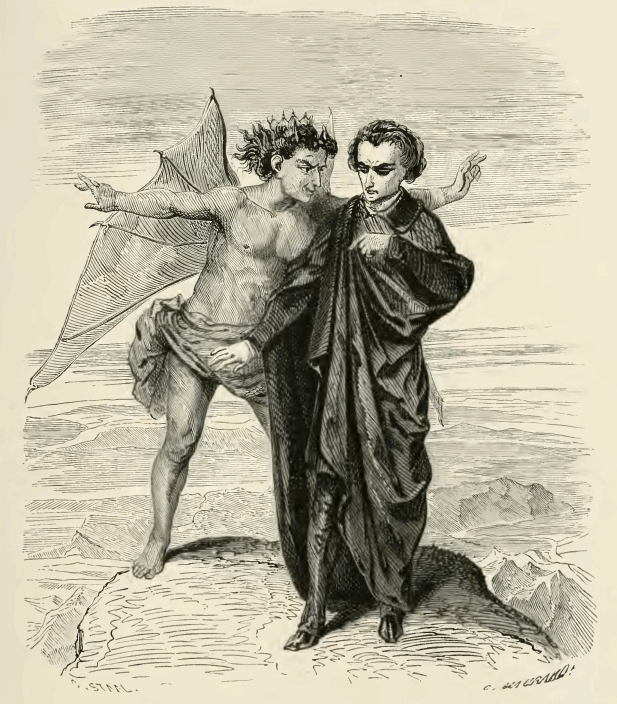
“I too, as happens to every man once in his life, have been taken by
Satan into the highest mountain in the earth, and when there he showed
me all the kingdoms of the world, and as he said before, so said he to
me, ‘Child of earth, what wouldst thou have to make thee adore me?’ I
reflected long, for a gnawing ambition had long preyed upon me, and
then I replied, ‘Listen,—I have always heard of Providence, and yet I
have never seen him, or anything that resembles him, or which can make
me believe that he exists. I wish to be Providence myself, for I feel
that the most beautiful, noblest, most sublime thing in the world, is
to recompense and punish.’ Satan bowed his head, and groaned. ‘You
mistake,’ he said, ‘Providence does exist, only you have never seen
him, because the child of God is as invisible as the parent. You have
seen nothing that resembles him, because he works by secret springs,
and moves by hidden ways. All I can do for you is to make you one of
the agents of that Providence.’ The bargain was concluded. I may
sacrifice my soul, but what matters it?” added Monte Cristo. “If the
thing were to do again, I would again do it.”
Villefort looked at Monte Cristo with extreme amazement.
“Count,” he inquired, “have you any relations?”
“No, sir, I am alone in the world.”
“So much the worse.”
“Why?” asked Monte Cristo.
“Because then you might witness a spectacle calculated to break down
your pride. You say you fear nothing but death?”
“I did not say that I feared it; I only said that death alone could
check the execution of my plans.”
“And old age?”
“My end will be achieved before I grow old.”
“And madness?”
“I have been nearly mad; and you know the axiom,—non bis in idem. It
is an axiom of criminal law, and, consequently, you understand its full
application.”
“Sir,” continued Villefort, “there is something to fear besides death,
old age, and madness. For instance, there is apoplexy—that
lightning-stroke which strikes but does not destroy you, and yet which
brings everything to an end. You are still yourself as now, and yet you
are yourself no longer; you who, like Ariel, verge on the angelic, are
but an inert mass, which, like Caliban, verges on the brutal; and this
is called in human tongues, as I tell you, neither more nor less than
apoplexy. Come, if so you will, count, and continue this conversation
at my house, any day you may be willing to see an adversary capable of
understanding and anxious to refute you, and I will show you my father,
M. Noirtier de Villefort, one of the most fiery Jacobins of the French
Revolution; that is to say, he had the most remarkable audacity,
seconded by a most powerful organization—a man who has not, perhaps,
like yourself seen all the kingdoms of the earth, but who has helped to
overturn one of the greatest; in fact, a man who believed himself, like
you, one of the envoys, not of God, but of a supreme being; not of
Providence, but of fate. Well, sir, the rupture of a blood-vessel on
the lobe of the brain has destroyed all this, not in a day, not in an
hour, but in a second. M. Noirtier, who, on the previous night, was the
old Jacobin, the old senator, the old Carbonaro, laughing at the
guillotine, the cannon, and the dagger—M. Noirtier, playing with
revolutions—M. Noirtier, for whom France was a vast chess-board, from
which pawns, rooks, knights, and queens were to disappear, so that the
king was checkmated—M. Noirtier, the redoubtable, was the next morning
poor M. Noirtier, the helpless old man, at the tender mercies of the
weakest creature in the household, that is, his grandchild, Valentine;
a dumb and frozen carcass, in fact, living painlessly on, that time may
be given for his frame to decompose without his consciousness of its
decay.”
“Alas, sir,” said Monte Cristo “this spectacle is neither strange to my
eye nor my thought. I am something of a physician, and have, like my
fellows, sought more than once for the soul in living and in dead
matter; yet, like Providence, it has remained invisible to my eyes,
although present to my heart. A hundred writers since Socrates, Seneca,
St. Augustine, and Gall, have made, in verse and prose, the comparison
you have made, and yet I can well understand that a father’s sufferings
may effect great changes in the mind of a son. I will call on you, sir,
since you bid me contemplate, for the advantage of my pride, this
terrible spectacle, which must have been so great a source of sorrow to
your family.”
“It would have been so unquestionably, had not God given me so large a
compensation. In contrast with the old man, who is dragging his way to
the tomb, are two children just entering into life—Valentine, the
daughter by my first wife—Mademoiselle Renée de Saint-Méran—and Edward,
the boy whose life you have this day saved.”
“And what is your deduction from this compensation, sir?” inquired
Monte Cristo.
“My deduction is,” replied Villefort, “that my father, led away by his
passions, has committed some fault unknown to human justice, but marked
by the justice of God. That God, desirous in his mercy to punish but
one person, has visited this justice on him alone.”
Monte Cristo with a smile on his lips, uttered in the depths of his
soul a groan which would have made Villefort fly had he but heard it.
“Adieu, sir,” said the magistrate, who had risen from his seat; “I
leave you, bearing a remembrance of you—a remembrance of esteem, which
I hope will not be disagreeable to you when you know me better; for I
am not a man to bore my friends, as you will learn. Besides, you have
made an eternal friend of Madame de Villefort.”
The count bowed, and contented himself with seeing Villefort to the
door of his cabinet, the procureur being escorted to his carriage by
two footmen, who, on a signal from their master, followed him with
every mark of attention. When he had gone, Monte Cristo breathed a
profound sigh, and said:
“Enough of this poison, let me now seek the antidote.”
Then sounding his bell, he said to Ali, who entered:
“I am going to madame’s chamber—have the carriage ready at one
o’clock.”