Monte Cristo noticed, as they descended the staircase, that Bertuccio
signed himself in the Corsican manner; that is, had formed the sign of
the cross in the air with his thumb, and as he seated himself in the
carriage, muttered a short prayer. Anyone but a man of exhaustless
thirst for knowledge would have had pity on seeing the steward’s
extraordinary repugnance for the count’s projected drive without the
walls; but the count was too curious to let Bertuccio off from this
little journey. In twenty minutes they were at Auteuil; the steward’s
emotion had continued to augment as they entered the village.
Bertuccio, crouched in the corner of the carriage, began to examine
with a feverish anxiety every house they passed.
“Tell them to stop at Rue de la Fontaine, No. 28,” said the count,
fixing his eyes on the steward, to whom he gave this order.
Bertuccio’s forehead was covered with perspiration; however, he obeyed,
and, leaning out of the window, he cried to the coachman,—“Rue de la
Fontaine, No. 28.” No. 28 was situated at the extremity of the village;
during the drive night had set in, and darkness gave the surroundings
the artificial appearance of a scene on the stage. The carriage
stopped, the footman sprang off the box and opened the door.
“Well,” said the count, “you do not get out, M. Bertuccio—you are going
to stay in the carriage, then? What are you thinking of this evening?”
Bertuccio sprang out, and offered his shoulder to the count, who, this
time, leaned upon it as he descended the three steps of the carriage.
“Knock,” said the count, “and announce me.”
Bertuccio knocked, the door opened, and the concierge appeared.
“What is it?” asked he.
“It is your new master, my good fellow,” said the footman. And he held
out to the concierge the notary’s order.
“The house is sold, then?” demanded the concierge; “and this gentleman
is coming to live here?”
“Yes, my friend,” returned the count; “and I will endeavor to give you
no cause to regret your old master.”
“Oh, monsieur,” said the concierge, “I shall not have much cause to
regret him, for he came here but seldom; it is five years since he was
here last, and he did well to sell the house, for it did not bring him
in anything at all.”
“What was the name of your old master?” said Monte Cristo.
“The Marquis of Saint-Méran. Ah, I am sure he has not sold the house
for what he gave for it.”
“The Marquis of Saint-Méran!” returned the count. “The name is not
unknown to me; the Marquis of Saint-Méran!” and he appeared to
meditate.
“An old gentleman,” continued the concierge, “a staunch follower of the
Bourbons; he had an only daughter, who married M. de Villefort, who had
been the king’s attorney at Nîmes, and afterwards at Versailles.”
Monte Cristo glanced at Bertuccio, who became whiter than the wall
against which he leaned to prevent himself from falling.
“And is not this daughter dead?” demanded Monte Cristo; “I fancy I have
heard so.”
“Yes, monsieur, one-and-twenty years ago; and since then we have not
seen the poor marquis three times.”
“Thanks, thanks,” said Monte Cristo, judging from the steward’s utter
prostration that he could not stretch the cord further without danger
of breaking it. “Give me a light.”
“Shall I accompany you, monsieur?”
“No, it is unnecessary; Bertuccio will show me a light.”
And Monte Cristo accompanied these words by the gift of two gold
pieces, which produced a torrent of thanks and blessings from the
concierge.
“Ah, monsieur,” said he, after having vainly searched on the
mantle-piece and the shelves, “I have not got any candles.”
“Take one of the carriage-lamps, Bertuccio,” said the count, “and show
me the apartments.”
The steward obeyed in silence, but it was easy to see, from the manner
in which the hand that held the light trembled, how much it cost him to
obey. They went over a tolerably large ground floor; a first floor
consisted of a salon, a bathroom, and two bedrooms; near one of the
bedrooms they came to a winding staircase that led down to the garden.
“Ah, here is a private staircase,” said the count; “that is convenient.
Light me, M. Bertuccio, and go first; we will see where it leads to.”
“Monsieur,” replied Bertuccio, “it leads to the garden.”
“And, pray, how do you know that?”
“It ought to do so, at least.”
“Well, let us be sure of that.”
Bertuccio sighed, and went on first; the stairs did, indeed, lead to
the garden. At the outer door the steward paused.
“Go on, Monsieur Bertuccio,” said the count.
But he who was addressed stood there, stupefied, bewildered, stunned;
his haggard eyes glanced around, as if in search of the traces of some
terrible event, and with his clenched hands he seemed striving to shut
out horrible recollections.
“Well!” insisted the Count.
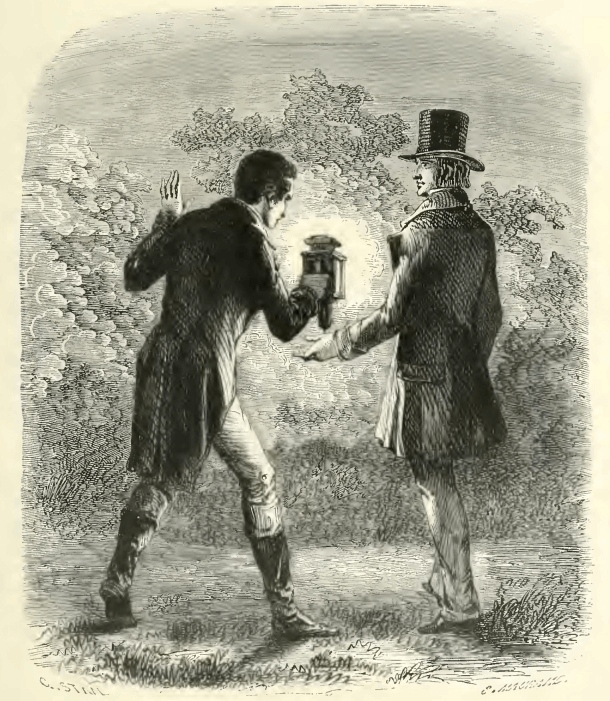
“No, no,” cried Bertuccio, setting down the lantern at the angle of the
interior wall. “No, monsieur, it is impossible; I can go no farther.”
“What does this mean?” demanded the irresistible voice of Monte Cristo.
“Why, you must see, your excellency,” cried the steward, “that this is
not natural; that, having a house to purchase, you purchase it exactly
at Auteuil, and that, purchasing it at Auteuil, this house should be
No. 28, Rue de la Fontaine. Oh, why did I not tell you all? I am sure
you would not have forced me to come. I hoped your house would have
been some other one than this; as if there was not another house at
Auteuil than that of the assassination!”
“What, what!” cried Monte Cristo, stopping suddenly, “what words do you
utter? Devil of a man, Corsican that you are—always mysteries or
superstitions. Come, take the lantern, and let us visit the garden; you
are not afraid of ghosts with me, I hope?”
Bertuccio raised the lantern, and obeyed. The door, as it opened,
disclosed a gloomy sky, in which the moon strove vainly to struggle
through a sea of clouds that covered her with billows of vapor which
she illumined for an instant, only to sink into obscurity. The steward
wished to turn to the left.
“No, no, monsieur,” said Monte Cristo. “What is the use of following
the alleys? Here is a beautiful lawn; let us go on straight forwards.”
Bertuccio wiped the perspiration from his brow, but obeyed; however, he
continued to take the left hand. Monte Cristo, on the contrary, took
the right hand; arrived near a clump of trees, he stopped. The steward
could not restrain himself.
“Move, monsieur—move away, I entreat you; you are exactly in the spot!”
“What spot?”
“Where he fell.”
“My dear Monsieur Bertuccio,” said Monte Cristo, laughing, “control
yourself; we are not at Sartène or at Corte. This is not a Corsican
maquis but an English garden; badly kept, I own, but still you must
not calumniate it for that.”
“Monsieur, I implore you do not stay there!”
“I think you are going mad, Bertuccio,” said the count coldly. “If that
is the case, I warn you, I shall have you put in a lunatic asylum.”
“Alas! excellency,” returned Bertuccio, joining his hands, and shaking
his head in a manner that would have excited the count’s laughter, had
not thoughts of a superior interest occupied him, and rendered him
attentive to the least revelation of this timorous conscience. “Alas!
excellency, the evil has arrived!”
“M. Bertuccio,” said the count, “I am very glad to tell you, that while
you gesticulate, you wring your hands and roll your eyes like a man
possessed by a devil who will not leave him; and I have always
observed, that the devil most obstinate to be expelled is a secret. I
knew you were a Corsican. I knew you were gloomy, and always brooding
over some old history of the vendetta; and I overlooked that in Italy,
because in Italy those things are thought nothing of. But in France
they are considered in very bad taste; there are gendarmes who occupy
themselves with such affairs, judges who condemn, and scaffolds which
avenge.”
Bertuccio clasped his hands, and as, in all these evolutions, he did
not let fall the lantern, the light showed his pale and altered
countenance. Monte Cristo examined him with the same look that, at
Rome, he had bent upon the execution of Andrea, and then, in a tone
that made a shudder pass through the veins of the poor steward—
“The Abbé Busoni, then told me an untruth,” said he, “when, after his
journey in France, in 1829, he sent you to me, with a letter of
recommendation, in which he enumerated all your valuable qualities.
Well, I shall write to the abbé; I shall hold him responsible for his
protégé’s misconduct, and I shall soon know all about this
assassination. Only I warn you, that when I reside in a country, I
conform to all its code, and I have no wish to put myself within the
compass of the French laws for your sake.”
“Oh, do not do that, excellency; I have always served you faithfully,”
cried Bertuccio, in despair. “I have always been an honest man, and, as
far as lay in my power, I have done good.”
“I do not deny it,” returned the count; “but why are you thus agitated.
It is a bad sign; a quiet conscience does not occasion such paleness in
the cheeks, and such fever in the hands of a man.”
“But, your excellency,” replied Bertuccio hesitatingly, “did not the
Abbé Busoni, who heard my confession in the prison at Nîmes, tell you
that I had a heavy burden upon my conscience?”
“Yes; but as he said you would make an excellent steward, I concluded
you had stolen—that was all.”
“Oh, your excellency!” returned Bertuccio in deep contempt.
“Or, as you are a Corsican, that you had been unable to resist the
desire of making a ‘stiff,’ as you call it.”
“Yes, my good master,” cried Bertuccio, casting himself at the count’s
feet, “it was simply vengeance—nothing else.”
“I understand that, but I do not understand what it is that galvanizes
you in this manner.”
“But, monsieur, it is very natural,” returned Bertuccio, “since it was
in this house that my vengeance was accomplished.”
“What! my house?”
“Oh, your excellency, it was not yours, then.”
“Whose, then? The Marquis de Saint-Méran, I think, the concierge said.
What had you to revenge on the Marquis de Saint-Méran?”
“Oh, it was not on him, monsieur; it was on another.”
“This is strange,” returned Monte Cristo, seeming to yield to his
reflections, “that you should find yourself without any preparation in
a house where the event happened that causes you so much remorse.”
“Monsieur,” said the steward, “it is fatality, I am sure. First, you
purchase a house at Auteuil—this house is the one where I have
committed an assassination; you descend to the garden by the same
staircase by which he descended; you stop at the spot where he received
the blow; and two paces farther is the grave in which he had just
buried his child. This is not chance, for chance, in this case, is too
much like Providence.”
“Well, amiable Corsican, let us suppose it is Providence. I always
suppose anything people please, and, besides, you must concede
something to diseased minds. Come, collect yourself, and tell me all.”
“I have related it but once, and that was to the Abbé Busoni. Such
things,” continued Bertuccio, shaking his head, “are only related under
the seal of confession.”
“Then,” said the count, “I refer you to your confessor. Turn Chartreux
or Trappist, and relate your secrets, but, as for me, I do not like
anyone who is alarmed by such phantasms, and I do not choose that my
servants should be afraid to walk in the garden of an evening. I
confess I am not very desirous of a visit from the commissary of
police, for, in Italy, justice is only paid when silent—in France she
is paid only when she speaks. Peste! I thought you somewhat Corsican,
a great deal smuggler, and an excellent steward; but I see you have
other strings to your bow. You are no longer in my service, Monsieur
Bertuccio.”
“Oh, your excellency, your excellency!” cried the steward, struck with
terror at this threat, “if that is the only reason I cannot remain in
your service, I will tell all, for if I quit you, it will only be to go
to the scaffold.”
“That is different,” replied Monte Cristo; “but if you intend to tell
an untruth, reflect it were better not to speak at all.”
“No, monsieur, I swear to you, by my hopes of salvation, I will tell
you all, for the Abbé Busoni himself only knew a part of my secret;
but, I pray you, go away from that plane-tree. The moon is just
bursting through the clouds, and there, standing where you do, and
wrapped in that cloak that conceals your figure, you remind me of M. de
Villefort.”
“What!” cried Monte Cristo, “it was M. de Villefort?”
“Your excellency knows him?”
“The former royal attorney at Nîmes?”
“Yes.”
“Who married the Marquis of Saint-Méran’s daughter?”
“Yes.”
“Who enjoyed the reputation of being the most severe, the most upright,
the most rigid magistrate on the bench?”
“Well, monsieur,” said Bertuccio, “this man with this spotless
reputation——”
“Well?”
“Was a villain.”
“Bah,” replied Monte Cristo, “impossible!”
“It is as I tell you.”
“Ah, really,” said Monte Cristo. “Have you proof of this?”
“I had it.”
“And you have lost it; how stupid!”
“Yes; but by careful search it might be recovered.”
“Really,” returned the count, “relate it to me, for it begins to
interest me.”
And the count, humming an air from Lucia, went to sit down on a
bench, while Bertuccio followed him, collecting his thoughts. Bertuccio
remained standing before him.
20285m
Chapter XLI
The Introduction
When Albert found himself alone with Monte Cristo, “My dear count,”
said he, “allow me to commence my services as cicerone by showing you
a specimen of a bachelor’s apartment. You, who are accustomed to the
palaces of Italy, can amuse yourself by calculating in how many square
feet a young man who is not the worst lodged in Paris can live. As we
pass from one room to another, I will open the windows to let you
breathe.”
Monte Cristo had already seen the breakfast-room and the salon on the
ground floor. Albert led him first to his atelier, which was, as we
have said, his favorite apartment. Monte Cristo quickly appreciated all
that Albert had collected here—old cabinets, Japanese porcelain,
Oriental stuffs, Venetian glass, arms from all parts of the
world—everything was familiar to him; and at the first glance he
recognized their date, their country, and their origin.
Morcerf had expected he should be the guide; on the contrary, it was he
who, under the count’s guidance, followed a course of archæology,
mineralogy, and natural history.
They descended to the first floor; Albert led his guest into the salon.
The salon was filled with the works of modern artists; there were
landscapes by Dupré, with their long reeds and tall trees, their lowing
oxen and marvellous skies; Delacroix’s Arabian cavaliers, with their
long white burnouses, their shining belts, their damasked arms, their
horses, who tore each other with their teeth while their riders
contended fiercely with their maces; aquarelles of Boulanger,
representing Notre Dame de Paris with that vigor that makes the artist
the rival of the poet; there were paintings by Diaz, who makes his
flowers more beautiful than flowers, his suns more brilliant than the
sun; designs by Decamp, as vividly colored as those of Salvator Rosa,
but more poetic; pastels by Giraud and Müller, representing children
like angels and women with the features of a virgin; sketches torn from
the album of Dauzats’ “Travels in the East,” that had been made in a
few seconds on the saddle of a camel, or beneath the dome of a
mosque—in a word, all that modern art can give in exchange and as
recompense for the art lost and gone with ages long since past.
Albert expected to have something new this time to show to the
traveller, but, to his great surprise, the latter, without seeking for
the signatures, many of which, indeed, were only initials, named
instantly the author of every picture in such a manner that it was easy
to see that each name was not only known to him, but that each style
associated with it had been appreciated and studied by him. From the
salon they passed into the bedchamber; it was a model of taste and
simple elegance. A single portrait, signed by Léopold Robert, shone in
its carved and gilded frame. This portrait attracted the Count of Monte
Cristo’s attention, for he made three rapid steps in the chamber, and
stopped suddenly before it.
It was the portrait of a young woman of five or six-and-twenty, with a
dark complexion, and light and lustrous eyes, veiled beneath long
lashes. She wore the picturesque costume of the Catalan fisherwomen, a
red and black bodice, and golden pins in her hair. She was looking at
the sea, and her form was outlined on the blue ocean and sky. The light
was so faint in the room that Albert did not perceive the pallor that
spread itself over the count’s visage, or the nervous heaving of his
chest and shoulders. Silence prevailed for an instant, during which
Monte Cristo gazed intently on the picture.
“You have there a most charming mistress, viscount,” said the count in
a perfectly calm tone; “and this costume—a ball costume,
doubtless—becomes her admirably.”
“Ah, monsieur,” returned Albert, “I would never forgive you this
mistake if you had seen another picture beside this. You do not know my
mother; she it is whom you see here. She had her portrait painted thus
six or eight years ago. This costume is a fancy one, it appears, and
the resemblance is so great that I think I still see my mother the same
as she was in 1830. The countess had this portrait painted during the
count’s absence. She doubtless intended giving him an agreeable
surprise; but, strange to say, this portrait seemed to displease my
father, and the value of the picture, which is, as you see, one of the
best works of Léopold Robert, could not overcome his dislike to it. It
is true, between ourselves, that M. de Morcerf is one of the most
assiduous peers at the Luxembourg, a general renowned for theory, but a
most mediocre amateur of art. It is different with my mother, who
paints exceedingly well, and who, unwilling to part with so valuable a
picture, gave it to me to put here, where it would be less likely to
displease M. de Morcerf, whose portrait, by Gros, I will also show you.
Excuse my talking of family matters, but as I shall have the honor of
introducing you to the count, I tell you this to prevent you making any
allusions to this picture. The picture seems to have a malign
influence, for my mother rarely comes here without looking at it, and
still more rarely does she look at it without weeping. This
disagreement is the only one that has ever taken place between the
count and countess, who are still as much united, although married more
than twenty years, as on the first day of their wedding.”
Monte Cristo glanced rapidly at Albert, as if to seek a hidden meaning
in his words, but it was evident the young man uttered them in the
simplicity of his heart.
“Now,” said Albert, “that you have seen all my treasures, allow me to
offer them to you, unworthy as they are. Consider yourself as in your
own house, and to put yourself still more at your ease, pray accompany
me to the apartments of M. de Morcerf, he whom I wrote from Rome an
account of the services you rendered me, and to whom I announced your
promised visit, and I may say that both the count and countess
anxiously desire to thank you in person. You are somewhat blasé I
know, and family scenes have not much effect on Sinbad the Sailor, who
has seen so many others. However, accept what I propose to you as an
initiation into Parisian life—a life of politeness, visiting, and
introductions.”
Monte Cristo bowed without making any answer; he accepted the offer
without enthusiasm and without regret, as one of those conventions of
society which every gentleman looks upon as a duty. Albert summoned his
servant, and ordered him to acquaint M. and Madame de Morcerf of the
arrival of the Count of Monte Cristo. Albert followed him with the
count. When they arrived at the antechamber, above the door was visible
a shield, which, by its rich ornaments and its harmony with the rest of
the furniture, indicated the importance the owner attached to this
blazon. Monte Cristo stopped and examined it attentively.
“Azure seven merlets, or, placed bender,” said he. “These are,
doubtless, your family arms? Except the knowledge of blazons, that
enables me to decipher them, I am very ignorant of heraldry—I, a count
of a fresh creation, fabricated in Tuscany by the aid of a commandery
of St. Stephen, and who would not have taken the trouble had I not been
told that when you travel much it is necessary. Besides, you must have
something on the panels of your carriage, to escape being searched by
the custom-house officers. Excuse my putting such a question to you.”
“It is not indiscreet,” returned Morcerf, with the simplicity of
conviction. “You have guessed rightly. These are our arms, that is,
those of my father, but they are, as you see, joined to another shield,
which has gules, a silver tower, which are my mother’s. By her side I
am Spanish, but the family of Morcerf is French, and, I have heard, one
of the oldest of the south of France.”
“Yes,” replied Monte Cristo “these blazons prove that. Almost all the
armed pilgrims that went to the Holy Land took for their arms either a
cross, in honor of their mission, or birds of passage, in sign of the
long voyage they were about to undertake, and which they hoped to
accomplish on the wings of faith. One of your ancestors had joined the
Crusades, and supposing it to be only that of St. Louis, that makes you
mount to the thirteenth century, which is tolerably ancient.”
“It is possible,” said Morcerf; “my father has in his study a
genealogical tree which will tell you all that, and on which I made
commentaries that would have greatly edified d’Hozier and Jaucourt. At
present I no longer think of it, and yet I must tell you that we are
beginning to occupy ourselves greatly with these things under our
popular government.”
“Well, then, your government would do well to choose from the past
something better than the things that I have noticed on your monuments,
and which have no heraldic meaning whatever. As for you, viscount,”
continued Monte Cristo to Morcerf, “you are more fortunate than the
government, for your arms are really beautiful, and speak to the
imagination. Yes, you are at once from Provence and Spain; that
explains, if the portrait you showed me be like, the dark hue I so much
admired on the visage of the noble Catalan.”
It would have required the penetration of Œdipus or the Sphinx to have
divined the irony the count concealed beneath these words, apparently
uttered with the greatest politeness. Morcerf thanked him with a smile,
and pushed open the door above which were his arms, and which, as we
have said, opened into the salon. In the most conspicuous part of the
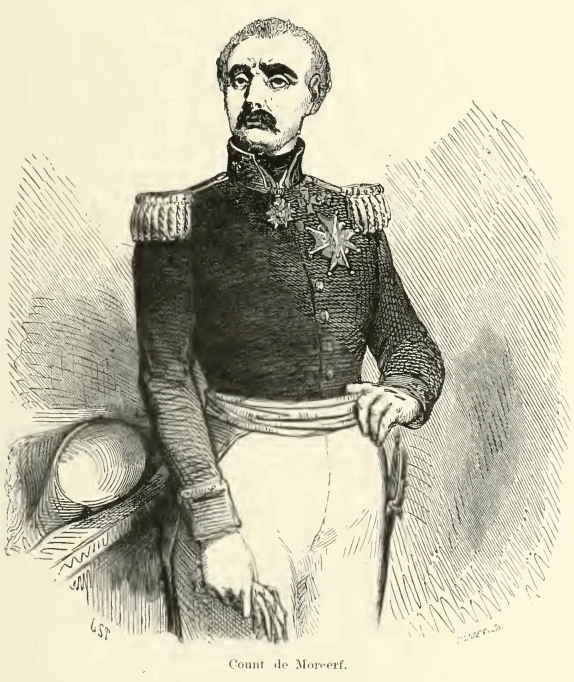
salon was another portrait. It was that of a man, from five to
eight-and-thirty, in the uniform of a general officer, wearing the
double epaulet of heavy bullion, that indicates superior rank, the
ribbon of the Legion of Honor around his neck, which showed he was a
commander, and on the right breast, the star of a grand officer of the
order of the Saviour, and on the left that of the grand cross of
Charles III., which proved that the person represented by the picture
had served in the wars of Greece and Spain, or, what was just the same
thing as regarded decorations, had fulfilled some diplomatic mission in
the two countries.
Monte Cristo was engaged in examining this portrait with no less care
than he had bestowed upon the other, when another door opened, and he
found himself opposite to the Count of Morcerf in person.
He was a man of forty to forty-five years, but he seemed at least
fifty, and his black moustache and eyebrows contrasted strangely with
his almost white hair, which was cut short, in the military fashion. He
was dressed in plain clothes, and wore at his button-hole the ribbons
of the different orders to which he belonged.
He entered with a tolerably dignified step, and some little haste.
Monte Cristo saw him advance towards him without making a single step.
It seemed as if his feet were rooted to the ground, and his eyes on the
Count of Morcerf.
“Father,” said the young man, “I have the honor of presenting to you
the Count of Monte Cristo, the generous friend whom I had the good
fortune to meet in the critical situation of which I have told you.”
“You are most welcome, monsieur,” said the Count of Morcerf, saluting
Monte Cristo with a smile, “and monsieur has rendered our house, in
preserving its only heir, a service which insures him our eternal
gratitude.”
As he said these words, the count of Morcerf pointed to a chair, while
he seated himself in another opposite the window.
Monte Cristo, in taking the seat Morcerf offered him, placed himself in
such a manner as to remain concealed in the shadow of the large velvet
curtains, and read on the careworn and livid features of the count a
whole history of secret griefs written in each wrinkle time had planted
there.
“The countess,” said Morcerf, “was at her toilet when she was informed
of the visit she was about to receive. She will, however, be in the
salon in ten minutes.”
“It is a great honor to me,” returned Monte Cristo, “to be thus, on the
first day of my arrival in Paris, brought in contact with a man whose
merit equals his reputation, and to whom fortune has for once been
equitable, but has she not still on the plains of Mitidja, or in the
mountains of Atlas, a marshal’s staff to offer you?”
“Oh,” replied Morcerf, reddening slightly, “I have left the service,
monsieur. Made a peer at the Restoration, I served through the first
campaign under the orders of Marshal Bourmont. I could, therefore,
expect a higher rank, and who knows what might have happened had the
elder branch remained on the throne? But the Revolution of July was, it
seems, sufficiently glorious to allow itself to be ungrateful, and it
was so for all services that did not date from the imperial period. I
tendered my resignation, for when you have gained your epaulets on the
battle-field, you do not know how to manœuvre on the slippery grounds
of the salons. I have hung up my sword, and cast myself into politics.
I have devoted myself to industry; I study the useful arts. During the
twenty years I served, I often wished to do so, but I had not the
time.”
“These are the ideas that render your nation superior to any other,”
returned Monte Cristo. “A gentleman of high birth, possessor of an
ample fortune, you have consented to gain your promotion as an obscure
soldier, step by step—this is uncommon; then become general, peer of
France, commander of the Legion of Honor, you consent to again commence
a second apprenticeship, without any other hope or any other desire
than that of one day becoming useful to your fellow-creatures; this,
indeed, is praiseworthy,—nay, more, it is sublime.”
Albert looked on and listened with astonishment; he was not used to see
Monte Cristo give vent to such bursts of enthusiasm.
“Alas,” continued the stranger, doubtless to dispel the slight cloud
that covered Morcerf’s brow, “we do not act thus in Italy; we grow
according to our race and our species, and we pursue the same lines,
and often the same uselessness, all our lives.”
“But, monsieur,” said the Count of Morcerf, “for a man of your merit,
Italy is not a country, and France opens her arms to receive you;
respond to her call. France will not, perhaps, be always ungrateful.
She treats her children ill, but she always welcomes strangers.”
“Ah, father,” said Albert with a smile, “it is evident you do not know
the Count of Monte Cristo; he despises all honors, and contents himself
with those written on his passport.”
“That is the most just remark,” replied the stranger, “I ever heard
made concerning myself.”
“You have been free to choose your career,” observed the Count of
Morcerf, with a sigh; “and you have chosen the path strewed with
flowers.”
“Precisely, monsieur,” replied Monte Cristo with one of those smiles
that a painter could never represent or a physiologist analyze.
“If I did not fear to fatigue you,” said the general, evidently charmed
with the count’s manners, “I would have taken you to the Chamber; there
is a debate very curious to those who are strangers to our modern
senators.”
“I shall be most grateful, monsieur, if you will, at some future time,
renew your offer, but I have been flattered with the hope of being
introduced to the countess, and I will therefore wait.”
“Ah, here is my mother,” cried the viscount.
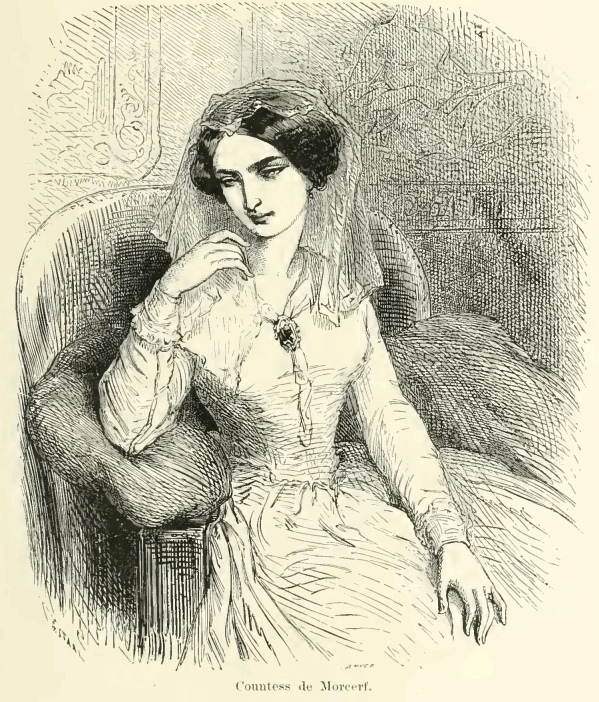
Monte Cristo, turned round hastily, and saw Madame de Morcerf at the
entrance of the salon, at the door opposite to that by which her
husband had entered, pale and motionless; when Monte Cristo turned
round, she let fall her arm, which for some unknown reason had been
resting on the gilded door-post. She had been there some moments, and
had heard the last words of the visitor. The latter rose and bowed to
the countess, who inclined herself without speaking.
“Ah! good heavens, madame,” said the count, “are you ill, or is it the
heat of the room that affects you?”
“Are you ill, mother?” cried the viscount, springing towards her.
She thanked them both with a smile.
“No,” returned she, “but I feel some emotion on seeing, for the first
time, the man without whose intervention we should have been in tears
and desolation. Monsieur,” continued the countess, advancing with the
majesty of a queen, “I owe to you the life of my son, and for this I
bless you. Now, I thank you for the pleasure you give me in thus
affording me the opportunity of thanking you as I have blessed you,
from the bottom of my heart.”
The count bowed again, but lower than before; he was even paler than
Mercédès.
“Madame,” said he, “the count and yourself recompense too generously a
simple action. To save a man, to spare a father’s feelings, or a
mother’s sensibility, is not to do a good action, but a simple deed of
humanity.”
At these words, uttered with the most exquisite sweetness and
politeness, Madame de Morcerf replied:
“It is very fortunate for my son, monsieur, that he found such a
friend, and I thank God that things are thus.”
And Mercédès raised her fine eyes to heaven with so fervent an
expression of gratitude, that the count fancied he saw tears in them.
M. de Morcerf approached her.
“Madame,” said he. “I have already made my excuses to the count for
quitting him, and I pray you to do so also. The sitting commences at
two; it is now three, and I am to speak.”
“Go, then, and monsieur and I will strive our best to forget your
absence,” replied the countess, with the same tone of deep feeling.
“Monsieur,” continued she, turning to Monte Cristo, “will you do us the
honor of passing the rest of the day with us?”
“Believe me, madame, I feel most grateful for your kindness, but I got
out of my travelling carriage at your door this morning, and I am
ignorant how I am installed in Paris, which I scarcely know; this is
but a trifling inquietude, I know, but one that may be appreciated.”
“We shall have the pleasure another time,” said the countess; “you
promise that?”
Monte Cristo inclined himself without answering, but the gesture might
pass for assent.
“I will not detain you, monsieur,” continued the countess; “I would not
have our gratitude become indiscreet or importunate.”
“My dear Count,” said Albert, “I will endeavor to return your
politeness at Rome, and place my coupé at your disposal until your own
be ready.”
“A thousand thanks for your kindness, viscount,” returned the Count of
Monte Cristo “but I suppose that M. Bertuccio has suitably employed the
four hours and a half I have given him, and that I shall find a
carriage of some sort ready at the door.”
Albert was used to the count’s manner of proceeding; he knew that, like
Nero, he was in search of the impossible, and nothing astonished him,
but wishing to judge with his own eyes how far the count’s orders had
been executed, he accompanied him to the door of the house. Monte
Cristo was not deceived. As soon as he appeared in the Count of
Morcerf’s antechamber, a footman, the same who at Rome had brought the
count’s card to the two young men, and announced his visit, sprang into
the vestibule, and when he arrived at the door the illustrious
traveller found his carriage awaiting him. It was a coupé of Koller’s
building, and with horses and harness for which Drake had, to the
knowledge of all the lions of Paris, refused on the previous day seven
hundred guineas.
“Monsieur,” said the count to Albert, “I do not ask you to accompany me
to my house, as I can only show you a habitation fitted up in a hurry,
and I have, as you know, a reputation to keep up as regards not being
taken by surprise. Give me, therefore, one more day before I invite
you; I shall then be certain not to fail in my hospitality.”
“If you ask me for a day, count, I know what to anticipate; it will not
be a house I shall see, but a palace. You have decidedly some genius at
your control.”
“Ma foi, spread that idea,” replied the Count of Monte Cristo,
putting his foot on the velvet-lined steps of his splendid carriage,
“and that will be worth something to me among the ladies.”
As he spoke, he sprang into the vehicle, the door was closed, but not
so rapidly that Monte Cristo failed to perceive the almost
imperceptible movement which stirred the curtains of the apartment in
which he had left Madame de Morcerf.
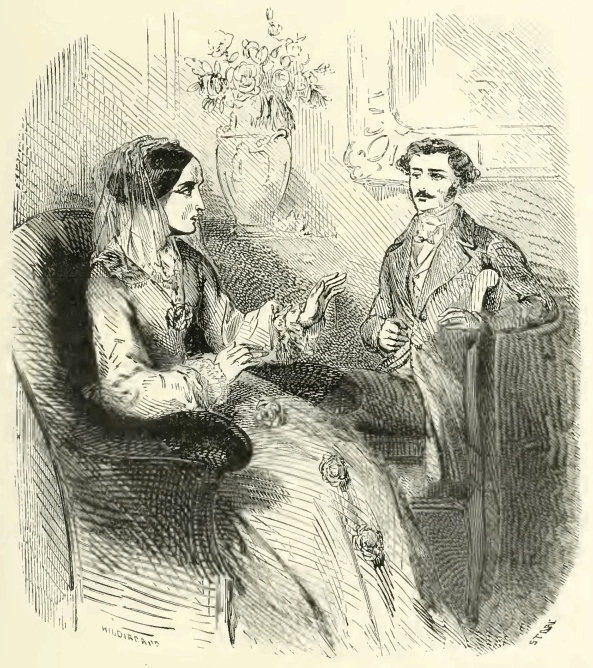
When Albert returned to his mother, he found her in the boudoir
reclining in a large velvet armchair, the whole room so obscure that
only the shining spangle, fastened here and there to the drapery, and
the angles of the gilded frames of the pictures, showed with some
degree of brightness in the gloom. Albert could not see the face of the
countess, as it was covered with a thin veil she had put on her head,
and which fell over her features in misty folds, but it seemed to him
as though her voice had altered. He could distinguish amid the perfumes
of the roses and heliotropes in the flower-stands, the sharp and
fragrant odor of volatile salts, and he noticed in one of the chased
cups on the mantle-piece the countess’s smelling-bottle, taken from its
shagreen case, and exclaimed in a tone of uneasiness, as he entered:
“My dear mother, have you been ill during my absence?”
“No, no, Albert, but you know these roses, tuberoses, and
orange-flowers throw out at first, before one is used to them, such
violent perfumes.”
“Then, my dear mother,” said Albert, putting his hand to the bell,
“they must be taken into the antechamber. You are really ill, and just
now were so pale as you came into the room——”
“Was I pale, Albert?”
“Yes; a pallor that suits you admirably, mother, but which did not the
less alarm my father and myself.”
“Did your father speak of it?” inquired Mercédès eagerly.
“No, madame; but do you not remember that he spoke of the fact to you?”
“Yes, I do remember,” replied the countess.
A servant entered, summoned by Albert’s ring of the bell.
“Take these flowers into the anteroom or dressing-room,” said the
viscount; “they make the countess ill.”
The footman obeyed his orders. A long pause ensued, which lasted until
all the flowers were removed.
“What is this name of Monte Cristo?” inquired the countess, when the
servant had taken away the last vase of flowers, “is it a family name,
or the name of the estate, or a simple title?”
“I believe, mother, it is merely a title. The count purchased an island
in the Tuscan archipelago, and, as he told you today, has founded a
commandery. You know the same thing was done for Saint Stephen of
Florence, Saint George Constantinian of Parma, and even for the Order
of Malta. Except this, he has no pretension to nobility, and calls
himself a chance count, although the general opinion at Rome is that
the count is a man of very high distinction.”
“His manners are admirable,” said the countess, “at least, as far as I
could judge in the few minutes he remained here.”
“They are perfect mother, so perfect, that they surpass by far all I
have known in the leading aristocracy of the three proudest nobilities
of Europe—the English, the Spanish, and the German.”
The countess paused a moment; then, after a slight hesitation, she
resumed.
“You have seen, my dear Albert—I ask the question as a mother—you have
seen M. de Monte Cristo in his house, you are quicksighted, have much
knowledge of the world, more tact than is usual at your age, do you
think the count is really what he appears to be?”
“What does he appear to be?”
“Why, you have just said,—a man of high distinction.”
“I told you, my dear mother, he was esteemed such.”
“But what is your own opinion, Albert?”
“I must tell you that I have not come to any decided opinion respecting
him, but I think him a Maltese.”
“I do not ask you of his origin but what he is.”
“Ah! what he is; that is quite another thing. I have seen so many
remarkable things in him, that if you would have me really say what I
think, I shall reply that I really do look upon him as one of Byron’s
heroes, whom misery has marked with a fatal brand; some Manfred, some
Lara, some Werner, one of those wrecks, as it were, of some ancient
family, who, disinherited of their patrimony, have achieved one by the
force of their adventurous genius, which has placed them above the laws
of society.”
“You say——”
“I say that Monte Cristo is an island in the midst of the
Mediterranean, without inhabitants or garrison, the resort of smugglers
of all nations, and pirates of every flag. Who knows whether or not
these industrious worthies do not pay to their feudal lord some dues
for his protection?”
“That is possible,” said the countess, reflecting.
“Never mind,” continued the young man, “smuggler or not, you must
agree, mother dear, as you have seen him, that the Count of Monte
Cristo is a remarkable man, who will have the greatest success in the
salons of Paris. Why, this very morning, in my rooms, he made his
entrée amongst us by striking every man of us with amazement, not
even excepting Château-Renaud.”
“And what do you suppose is the count’s age?” inquired Mercédès,
evidently attaching great importance to this question.
“Thirty-five or thirty-six, mother.”
“So young,—it is impossible,” said Mercédès, replying at the same time
to what Albert said as well as to her own private reflection.
“It is the truth, however. Three or four times he has said to me, and
certainly without the slightest premeditation, ‘at such a period I was
five years old, at another ten years old, at another twelve,’ and I,
induced by curiosity, which kept me alive to these details, have
compared the dates, and never found him inaccurate. The age of this
singular man, who is of no age, is then, I am certain, thirty-five.
Besides, mother, remark how vivid his eye, how raven-black his hair,
and his brow, though so pale, is free from wrinkles,—he is not only
vigorous, but also young.”
The countess bent her head, as if beneath a heavy wave of bitter
thoughts.
“And has this man displayed a friendship for you, Albert?” she asked
with a nervous shudder.
“I am inclined to think so.”
“And—do—you—like—him?”
“Why, he pleases me in spite of Franz d’Épinay, who tries to convince
me that he is a being returned from the other world.”
The countess shuddered.
“Albert,” she said, in a voice which was altered by emotion, “I have
always put you on your guard against new acquaintances. Now you are a
man, and are able to give me advice; yet I repeat to you, Albert, be
prudent.”
“Why, my dear mother, it is necessary, in order to make your advice
turn to account, that I should know beforehand what I have to distrust.
The count never plays, he only drinks pure water tinged with a little
sherry, and is so rich that he cannot, without intending to laugh at
me, try to borrow money. What, then, have I to fear from him?”
“You are right,” said the countess, “and my fears are weakness,
especially when directed against a man who has saved your life. How did
your father receive him, Albert? It is necessary that we should be more
than complaisant to the count. M. de Morcerf is sometimes occupied, his
business makes him reflective, and he might, without intending it——”
“Nothing could be in better taste than my father’s demeanor, madame,”
said Albert; “nay, more, he seemed greatly flattered at two or three
compliments which the count very skilfully and agreeably paid him with
as much ease as if he had known him these thirty years. Each of these
little tickling arrows must have pleased my father,” added Albert with
a laugh. “And thus they parted the best possible friends, and M. de
Morcerf even wished to take him to the Chamber to hear the speakers.”
The countess made no reply. She fell into so deep a reverie that her
eyes gradually closed. The young man, standing up before her, gazed
upon her with that filial affection which is so tender and endearing
with children whose mothers are still young and handsome. Then, after
seeing her eyes closed, and hearing her breathe gently, he believed she
had dropped asleep, and left the apartment on tiptoe, closing the door
after him with the utmost precaution.
“This devil of a fellow,” he muttered, shaking his head; “I said at the
time he would create a sensation here, and I measure his effect by an
infallible thermometer. My mother has noticed him, and he must
therefore, perforce, be remarkable.”
He went down to the stables, not without some slight annoyance, when he
remembered that the Count of Monte Cristo had laid his hands on a
“turnout” which sent his bays down to second place in the opinion of
connoisseurs.
“Most decidedly,” said he, “men are not equal, and I must beg my father
to develop this theorem in the Chamber of Peers.”
Chapter XLII
Monsieur Bertuccio
Meanwhile the count had arrived at his house; it had taken him six
minutes to perform the distance, but these six minutes were sufficient
to induce twenty young men who knew the price of the equipage they had
been unable to purchase themselves, to put their horses in a gallop in
order to see the rich foreigner who could afford to give 20,000 francs
apiece for his horses.
The house Ali had chosen, and which was to serve as a town residence to
Monte Cristo, was situated on the right hand as you ascend the
Champs-Élysées. A thick clump of trees and shrubs rose in the centre,
and masked a portion of the front; around this shrubbery two alleys,
like two arms, extended right and left, and formed a carriage-drive
from the iron gates to a double portico, on every step of which stood a
porcelain vase, filled with flowers. This house, isolated from the
rest, had, besides the main entrance, another in the Rue de Ponthieu.
Even before the coachman had hailed the concierge, the massy gates
rolled on their hinges—they had seen the Count coming, and at Paris, as
everywhere else, he was served with the rapidity of lightning. The
coachman entered and traversed the half-circle without slackening his
speed, and the gates were closed ere the wheels had ceased to sound on
the gravel. The carriage stopped at the left side of the portico, two
men presented themselves at the carriage-window; the one was Ali, who,
smiling with an expression of the most sincere joy, seemed amply repaid
by a mere look from Monte Cristo. The other bowed respectfully, and
offered his arm to assist the count in descending.
“Thanks, M. Bertuccio,” said the count, springing lightly up the three
steps of the portico; “and the notary?”
“He is in the small salon, excellency,” returned Bertuccio.
“And the cards I ordered to be engraved as soon as you knew the number
of the house?”
“Your excellency, it is done already. I have been myself to the best
engraver of the Palais Royal, who did the plate in my presence. The
first card struck off was taken, according to your orders, to the Baron
Danglars, Rue de la Chaussée d’Antin, No. 7; the others are on the
mantle-piece of your excellency’s bedroom.”
“Good; what o’clock is it?”
“Four o’clock.”
Monte Cristo gave his hat, cane, and gloves to the same French footman
who had called his carriage at the Count of Morcerf’s, and then he
passed into the small salon, preceded by Bertuccio, who showed him the
way.
“These are but indifferent marbles in this antechamber,” said Monte
Cristo. “I trust all this will soon be taken away.”
Bertuccio bowed. As the steward had said, the notary awaited him in the
small salon. He was a simple-looking lawyer’s clerk, elevated to the
extraordinary dignity of a provincial scrivener.
“You are the notary empowered to sell the country house that I wish to
purchase, monsieur?” asked Monte Cristo.
“Yes, count,” returned the notary.
“Is the deed of sale ready?”
“Yes, count.”
“Have you brought it?”
“Here it is.”
“Very well; and where is this house that I purchase?” asked the count
carelessly, addressing himself half to Bertuccio, half to the notary.
The steward made a gesture that signified, “I do not know.” The notary
looked at the count with astonishment.
“What!” said he, “does not the count know where the house he purchases
is situated?”
“No,” returned the count.
“The count does not know?”
“How should I know? I have arrived from Cadiz this morning. I have
never before been at Paris, and it is the first time I have ever even
set my foot in France.”
“Ah, that is different; the house you purchase is at Auteuil.”
At these words Bertuccio turned pale.
“And where is Auteuil?” asked the count.
“Close by here, monsieur,” replied the notary—“a little beyond Passy; a
charming situation, in the heart of the Bois de Boulogne.”
“So near as that?” said the Count; “but that is not in the country.
What made you choose a house at the gates of Paris, M. Bertuccio?”
“I,” cried the steward with a strange expression. “His excellency did
not charge me to purchase this house. If his excellency will
recollect—if he will think——”
“Ah, true,” observed Monte Cristo; “I recollect now. I read the
advertisement in one of the papers, and was tempted by the false title,
‘a country house.’”
“It is not yet too late,” cried Bertuccio, eagerly; “and if your
excellency will intrust me with the commission, I will find you a
better at Enghien, at Fontenay-aux-Roses, or at Bellevue.”
“Oh, no,” returned Monte Cristo negligently; “since I have this, I will
keep it.”
“And you are quite right,” said the notary, who feared to lose his fee.
“It is a charming place, well supplied with spring-water and fine
trees; a comfortable habitation, although abandoned for a long time,
without reckoning the furniture, which, although old, is yet valuable,
now that old things are so much sought after. I suppose the count has
the tastes of the day?”
“To be sure,” returned Monte Cristo; “it is very convenient, then?”
“It is more—it is magnificent.”
“Peste! let us not lose such an opportunity,” returned Monte Cristo.
“The deed, if you please, Mr. Notary.”
And he signed it rapidly, after having first run his eye over that part
of the deed in which were specified the situation of the house and the
names of the proprietors.
“Bertuccio,” said he, “give fifty-five thousand francs to monsieur.”
The steward left the room with a faltering step, and returned with a
bundle of bank-notes, which the notary counted like a man who never
gives a receipt for money until after he is sure it is all there.
“And now,” demanded the count, “are all the forms complied with?”
“All, sir.”
“Have you the keys?”
“They are in the hands of the concierge, who takes care of the house,
but here is the order I have given him to install the count in his new
possessions.”
“Very well;” and Monte Cristo made a sign with his hand to the notary,
which said, “I have no further need of you; you may go.”
“But,” observed the honest notary, “the count is, I think, mistaken; it
is only fifty thousand francs, everything included.”
“And your fee?”
“Is included in this sum.”
“But have you not come from Auteuil here?”
“Yes, certainly.”
“Well, then, it is but fair that you should be paid for your loss of
time and trouble,” said the count; and he made a gesture of polite
dismissal.
The notary left the room backwards, and bowing down to the ground; it
was the first time he had ever met a similar client.
“See this gentleman out,” said the count to Bertuccio. And the steward
followed the notary out of the room.
Scarcely was the count alone, when he drew from his pocket a book
closed with a lock, and opened it with a key which he wore round his
neck, and which never left him. After having sought for a few minutes,
he stopped at a leaf which had several notes, and compared them with
the deed of sale, which lay on the table, and recalling his
souvenirs—
“‘Auteuil, Rue de la Fontaine, No. 28;’ it is indeed the same,” said
he; “and now, am I to rely upon an avowal extorted by religious or
physical terror? However, in an hour I shall know all. Bertuccio!”
cried he, striking a light hammer with a pliant handle on a small gong.
“Bertuccio!”
The steward appeared at the door.
“Monsieur Bertuccio,” said the count, “did you never tell me that you
had travelled in France?”
“In some parts of France—yes, excellency.”
“You know the environs of Paris, then?”
“No, excellency, no,” returned the steward, with a sort of nervous
trembling, which Monte Cristo, a connoisseur in all emotions, rightly
attributed to great disquietude.
“It is unfortunate,” returned he, “that you have never visited the
environs, for I wish to see my new property this evening, and had you
gone with me, you could have given me some useful information.”
“To Auteuil!” cried Bertuccio, whose copper complexion became livid—“I
go to Auteuil?”
“Well, what is there surprising in that? When I live at Auteuil, you
must come there, as you belong to my service.”
Bertuccio hung down his head before the imperious look of his master,
and remained motionless, without making any answer.
“Why, what has happened to you?—are you going to make me ring a second
time for the carriage?” asked Monte Cristo, in the same tone that Louis
XIV. pronounced the famous, “I have been almost obliged to wait.”
Bertuccio made but one bound to the antechamber, and cried in a hoarse
voice:
“His excellency’s horses!”
Monte Cristo wrote two or three notes, and, as he sealed the last, the
steward appeared.
“Your excellency’s carriage is at the door,” said he.
“Well, take your hat and gloves,” returned Monte Cristo.
“Am I to accompany you, your excellency?” cried Bertuccio.
“Certainly, you must give the orders, for I intend residing at the
house.”
It was unexampled for a servant of the count’s to dare to dispute an
order of his, so the steward, without saying a word, followed his
master, who got into the carriage, and signed to him to follow, which
he did, taking his place respectfully on the front seat.