On the bed, at full length, and faintly illuminated by the pale light
that came from the window, lay a sack of canvas, and under its rude
folds was stretched a long and stiffened form; it was Faria’s last
winding-sheet,—a winding-sheet which, as the turnkey said, cost so
little. Everything was in readiness. A barrier had been placed between
Dantès and his old friend. No longer could Edmond look into those
wide-open eyes which had seemed to be penetrating the mysteries of
death; no longer could he clasp the hand which had done so much to make
his existence blessed. Faria, the beneficent and cheerful companion,
with whom he was accustomed to live so intimately, no longer breathed.
He seated himself on the edge of that terrible bed, and fell into
melancholy and gloomy reverie.
Alone! he was alone again! again condemned to silence—again face to
face with nothingness! Alone!—never again to see the face, never again
to hear the voice of the only human being who united him to earth! Was
not Faria’s fate the better, after all—to solve the problem of life at
its source, even at the risk of horrible suffering?
The idea of suicide, which his friend had driven away and kept away by
his cheerful presence, now hovered like a phantom over the abbé’s dead
body.
“If I could die,” he said, “I should go where he goes, and should
assuredly find him again. But how to die? It is very easy,” he went on
with a smile; “I will remain here, rush on the first person that opens
the door, strangle him, and then they will guillotine me.”
But excessive grief is like a storm at sea, where the frail bark is
tossed from the depths to the top of the wave. Dantès recoiled from the
idea of so infamous a death, and passed suddenly from despair to an
ardent desire for life and liberty.
“Die? oh, no,” he exclaimed—“not die now, after having lived and
suffered so long and so much! Die? yes, had I died years ago; but now
to die would be, indeed, to give way to the sarcasm of destiny. No, I
want to live; I shall struggle to the very last; I will yet win back
the happiness of which I have been deprived. Before I die I must not
forget that I have my executioners to punish, and perhaps, too, who
knows, some friends to reward. Yet they will forget me here, and I
shall die in my dungeon like Faria.”
As he said this, he became silent and gazed straight before him like
one overwhelmed with a strange and amazing thought. Suddenly he arose,
lifted his hand to his brow as if his brain were giddy, paced twice or
thrice round the dungeon, and then paused abruptly by the bed.
“Just God!” he muttered, “whence comes this thought? Is it from thee?
Since none but the dead pass freely from this dungeon, let me take the
place of the dead!”
Without giving himself time to reconsider his decision, and, indeed,
that he might not allow his thoughts to be distracted from his
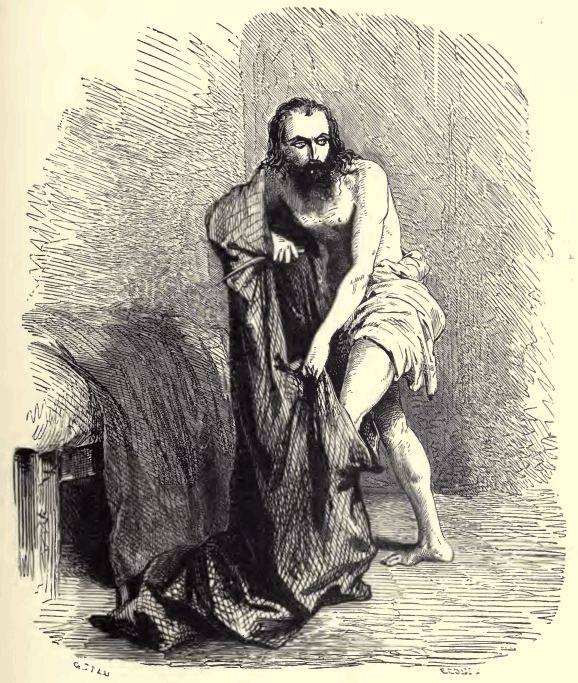
desperate resolution, he bent over the appalling shroud, opened it with
the knife which Faria had made, drew the corpse from the sack, and bore
it along the tunnel to his own chamber, laid it on his couch, tied
around its head the rag he wore at night around his own, covered it
with his counterpane, once again kissed the ice-cold brow, and tried
vainly to close the resisting eyes, which glared horribly, turned the
head towards the wall, so that the jailer might, when he brought the
evening meal, believe that he was asleep, as was his frequent custom;
entered the tunnel again, drew the bed against the wall, returned to
the other cell, took from the hiding-place the needle and thread, flung
off his rags, that they might feel only naked flesh beneath the coarse
canvas, and getting inside the sack, placed himself in the posture in
which the dead body had been laid, and sewed up the mouth of the sack
from the inside.
He would have been discovered by the beating of his heart, if by any
mischance the jailers had entered at that moment. Dantès might have
waited until the evening visit was over, but he was afraid that the
governor would change his mind, and order the dead body to be removed
earlier. In that case his last hope would have been destroyed.
Now his plans were fully made, and this is what he intended to do. If
while he was being carried out the grave-diggers should discover that
they were bearing a live instead of a dead body, Dantès did not intend
to give them time to recognize him, but with a sudden cut of the knife,
he meant to open the sack from top to bottom, and, profiting by their
alarm, escape; if they tried to catch him, he would use his knife to
better purpose.
If they took him to the cemetery and laid him in a grave, he would
allow himself to be covered with earth, and then, as it was night, the
grave-diggers could scarcely have turned their backs before he would
have worked his way through the yielding soil and escaped. He hoped
that the weight of earth would not be so great that he could not
overcome it. If he was detected in this and the earth proved too heavy,
he would be stifled, and then—so much the better, all would be over.
Dantès had not eaten since the preceding evening, but he had not
thought of hunger, nor did he think of it now. His situation was too
precarious to allow him even time to reflect on any thought but one.
The first risk that Dantès ran was, that the jailer, when he brought
him his supper at seven o’clock, might perceive the change that had
been made; fortunately, twenty times at least, from misanthropy or
fatigue, Dantès had received his jailer in bed, and then the man placed
his bread and soup on the table, and went away without saying a word.
This time the jailer might not be as silent as usual, but speak to
Dantès, and seeing that he received no reply, go to the bed, and thus
discover all.
When seven o’clock came, Dantès’ agony really began. His hand placed
upon his heart was unable to redress its throbbings, while, with the
other he wiped the perspiration from his temples. From time to time
chills ran through his whole body, and clutched his heart in a grasp of
ice. Then he thought he was going to die. Yet the hours passed on
without any unusual disturbance, and Dantès knew that he had escaped
the first peril. It was a good augury.
At length, about the hour the governor had appointed, footsteps were
heard on the stairs. Edmond felt that the moment had arrived, summoned
up all his courage, held his breath, and would have been happy if at
the same time he could have repressed the throbbing of his veins. The
footsteps—they were double—paused at the door—and Dantès guessed that
the two grave-diggers had come to seek him—this idea was soon converted
into certainty, when he heard the noise they made in putting down the
hand-bier.
The door opened, and a dim light reached Dantès’ eyes through the
coarse sack that covered him; he saw two shadows approach his bed, a
third remaining at the door with a torch in its hand. The two men,
approaching the ends of the bed, took the sack by its extremities.
“He’s heavy, though, for an old and thin man,” said one, as he raised
the head.
“They say every year adds half a pound to the weight of the bones,”
said another, lifting the feet.
“Have you tied the knot?” inquired the first speaker.
“What would be the use of carrying so much more weight?” was the reply,
“I can do that when we get there.”
“Yes, you’re right,” replied the companion.
“What’s the knot for?” thought Dantès.
They deposited the supposed corpse on the bier. Edmond stiffened
himself in order to play the part of a dead man, and then the party,
lighted by the man with the torch, who went first, ascended the stairs.
Suddenly he felt the fresh and sharp night air, and Dantès knew that
the mistral was blowing. It was a sensation in which pleasure and pain
were strangely mingled.
The bearers went on for twenty paces, then stopped, putting the bier
down on the ground. One of them went away, and Dantès heard his shoes
striking on the pavement.
“Where am I?” he asked himself.
“Really, he is by no means a light load!” said the other bearer,
sitting on the edge of the hand-barrow.
Dantès’ first impulse was to escape, but fortunately he did not attempt
it.
“Give us a light,” said the other bearer, “or I shall never find what I
am looking for.”
The man with the torch complied, although not asked in the most polite
terms.
“What can he be looking for?” thought Edmond. “The spade, perhaps.”
An exclamation of satisfaction indicated that the grave-digger had
found the object of his search. “Here it is at last,” he said, “not
without some trouble, though.”
“Yes,” was the answer, “but it has lost nothing by waiting.”
As he said this, the man came towards Edmond, who heard a heavy
metallic substance laid down beside him, and at the same moment a cord
was fastened round his feet with sudden and painful violence.
“Well, have you tied the knot?” inquired the grave-digger, who was
looking on.
“Yes, and pretty tight too, I can tell you,” was the answer.
“Move on, then.” And the bier was lifted once more, and they proceeded.
They advanced fifty paces farther, and then stopped to open a door,
then went forward again. The noise of the waves dashing against the
rocks on which the château is built, reached Dantès’ ear distinctly as
they went forward.
“Bad weather!” observed one of the bearers; “not a pleasant night for a
dip in the sea.”
“Why, yes, the abbé runs a chance of being wet,” said the other; and
then there was a burst of brutal laughter.
Dantès did not comprehend the jest, but his hair stood erect on his
head.
“Well, here we are at last,” said one of them.
“A little farther—a little farther,” said the other. “You know very
well that the last was stopped on his way, dashed on the rocks, and the
governor told us next day that we were careless fellows.”
They ascended five or six more steps, and then Dantès felt that they
took him, one by the head and the other by the heels, and swung him to
and fro.
“One!” said the grave-diggers, “two! three!”
And at the same instant Dantès felt himself flung into the air like a
wounded bird, falling, falling, with a rapidity that made his blood
curdle. Although drawn downwards by the heavy weight which hastened his
rapid descent, it seemed to him as if the fall lasted for a century. At
last, with a horrible splash, he darted like an arrow into the ice-cold
water, and as he did so he uttered a shrill cry, stifled in a moment by
his immersion beneath the waves.
Dantès had been flung into the sea, and was dragged into its depths by
a thirty-six-pound shot tied to his feet.
The sea is the cemetery of the Château d’If.
0267m
Chapter XVIII
The Treasure
When Dantès returned next morning to the chamber of his companion in
captivity, he found Faria seated and looking composed. In the ray of
light which entered by the narrow window of his cell, he held open in
his left hand, of which alone, it will be recollected, he retained the
use, a sheet of paper, which, from being constantly rolled into a small
compass, had the form of a cylinder, and was not easily kept open. He
did not speak, but showed the paper to Dantès.
“What is that?” he inquired.
“Look at it,” said the abbé with a smile.
“I have looked at it with all possible attention,” said Dantès, “and I
only see a half-burnt paper, on which are traces of Gothic characters
inscribed with a peculiar kind of ink.”
“This paper, my friend,” said Faria, “I may now avow to you, since I
have the proof of your fidelity—this paper is my treasure, of which,
from this day forth, one-half belongs to you.”
The sweat started forth on Dantès’ brow. Until this day and for how
long a time!—he had refrained from talking of the treasure, which had
brought upon the abbé the accusation of madness. With his instinctive
delicacy Edmond had preferred avoiding any touch on this painful chord,
and Faria had been equally silent. He had taken the silence of the old
man for a return to reason; and now these few words uttered by Faria,
after so painful a crisis, seemed to indicate a serious relapse into
mental alienation.
“Your treasure?” stammered Dantès. Faria smiled.
“Yes,” said he. “You have, indeed, a noble nature, Edmond, and I see by
your paleness and agitation what is passing in your heart at this
moment. No, be assured, I am not mad. This treasure exists, Dantès, and
if I have not been allowed to possess it, you will. Yes—you. No one
would listen or believe me, because everyone thought me mad; but you,
who must know that I am not, listen to me, and believe me so afterwards
if you will.”
“Alas,” murmured Edmond to himself, “this is a terrible relapse! There
was only this blow wanting.” Then he said aloud, “My dear friend, your
attack has, perhaps, fatigued you; had you not better repose awhile?
Tomorrow, if you will, I will hear your narrative; but today I wish to
nurse you carefully. Besides,” he said, “a treasure is not a thing we
need hurry about.”
“On the contrary, it is a matter of the utmost importance, Edmond!”
replied the old man. “Who knows if tomorrow, or the next day after, the
third attack may not come on? and then must not all be over? Yes,
indeed, I have often thought with a bitter joy that these riches, which
would make the wealth of a dozen families, will be forever lost to
those men who persecute me. This idea was one of vengeance to me, and I
tasted it slowly in the night of my dungeon and the despair of my
captivity. But now I have forgiven the world for the love of you; now
that I see you, young and with a promising future,—now that I think of
all that may result to you in the good fortune of such a disclosure, I
shudder at any delay, and tremble lest I should not assure to one as
worthy as yourself the possession of so vast an amount of hidden
wealth.”
Edmond turned away his head with a sigh.
“You persist in your incredulity, Edmond,” continued Faria. “My words
have not convinced you. I see you require proofs. Well, then, read this
paper, which I have never shown to anyone.”
“Tomorrow, my dear friend,” said Edmond, desirous of not yielding to
the old man’s madness. “I thought it was understood that we should not
talk of that until tomorrow.”
“Then we will not talk of it until tomorrow; but read this paper
today.”
“I will not irritate him,” thought Edmond, and taking the paper, of
which half was wanting,—having been burnt, no doubt, by some
accident,—he read:
“this treasure, which may amount to two...
of Roman crowns in the most distant a...
of the second opening wh...
declare to belong to him alo...
heir.
“25th April, 149’”
“Well!” said Faria, when the young man had finished reading it.
“Why,” replied Dantès, “I see nothing but broken lines and unconnected
words, which are rendered illegible by fire.”
“Yes, to you, my friend, who read them for the first time; but not for
me, who have grown pale over them by many nights’ study, and have
reconstructed every phrase, completed every thought.”
“And do you believe you have discovered the hidden meaning?”
“I am sure I have, and you shall judge for yourself; but first listen
to the history of this paper.”
And Dantès, happy to escape the history and explanation which would be
sure to confirm his belief in his friend’s mental instability, glided
like a snake along the narrow passage; while Faria, restored by his
alarm to a certain amount of activity, pushed the stone into place with
his foot, and covered it with a mat in order the more effectually to
avoid discovery.
It was the governor, who, hearing of Faria’s illness from the jailer,
had come in person to see him.
Faria sat up to receive him, avoiding all gestures in order that he
might conceal from the governor the paralysis that had already half
stricken him with death. His fear was lest the governor, touched with
pity, might order him to be removed to better quarters, and thus
separate him from his young companion. But fortunately this was not the
case, and the governor left him, convinced that the poor madman, for
whom in his heart he felt a kind of affection, was only troubled with a
slight indisposition.
During this time, Edmond, seated on his bed with his head in his hands,
tried to collect his scattered thoughts. Faria, since their first
acquaintance, had been on all points so rational and logical, so
wonderfully sagacious, in fact, that he could not understand how so
much wisdom on all points could be allied with madness. Was Faria
deceived as to his treasure, or was all the world deceived as to Faria?
Dantès remained in his cell all day, not daring to return to his
friend, thinking thus to defer the moment when he should be convinced,
once for all, that the abbé was mad—such a conviction would be so
terrible!
But, towards the evening after the hour for the customary visit had
gone by, Faria, not seeing the young man appear, tried to move and get
over the distance which separated them. Edmond shuddered when he heard
the painful efforts which the old man made to drag himself along; his
leg was inert, and he could no longer make use of one arm. Edmond was
obliged to assist him, for otherwise he would not have been able to
enter by the small aperture which led to Dantès’ chamber.
“Here I am, pursuing you remorselessly,” he said with a benignant
smile. “You thought to escape my munificence, but it is in vain. Listen
to me.”
Edmond saw there was no escape, and placing the old man on his bed, he
seated himself on the stool beside him.
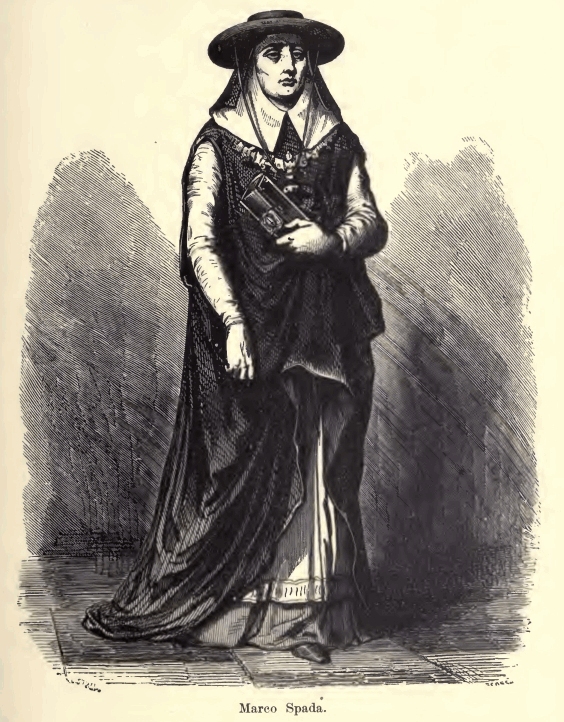
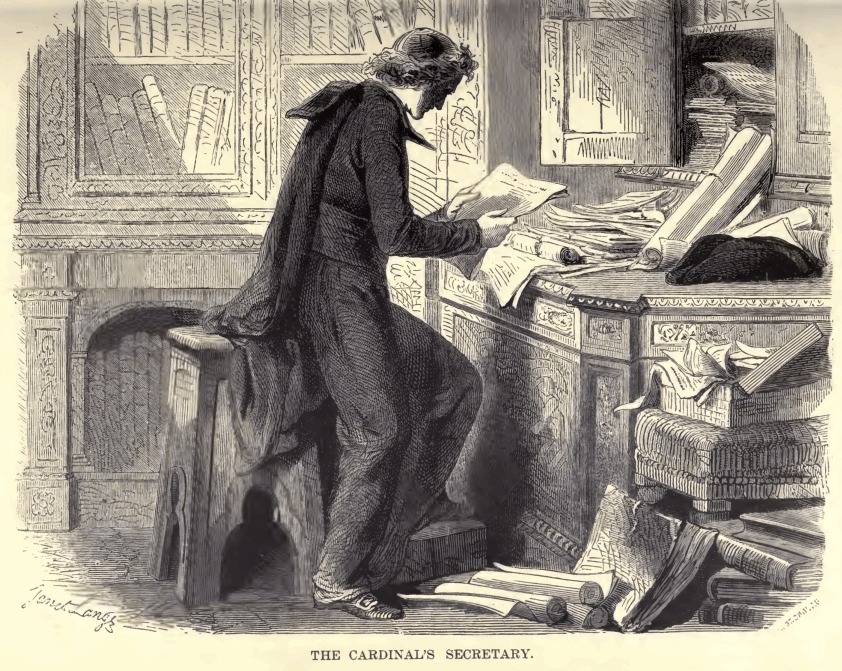
“You know,” said the abbé, “that I was the secretary and intimate
friend of Cardinal Spada, the last of the princes of that name. I owe
to this worthy lord all the happiness I ever knew. He was not rich,
although the wealth of his family had passed into a proverb, and I
heard the phrase very often, ‘As rich as a Spada.’ But he, like public
rumor, lived on this reputation for wealth; his palace was my paradise.
I was tutor to his nephews, who are dead; and when he was alone in the
world, I tried by absolute devotion to his will, to make up to him all
he had done for me during ten years of unremitting kindness. The
cardinal’s house had no secrets for me. I had often seen my noble
patron annotating ancient volumes, and eagerly searching amongst dusty
family manuscripts. One day when I was reproaching him for his
unavailing searches, and deploring the prostration of mind that
followed them, he looked at me, and, smiling bitterly, opened a volume
relating to the History of the City of Rome. There, in the twentieth
chapter of the Life of Pope Alexander VI., were the following lines,
which I can never forget:—
“‘The great wars of Romagna had ended; Cæsar Borgia, who had completed
his conquest, had need of money to purchase all Italy. The pope had
also need of money to bring matters to an end with Louis XII. King of
France, who was formidable still in spite of his recent reverses; and
it was necessary, therefore, to have recourse to some profitable
scheme, which was a matter of great difficulty in the impoverished
condition of exhausted Italy. His holiness had an idea. He determined
to make two cardinals.’
“By choosing two of the greatest personages of Rome, especially rich
men—this was the return the Holy Father looked for. In the first
place, he could sell the great appointments and splendid offices which
the cardinals already held; and then he had the two hats to sell
besides. There was a third point in view, which will appear hereafter.
“The pope and Cæsar Borgia first found the two future cardinals; they
were Giovanni Rospigliosi, who held four of the highest dignities of
the Holy See, and Cæsar Spada, one of the noblest and richest of the
Roman nobility; both felt the high honor of such a favor from the pope.
They were ambitious, and Cæsar Borgia soon found purchasers for their
appointments. The result was, that Rospigliosi and Spada paid for being
cardinals, and eight other persons paid for the offices the cardinals
held before their elevation, and thus eight hundred thousand crowns
entered into the coffers of the speculators.
“It is time now to proceed to the last part of the speculation. The
pope heaped attentions upon Rospigliosi and Spada, conferred upon them
the insignia of the cardinalate, and induced them to arrange their
affairs and take up their residence at Rome. Then the pope and Cæsar
Borgia invited the two cardinals to dinner. This was a matter of
dispute between the Holy Father and his son. Cæsar thought they could
make use of one of the means which he always had ready for his friends,
that is to say, in the first place, the famous key which was given to
certain persons with the request that they go and open a designated
cupboard. This key was furnished with a small iron point,—a negligence
on the part of the locksmith. When this was pressed to effect the
opening of the cupboard, of which the lock was difficult, the person
was pricked by this small point, and died next day. Then there was the
ring with the lion’s head, which Cæsar wore when he wanted to greet his
friends with a clasp of the hand. The lion bit the hand thus favored,
and at the end of twenty-four hours, the bite was mortal.
“Cæsar proposed to his father, that they should either ask the
cardinals to open the cupboard, or shake hands with them; but Alexander
VI. replied: ‘Now as to the worthy cardinals, Spada and Rospigliosi,
let us ask both of them to dinner, something tells me that we shall get
that money back. Besides, you forget, Cæsar, an indigestion declares
itself immediately, while a prick or a bite occasions a delay of a day
or two.’ Cæsar gave way before such cogent reasoning, and the cardinals
were consequently invited to dinner.
“The table was laid in a vineyard belonging to the pope, near San
Pierdarena, a charming retreat which the cardinals knew very well by
report. Rospigliosi, quite set up with his new dignities, went with a
good appetite and his most ingratiating manner. Spada, a prudent man,
and greatly attached to his only nephew, a young captain of the highest
promise, took paper and pen, and made his will. He then sent word to
his nephew to wait for him near the vineyard; but it appeared the
servant did not find him.
“Spada knew what these invitations meant; since Christianity, so
eminently civilizing, had made progress in Rome, it was no longer a
centurion who came from the tyrant with a message, ‘Cæsar wills that
you die.’ but it was a legate à latere, who came with a smile on his
lips to say from the pope, ‘His holiness requests you to dine with
him.’
“Spada set out about two o’clock to San Pierdarena. The pope awaited
him. The first sight that attracted the eyes of Spada was that of his
nephew, in full costume, and Cæsar Borgia paying him most marked
attentions. Spada turned pale, as Cæsar looked at him with an ironical
air, which proved that he had anticipated all, and that the snare was
well spread.
“They began dinner and Spada was only able to inquire of his nephew if
he had received his message. The nephew replied no; perfectly
comprehending the meaning of the question. It was too late, for he had
already drunk a glass of excellent wine, placed for him expressly by
the pope’s butler. Spada at the same moment saw another bottle approach
him, which he was pressed to taste. An hour afterwards a physician
declared they were both poisoned through eating mushrooms. Spada died
on the threshold of the vineyard; the nephew expired at his own door,
making signs which his wife could not comprehend.
“Then Cæsar and the pope hastened to lay hands on the heritage, under
pretense of seeking for the papers of the dead man. But the inheritance
consisted in this only, a scrap of paper on which Spada had written:—‘I
bequeath to my beloved nephew my coffers, my books, and, amongst
others, my breviary with the gold corners, which I beg he will preserve
in remembrance of his affectionate uncle.’
“The heirs sought everywhere, admired the breviary, laid hands on the
furniture, and were greatly astonished that Spada, the rich man, was
really the most miserable of uncles—no treasures—unless they were those
of science, contained in the library and laboratories. That was all.
Cæsar and his father searched, examined, scrutinized, but found
nothing, or at least very little; not exceeding a few thousand crowns
in plate, and about the same in ready money; but the nephew had time to
say to his wife before he expired: ‘Look well among my uncle’s papers;
there is a will.’
“They sought even more thoroughly than the august heirs had done, but
it was fruitless. There were two palaces and a vineyard behind the
Palatine Hill; but in these days landed property had not much value,
and the two palaces and the vineyard remained to the family since they
were beneath the rapacity of the pope and his son. Months and years
rolled on. Alexander VI. died, poisoned,—you know by what mistake.
Cæsar, poisoned at the same time, escaped by shedding his skin like a
snake; but the new skin was spotted by the poison till it looked like a
tiger’s. Then, compelled to quit Rome, he went and got himself
obscurely killed in a night skirmish, scarcely noticed in history.
“After the pope’s death and his son’s exile, it was supposed that the
Spada family would resume the splendid position they had held before
the cardinal’s time; but this was not the case. The Spadas remained in
doubtful ease, a mystery hung over this dark affair, and the public
rumor was, that Cæsar, a better politician than his father, had carried
off from the pope the fortune of the two cardinals. I say the two,
because Cardinal Rospigliosi, who had not taken any precaution, was
completely despoiled.
“Up to this point,” said Faria, interrupting the thread of his
narrative, “this seems to you very meaningless, no doubt, eh?”
“Oh, my friend,” cried Dantès, “on the contrary, it seems as if I were
reading a most interesting narrative; go on, I beg of you.”
“I will. The family began to get accustomed to their obscurity. Years
rolled on, and amongst the descendants some were soldiers, others
diplomatists; some churchmen, some bankers; some grew rich, and some
were ruined. I come now to the last of the family, whose secretary I
was—the Count of Spada. I had often heard him complain of the
disproportion of his rank with his fortune; and I advised him to invest
all he had in an annuity. He did so, and thus doubled his income. The
celebrated breviary remained in the family, and was in the count’s
possession. It had been handed down from father to son; for the
singular clause of the only will that had been found, had caused it to
be regarded as a genuine relic, preserved in the family with
superstitious veneration. It was an illuminated book, with beautiful
Gothic characters, and so weighty with gold, that a servant always
carried it before the cardinal on days of great solemnity.
“At the sight of papers of all sorts,—titles, contracts, parchments,
which were kept in the archives of the family, all descending from the
poisoned cardinal, I in my turn examined the immense bundles of
documents, like twenty servitors, stewards, secretaries before me; but
in spite of the most exhaustive researches, I found—nothing. Yet I had
read, I had even written a precise history of the Borgia family, for
the sole purpose of assuring myself whether any increase of fortune had
occurred to them on the death of the Cardinal Cæsar Spada; but could
only trace the acquisition of the property of the Cardinal Rospigliosi,
his companion in misfortune.
“I was then almost assured that the inheritance had neither profited
the Borgias nor the family, but had remained unpossessed like the
treasures of the Arabian Nights, which slept in the bosom of the earth
under the eyes of the genie. I searched, ransacked, counted, calculated
a thousand and a thousand times the income and expenditure of the
family for three hundred years. It was useless. I remained in my
ignorance, and the Count of Spada in his poverty.
“My patron died. He had reserved from his annuity his family papers,
his library, composed of five thousand volumes, and his famous
breviary. All these he bequeathed to me, with a thousand Roman crowns,
which he had in ready money, on condition that I would have anniversary
masses said for the repose of his soul, and that I would draw up a
genealogical tree and history of his house. All this I did
scrupulously. Be easy, my dear Edmond, we are near the conclusion.
“In 1807, a month before I was arrested, and a fortnight after the
death of the Count of Spada, on the 25th of December (you will see
presently how the date became fixed in my memory), I was reading, for
the thousandth time, the papers I was arranging, for the palace was
sold to a stranger, and I was going to leave Rome and settle at
Florence, intending to take with me twelve thousand francs I possessed,
my library, and the famous breviary, when, tired with my constant labor
at the same thing, and overcome by a heavy dinner I had eaten, my head
dropped on my hands, and I fell asleep about three o’clock in the
afternoon.
“I awoke as the clock was striking six. I raised my head; I was in
utter darkness. I rang for a light, but, as no one came, I determined
to find one for myself. It was indeed but anticipating the simple
manners which I should soon be under the necessity of adopting. I took
a wax-candle in one hand, and with the other groped about for a piece
of paper (my match-box being empty), with which I proposed to get a
light from the small flame still playing on the embers. Fearing,
however, to make use of any valuable piece of paper, I hesitated for a
moment, then recollected that I had seen in the famous breviary, which
was on the table beside me, an old paper quite yellow with age, and
which had served as a marker for centuries, kept there by the request
of the heirs. I felt for it, found it, twisted it up together, and
putting it into the expiring flame, set light to it.
“But beneath my fingers, as if by magic, in proportion as the fire
ascended, I saw yellowish characters appear on the paper. I grasped it
in my hand, put out the flame as quickly as I could, lighted my taper
in the fire itself, and opened the crumpled paper with inexpressible
emotion, recognizing, when I had done so, that these characters had
been traced in mysterious and sympathetic ink, only appearing when
exposed to the fire; nearly one-third of the paper had been consumed by
the flame. It was that paper you read this morning; read it again,
Dantès, and then I will complete for you the incomplete words and
unconnected sense.”
Faria, with an air of triumph, offered the paper to Dantès, who this
time read the following words, traced with an ink of a reddish color
resembling rust:
“This 25th day of April, 1498, be...
Alexander VI., and fearing that not...
he may desire to become my heir, and re...
and Bentivoglio, who were poisoned,...
my sole heir, that I have bu...
and has visited with me, that is, in...
Island of Monte Cristo, all I poss...
jewels, diamonds, gems; that I alone...
may amount to nearly two mil...
will find on raising the twentieth ro...
creek to the east in a right line. Two open...
in these caves; the treasure is in the furthest a...
which treasure I bequeath and leave en...
as my sole heir.
“25th April, 1498.
“Cæs...
“And now,” said the abbé, “read this other paper;” and he presented to
Dantès a second leaf with fragments of lines written on it, which
Edmond read as follows:
“...ing invited to dine by his Holiness
...content with making me pay for my hat,
...serves for me the fate of Cardinals Caprara
...I declare to my nephew, Guido Spada
...ried in a place he knows
...the caves of the small
...essed of ingots, gold, money,
...know of the existence of this treasure, which
...lions of Roman crowns, and which he
...ck from the small
...ings have been made
...ngle in the second;
...tire to him
...ar † Spada.”
Faria followed him with an excited look.
“And now,” he said, when he saw that Dantès had read the last line,
“put the two fragments together, and judge for yourself.” Dantès
obeyed, and the conjointed pieces gave the following:
“This 25th day of April, 1498, be...ing invited to dine by his Holiness
Alexander VI., and fearing that not...content with making me pay for my
hat, he may desire to become my heir, and re...serves for me the fate
of Cardinals Caprara and Bentivoglio, who were poisoned,...I declare to
my nephew, Guido Spada, my sole heir, that I have bu...ried in a place
he knows and has visited with me, that is, in...the caves of the small
Island of Monte Cristo, all I poss...essed of ingots, gold, money,
jewels, diamonds, gems; that I alone...know of the existence of this
treasure, which may amount to nearly two mil...lions of Roman crowns,
and which he will find on raising the twentieth ro...ck from the small
creek to the east in a right line. Two open...ings have been made in
these caves; the treasure is in the furthest a...ngle in the second;
which treasure I bequeath and leave en...tire to him as my sole heir.
“25th April, 1498. “Cæs...ar † Spada.”
“Well, do you comprehend now?” inquired Faria.
“It is the declaration of Cardinal Spada, and the will so long sought
for,” replied Edmond, still incredulous.
“Yes; a thousand times, yes!”
“And who completed it as it now is?”
“I did. Aided by the remaining fragment, I guessed the rest; measuring
the length of the lines by those of the paper, and divining the hidden
meaning by means of what was in part revealed, as we are guided in a
cavern by the small ray of light above us.”
“And what did you do when you arrived at this conclusion?”
“I resolved to set out, and did set out at that very instant, carrying
with me the beginning of my great work, the unity of the Italian
kingdom; but for some time the imperial police (who at this period,
quite contrary to what Napoleon desired so soon as he had a son born to
him, wished for a partition of provinces) had their eyes on me; and my
hasty departure, the cause of which they were unable to guess, having
aroused their suspicions, I was arrested at the very moment I was
leaving Piombino.
“Now,” continued Faria, addressing Dantès with an almost paternal
expression, “now, my dear fellow, you know as much as I do myself. If
we ever escape together, half this treasure is yours; if I die here,
and you escape alone, the whole belongs to you.”
“But,” inquired Dantès hesitating, “has this treasure no more
legitimate possessor in the world than ourselves?”
“No, no, be easy on that score; the family is extinct. The last Count
of Spada, moreover, made me his heir, bequeathing to me this symbolic
breviary, he bequeathed to me all it contained; no, no, make your mind
satisfied on that point. If we lay hands on this fortune, we may enjoy
it without remorse.”
“And you say this treasure amounts to——”
“Two millions of Roman crowns; nearly thirteen millions of our money.”2
“Impossible!” said Dantès, staggered at the enormous amount.
“Impossible? and why?” asked the old man. “The Spada family was one of
the oldest and most powerful families of the fifteenth century; and in
those times, when other opportunities for investment were wanting, such
accumulations of gold and jewels were by no means rare; there are at
this day Roman families perishing of hunger, though possessed of nearly
a million in diamonds and jewels, handed down by entail, and which they
cannot touch.”
Edmond thought he was in a dream—he wavered between incredulity and
joy.
“I have only kept this secret so long from you,” continued Faria, “that
I might test your character, and then surprise you. Had we escaped
before my attack of catalepsy, I should have conducted you to Monte
Cristo; now,” he added, with a sigh, “it is you who will conduct me
thither. Well, Dantès, you do not thank me?”
“This treasure belongs to you, my dear friend,” replied Dantès, “and to
you only. I have no right to it. I am no relation of yours.”
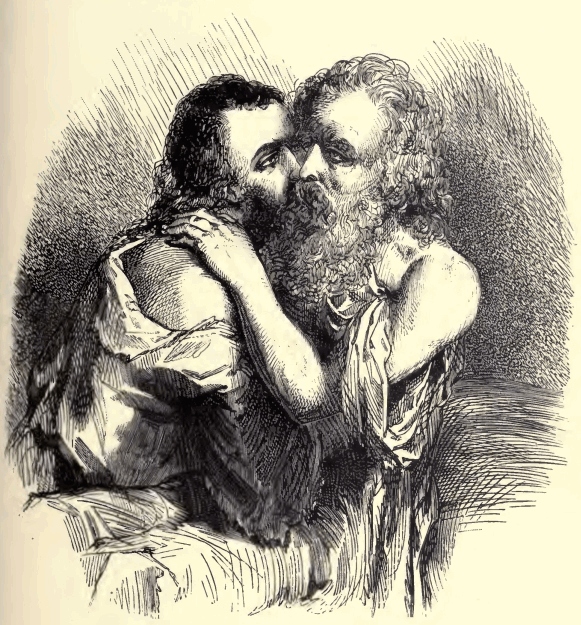
“You are my son, Dantès,” exclaimed the old man. “You are the child of
my captivity. My profession condemns me to celibacy. God has sent you
to me to console, at one and the same time, the man who could not be a
father, and the prisoner who could not get free.”
And Faria extended the arm of which alone the use remained to him to
the young man, who threw himself upon his neck and wept.
Chapter XIX
The Third Seizure
Now that this treasure, which had so long been the object of the abbé’s
meditations, could insure the future happiness of him whom Faria really
loved as a son, it had doubled its value in his eyes, and every day he
expatiated on the amount, explaining to Dantès all the good which, with
thirteen or fourteen millions of francs, a man could do in these days
to his friends; and then Dantès’ countenance became gloomy, for the
oath of vengeance he had taken recurred to his memory, and he reflected
how much ill, in these times, a man with thirteen or fourteen millions
could do to his enemies.
The abbé did not know the Island of Monte Cristo; but Dantès knew it,
and had often passed it, situated twenty-five miles from Pianosa,
between Corsica and the Island of Elba, and had once touched there.
This island was, always had been, and still is, completely deserted. It
is a rock of almost conical form, which looks as though it had been
thrust up by volcanic force from the depth to the surface of the ocean.
Dantès drew a plan of the island for Faria, and Faria gave Dantès
advice as to the means he should employ to recover the treasure. But
Dantès was far from being as enthusiastic and confident as the old man.
It was past a question now that Faria was not a lunatic, and the way in
which he had achieved the discovery, which had given rise to the
suspicion of his madness, increased Edmond’s admiration of him; but at
the same time Dantès could not believe that the deposit, supposing it
had ever existed, still existed; and though he considered the treasure
as by no means chimerical, he yet believed it was no longer there.
However, as if fate resolved on depriving the prisoners of their last
chance, and making them understand that they were condemned to
perpetual imprisonment, a new misfortune befell them; the gallery on
the sea side, which had long been in ruins, was rebuilt. They had
repaired it completely, and stopped up with vast masses of stone the
hole Dantès had partly filled in. But for this precaution, which, it
will be remembered, the abbé had made to Edmond, the misfortune would
have been still greater, for their attempt to escape would have been
detected, and they would undoubtedly have been separated. Thus a new, a
stronger, and more inexorable barrier was interposed to cut off the
realization of their hopes.
“You see,” said the young man, with an air of sorrowful resignation, to
Faria, “that God deems it right to take from me any claim to merit for
what you call my devotion to you. I have promised to remain forever
with you, and now I could not break my promise if I would. The treasure
will be no more mine than yours, and neither of us will quit this
prison. But my real treasure is not that, my dear friend, which awaits
me beneath the sombre rocks of Monte Cristo, it is your presence, our
living together five or six hours a day, in spite of our jailers; it is
the rays of intelligence you have elicited from my brain, the languages
you have implanted in my memory, and which have taken root there with
all their philological ramifications. These different sciences that you
have made so easy to me by the depth of the knowledge you possess of
them, and the clearness of the principles to which you have reduced
them—this is my treasure, my beloved friend, and with this you have
made me rich and happy. Believe me, and take comfort, this is better
for me than tons of gold and cases of diamonds, even were they not as
problematical as the clouds we see in the morning floating over the
sea, which we take for terra firma, and which evaporate and vanish as
we draw near to them. To have you as long as possible near me, to hear
your eloquent speech,—which embellishes my mind, strengthens my soul,
and makes my whole frame capable of great and terrible things, if I
should ever be free,—so fills my whole existence, that the despair to
which I was just on the point of yielding when I knew you, has no
longer any hold over me; and this—this is my fortune—not chimerical,
but actual. I owe you my real good, my present happiness; and all the
sovereigns of the earth, even Cæsar Borgia himself, could not deprive
me of this.”
Thus, if not actually happy, yet the days these two unfortunates passed
together went quickly. Faria, who for so long a time had kept silence
as to the treasure, now perpetually talked of it. As he had prophesied
would be the case, he remained paralyzed in the right arm and the left
leg, and had given up all hope of ever enjoying it himself. But he was
continually thinking over some means of escape for his young companion,
and anticipating the pleasure he would enjoy. For fear the letter might
be some day lost or stolen, he compelled Dantès to learn it by heart;
and Dantès knew it from the first to the last word. Then he destroyed
the second portion, assured that if the first were seized, no one would
be able to discover its real meaning. Whole hours sometimes passed
while Faria was giving instructions to Dantès,—instructions which were
to serve him when he was at liberty. Then, once free, from the day and
hour and moment when he was so, he could have but one only thought,
which was, to gain Monte Cristo by some means, and remain there alone
under some pretext which would arouse no suspicions; and once there, to
endeavor to find the wonderful caverns, and search in the appointed
spot,—the appointed spot, be it remembered, being the farthest angle in
the second opening.
In the meanwhile the hours passed, if not rapidly, at least tolerably.
Faria, as we have said, without having recovered the use of his hand
and foot, had regained all the clearness of his understanding, and had
gradually, besides the moral instructions we have detailed, taught his
youthful companion the patient and sublime duty of a prisoner, who
learns to make something from nothing. They were thus perpetually
employed,—Faria, that he might not see himself grow old; Dantès, for
fear of recalling the almost extinct past which now only floated in his
memory like a distant light wandering in the night. So life went on for
them as it does for those who are not victims of misfortune and whose
activities glide along mechanically and tranquilly beneath the eye of
Providence.
But beneath this superficial calm there were in the heart of the young
man, and perhaps in that of the old man, many repressed desires, many
stifled sighs, which found vent when Faria was left alone, and when
Edmond returned to his cell.
One night Edmond awoke suddenly, believing that he heard someone
calling him. He opened his eyes upon utter darkness. His name, or
rather a plaintive voice which essayed to pronounce his name, reached
him. He sat up in bed and a cold sweat broke out upon his brow.
Undoubtedly the call came from Faria’s dungeon.
“Alas,” murmured Edmond; “can it be?”
He moved his bed, drew up the stone, rushed into the passage, and
reached the opposite extremity; the secret entrance was open. By the
light of the wretched and wavering lamp, of which we have spoken,
Dantès saw the old man, pale, but yet erect, clinging to the bedstead.
His features were writhing with those horrible symptoms which he
already knew, and which had so seriously alarmed him when he saw them
for the first time.
“Alas, my dear friend,” said Faria in a resigned tone, “you understand,
do you not, and I need not attempt to explain to you?”
Edmond uttered a cry of agony, and, quite out of his senses, rushed
towards the door, exclaiming, “Help, help!”
Faria had just sufficient strength to restrain him.
“Silence,” he said, “or you are lost. We must now only think of you, my
dear friend, and so act as to render your captivity supportable or your
flight possible. It would require years to do again what I have done
here, and the results would be instantly destroyed if our jailers knew
we had communicated with each other. Besides, be assured, my dear
Edmond, the dungeon I am about to leave will not long remain empty;
some other unfortunate being will soon take my place, and to him you
will appear like an angel of salvation. Perhaps he will be young,
strong, and enduring, like yourself, and will aid you in your escape,
while I have been but a hindrance. You will no longer have half a dead
body tied to you as a drag to all your movements. At length Providence
has done something for you; he restores to you more than he takes away,
and it was time I should die.”
Edmond could only clasp his hands and exclaim, “Oh, my friend, my
friend, speak not thus!” and then resuming all his presence of mind,
which had for a moment staggered under this blow, and his strength,
which had failed at the words of the old man, he said, “Oh, I have
saved you once, and I will save you a second time!” And raising the
foot of the bed, he drew out the phial, still a third filled with the
red liquor.
“See,” he exclaimed, “there remains still some of the magic draught.
Quick, quick! tell me what I must do this time; are there any fresh
instructions? Speak, my friend; I listen.”
“There is not a hope,” replied Faria, shaking his head, “but no matter;
God wills it that man whom he has created, and in whose heart he has so
profoundly rooted the love of life, should do all in his power to
preserve that existence, which, however painful it may be, is yet
always so dear.”
“Oh, yes, yes!” exclaimed Dantès; “and I tell you that I will save you
yet.”
“Well, then, try. The cold gains upon me. I feel the blood flowing
towards my brain. These horrible chills, which make my teeth chatter
and seem to dislocate my bones, begin to pervade my whole frame; in
five minutes the malady will reach its height, and in a quarter of an
hour there will be nothing left of me but a corpse.”
“Oh!” exclaimed Dantès, his heart wrung with anguish.
“Do as you did before, only do not wait so long, all the springs of
life are now exhausted in me, and death,” he continued, looking at his
paralyzed arm and leg, “has but half its work to do. If, after having
made me swallow twelve drops instead of ten, you see that I do not
recover, then pour the rest down my throat. Now lift me on my bed, for
I can no longer support myself.”
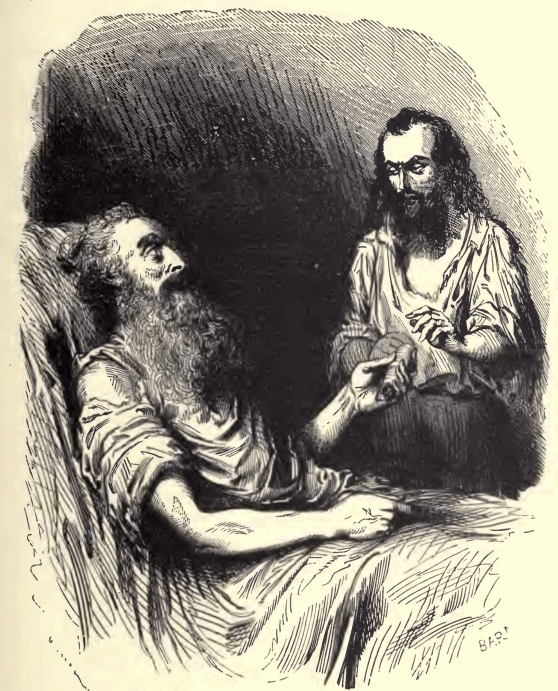
Edmond took the old man in his arms, and laid him on the bed.
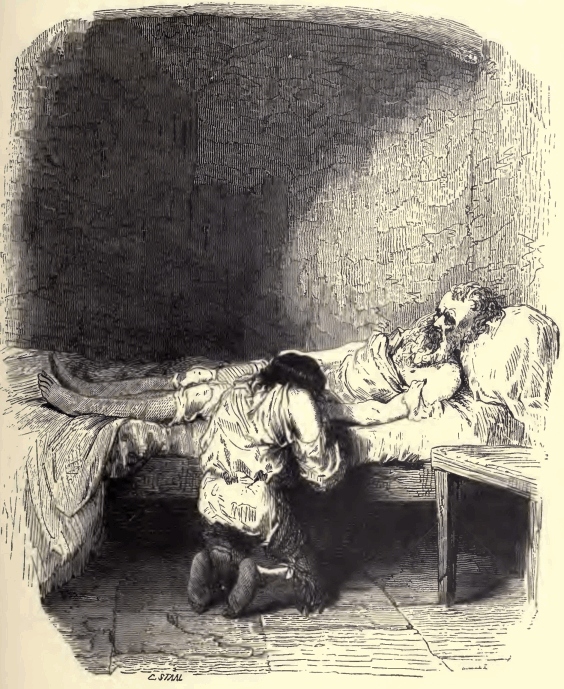
“And now, my dear friend,” said Faria, “sole consolation of my wretched
existence,—you whom Heaven gave me somewhat late, but still gave me, a
priceless gift, and for which I am most grateful,—at the moment of
separating from you forever, I wish you all the happiness and all the
prosperity you so well deserve. My son, I bless thee!”
The young man cast himself on his knees, leaning his head against the
old man’s bed.
“Listen, now, to what I say in this my dying moment. The treasure of
the Spadas exists. God grants me the boon of vision unrestricted by
time or space. I see it in the depths of the inner cavern. My eyes
pierce the inmost recesses of the earth, and are dazzled at the sight
of so much riches. If you do escape, remember that the poor abbé, whom
all the world called mad, was not so. Hasten to Monte Cristo—avail
yourself of the fortune—for you have indeed suffered long enough.”
A violent convulsion attacked the old man. Dantès raised his head and
saw Faria’s eyes injected with blood. It seemed as if a flow of blood
had ascended from the chest to the head.
“Adieu, adieu!” murmured the old man, clasping Edmond’s hand
convulsively—“adieu!”
“Oh, no,—no, not yet,” he cried; “do not forsake me! Oh, succor him!
Help—help—help!”
“Hush! hush!” murmured the dying man, “that they may not separate us if
you save me!”
“You are right. Oh, yes, yes; be assured I shall save you! Besides,
although you suffer much, you do not seem to be in such agony as you
were before.”
“Do not mistake! I suffer less because there is in me less strength to
endure. At your age we have faith in life; it is the privilege of youth
to believe and hope, but old men see death more clearly. Oh, ’tis
here—’tis here—’tis over—my sight is gone—my senses fail! Your hand,
Dantès! Adieu! adieu!”
And raising himself by a final effort, in which he summoned all his
faculties, he said,—“Monte Cristo, forget not Monte Cristo!” And he
fell back on the bed.
The crisis was terrible, and a rigid form with twisted limbs, swollen
eyelids, and lips flecked with bloody foam, lay on the bed of torture,
in place of the intellectual being who so lately rested there.
Dantès took the lamp, placed it on a projecting stone above the bed,
whence its tremulous light fell with strange and fantastic ray on the
distorted countenance and motionless, stiffened body. With steady gaze
he awaited confidently the moment for administering the restorative.
When he believed that the right moment had arrived, he took the knife,
pried open the teeth, which offered less resistance than before,
counted one after the other twelve drops, and watched; the phial
contained, perhaps, twice as much more. He waited ten minutes, a
quarter of an hour, half an hour,—no change took place. Trembling, his
hair erect, his brow bathed with perspiration, he counted the seconds
by the beating of his heart. Then he thought it was time to make the
last trial, and he put the phial to the purple lips of Faria, and
without having occasion to force open his jaws, which had remained
extended, he poured the whole of the liquid down his throat.
The draught produced a galvanic effect, a violent trembling pervaded
the old man’s limbs, his eyes opened until it was fearful to gaze upon
them, he heaved a sigh which resembled a shriek, and then his convulsed
body returned gradually to its former immobility, the eyes remaining
open.
Half an hour, an hour, an hour and a half elapsed, and during this
period of anguish, Edmond leaned over his friend, his hand applied to
his heart, and felt the body gradually grow cold, and the heart’s
pulsation become more and more deep and dull, until at length it
stopped; the last movement of the heart ceased, the face became livid,
the eyes remained open, but the eyeballs were glazed.
It was six o’clock in the morning, the dawn was just breaking, and its
feeble ray came into the dungeon, and paled the ineffectual light of
the lamp. Strange shadows passed over the countenance of the dead man,
and at times gave it the appearance of life. While the struggle between
day and night lasted, Dantès still doubted; but as soon as the daylight
gained the pre-eminence, he saw that he was alone with a corpse. Then
an invincible and extreme terror seized upon him, and he dared not
again press the hand that hung out of bed, he dared no longer to gaze
on those fixed and vacant eyes, which he tried many times to close, but
in vain—they opened again as soon as shut. He extinguished the lamp,
carefully concealed it, and then went away, closing as well as he could
the entrance to the secret passage by the large stone as he descended.
It was time, for the jailer was coming. On this occasion he began his
rounds at Dantès’ cell, and on leaving him he went on to Faria’s
dungeon, taking thither breakfast and some linen. Nothing betokened
that the man knew anything of what had occurred. He went on his way.
Dantès was then seized with an indescribable desire to know what was
going on in the dungeon of his unfortunate friend. He therefore
returned by the subterraneous gallery, and arrived in time to hear the
exclamations of the turnkey, who called out for help. Other turnkeys
came, and then was heard the regular tramp of soldiers. Last of all
came the governor.
Edmond heard the creaking of the bed as they moved the corpse, heard
the voice of the governor, who asked them to throw water on the dead
man’s face; and seeing that, in spite of this application, the prisoner
did not recover, they sent for the doctor. The governor then went out,
and words of pity fell on Dantès’ listening ears, mingled with brutal
laughter.
“Well, well,” said one, “the madman has gone to look after his
treasure. Good journey to him!”
“With all his millions, he will not have enough to pay for his shroud!”
said another.
“Oh,” added a third voice, “the shrouds of the Château d’If are not
dear!”
“Perhaps,” said one of the previous speakers, “as he was a churchman,
they may go to some expense in his behalf.”
“They may give him the honors of the sack.”
Edmond did not lose a word, but comprehended very little of what was
said. The voices soon ceased, and it seemed to him as if everyone had
left the cell. Still he dared not to enter, as they might have left
some turnkey to watch the dead. He remained, therefore, mute and
motionless, hardly venturing to breathe. At the end of an hour, he
heard a faint noise, which increased. It was the governor who returned,
followed by the doctor and other attendants. There was a moment’s
silence,—it was evident that the doctor was examining the dead body.
The inquiries soon commenced.
The doctor analyzed the symptoms of the malady to which the prisoner
had succumbed, and declared that he was dead. Questions and answers
followed in a nonchalant manner that made Dantès indignant, for he felt
that all the world should have for the poor abbé a love and respect
equal to his own.
“I am very sorry for what you tell me,” said the governor, replying to
the assurance of the doctor, “that the old man is really dead; for he
was a quiet, inoffensive prisoner, happy in his folly, and required no
watching.”
“Ah,” added the turnkey, “there was no occasion for watching him; he
would have stayed here fifty years, I’ll answer for it, without any
attempt to escape.”
“Still,” said the governor, “I believe it will be requisite,
notwithstanding your certainty, and not that I doubt your science, but
in discharge of my official duty, that we should be perfectly assured
that the prisoner is dead.”
There was a moment of complete silence, during which Dantès, still
listening, knew that the doctor was examining the corpse a second time.
“You may make your mind easy,” said the doctor; “he is dead. I will
answer for that.”
“You know, sir,” said the governor, persisting, “that we are not
content in such cases as this with such a simple examination. In spite
of all appearances, be so kind, therefore, as to finish your duty by
fulfilling the formalities described by law.”
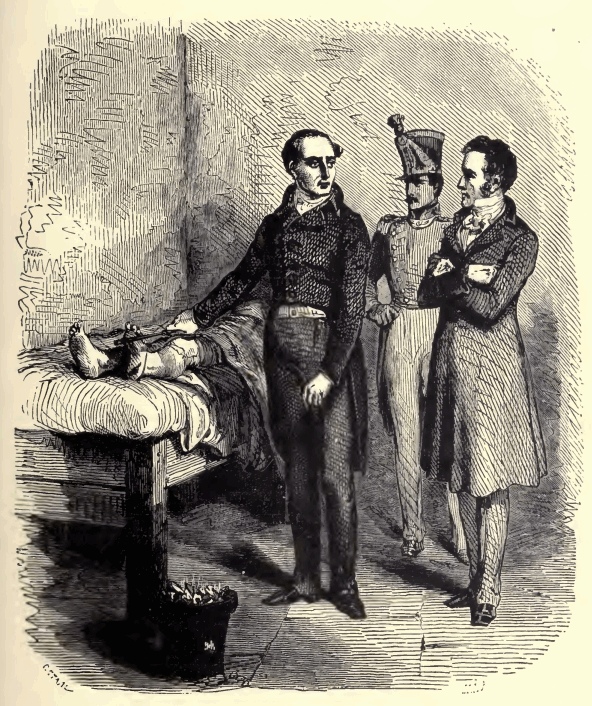
“Let the irons be heated,” said the doctor; “but really it is a useless
precaution.”
This order to heat the irons made Dantès shudder. He heard hasty steps,
the creaking of a door, people going and coming, and some minutes
afterwards a turnkey entered, saying:
“Here is the brazier, lighted.”
There was a moment’s silence, and then was heard the crackling of
burning flesh, of which the peculiar and nauseous smell penetrated even
behind the wall where Dantès was listening in horror. The perspiration
poured forth upon the young man’s brow, and he felt as if he should
faint.
“You see, sir, he is really dead,” said the doctor; “this burn in the
heel is decisive. The poor fool is cured of his folly, and delivered
from his captivity.”
“Wasn’t his name Faria?” inquired one of the officers who accompanied
the governor.
“Yes, sir; and, as he said, it was an ancient name. He was, too, very
learned, and rational enough on all points which did not relate to his
treasure; but on that, indeed, he was intractable.”
“It is the sort of malady which we call monomania,” said the doctor.
“You had never anything to complain of?” said the governor to the
jailer who had charge of the abbé.
“Never, sir,” replied the jailer, “never; on the contrary, he sometimes
amused me very much by telling me stories. One day, too, when my wife
was ill, he gave me a prescription which cured her.”
“Ah, ah!” said the doctor, “I did not know that I had a rival; but I
hope, governor, that you will show him all proper respect in
consequence.”
“Yes, yes, make your mind easy, he shall be decently interred in the
newest sack we can find. Will that satisfy you?”
“Must this last formality take place in your presence, sir?” inquired a
turnkey.
“Certainly. But make haste—I cannot stay here all day.” Other
footsteps, going and coming, were now heard, and a moment afterwards
the noise of rustling canvas reached Dantès’ ears, the bed creaked, and
the heavy footfall of a man who lifts a weight sounded on the floor;
then the bed again creaked under the weight deposited upon it.
“This evening,” said the governor.
“Will there be any mass?” asked one of the attendants.
“That is impossible,” replied the governor. “The chaplain of the
château came to me yesterday to beg for leave of absence, in order to
take a trip to Hyères for a week. I told him I would attend to the
prisoners in his absence. If the poor abbé had not been in such a
hurry, he might have had his requiem.”
“Pooh, pooh;” said the doctor, with the impiety usual in persons of his
profession; “he is a churchman. God will respect his profession, and
not give the devil the wicked delight of sending him a priest.” A shout
of laughter followed this brutal jest. Meanwhile the operation of
putting the body in the sack was going on.
“This evening,” said the governor, when the task was ended.
“At what hour?” inquired a turnkey.
“Why, about ten or eleven o’clock.”
“Shall we watch by the corpse?”
“Of what use would it be? Shut the dungeon as if he were alive—that is
all.”
Then the steps retreated, and the voices died away in the distance; the
noise of the door, with its creaking hinges and bolts ceased, and a
silence more sombre than that of solitude ensued,—the silence of death,
which was all-pervasive, and struck its icy chill to the very soul of
Dantès.
Then he raised the flag-stone cautiously with his head, and looked
carefully around the chamber. It was empty, and Dantès emerged from the
tunnel.