M. d’Avrigny soon restored the magistrate to consciousness, who had
looked like a second corpse in that chamber of death.
“Oh, death is in my house!” cried Villefort.
“Say, rather, crime!” replied the doctor.
“M. d’Avrigny,” cried Villefort, “I cannot tell you all I feel at this
moment,—terror, grief, madness.”
“Yes,” said M. d’Avrigny, with an imposing calmness, “but I think it is
now time to act. I think it is time to stop this torrent of mortality.
I can no longer bear to be in possession of these secrets without the
hope of seeing the victims and society generally revenged.”
Villefort cast a gloomy look around him. “In my house,” murmured he,
“in my house!”
“Come, magistrate,” said M. d’Avrigny, “show yourself a man; as an
interpreter of the law, do honor to your profession by sacrificing your
selfish interests to it.”
“You make me shudder, doctor. Do you talk of a sacrifice?”
“I do.”
“Do you then suspect anyone?”
“I suspect no one; death raps at your door—it enters—it goes, not
blindfolded, but circumspectly, from room to room. Well, I follow its
course, I track its passage; I adopt the wisdom of the ancients, and
feel my way, for my friendship for your family and my respect for you
are as a twofold bandage over my eyes; well——”
“Oh, speak, speak, doctor; I shall have courage.”
“Well, sir, you have in your establishment, or in your family, perhaps,
one of the frightful monstrosities of which each century produces only
one. Locusta and Agrippina, living at the same time, were an exception,
and proved the determination of Providence to effect the entire ruin of
the Roman empire, sullied by so many crimes. Brunhilda and Fredegund
were the results of the painful struggle of civilization in its
infancy, when man was learning to control mind, were it even by an
emissary from the realms of darkness. All these women had been, or
were, beautiful. The same flower of innocence had flourished, or was
still flourishing, on their brow, that is seen on the brow of the
culprit in your house.”
Villefort shrieked, clasped his hands, and looked at the doctor with a
supplicating air. But the latter went on without pity:
“‘Seek whom the crime will profit,’ says an axiom of jurisprudence.”
“Doctor,” cried Villefort, “alas, doctor, how often has man’s justice
been deceived by those fatal words. I know not why, but I feel that
this crime——”
“You acknowledge, then, the existence of the crime?”
“Yes, I see too plainly that it does exist. But it seems that it is
intended to affect me personally. I fear an attack myself, after all
these disasters.”
“Oh, man!” murmured d’Avrigny, “the most selfish of all animals, the
most personal of all creatures, who believes the earth turns, the sun
shines, and death strikes for him alone,—an ant cursing God from the
top of a blade of grass! And have those who have lost their lives lost
nothing?—M. de Saint-Méran, Madame de Saint-Méran, M. Noirtier——”
“How? M. Noirtier?”
“Yes; think you it was the poor servant’s life was coveted? No, no;
like Shakespeare’s Polonius, he died for another. It was Noirtier the
lemonade was intended for—it is Noirtier, logically speaking, who drank
it. The other drank it only by accident, and, although Barrois is dead,
it was Noirtier whose death was wished for.”
“But why did it not kill my father?”
“I told you one evening in the garden after Madame de Saint-Méran’s
death—because his system is accustomed to that very poison, and the
dose was trifling to him, which would be fatal to another; because no
one knows, not even the assassin, that, for the last twelve months, I
have given M. Noirtier brucine for his paralytic affection, while the
assassin is not ignorant, for he has proved that brucine is a violent
poison.”
“Oh, have pity—have pity!” murmured Villefort, wringing his hands.
“Follow the culprit’s steps; he first kills M. de Saint-Méran——”
“Oh, doctor!”
“I would swear to it; what I heard of his symptoms agrees too well with
what I have seen in the other cases.” Villefort ceased to contend; he
only groaned. “He first kills M. de Saint-Méran,” repeated the doctor,
“then Madame de Saint-Méran,—a double fortune to inherit.” Villefort
wiped the perspiration from his forehead. “Listen attentively.”
“Alas,” stammered Villefort, “I do not lose a single word.”
“M. Noirtier,” resumed M. d’Avrigny in the same pitiless tone,—“M.
Noirtier had once made a will against you—against your family—in favor
of the poor, in fact; M. Noirtier is spared, because nothing is
expected from him. But he has no sooner destroyed his first will and
made a second, than, for fear he should make a third, he is struck
down. The will was made the day before yesterday, I believe; you see
there has been no time lost.”
“Oh, mercy, M. d’Avrigny!”
“No mercy, sir! The physician has a sacred mission on earth; and to
fulfil it he begins at the source of life, and goes down to the
mysterious darkness of the tomb. When crime has been committed, and
God, doubtless in anger, turns away his face, it is for the physician
to bring the culprit to justice.”
“Have mercy on my child, sir,” murmured Villefort.
“You see it is yourself who have first named her—you, her father.”
“Have pity on Valentine! Listen, it is impossible. I would as willingly
accuse myself! Valentine, whose heart is pure as a diamond or a lily!”
“No pity, procureur; the crime is fragrant. Mademoiselle herself packed
all the medicines which were sent to M. de Saint-Méran; and M. de
Saint-Méran is dead. Mademoiselle de Villefort prepared all the cooling
draughts which Madame de Saint-Méran took, and Madame de Saint-Méran is
dead. Mademoiselle de Villefort took from the hands of Barrois, who was
sent out, the lemonade which M. Noirtier had every morning, and he has
escaped by a miracle. Mademoiselle de Villefort is the culprit—she is
the poisoner! To you, as the king’s attorney, I denounce Mademoiselle
de Villefort, do your duty.”
“Doctor, I resist no longer—I can no longer defend myself—I believe
you; but, for pity’s sake, spare my life, my honor!”
“M. de Villefort,” replied the doctor, with increased vehemence, “there
are occasions when I dispense with all foolish human circumspection. If
your daughter had committed only one crime, and I saw her meditating
another, I would say ‘Warn her, punish her, let her pass the remainder
of her life in a convent, weeping and praying.’ If she had committed
two crimes, I would say, ‘Here, M. de Villefort, is a poison that the
prisoner is not acquainted with,—one that has no known antidote, quick
as thought, rapid as lightning, mortal as the thunderbolt; give her
that poison, recommending her soul to God, and save your honor and your
life, for it is yours she aims at; and I can picture her approaching
your pillow with her hypocritical smiles and her sweet exhortations.
Woe to you, M. de Villefort, if you do not strike first!’ This is what
I would say had she only killed two persons but she has seen three
deaths,—has contemplated three murdered persons,—has knelt by three
corpses! To the scaffold with the poisoner—to the scaffold! Do you talk
of your honor? Do what I tell you, and immortality awaits you!”
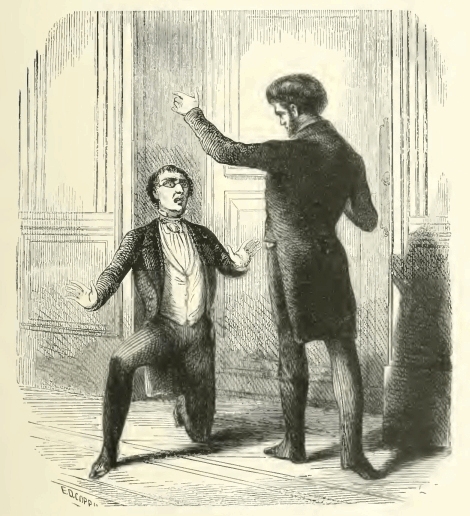
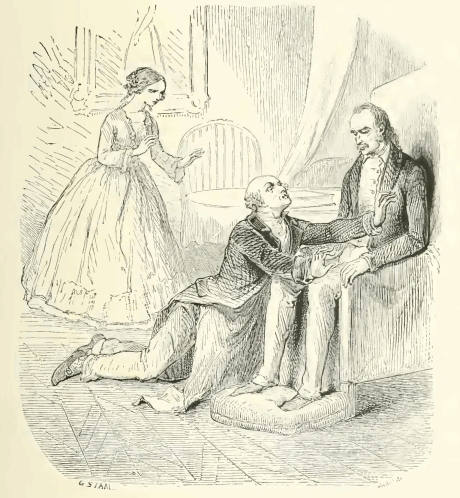
Villefort fell on his knees.
“Listen,” said he; “I have not the strength of mind you have, or rather
that which you would not have, if instead of my daughter Valentine your
daughter Madeleine were concerned.” The doctor turned pale. “Doctor,
every son of woman is born to suffer and to die; I am content to suffer
and to await death.”
“Beware,” said M. d’Avrigny, “it may come slowly; you will see it
approach after having struck your father, your wife, perhaps your son.”
Villefort, suffocating, pressed the doctor’s arm.
“Listen,” cried he; “pity me—help me! No, my daughter is not guilty. If
you drag us both before a tribunal I will still say, ‘No, my daughter
is not guilty;—there is no crime in my house. I will not acknowledge a
crime in my house; for when crime enters a dwelling, it is like
death—it does not come alone.’ Listen. What does it signify to you if I
am murdered? Are you my friend? Are you a man? Have you a heart? No,
you are a physician! Well, I tell you I will not drag my daughter
before a tribunal, and give her up to the executioner! The bare idea
would kill me—would drive me like a madman to dig my heart out with my
finger-nails! And if you were mistaken, doctor—if it were not my
daughter—if I should come one day, pale as a spectre, and say to you,
‘Assassin, you have killed my child!’—hold—if that should happen,
although I am a Christian, M. d’Avrigny, I should kill myself.”
“Well,” said the doctor, after a moment’s silence, “I will wait.”
Villefort looked at him as if he had doubted his words.
“Only,” continued M. d’Avrigny, with a slow and solemn tone, “if anyone
falls ill in your house, if you feel yourself attacked, do not send for
me, for I will come no more. I will consent to share this dreadful
secret with you, but I will not allow shame and remorse to grow and
increase in my conscience, as crime and misery will in your house.”
“Then you abandon me, doctor?”
“Yes, for I can follow you no farther, and I only stop at the foot of
the scaffold. Some further discovery will be made, which will bring
this dreadful tragedy to a close. Adieu.”
“I entreat you, doctor!”
“All the horrors that disturb my thoughts make your house odious and
fatal. Adieu, sir.”
“One word—one single word more, doctor! You go, leaving me in all the
horror of my situation, after increasing it by what you have revealed
to me. But what will be reported of the sudden death of the poor old
servant?”
“True,” said M. d’Avrigny; “we will return.”
The doctor went out first, followed by M. de Villefort. The terrified
servants were on the stairs and in the passage where the doctor would
pass.
“Sir,” said d’Avrigny to Villefort, so loud that all might hear, “poor
Barrois has led too sedentary a life of late; accustomed formerly to
ride on horseback, or in the carriage, to the four corners of Europe,
the monotonous walk around that armchair has killed him—his blood has
thickened. He was stout, had a short, thick neck; he was attacked with
apoplexy, and I was called in too late. By the way,” added he in a low
tone, “take care to throw away that cup of syrup of violets in the
ashes.”
The doctor, without shaking hands with Villefort, without adding a word
to what he had said, went out, amid the tears and lamentations of the
whole household. The same evening all Villefort’s servants, who had
assembled in the kitchen, and had a long consultation, came to tell
Madame de Villefort that they wished to leave. No entreaty, no
proposition of increased wages, could induce them to remain; to every
argument they replied, “We must go, for death is in this house.”
They all left, in spite of prayers and entreaties, testifying their
regret at leaving so good a master and mistress, and especially
Mademoiselle Valentine, so good, so kind, and so gentle.
Villefort looked at Valentine as they said this. She was in tears, and,
strange as it was, in spite of the emotions he felt at the sight of
these tears, he looked also at Madame de Villefort, and it appeared to
him as if a slight gloomy smile had passed over her thin lips, like a
meteor seen passing inauspiciously between two clouds in a stormy sky.
Chapter LXXVIII
A Correspondent Writes from Janina
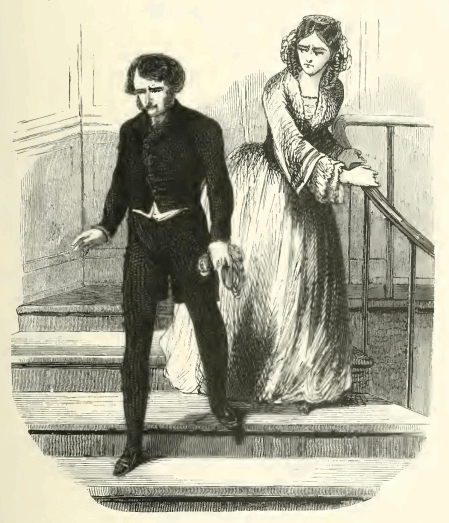
If Valentine could have seen the trembling step and agitated
countenance of Franz when he quitted the chamber of M. Noirtier, even
she would have been constrained to pity him. Villefort had only just
given utterance to a few incoherent sentences, and then retired to his
study, where he received about two hours afterwards the following
letter:
“After all the disclosures which were made this morning, M. Noirtier de
Villefort must see the utter impossibility of any alliance being formed
between his family and that of M. Franz d’Épinay. M. d’Épinay must say
that he is shocked and astonished that M. de Villefort, who appeared to
be aware of all the circumstances detailed this morning, should not
have anticipated him in this announcement.”
No one who had seen the magistrate at this moment, so thoroughly
unnerved by the recent inauspicious combination of circumstances, would
have supposed for an instant that he had anticipated the annoyance;
although it certainly never had occurred to him that his father would
carry candor, or rather rudeness, so far as to relate such a history.
And in justice to Villefort, it must be understood that M. Noirtier,
who never cared for the opinion of his son on any subject, had always
omitted to explain the affair to Villefort, so that he had all his life
entertained the belief that General de Quesnel, or the Baron d’Épinay,
as he was alternately styled, according as the speaker wished to
identify him by his own family name, or by the title which had been
conferred on him, fell the victim of assassination, and not that he was
killed fairly in a duel. This harsh letter, coming as it did from a man
generally so polite and respectful, struck a mortal blow at the pride
of Villefort.
Hardly had he read the letter, when his wife entered. The sudden
departure of Franz, after being summoned by M. Noirtier, had so much
astonished everyone, that the position of Madame de Villefort, left
alone with the notary and the witnesses, became every moment more
embarrassing. Determined to bear it no longer, she arose and left the
room; saying she would go and make some inquiries into the cause of his
sudden disappearance.
M. de Villefort’s communications on the subject were very limited and
concise; he told her, in fact, that an explanation had taken place
between M. Noirtier, M. d’Épinay, and himself, and that the marriage of
Valentine and Franz would consequently be broken off. This was an
awkward and unpleasant thing to have to report to those who were
waiting. She therefore contented herself with saying that M. Noirtier
having at the commencement of the discussion been attacked by a sort of
apoplectic fit, the affair would necessarily be deferred for some days
longer. This news, false as it was following so singularly in the train
of the two similar misfortunes which had so recently occurred,
evidently astonished the auditors, and they retired without a word.
During this time Valentine, at once terrified and happy, after having
embraced and thanked the feeble old man for thus breaking with a single
blow the chain which she had been accustomed to consider as
irrefragable, asked leave to retire to her own room, in order to
recover her composure. Noirtier looked the permission which she
solicited. But instead of going to her own room, Valentine, having once
gained her liberty, entered the gallery, and, opening a small door at
the end of it, found herself at once in the garden.
In the midst of all the strange events which had crowded one on the
other, an indefinable sentiment of dread had taken possession of
Valentine’s mind. She expected every moment that she should see Morrel
appear, pale and trembling, to forbid the signing of the contract, like
the Laird of Ravenswood in The Bride of Lammermoor.
It was high time for her to make her appearance at the gate, for
Maximilian had long awaited her coming. He had half guessed what was
going on when he saw Franz quit the cemetery with M. de Villefort. He
followed M. d’Épinay, saw him enter, afterwards go out, and then
re-enter with Albert and Château-Renaud. He had no longer any doubts as
to the nature of the conference; he therefore quickly went to the gate
in the clover-patch, prepared to hear the result of the proceedings,
and very certain that Valentine would hasten to him the first moment
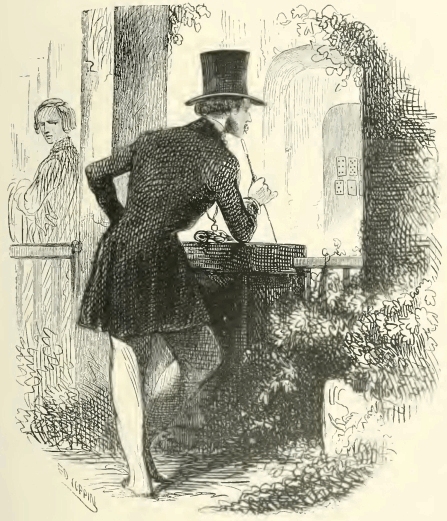
she should be set at liberty. He was not mistaken; peering through the
crevices of the wooden partition, he soon discovered the young girl,
who cast aside all her usual precautions and walked at once to the
barrier. The first glance which Maximilian directed towards her
entirely reassured him, and the first words she spoke made his heart
bound with delight.
“We are saved!” said Valentine.
“Saved?” repeated Morrel, not being able to conceive such intense
happiness; “by whom?”
“By my grandfather. Oh, Morrel, pray love him for all his goodness to
us!”
Morrel swore to love him with all his soul; and at that moment he could
safely promise to do so, for he felt as though it were not enough to
love him merely as a friend or even as a father, he worshiped him as a
god.
“But tell me, Valentine, how has it all been effected? What strange
means has he used to compass this blessed end?”
Valentine was on the point of relating all that had passed, but she
suddenly remembered that in doing so she must reveal a terrible secret
which concerned others as well as her grandfather, and she said:
“At some future time I will tell you all about it.”
“But when will that be?”
“When I am your wife.”
The conversation had now turned upon a topic so pleasing to Morrel,
that he was ready to accede to anything that Valentine thought fit to
propose, and he likewise felt that a piece of intelligence such as he
just heard ought to be more than sufficient to content him for one day.
However, he would not leave without the promise of seeing Valentine
again the next night. Valentine promised all that Morrel required of
her, and certainly it was less difficult now for her to believe that
she should marry Maximilian than it was an hour ago to assure herself
that she should not marry Franz.
During the time occupied by the interview we have just detailed, Madame
de Villefort had gone to visit M. Noirtier. The old man looked at her
with that stern and forbidding expression with which he was accustomed
to receive her.
“Sir,” said she, “it is superfluous for me to tell you that Valentine’s
marriage is broken off, since it was here that the affair was
concluded.”
Noirtier’s countenance remained immovable.
“But one thing I can tell you, of which I do not think you are aware;
that is, that I have always been opposed to this marriage, and that the
contract was entered into entirely without my consent or approbation.”
Noirtier regarded his daughter-in-law with the look of a man desiring
an explanation.
“Now that this marriage, which I know you so much disliked, is done
away with, I come to you on an errand which neither M. de Villefort nor
Valentine could consistently undertake.”
Noirtier’s eyes demanded the nature of her mission.
“I come to entreat you, sir,” continued Madame de Villefort, “as the
only one who has the right of doing so, inasmuch as I am the only one
who will receive no personal benefit from the transaction,—I come to
entreat you to restore, not your love, for that she has always
possessed, but to restore your fortune to your granddaughter.”
There was a doubtful expression in Noirtier’s eyes; he was evidently
trying to discover the motive of this proceeding, and he could not
succeed in doing so.
“May I hope, sir,” said Madame de Villefort, “that your intentions
accord with my request?”
Noirtier made a sign that they did.
“In that case, sir,” rejoined Madame de Villefort, “I will leave you
overwhelmed with gratitude and happiness at your prompt acquiescence to
my wishes.” She then bowed to M. Noirtier and retired.
The next day M. Noirtier sent for the notary; the first will was torn
up and a second made, in which he left the whole of his fortune to
Valentine, on condition that she should never be separated from him. It
was then generally reported that Mademoiselle de Villefort, the heiress
of the marquis and marchioness of Saint-Méran, had regained the good
graces of her grandfather, and that she would ultimately be in
possession of an income of 300,000 livres.
While all the proceedings relative to the dissolution of the
marriage-contract were being carried on at the house of M. de
Villefort, Monte Cristo had paid his visit to the Count of Morcerf,
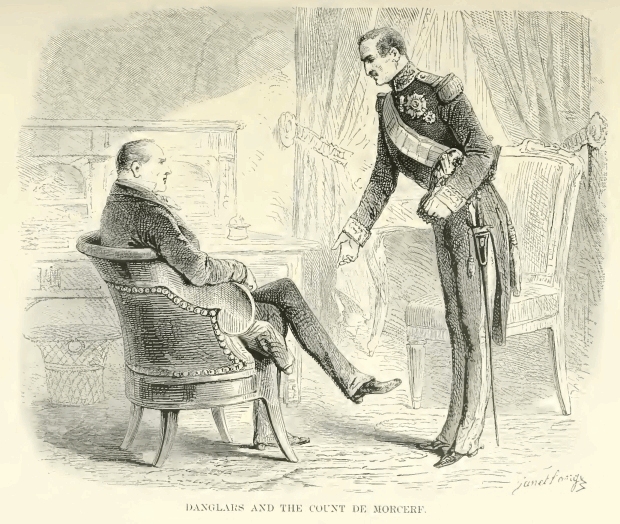
who, in order to lose no time in responding to M. Danglars’ wishes, and
at the same time to pay all due deference to his position in society,
donned his uniform of lieutenant-general, which he ornamented with all
his crosses, and thus attired, ordered his finest horses and drove to
the Rue de la Chaussée d’Antin.
Danglars was balancing his monthly accounts, and it was perhaps not the
most favorable moment for finding him in his best humor. At the first
sight of his old friend, Danglars assumed his majestic air, and settled
himself in his easy-chair.
Morcerf, usually so stiff and formal, accosted the banker in an affable
and smiling manner, and, feeling sure that the overture he was about to
make would be well received, he did not consider it necessary to adopt
any manœuvres in order to gain his end, but went at once straight to
the point.
“Well, baron,” said he, “here I am at last; some time has elapsed since
our plans were formed, and they are not yet executed.”
Morcerf paused at these words, quietly waiting till the cloud should
have dispersed which had gathered on the brow of Danglars, and which he
attributed to his silence; but, on the contrary, to his great surprise,
it grew darker and darker.
“To what do you allude, monsieur?” said Danglars; as if he were trying
in vain to guess at the possible meaning of the general’s words.
“Ah,” said Morcerf, “I see you are a stickler for forms, my dear sir,
and you would remind me that the ceremonial rites should not be
omitted. Ma foi, I beg your pardon, but as I have but one son, and it
is the first time I have ever thought of marrying him, I am still
serving my apprenticeship, you know; come, I will reform.”
And Morcerf with a forced smile arose, and, making a low bow to M.
Danglars, said:
“Baron, I have the honor of asking of you the hand of Mademoiselle
Eugénie Danglars for my son, the Vicomte Albert de Morcerf.”
But Danglars, instead of receiving this address in the favorable manner
which Morcerf had expected, knit his brow, and without inviting the
count, who was still standing, to take a seat, he said:
“Monsieur, it will be necessary to reflect before I give you an
answer.”
“To reflect?” said Morcerf, more and more astonished; “have you not had
enough time for reflection during the eight years which have elapsed
since this marriage was first discussed between us?”
“Count,” said the banker, “things are constantly occurring in the world
to induce us to lay aside our most established opinions, or at all
events to cause us to remodel them according to the change of
circumstances, which may have placed affairs in a totally different
light to that in which we at first viewed them.”
“I do not understand you, baron,” said Morcerf.
“What I mean to say is this, sir,—that during the last fortnight
unforeseen circumstances have occurred——”
“Excuse me,” said Morcerf, “but is it a play we are acting?”
“A play?”
“Yes, for it is like one; pray let us come more to the point, and
endeavor thoroughly to understand each other.”
“That is quite my desire.”
“You have seen M. de Monte Cristo have you not?”
“I see him very often,” said Danglars, drawing himself up; “he is a
particular friend of mine.”
“Well, in one of your late conversations with him, you said that I
appeared to be forgetful and irresolute concerning this marriage, did
you not?”
“I did say so.”
“Well, here I am, proving at once that I am really neither the one nor
the other, by entreating you to keep your promise on that score.”
Danglars did not answer.
“Have you so soon changed your mind,” added Morcerf, “or have you only
provoked my request that you may have the pleasure of seeing me
humbled?”
Danglars, seeing that if he continued the conversation in the same tone
in which he had begun it, the whole thing might turn out to his own
disadvantage, turned to Morcerf, and said:
“Count, you must doubtless be surprised at my reserve, and I assure you
it costs me much to act in such a manner towards you; but, believe me
when I say that imperative necessity has imposed the painful task upon
me.”
“These are all so many empty words, my dear sir,” said Morcerf: “they
might satisfy a new acquaintance, but the Comte de Morcerf does not
rank in that list; and when a man like him comes to another, recalls to
him his plighted word, and this man fails to redeem the pledge, he has
at least a right to exact from him a good reason for so doing.”
Danglars was a coward, but did not wish to appear so; he was piqued at
the tone which Morcerf had just assumed.
“I am not without a good reason for my conduct,” replied the banker.
“What do you mean to say?”
“I mean to say that I have a good reason, but that it is difficult to
explain.”
“You must be aware, at all events, that it is impossible for me to
understand motives before they are explained to me; but one thing at
least is clear, which is, that you decline allying yourself with my
family.”
“No, sir,” said Danglars; “I merely suspend my decision, that is all.”
“And do you really flatter yourself that I shall yield to all your
caprices, and quietly and humbly await the time of again being received
into your good graces?”
“Then, count, if you will not wait, we must look upon these projects as
if they had never been entertained.”
The count bit his lips till the blood almost started, to prevent the
ebullition of anger which his proud and irritable temper scarcely
allowed him to restrain; understanding, however, that in the present
state of things the laugh would decidedly be against him, he turned
from the door, towards which he had been directing his steps, and again
confronted the banker. A cloud settled on his brow, evincing decided
anxiety and uneasiness, instead of the expression of offended pride
which had lately reigned there.
“My dear Danglars,” said Morcerf, “we have been acquainted for many
years, and consequently we ought to make some allowance for each
other’s failings. You owe me an explanation, and really it is but fair
that I should know what circumstance has occurred to deprive my son of
your favor.”
“It is from no personal ill-feeling towards the viscount, that is all I
can say, sir,” replied Danglars, who resumed his insolent manner as
soon as he perceived that Morcerf was a little softened and calmed
down.
“And towards whom do you bear this personal ill-feeling, then?” said
Morcerf, turning pale with anger. The expression of the count’s face
had not remained unperceived by the banker; he fixed on him a look of
greater assurance than before, and said:
“You may, perhaps, be better satisfied that I should not go farther
into particulars.”
A tremor of suppressed rage shook the whole frame of the count, and
making a violent effort over himself, he said: “I have a right to
insist on your giving me an explanation. Is it Madame de Morcerf who
has displeased you? Is it my fortune which you find insufficient? Is it
because my opinions differ from yours?”
“Nothing of the kind, sir,” replied Danglars: “if such had been the
case, I only should have been to blame, inasmuch as I was aware of all
these things when I made the engagement. No, do not seek any longer to
discover the reason. I really am quite ashamed to have been the cause
of your undergoing such severe self-examination; let us drop the
subject, and adopt the middle course of delay, which implies neither a
rupture nor an engagement. Ma foi, there is no hurry. My daughter is
only seventeen years old, and your son twenty-one. While we wait, time
will be progressing, events will succeed each other; things which in
the evening look dark and obscure, appear but too clearly in the light
of morning, and sometimes the utterance of one word, or the lapse of a
single day, will reveal the most cruel calumnies.”
“Calumnies, did you say, sir?” cried Morcerf, turning livid with rage.
“Does anyone dare to slander me?”
“Monsieur, I told you that I considered it best to avoid all
explanation.”
“Then, sir, I am patiently to submit to your refusal?”
“Yes, sir, although I assure you the refusal is as painful for me to
give as it is for you to receive, for I had reckoned on the honor of
your alliance, and the breaking off of a marriage contract always
injures the lady more than the gentleman.”
“Enough, sir,” said Morcerf, “we will speak no more on the subject.”
And clutching his gloves in anger, he left the apartment. Danglars
observed that during the whole conversation Morcerf had never once
dared to ask if it was on his own account that Danglars recalled his
word.
That evening he had a long conference with several friends; and M.
Cavalcanti, who had remained in the drawing-room with the ladies, was
the last to leave the banker’s house.
The next morning, as soon as he awoke, Danglars asked for the
newspapers; they were brought to him; he laid aside three or four, and
at last fixed on l’Impartial, the paper of which Beauchamp was the
chief editor. He hastily tore off the cover, opened the journal with
nervous precipitation, passed contemptuously over the Paris jottings,
and arriving at the miscellaneous intelligence, stopped with a
malicious smile, at a paragraph headed
We hear from Yanina.
“Very good,” observed Danglars, after having read the paragraph; “here
is a little article on Colonel Fernand, which, if I am not mistaken,
would render the explanation which the Comte de Morcerf required of me
perfectly unnecessary.”
At the same moment, that is, at nine o’clock in the morning, Albert de
Morcerf, dressed in a black coat buttoned up to his chin, might have
been seen walking with a quick and agitated step in the direction of
Monte Cristo’s house in the Champs-Élysées. When he presented himself
at the gate the porter informed him that the Count had gone out about
half an hour previously.
“Did he take Baptistin with him?”
“No, my lord.”
“Call him, then; I wish to speak to him.”
The concierge went to seek the valet de chambre, and returned with him
in an instant.
“My good friend,” said Albert, “I beg pardon for my intrusion, but I
was anxious to know from your own mouth if your master was really out
or not.”
“He is really out, sir,” replied Baptistin.
“Out, even to me?”
“I know how happy my master always is to receive the vicomte,” said
Baptistin; “and I should therefore never think of including him in any
general order.”
“You are right; and now I wish to see him on an affair of great
importance. Do you think it will be long before he comes in?”
“No, I think not, for he ordered his breakfast at ten o’clock.”
“Well, I will go and take a turn in the Champs-Élysées, and at ten
o’clock I will return here; meanwhile, if the count should come in,
will you beg him not to go out again without seeing me?”
“You may depend on my doing so, sir,” said Baptistin.
Albert left the cab in which he had come at the count’s door, intending
to take a turn on foot. As he was passing the Allée des Veuves, he
thought he saw the count’s horses standing at Gosset’s
shooting-gallery; he approached, and soon recognized the coachman.
“Is the count shooting in the gallery?” said Morcerf.
“Yes, sir,” replied the coachman. While he was speaking, Albert had
heard the report of two or three pistol-shots. He entered, and on his
way met the waiter.
“Excuse me, my lord,” said the lad; “but will you have the kindness to
wait a moment?”
“What for, Philip?” asked Albert, who, being a constant visitor there,
did not understand this opposition to his entrance.
“Because the person who is now in the gallery prefers being alone, and
never practices in the presence of anyone.”
“Not even before you, Philip? Then who loads his pistol?”
“His servant.”
“A Nubian?”
“A negro.”
“It is he, then.”
“Do you know this gentleman?”
“Yes, and I am come to look for him; he is a friend of mine.”
“Oh, that is quite another thing, then. I will go immediately and
inform him of your arrival.”
And Philip, urged by his own curiosity, entered the gallery; a second
afterwards, Monte Cristo appeared on the threshold.
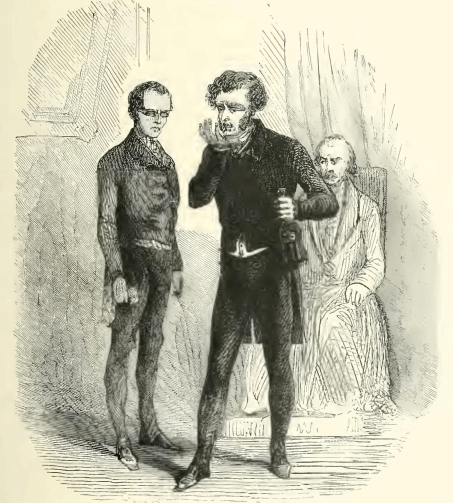
“I ask your pardon, my dear count,” said Albert, “for following you
here, and I must first tell you that it was not the fault of your
servants that I did so; I alone am to blame for the indiscretion. I
went to your house, and they told me you were out, but that they
expected you home at ten o’clock to breakfast. I was walking about in
order to pass away the time till ten o’clock, when I caught sight of
your carriage and horses.”
“What you have just said induces me to hope that you intend
breakfasting with me.”
“No, thank you, I am thinking of other things besides breakfast just
now; perhaps we may take that meal at a later hour and in worse
company.”
“What on earth are you talking of?”
“I am to fight today.”
“For what?”
“For the sake of fighting!”
“Yes, I understand that, but what is the quarrel? People fight for all
sorts of reasons, you know.”
“I fight in the cause of honor.”
“Ah, that is something serious.”
“So serious, that I come to beg you to render me a service.”
“What is it?”
“To be my second.”
“That is a serious matter, and we will not discuss it here; let us
speak of nothing till we get home. Ali, bring me some water.”
The count turned up his sleeves, and passed into the little vestibule
where the gentlemen were accustomed to wash their hands after shooting.
“Come in, my lord,” said Philip in a low tone, “and I will show you
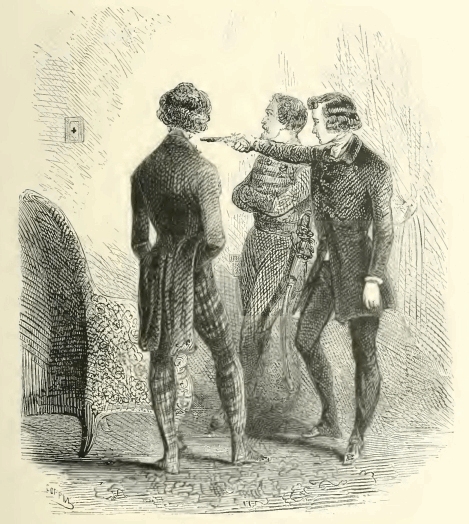
something droll.” Morcerf entered, and in place of the usual target, he
saw some playing-cards fixed against the wall. At a distance Albert
thought it was a complete suit, for he counted from the ace to the ten.
“Ah, ha,” said Albert, “I see you were preparing for a game of cards.”
“No,” said the count, “I was making a suit.”
“How?” said Albert.
“Those are really aces and twos which you see, but my shots have turned
them into threes, fives, sevens, eights, nines, and tens.”
Albert approached. In fact, the bullets had actually pierced the cards
in the exact places which the painted signs would otherwise have
occupied, the lines and distances being as regularly kept as if they
had been ruled with pencil. In going up to the target Morcerf picked up
two or three swallows that had been rash enough to come within the
range of the count’s pistol.
“Diable!” said Morcerf.
“What would you have, my dear viscount?” said Monte Cristo, wiping his
hands on the towel which Ali had brought him; “I must occupy my leisure
moments in some way or other. But come, I am waiting for you.”
Both men entered Monte Cristo’s carriage, which in the course of a few
minutes deposited them safely at No. 30. Monte Cristo took Albert into
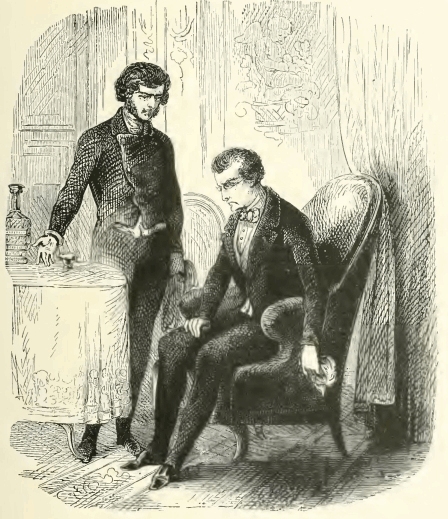
his study, and pointing to a seat, placed another for himself. “Now let
us talk the matter over quietly,” said the count.
“You see I am perfectly composed,” said Albert.
“With whom are you going to fight?”
“With Beauchamp.”
“One of your friends!”
“Of course; it is always with friends that one fights.”
“I suppose you have some cause of quarrel?”
“I have.”
“What has he done to you?”
“There appeared in his journal last night—but wait, and read for
yourself.” And Albert handed over the paper to the count, who read as
follows:
“A correspondent at Yanina informs us of a fact of which until now we
had remained in ignorance. The castle which formed the protection of
the town was given up to the Turks by a French officer named Fernand,
in whom the grand vizier, Ali Tepelini, had reposed the greatest
confidence.”
“Well,” said Monte Cristo, “what do you see in that to annoy you?”
“What do I see in it?”
“Yes; what does it signify to you if the castle of Yanina was given up
by a French officer?”
“It signifies to my father, the Count of Morcerf, whose Christian name
is Fernand!”
“Did your father serve under Ali Pasha?”
“Yes; that is to say, he fought for the independence of the Greeks, and
hence arises the calumny.”
“Oh, my dear viscount, do talk reason!”
“I do not desire to do otherwise.”
“Now, just tell me who the devil should know in France that the officer
Fernand and the Count of Morcerf are one and the same person? and who
cares now about Yanina, which was taken as long ago as the year 1822 or
1823?”
“That just shows the meanness of this slander. They have allowed all
this time to elapse, and then all of a sudden rake up events which have
been forgotten to furnish materials for scandal, in order to tarnish
the lustre of our high position. I inherit my father’s name, and I do
not choose that the shadow of disgrace should darken it. I am going to
Beauchamp, in whose journal this paragraph appears, and I shall insist
on his retracting the assertion before two witnesses.”
“Beauchamp will never retract.”
“Then we must fight.”
“No you will not, for he will tell you, what is very true, that perhaps
there were fifty officers in the Greek army bearing the same name.”
“We will fight, nevertheless. I will efface that blot on my father’s
character. My father, who was such a brave soldier, whose career was so
brilliant——”
“Oh, well, he will add, ‘We are warranted in believing that this
Fernand is not the illustrious Count of Morcerf, who also bears the
same Christian name.’”
“I am determined not to be content with anything short of an entire
retractation.”
“And you intend to make him do it in the presence of two witnesses, do
you?”
“Yes.”
“You do wrong.”
“Which means, I suppose, that you refuse the service which I asked of
you?”
“You know my theory regarding duels; I told you my opinion on that
subject, if you remember, when we were at Rome.”
“Nevertheless, my dear count, I found you this morning engaged in an
occupation but little consistent with the notions you profess to
entertain.”
“Because, my dear fellow, you understand one must never be eccentric.
If one’s lot is cast among fools, it is necessary to study folly. I
shall perhaps find myself one day called out by some harebrained scamp,
who has no more real cause of quarrel with me than you have with
Beauchamp; he may take me to task for some foolish trifle or other, he
will bring his witnesses, or will insult me in some public place, and I
am expected to kill him for all that.”
“You admit that you would fight, then? Well, if so, why do you object
to my doing so?”
“I do not say that you ought not to fight, I only say that a duel is a
serious thing, and ought not to be undertaken without due reflection.”
“Did he reflect before he insulted my father?”
“If he spoke hastily, and owns that he did so, you ought to be
satisfied.”
“Ah, my dear count, you are far too indulgent.”
“And you are far too exacting. Supposing, for instance, and do not be
angry at what I am going to say——”
“Well.”
“Supposing the assertion to be really true?”
“A son ought not to submit to such a stain on his father’s honor.”
“Ma foi! we live in times when there is much to which we must
submit.”
“That is precisely the fault of the age.”
“And do you undertake to reform it?”
“Yes, as far as I am personally concerned.”
“Well, you are indeed exacting, my dear fellow!”
“Yes, I own it.”
“Are you quite impervious to good advice?”
“Not when it comes from a friend.”
“And do you account me that title?”
“Certainly I do.”
“Well, then, before going to Beauchamp with your witnesses, seek
further information on the subject.”
“From whom?”
“From Haydée.”
“Why, what can be the use of mixing a woman up in the affair?—what can
she do in it?”
“She can declare to you, for example, that your father had no hand
whatever in the defeat and death of the vizier; or if by chance he had,
indeed, the misfortune to——”
“I have told you, my dear count, that I would not for one moment admit
of such a proposition.”
“You reject this means of information, then?”
“I do—most decidedly.”
“Then let me offer one more word of advice.”
“Do so, then, but let it be the last.”
“You do not wish to hear it, perhaps?”
“On the contrary, I request it.”
“Do not take any witnesses with you when you go to Beauchamp—visit him
alone.”
“That would be contrary to all custom.”
“Your case is not an ordinary one.”
“And what is your reason for advising me to go alone?”
“Because then the affair will rest between you and Beauchamp.”
“Explain yourself.”
“I will do so. If Beauchamp be disposed to retract, you ought at least
to give him the opportunity of doing it of his own free will,—the
satisfaction to you will be the same. If, on the contrary, he refuses
to do so, it will then be quite time enough to admit two strangers into
your secret.”
“They will not be strangers, they will be friends.”
“Ah, but the friends of today are the enemies of tomorrow; Beauchamp,
for instance.”
“So you recommend——”
“I recommend you to be prudent.”
“Then you advise me to go alone to Beauchamp?”
“I do, and I will tell you why. When you wish to obtain some concession
from a man’s self-love, you must avoid even the appearance of wishing
to wound it.”
“I believe you are right.”
“I am glad of it.”
“Then I will go alone.”
“Go; but you would do better still by not going at all.”
“That is impossible.”
“Do so, then; it will be a wiser plan than the first which you
proposed.”
“But if, in spite of all my precautions, I am at last obliged to fight,
will you not be my second?”
“My dear viscount,” said Monte Cristo gravely, “you must have seen
before today that at all times and in all places I have been at your
disposal, but the service which you have just demanded of me is one
which it is out of my power to render you.”
“Why?”
“Perhaps you may know at some future period, and in the mean time I
request you to excuse my declining to put you in possession of my
reasons.”
“Well, I will have Franz and Château-Renaud; they will be the very men
for it.”
“Do so, then.”
“But if I do fight, you will surely not object to giving me a lesson or
two in shooting and fencing?”
“That, too, is impossible.”
“What a singular being you are!—you will not interfere in anything.”
“You are right—that is the principle on which I wish to act.”
“We will say no more about it, then. Good-bye, count.”
Morcerf took his hat, and left the room. He found his carriage at the
door, and doing his utmost to restrain his anger he went at once to
find Beauchamp, who was in his office. It was a gloomy, dusty-looking
apartment, such as journalists’ offices have always been from time
immemorial. The servant announced M. Albert de Morcerf. Beauchamp
repeated the name to himself, as though he could scarcely believe that
he had heard aright, and then gave orders for him to be admitted.
Albert entered.
Beauchamp uttered an exclamation of surprise on seeing his friend leap
over and trample under foot all the newspapers which were strewed about
the room.
“This way, this way, my dear Albert!” said he, holding out his hand to
the young man. “Are you out of your senses, or do you come peaceably to
take breakfast with me? Try and find a seat—there is one by that
geranium, which is the only thing in the room to remind me that there
are other leaves in the world besides leaves of paper.”
“Beauchamp,” said Albert, “it is of your journal that I come to speak.”
“Indeed? What do you wish to say about it?”
“I desire that a statement contained in it should be rectified.”
“To what do you refer? But pray sit down.”
“Thank you,” said Albert, with a cold and formal bow.
“Will you now have the kindness to explain the nature of the statement
which has displeased you?”
“An announcement has been made which implicates the honor of a member
of my family.”
“What is it?” said Beauchamp, much surprised; “surely you must be
mistaken.”
“The story sent you from Yanina.”
“Yanina?”
“Yes; really you appear to be totally ignorant of the cause which
brings me here.”
“Such is really the case, I assure you, upon my honor! Baptiste, give
me yesterday’s paper,” cried Beauchamp.
“Here, I have brought mine with me,” replied Albert.
Beauchamp took the paper, and read the article to which Albert pointed
in an undertone.
“You see it is a serious annoyance,” said Morcerf, when Beauchamp had
finished the perusal of the paragraph.
“Is the officer referred to a relation of yours, then?” demanded the
journalist.
“Yes,” said Albert, blushing.
“Well, what do you wish me to do for you?” said Beauchamp mildly.
“My dear Beauchamp, I wish you to contradict this statement.” Beauchamp
looked at Albert with a benevolent expression.
“Come,” said he, “this matter will want a good deal of talking over; a
retractation is always a serious thing, you know. Sit down, and I will
read it again.”
Albert resumed his seat, and Beauchamp read, with more attention than
at first, the lines denounced by his friend.
“Well,” said Albert in a determined tone, “you see that your paper has
insulted a member of my family, and I insist on a retractation being
made.”
“You insist?”
“Yes, I insist.”
“Permit me to remind you that you are not in the Chamber, my dear
viscount.”
“Nor do I wish to be there,” replied the young man, rising. “I repeat
that I am determined to have the announcement of yesterday
contradicted. You have known me long enough,” continued Albert, biting
his lips convulsively, for he saw that Beauchamp’s anger was beginning
to rise,—“you have been my friend, and therefore sufficiently intimate
with me to be aware that I am likely to maintain my resolution on this
point.”
“If I have been your friend, Morcerf, your present manner of speaking
would almost lead me to forget that I ever bore that title. But wait a
moment, do not let us get angry, or at least not yet. You are irritated
and vexed—tell me how this Fernand is related to you?”
“He is merely my father,” said Albert—“M. Fernand Mondego, Count of
Morcerf, an old soldier who has fought in twenty battles and whose
honorable scars they would denounce as badges of disgrace.”
“Is it your father?” said Beauchamp; “that is quite another thing. Then
I can well understand your indignation, my dear Albert. I will look at
it again;” and he read the paragraph for the third time, laying a
stress on each word as he proceeded. “But the paper nowhere identifies
this Fernand with your father.”
“No; but the connection will be seen by others, and therefore I will
have the article contradicted.”
At the words I will, Beauchamp steadily raised his eyes to Albert’s
countenance, and then as gradually lowering them, he remained
thoughtful for a few moments.
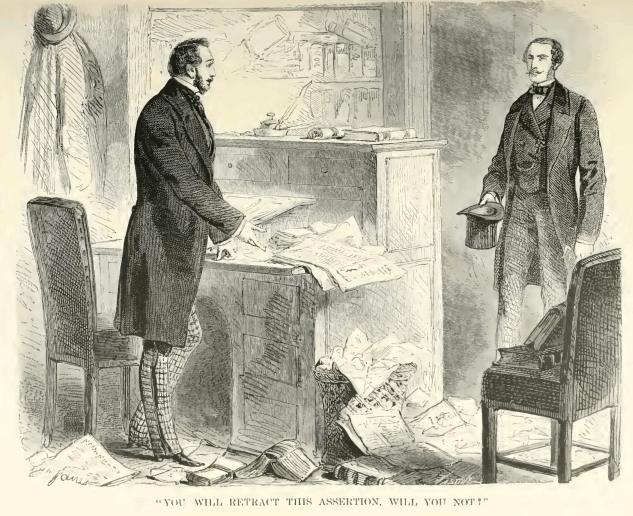
“You will retract this assertion, will you not, Beauchamp?” said Albert
with increased though stifled anger.
“Yes,” replied Beauchamp.
“Immediately?” said Albert.
“When I am convinced that the statement is false.”
“What?”
“The thing is worth looking into, and I will take pains to investigate
the matter thoroughly.”
“But what is there to investigate, sir?” said Albert, enraged beyond
measure at Beauchamp’s last remark. “If you do not believe that it is
my father, say so immediately; and if, on the contrary, you believe it
to be him, state your reasons for doing so.”
Beauchamp looked at Albert with the smile which was so peculiar to him,
and which in its numerous modifications served to express every varied
emotion of his mind.
“Sir,” replied he, “if you came to me with the idea of demanding
satisfaction, you should have gone at once to the point, and not have
entertained me with the idle conversation to which I have been
patiently listening for the last half hour. Am I to put this
construction on your visit?”
“Yes, if you will not consent to retract that infamous calumny.”
“Wait a moment—no threats, if you please, M. Fernand Mondego, Vicomte
de Morcerf; I never allow them from my enemies, and therefore shall not
put up with them from my friends. You insist on my contradicting the
article relating to General Fernand, an article with which, I assure
you on my word of honor, I had nothing whatever to do?”
“Yes, I insist on it,” said Albert, whose mind was beginning to get
bewildered with the excitement of his feelings.
“And if I refuse to retract, you wish to fight, do you?” said Beauchamp
in a calm tone.
“Yes,” replied Albert, raising his voice.
“Well,” said Beauchamp, “here is my answer, my dear sir. The article
was not inserted by me—I was not even aware of it; but you have, by the
step you have taken, called my attention to the paragraph in question,
and it will remain until it shall be either contradicted or confirmed
by someone who has a right to do so.”
“Sir,” said Albert, rising, “I will do myself the honor of sending my
seconds to you, and you will be kind enough to arrange with them the
place of meeting and the weapons.”
“Certainly, my dear sir.”
“And this evening, if you please, or tomorrow at the latest, we will
meet.”
“No, no, I will be on the ground at the proper time; but in my opinion
(and I have a right to dictate the preliminaries, as it is I who have
received the provocation)—in my opinion the time ought not to be yet. I
know you to be well skilled in the management of the sword, while I am
only moderately so; I know, too, that you are a good marksman—there we
are about equal. I know that a duel between us two would be a serious
affair, because you are brave, and I am brave also. I do not therefore
wish either to kill you, or to be killed myself without a cause. Now, I
am going to put a question to you, and one very much to the purpose
too. Do you insist on this retractation so far as to kill me if I do
not make it, although I have repeated more than once, and affirmed on
my honor, that I was ignorant of the thing with which you charge me,
and although I still declare that it is impossible for anyone but you
to recognize the Count of Morcerf under the name of Fernand?”
“I maintain my original resolution.”
“Very well, my dear sir; then I consent to cut throats with you. But I
require three weeks’ preparation; at the end of that time I shall come
and say to you, ‘The assertion is false, and I retract it,’ or ‘The
assertion is true,’ when I shall immediately draw the sword from its
sheath, or the pistols from the case, whichever you please.”
“Three weeks!” cried Albert; “they will pass as slowly as three
centuries when I am all the time suffering dishonor.”
“Had you continued to remain on amicable terms with me, I should have
said, ‘Patience, my friend;’ but you have constituted yourself my
enemy, therefore I say, ‘What does that signify to me, sir?’”
“Well, let it be three weeks then,” said Morcerf; “but remember, at the
expiration of that time no delay or subterfuge will justify you in——”
“M. Albert de Morcerf,” said Beauchamp, rising in his turn, “I cannot
throw you out of window for three weeks—that is to say, for twenty-four
days to come—nor have you any right to split my skull open till that
time has elapsed. Today is the 29th of August; the 21st of September
will, therefore, be the conclusion of the term agreed on, and till that
time arrives—and it is the advice of a gentleman which I am about to
give you—till then we will refrain from growling and barking like two
dogs chained within sight of each other.”
When he had concluded his speech, Beauchamp bowed coldly to Albert,
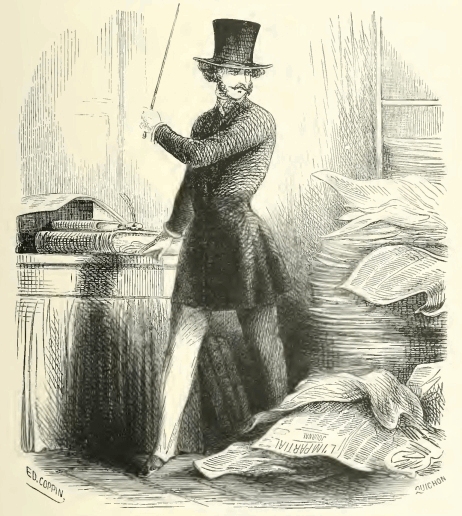
turned his back upon him, and went to the press-room. Albert vented his
anger on a pile of newspapers, which he sent flying all over the office
by switching them violently with his stick; after which ebullition he
departed—not, however, without walking several times to the door of the
press-room, as if he had half a mind to enter.
While Albert was lashing the front of his carriage in the same manner
that he had the newspapers which were the innocent agents of his
discomfiture, as he was crossing the barrier he perceived Morrel, who
was walking with a quick step and a bright eye. He was passing the
Chinese Baths, and appeared to have come from the direction of the
Porte Saint-Martin, and to be going towards the Madeleine.
“Ah,” said Morcerf, “there goes a happy man!” And it so happened Albert
was not mistaken in his opinion.
Chapter LXXIX
Lemonade
Morrel was, in fact, very happy. M. Noirtier had just sent for him, and
he was in such haste to know the reason of his doing so that he had not
stopped to take a cab, placing infinitely more dependence on his own
two legs than on the four legs of a cab-horse. He had therefore set off
at a furious rate from the Rue Meslay, and was hastening with rapid
strides in the direction of the Faubourg Saint-Honoré.
Morrel advanced with a firm, manly tread, and poor Barrois followed him
as he best might. Morrel was only thirty-one, Barrois was sixty years
of age; Morrel was deeply in love, and Barrois was dying with heat and
exertion. These two men, thus opposed in age and interests, resembled
two parts of a triangle, presenting the extremes of separation, yet
nevertheless possessing their point of union. This point of union was
Noirtier, and it was he who had just sent for Morrel, with the request
that the latter would lose no time in coming to him—a command which
Morrel obeyed to the letter, to the great discomfiture of Barrois. On
arriving at the house, Morrel was not even out of breath, for love
lends wings to our desires; but Barrois, who had long forgotten what it
was to love, was sorely fatigued by the expedition he had been
constrained to use.
The old servant introduced Morrel by a private entrance, closed the
door of the study, and soon the rustling of a dress announced the
arrival of Valentine. She looked marvellously beautiful in her deep
mourning dress, and Morrel experienced such intense delight in gazing
upon her that he felt as if he could almost have dispensed with the
conversation of her grandfather.
But the easy-chair of the old man was heard rolling along the floor,
and he soon made his appearance in the room. Noirtier acknowledged by a
look of extreme kindness and benevolence the thanks which Morrel
lavished on him for his timely intervention on behalf of Valentine and
himself—an intervention which had saved them from despair. Morrel then
cast on the invalid an interrogative look as to the new favor which he
designed to bestow on him. Valentine was sitting at a little distance
from them, timidly awaiting the moment when she should be obliged to
speak. Noirtier fixed his eyes on her.
“Am I to say what you told me?” asked Valentine. Noirtier made a sign
that she was to do so.
“Monsieur Morrel,” said Valentine to the young man, who was regarding
her with the most intense interest, “my grandfather, M. Noirtier, had a
thousand things to say, which he told me three days ago; and now, he
has sent for you, that I may repeat them to you. I will repeat them,
then; and since he has chosen me as his interpreter, I will be faithful
to the trust, and will not alter a word of his intentions.”
“Oh, I am listening with the greatest impatience,” replied the young
man; “speak, I beg of you.”
Valentine cast down her eyes; this was a good omen for Morrel, for he
knew that nothing but happiness could have the power of thus overcoming
Valentine.
“My grandfather intends leaving this house,” said she, “and Barrois is
looking out for suitable apartments for him in another.”
“But you, Mademoiselle de Villefort,—you, who are necessary to M.
Noirtier’s happiness——”
“I?” interrupted Valentine; “I shall not leave my grandfather,—that is
an understood thing between us. My apartment will be close to his. Now,
M. de Villefort must either give his consent to this plan or his
refusal; in the first case, I shall leave directly, and in the second,
I shall wait till I am of age, which will be in about ten months. Then
I shall be free, I shall have an independent fortune, and”—
“And what?” demanded Morrel.
“And with my grandfather’s consent I shall fulfil the promise which I
have made you.”
Valentine pronounced these last few words in such a low tone, that
nothing but Morrel’s intense interest in what she was saying could have
enabled him to hear them.
“Have I not explained your wishes, grandpapa?” said Valentine,
addressing Noirtier.
“Yes,” looked the old man.
“Once under my grandfather’s roof, M. Morrel can visit me in the
presence of my good and worthy protector, if we still feel that the
union we contemplated will be likely to insure our future comfort and
happiness; in that case I shall expect M. Morrel to come and claim me
at my own hands. But, alas, I have heard it said that hearts inflamed
by obstacles to their desire grew cold in time of security; I trust we
shall never find it so in our experience!”
“Oh,” cried Morrel, almost tempted to throw himself on his knees before
Noirtier and Valentine, and to adore them as two superior beings, “what
have I ever done in my life to merit such unbounded happiness?”
“Until that time,” continued the young girl in a calm and
self-possessed tone of voice, “we will conform to circumstances, and be
guided by the wishes of our friends, so long as those wishes do not
tend finally to separate us; in a word, and I repeat it, because it
expresses all I wish to convey,—we will wait.”
“And I swear to make all the sacrifices which this word imposes, sir,”
said Morrel, “not only with resignation, but with cheerfulness.”
“Therefore,” continued Valentine, looking playfully at Maximilian, “no
more inconsiderate actions—no more rash projects; for you surely would
not wish to compromise one who from this day regards herself as
destined, honorably and happily, to bear your name?”
Morrel looked obedience to her commands. Noirtier regarded the lovers
with a look of ineffable tenderness, while Barrois, who had remained in
the room in the character of a man privileged to know everything that
passed, smiled on the youthful couple as he wiped the perspiration from
his bald forehead.
“How hot you look, my good Barrois,” said Valentine.
“Ah, I have been running very fast, mademoiselle, but I must do M.
Morrel the justice to say that he ran still faster.”
Noirtier directed their attention to a waiter, on which was placed a
decanter containing lemonade and a glass. The decanter was nearly full,
with the exception of a little, which had been already drunk by M.
Noirtier.
“Come, Barrois,” said the young girl, “take some of this lemonade; I
see you are coveting a good draught of it.”
“The fact is, mademoiselle,” said Barrois, “I am dying with thirst, and
since you are so kind as to offer it me, I cannot say I should at all
object to drinking your health in a glass of it.”
“Take some, then, and come back immediately.”
Barrois took away the waiter, and hardly was he outside the door, which
in his haste he forgot to shut, than they saw him throw back his head
and empty to the very dregs the glass which Valentine had filled.
Valentine and Morrel were exchanging their adieux in the presence of
Noirtier when a ring was heard at the door-bell. It was the signal of a
visit. Valentine looked at her watch.
“It is past noon,” said she, “and today is Saturday; I dare say it is
the doctor, grandpapa.”
Noirtier looked his conviction that she was right in her supposition.
“He will come in here, and M. Morrel had better go,—do you not think
so, grandpapa?”
“Yes,” signed the old man.
“Barrois,” cried Valentine, “Barrois!”
“I am coming, mademoiselle,” replied he.
“Barrois will open the door for you,” said Valentine, addressing
Morrel. “And now remember one thing, Monsieur Officer, that my
grandfather commands you not to take any rash or ill-advised step which
would be likely to compromise our happiness.”
“I promised him to wait,” replied Morrel; “and I will wait.”
At this moment Barrois entered. “Who rang?” asked Valentine.
“Doctor d’Avrigny,” said Barrois, staggering as if he would fall.
“What is the matter, Barrois?” said Valentine. The old man did not
answer, but looked at his master with wild staring eyes, while with his
cramped hand he grasped a piece of furniture to enable him to stand
upright.
“He is going to fall!” cried Morrel.
The rigors which had attacked Barrois gradually increased, the features
of the face became quite altered, and the convulsive movement of the
muscles appeared to indicate the approach of a most serious nervous
disorder. Noirtier, seeing Barrois in this pitiable condition, showed
by his looks all the various emotions of sorrow and sympathy which can
animate the heart of man. Barrois made some steps towards his master.
“Ah, sir,” said he, “tell me what is the matter with me. I am
suffering—I cannot see. A thousand fiery darts are piercing my brain.
Ah, don’t touch me, pray don’t.”
By this time his haggard eyes had the appearance of being ready to
start from their sockets; his head fell back, and the lower extremities
of the body began to stiffen. Valentine uttered a cry of horror; Morrel
took her in his arms, as if to defend her from some unknown danger.
“M. d’Avrigny, M. d’Avrigny,” cried she, in a stifled voice. “Help,
help!”
Barrois turned round and with a great effort stumbled a few steps, then
fell at the feet of Noirtier, and resting his hand on the knee of the
invalid, exclaimed:
“My master, my good master!”
At this moment M. de Villefort, attracted by the noise, appeared on the
threshold. Morrel relaxed his hold of Valentine, and retreating to a
distant corner of the room remained half hidden behind a curtain. Pale
as if he had been gazing on a serpent, he fixed his terrified eye on
the agonized sufferer.
Noirtier, burning with impatience and terror, was in despair at his
utter inability to help his old domestic, whom he regarded more in the
light of a friend than a servant. One might by the fearful swelling of
the veins of his forehead and the contraction of the muscles round the
eye, trace the terrible conflict which was going on between the living
energetic mind and the inanimate and helpless body.
Barrois, his features convulsed, his eyes suffused with blood, and his
head thrown back, was lying at full length, beating the floor with his
hands, while his legs had become so stiff, that they looked as if they
would break rather than bend. A slight appearance of foam was visible
around the mouth, and he breathed painfully, and with extreme
difficulty.
Villefort seemed stupefied with astonishment, and remained gazing
intently on the scene before him without uttering a word. He had not
seen Morrel. After a moment of dumb contemplation, during which his
face became pale and his hair seemed to stand on end, he sprang towards
the door, crying out:
“Doctor, doctor! come instantly, pray come!”
“Madame, madame!” cried Valentine, calling her step-mother, and running
upstairs to meet her; “come quick, quick!—and bring your bottle of
smelling-salts with you.”
“What is the matter?” said Madame de Villefort in a harsh and
constrained tone.
“Oh! come! come!”
“But where is the doctor?” exclaimed Villefort; “where is he?”
Madame de Villefort now deliberately descended the staircase. In one
hand she held her handkerchief, with which she appeared to be wiping
her face, and in the other a bottle of English smelling-salts. Her
first look on entering the room was at Noirtier, whose face,
independent of the emotion which such a scene could not fail of
producing, proclaimed him to be in possession of his usual health; her
second glance was at the dying man. She turned pale, and her eye passed
quickly from the servant and rested on the master.
“In the name of heaven, madame,” said Villefort, “where is the doctor?
He was with you just now. You see this is a fit of apoplexy, and he
might be saved if he could but be bled!”
“Has he eaten anything lately?” asked Madame de Villefort, eluding her
husband’s question.
“Madame,” replied Valentine, “he has not even breakfasted. He has been
running very fast on an errand with which my grandfather charged him,
and when he returned, took nothing but a glass of lemonade.”
“Ah,” said Madame de Villefort, “why did he not take wine? Lemonade was
a very bad thing for him.”
“Grandpapa’s bottle of lemonade was standing just by his side; poor
Barrois was very thirsty, and was thankful to drink anything he could
find.”
Madame de Villefort started. Noirtier looked at her with a glance of
the most profound scrutiny.
“He has such a short neck,” said she.
“Madame,” said Villefort, “I ask where is M. d’Avrigny? In God’s name
answer me!”
“He is with Edward, who is not quite well,” replied Madame de
Villefort, no longer being able to avoid answering.
Villefort rushed upstairs to fetch him.
“Take this,” said Madame de Villefort, giving her smelling-bottle to
Valentine. “They will, no doubt, bleed him; therefore I will retire,
for I cannot endure the sight of blood;” and she followed her husband
upstairs. Morrel now emerged from his hiding-place, where he had
remained quite unperceived, so great had been the general confusion.
“Go away as quick as you can, Maximilian,” said Valentine, “and stay
till I send for you. Go.”
Morrel looked towards Noirtier for permission to retire. The old man,
who had preserved all his usual coolness, made a sign to him to do so.
The young man pressed Valentine’s hand to his lips, and then left the
house by a back staircase.
At the same moment that he quitted the room, Villefort and the doctor
entered by an opposite door. Barrois was now showing signs of returning
consciousness. The crisis seemed past, a low moaning was heard, and he
raised himself on one knee. D’Avrigny and Villefort laid him on a
couch.
“What do you prescribe, doctor?” demanded Villefort.
“Give me some water and ether. You have some in the house, have you
not?”
“Yes.”
“Send for some oil of turpentine and tartar emetic.”
Villefort immediately despatched a messenger. “And now let everyone
retire.”
“Must I go too?” asked Valentine timidly.
“Yes, mademoiselle, you especially,” replied the doctor abruptly.
Valentine looked at M. d’Avrigny with astonishment, kissed her
grandfather on the forehead, and left the room. The doctor closed the
door after her with a gloomy air.
“Look, look, doctor,” said Villefort, “he is quite coming round again;
I really do not think, after all, it is anything of consequence.”
M. d’Avrigny answered by a melancholy smile.
“How do you feel, Barrois?” asked he.
“A little better, sir.”
“Will you drink some of this ether and water?”
“I will try; but don’t touch me.”
“Why not?”
“Because I feel that if you were only to touch me with the tip of your
finger the fit would return.”
“Drink.”
Barrois took the glass, and, raising it to his purple lips, took about
half of the liquid offered him.
“Where do you suffer?” asked the doctor.
“Everywhere. I feel cramps over my whole body.”
“Do you find any dazzling sensation before the eyes?”
“Yes.”
“Any noise in the ears?”
“Frightful.”
“When did you first feel that?”
“Just now.”
“Suddenly?”
“Yes, like a clap of thunder.”
“Did you feel nothing of it yesterday or the day before?”
“Nothing.”
“No drowsiness?”
“None.”
“What have you eaten today?”
“I have eaten nothing; I only drank a glass of my master’s
lemonade—that’s all.” And Barrois turned towards Noirtier, who,
immovably fixed in his armchair, was contemplating this terrible scene
without allowing a word or a movement to escape him.
“Where is this lemonade?” asked the doctor eagerly.
“Downstairs in the decanter.”
“Whereabouts downstairs?”
“In the kitchen.”
“Shall I go and fetch it, doctor?” inquired Villefort.
“No, stay here and try to make Barrois drink the rest of this glass of
ether and water. I will go myself and fetch the lemonade.”
D’Avrigny bounded towards the door, flew down the back staircase, and
almost knocked down Madame de Villefort, in his haste, who was herself
going down to the kitchen. She cried out, but d’Avrigny paid no
attention to her; possessed with but one idea, he cleared the last four
steps with a bound, and rushed into the kitchen, where he saw the
decanter about three parts empty still standing on the waiter, where it
had been left. He darted upon it as an eagle would seize upon its prey.
Panting with loss of breath, he returned to the room he had just left.
Madame de Villefort was slowly ascending the steps which led to her
room.
“Is this the decanter you spoke of?” asked d’Avrigny.
“Yes, doctor.”
“Is this the same lemonade of which you partook?”
“I believe so.”
“What did it taste like?”
“It had a bitter taste.”
The doctor poured some drops of the lemonade into the palm of his hand,
put his lips to it, and after having rinsed his mouth as a man does
when he is tasting wine, he spat the liquor into the fireplace.
“It is no doubt the same,” said he. “Did you drink some too, M.
Noirtier?”
“Yes.”
“And did you also discover a bitter taste?”
“Yes.”
“Oh, doctor,” cried Barrois, “the fit is coming on again. Oh, do
something for me.” The doctor flew to his patient.
“That emetic, Villefort—see if it is coming.”
Villefort sprang into the passage, exclaiming, “The emetic! the
emetic!—is it come yet?” No one answered. The most profound terror
reigned throughout the house.
“If I had anything by means of which I could inflate the lungs,” said
d’Avrigny, looking around him, “perhaps I might prevent suffocation.
But there is nothing which would do!—nothing!”
“Oh, sir,” cried Barrois, “are you going to let me die without help?
Oh, I am dying! Oh, save me!”
“A pen, a pen!” said the doctor. There was one lying on the table; he
endeavored to introduce it into the mouth of the patient, who, in the
midst of his convulsions, was making vain attempts to vomit; but the
jaws were so clenched that the pen could not pass them. This second
attack was much more violent than the first, and he had slipped from
the couch to the ground, where he was writhing in agony. The doctor
left him in this paroxysm, knowing that he could do nothing to
alleviate it, and, going up to Noirtier, said abruptly:
“How do you find yourself?—well?”
“Yes.”
“Have you any weight on the chest; or does your stomach feel light and
comfortable—eh?”
“Yes.”
“Then you feel pretty much as you generally do after you have had the
dose which I am accustomed to give you every Sunday?”
“Yes.”
“Did Barrois make your lemonade?”
“Yes.”
“Was it you who asked him to drink some of it?”
“No.”
“Was it M. de Villefort?”
“No.”
“Madame?”
“No.”
“It was your granddaughter, then, was it not?”
“Yes.”
A groan from Barrois, accompanied by a yawn which seemed to crack the
very jawbones, attracted the attention of M. d’Avrigny; he left M.
Noirtier, and returned to the sick man.
“Barrois,” said the doctor, “can you speak?” Barrois muttered a few
unintelligible words. “Try and make an effort to do so, my good man.”
said d’Avrigny. Barrois reopened his bloodshot eyes.
“Who made the lemonade?”
“I did.”
“Did you bring it to your master directly it was made?”
“No.”
“You left it somewhere, then, in the meantime?”
“Yes; I left it in the pantry, because I was called away.”
“Who brought it into this room, then?”
“Mademoiselle Valentine.” D’Avrigny struck his forehead with his hand.
“Gracious heaven,” exclaimed he.
“Doctor, doctor!” cried Barrois, who felt another fit coming.
“Will they never bring that emetic?” asked the doctor.
“Here is a glass with one already prepared,” said Villefort, entering
the room.
“Who prepared it?”
“The chemist who came here with me.”
“Drink it,” said the doctor to Barrois.
“Impossible, doctor; it is too late; my throat is closing up. I am
choking! Oh, my heart! Ah, my head!—Oh, what agony!—Shall I suffer like
this long?”
“No, no, friend,” replied the doctor, “you will soon cease to suffer.”
“Ah, I understand you,” said the unhappy man. “My God, have mercy upon
me!” and, uttering a fearful cry, Barrois fell back as if he had been
struck by lightning. D’Avrigny put his hand to his heart, and placed a
glass before his lips.
“Well?” said Villefort.
“Go to the kitchen and get me some syrup of violets.”
Villefort went immediately.
“Do not be alarmed, M. Noirtier,” said d’Avrigny; “I am going to take
my patient into the next room to bleed him; this sort of attack is very
frightful to witness.”
And taking Barrois under the arms, he dragged him into an adjoining
room; but almost immediately he returned to fetch the lemonade.
Noirtier closed his right eye.
“You want Valentine, do you not? I will tell them to send her to you.”
Villefort returned, and d’Avrigny met him in the passage.
“Well, how is he now?” asked he.
“Come in here,” said d’Avrigny, and he took him into the chamber where
the sick man lay.
“Is he still in a fit?” said the procureur.
“He is dead.”
Villefort drew back a few steps, and, clasping his hands, exclaimed,
with real amazement and sympathy, “Dead?—and so soon too!”
“Yes, it is very soon,” said the doctor, looking at the corpse before
him; “but that ought not to astonish you; Monsieur and Madame de
Saint-Méran died as soon. People die very suddenly in your house, M. de
Villefort.”
“What?” cried the magistrate, with an accent of horror and
consternation, “are you still harping on that terrible idea?”
“Still, sir; and I shall always do so,” replied d’Avrigny, “for it has
never for one instant ceased to retain possession of my mind; and that
you may be quite sure I am not mistaken this time, listen well to what
I am going to say, M. de Villefort.”
The magistrate trembled convulsively.
“There is a poison which destroys life almost without leaving any
perceptible traces. I know it well; I have studied it in all its forms
and in the effects which it produces. I recognized the presence of this
poison in the case of poor Barrois as well as in that of Madame de
Saint-Méran. There is a way of detecting its presence. It restores the
blue color of litmus-paper reddened by an acid, and it turns syrup of
violets green. We have no litmus-paper, but, see, here they come with
the syrup of violets.”
The doctor was right; steps were heard in the passage. M. d’Avrigny
opened the door, and took from the hands of the chambermaid a cup which
contained two or three spoonfuls of the syrup, he then carefully closed
the door.
“Look,” said he to the procureur, whose heart beat so loudly that it
might almost be heard, “here is in this cup some syrup of violets, and
this decanter contains the remainder of the lemonade of which M.
Noirtier and Barrois partook. If the lemonade be pure and inoffensive,
the syrup will retain its color; if, on the contrary, the lemonade be
drugged with poison, the syrup will become green. Look closely!”
The doctor then slowly poured some drops of the lemonade from the
decanter into the cup, and in an instant a light cloudy sediment began
to form at the bottom of the cup; this sediment first took a blue
shade, then from the color of sapphire it passed to that of opal, and
from opal to emerald. Arrived at this last hue, it changed no more. The
result of the experiment left no doubt whatever on the mind.
“The unfortunate Barrois has been poisoned,” said d’Avrigny, “and I
will maintain this assertion before God and man.”
Villefort said nothing, but he clasped his hands, opened his haggard
eyes, and, overcome with his emotion, sank into a chair.