One division of La Force, in which the most dangerous and desperate
prisoners are confined, is called the court of Saint-Bernard. The
prisoners, in their expressive language, have named it the “Lions’
Den,” probably because the captives possess teeth which frequently gnaw
the bars, and sometimes the keepers also. It is a prison within a
prison; the walls are double the thickness of the rest. The gratings
are every day carefully examined by jailers, whose herculean
proportions and cold pitiless expression prove them to have been chosen
to reign over their subjects for their superior activity and
intelligence.
The courtyard of this quarter is enclosed by enormous walls, over which
the sun glances obliquely, when it deigns to penetrate into this gulf
of moral and physical deformity. On this paved yard are to be
seen,—pacing to and fro from morning till night, pale, careworn, and
haggard, like so many shadows,—the men whom justice holds beneath the
steel she is sharpening. There, crouched against the side of the wall
which attracts and retains the most heat, they may be seen sometimes
talking to one another, but more frequently alone, watching the door,
which sometimes opens to call forth one from the gloomy assemblage, or
to throw in another outcast from society.
The court of Saint-Bernard has its own particular apartment for the
reception of guests; it is a long rectangle, divided by two upright
gratings placed at a distance of three feet from one another to prevent
a visitor from shaking hands with or passing anything to the prisoners.
It is a wretched, damp, nay, even horrible spot, more especially when
we consider the agonizing conferences which have taken place between
those iron bars. And yet, frightful though this spot may be, it is
looked upon as a kind of paradise by the men whose days are numbered;
it is so rare for them to leave the Lions’ Den for any other place than
the barrier Saint-Jacques, the galleys! or solitary confinement.
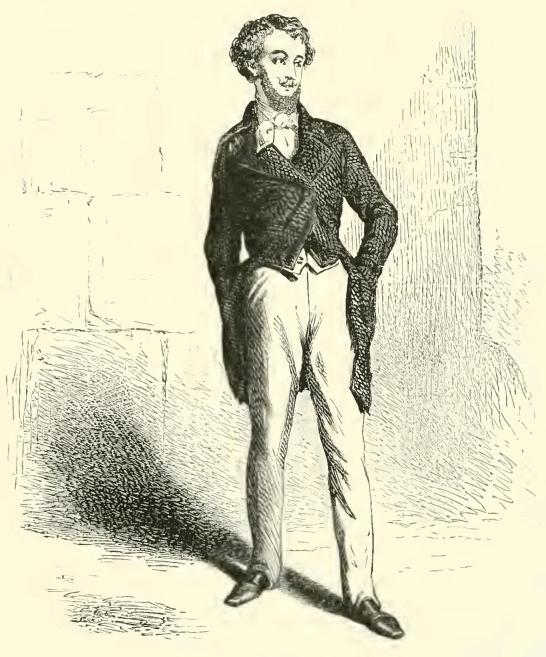
In the court which we have attempted to describe, and from which a damp
vapor was rising, a young man with his hands in his pockets, who had
excited much curiosity among the inhabitants of the “Den,” might be
seen walking. The cut of his clothes would have made him pass for an
elegant man, if those clothes had not been torn to shreds; still they
did not show signs of wear, and the fine cloth, beneath the careful
hands of the prisoner, soon recovered its gloss in the parts which were
still perfect, for the wearer tried his best to make it assume the
appearance of a new coat. He bestowed the same attention upon the
cambric front of a shirt, which had considerably changed in color since
his entrance into the prison, and he polished his varnished boots with
the corner of a handkerchief embroidered with initials surmounted by a
coronet.
Some of the inmates of the “Lions’ Den” were watching the operations of
the prisoner’s toilet with considerable interest.
“See, the prince is pluming himself,” said one of the thieves.
“He’s a fine looking fellow,” said another; “if he had only a comb and
hair-grease, he’d take the shine off the gentlemen in white kids.”
“His coat looks nearly new, and his boots are brilliant. It is pleasant
to have such well-dressed brethren; and those gendarmes behaved
shamefully. What jealousy; to tear such clothes!”
“He looks like a big-bug,” said another; “dresses in fine style. And,
then, to be here so young! Oh, what larks!”
Meanwhile the object of this hideous admiration approached the wicket,
against which one of the keepers was leaning.
“Come, sir,” he said, “lend me twenty francs; you will soon be paid;
you run no risks with me. Remember, I have relations who possess more
millions than you have deniers. Come, I beseech you, lend me twenty
francs, so that I may buy a dressing-gown; it is intolerable always to
be in a coat and boots! And what a coat, sir, for a prince of the
Cavalcanti!”
The keeper turned his back, and shrugged his shoulders; he did not even
laugh at what would have caused anyone else to do so; he had heard so
many utter the same things,—indeed, he heard nothing else.
“Come,” said Andrea, “you are a man void of compassion; I’ll have you
turned out.”
This made the keeper turn around, and he burst into a loud laugh. The
prisoners then approached and formed a circle.
“I tell you that with that wretched sum,” continued Andrea, “I could
obtain a coat, and a room in which to receive the illustrious visitor I
am daily expecting.”
“Of course—of course,” said the prisoners;—“anyone can see he’s a
gentleman!”
“Well, then, lend him the twenty francs,” said the keeper, leaning on
the other shoulder; “surely you will not refuse a comrade!”
“I am no comrade of these people,” said the young man, proudly, “you
have no right to insult me thus.”
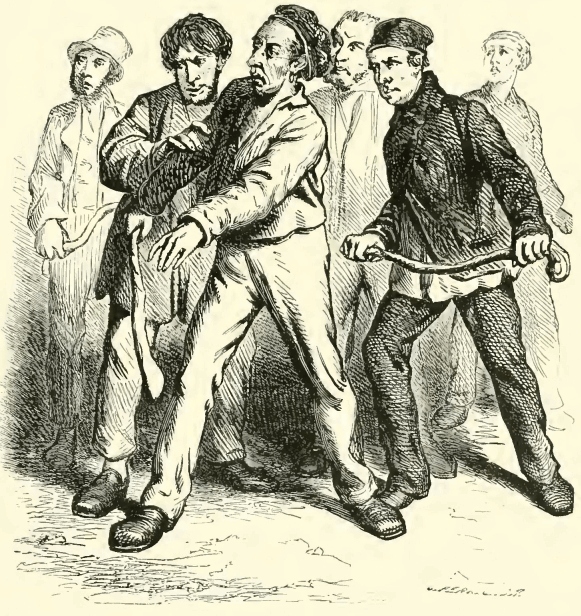
The thieves looked at one another with low murmurs, and a storm
gathered over the head of the aristocratic prisoner, raised less by his
own words than by the manner of the keeper. The latter, sure of
quelling the tempest when the waves became too violent, allowed them to
rise to a certain pitch that he might be revenged on the importunate
Andrea, and besides it would afford him some recreation during the long
day.
The thieves had already approached Andrea, some screaming, _“La
savate—La savate!”_26 a cruel operation, which consists in cuffing a
comrade who may have fallen into disgrace, not with an old shoe, but
with an iron-heeled one. Others proposed the anguille, another kind
of recreation, in which a handkerchief is filled with sand, pebbles,
and two-sous pieces, when they have them, which the wretches beat like
a flail over the head and shoulders of the unhappy sufferer.
“Let us horsewhip the fine gentleman!” said others.
But Andrea, turning towards them, winked his eyes, rolled his tongue
around his cheeks, and smacked his lips in a manner equivalent to a
hundred words among the bandits when forced to be silent. It was a
Masonic sign Caderousse had taught him. He was immediately recognized
as one of them; the handkerchief was thrown down, and the iron-heeled
shoe replaced on the foot of the wretch to whom it belonged.
Some voices were heard to say that the gentleman was right; that he
intended to be civil, in his way, and that they would set the example
of liberty of conscience,—and the mob retired. The keeper was so
stupefied at this scene that he took Andrea by the hands and began
examining his person, attributing the sudden submission of the inmates
of the Lions’ Den to something more substantial than mere fascination.
Andrea made no resistance, although he protested against it. Suddenly a
voice was heard at the wicket.
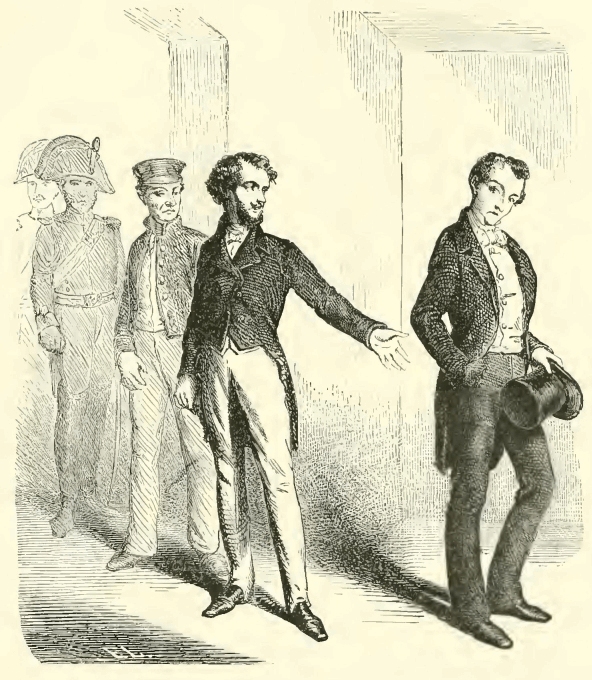
“Benedetto!” exclaimed an inspector. The keeper relaxed his hold.
“I am called,” said Andrea.
“To the visitors’ room!” said the same voice.
“You see someone pays me a visit. Ah, my dear sir, you will see whether
a Cavalcanti is to be treated like a common person!”
And Andrea, gliding through the court like a black shadow, rushed out
through the wicket, leaving his comrades, and even the keeper, lost in
wonder. Certainly a call to the visitors’ room had scarcely astonished
Andrea less than themselves, for the wily youth, instead of making use
of his privilege of waiting to be claimed on his entry into La Force,
had maintained a rigid silence.
“Everything,” he said, “proves me to be under the protection of some
powerful person,—this sudden fortune, the facility with which I have
overcome all obstacles, an unexpected family and an illustrious name
awarded to me, gold showered down upon me, and the most splendid
alliances about to be entered into. An unhappy lapse of fortune and the
absence of my protector have cast me down, certainly, but not forever.
The hand which has retreated for a while will be again stretched forth
to save me at the very moment when I shall think myself sinking into
the abyss. Why should I risk an imprudent step? It might alienate my
protector. He has two means of extricating me from this dilemma,—the
one by a mysterious escape, managed through bribery; the other by
buying off my judges with gold. I will say and do nothing until I am
convinced that he has quite abandoned me, and then——”
Andrea had formed a plan which was tolerably clever. The unfortunate
youth was intrepid in the attack, and rude in the defence. He had borne
with the public prison, and with privations of all sorts; still, by
degrees nature, or rather custom, had prevailed, and he suffered from
being naked, dirty, and hungry. It was at this moment of discomfort
that the inspector’s voice called him to the visiting-room. Andrea felt
his heart leap with joy. It was too soon for a visit from the examining
magistrate, and too late for one from the director of the prison, or
the doctor; it must, then, be the visitor he hoped for. Behind the
grating of the room into which Andrea had been led, he saw, while his
eyes dilated with surprise, the dark and intelligent face of M.
Bertuccio, who was also gazing with sad astonishment upon the iron
bars, the bolted doors, and the shadow which moved behind the other
grating.
“Ah,” said Andrea, deeply affected.
“Good morning, Benedetto,” said Bertuccio, with his deep, hollow voice.
“You—you?” said the young man, looking fearfully around him.
“Do you not recognize me, unhappy child?”
“Silence,—be silent!” said Andrea, who knew the delicate sense of
hearing possessed by the walls; “for Heaven’s sake, do not speak so
loud!”
“You wish to speak with me alone, do you not?” said Bertuccio.
“Oh, yes.”
“That is well.”
And Bertuccio, feeling in his pocket, signed to a keeper whom he saw
through the window of the wicket.
“Read?” he said.
“What is that?” asked Andrea.
“An order to conduct you to a room, and to leave you there to talk to
me.”
“Oh,” cried Andrea, leaping with joy. Then he mentally added,—“Still my
unknown protector! I am not forgotten. They wish for secrecy, since we
are to converse in a private room. I understand, Bertuccio has been
sent by my protector.”
The keeper spoke for a moment with an official, then opened the iron
gates and conducted Andrea to a room on the first floor. The room was
whitewashed, as is the custom in prisons, but it looked quite brilliant
to a prisoner, though a stove, a bed, a chair, and a table formed the
whole of its sumptuous furniture. Bertuccio sat down upon the chair,
Andrea threw himself upon the bed; the keeper retired.
“Now,” said the steward, “what have you to tell me?”
“And you?” said Andrea.
“You speak first.”
“Oh, no. You must have much to tell me, since you have come to seek
me.”
“Well, be it so. You have continued your course of villany; you have
robbed—you have assassinated.”
“Well, I should say! If you had me taken to a private room only to tell
me this, you might have saved yourself the trouble. I know all these
things. But there are some with which, on the contrary, I am not
acquainted. Let us talk of those, if you please. Who sent you?”
“Come, come, you are going on quickly, M. Benedetto!”
“Yes, and to the point. Let us dispense with useless words. Who sends
you?”
“No one.”
“How did you know I was in prison?”
“I recognized you, some time since, as the insolent dandy who so
gracefully mounted his horse in the Champs-Élysées.”
“Oh, the Champs-Élysées? Ah, yes; we burn, as they say at the game of
pincette. The Champs-Élysées? Come, let us talk a little about my
father.”
“Who, then, am I?”
“You, sir?—you are my adopted father. But it was not you, I presume,
who placed at my disposal 100,000 francs, which I spent in four or five
months; it was not you who manufactured an Italian gentleman for my
father; it was not you who introduced me into the world, and had me
invited to a certain dinner at Auteuil, which I fancy I am eating at
this moment, in company with the most distinguished people in
Paris—amongst the rest with a certain procureur, whose acquaintance I
did very wrong not to cultivate, for he would have been very useful to
me just now;—it was not you, in fact, who bailed me for one or two
millions, when the fatal discovery of my little secret took place.
Come, speak, my worthy Corsican, speak!”
“What do you wish me to say?”
“I will help you. You were speaking of the Champs-Élysées just now,
worthy foster-father.”
“Well?”
“Well, in the Champs-Élysées there resides a very rich gentleman.”
“At whose house you robbed and murdered, did you not?”
“I believe I did.”
“The Count of Monte Cristo?”
“’Tis you who have named him, as M. Racine says. Well, am I to rush
into his arms, and strain him to my heart, crying, ‘My father, my
father!’ like Monsieur Pixérécourt.”27
“Do not let us jest,” gravely replied Bertuccio, “and dare not to utter
that name again as you have pronounced it.”
“Bah,” said Andrea, a little overcome, by the solemnity of Bertuccio’s
manner, “why not?”
“Because the person who bears it is too highly favored by Heaven to be
the father of such a wretch as you.”
“Oh, these are fine words.”
“And there will be fine doings, if you do not take care.”
“Menaces—I do not fear them. I will say——”
“Do you think you are engaged with a pygmy like yourself?” said
Bertuccio, in so calm a tone, and with so steadfast a look, that Andrea
was moved to the very soul. “Do you think you have to do with
galley-slaves, or novices in the world? Benedetto, you are fallen into
terrible hands; they are ready to open for you—make use of them. Do not
play with the thunderbolt they have laid aside for a moment, but which
they can take up again instantly, if you attempt to intercept their
movements.”
“My father—I will know who my father is,” said the obstinate youth; “I
will perish if I must, but I will know it. What does scandal signify
to me? What possessions, what reputation, what ‘pull,’ as Beauchamp
says,—have I? You great people always lose something by scandal,
notwithstanding your millions. Come, who is my father?”
“I came to tell you.”
“Ah,” cried Benedetto, his eyes sparkling with joy. Just then the door
opened, and the jailer, addressing himself to Bertuccio, said:
“Excuse me, sir, but the examining magistrate is waiting for the
prisoner.”
“And so closes our interview,” said Andrea to the worthy steward; “I
wish the troublesome fellow were at the devil!”
“I will return tomorrow,” said Bertuccio.
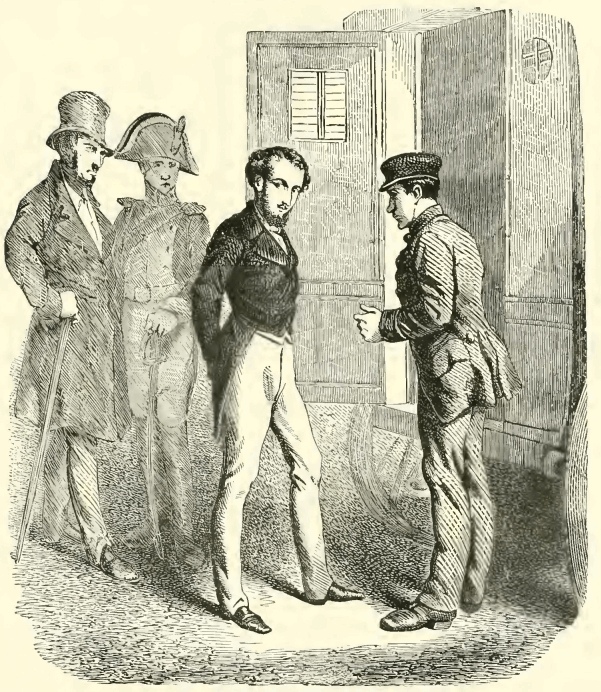
“Good! Gendarmes, I am at your service. Ah, sir, do leave a few crowns
for me at the gate that I may have some things I am in need of!”
“It shall be done,” replied Bertuccio.
Andrea extended his hand; Bertuccio kept his own in his pocket, and
merely jingled a few pieces of money.
“That’s what I mean,” said Andrea, endeavoring to smile, quite overcome
by the strange tranquillity of Bertuccio.
“Can I be deceived?” he murmured, as he stepped into the oblong and
grated vehicle which they call “the salad basket.”
“Never mind, we shall see! Tomorrow, then!” he added, turning towards
Bertuccio.
“Tomorrow!” replied the steward.
Chapter CV
The Père Lachaise Cemetery
M. de Boville had indeed met the funeral procession which was taking
Valentine to her last home on earth. The weather was dull and stormy, a
cold wind shook the few remaining yellow leaves from the boughs of the
trees, and scattered them among the crowd which filled the boulevards.
M. de Villefort, a true Parisian, considered the cemetery of
Père-Lachaise alone worthy of receiving the mortal remains of a
Parisian family; there alone the corpses belonging to him would be
surrounded by worthy associates. He had therefore purchased a vault,
which was quickly occupied by members of his family. On the front of
the monument was inscribed: “The families of Saint-Méran and
Villefort,” for such had been the last wish expressed by poor Renée,
Valentine’s mother. The pompous procession therefore wended its way
towards Père-Lachaise from the Faubourg Saint-Honoré. Having crossed
Paris, it passed through the Faubourg du Temple, then leaving the
exterior boulevards, it reached the cemetery. More than fifty private
carriages followed the twenty mourning-coaches, and behind them more
than five hundred persons joined in the procession on foot.
These last consisted of all the young people whom Valentine’s death had
struck like a thunderbolt, and who, notwithstanding the raw chilliness
of the season, could not refrain from paying a last tribute to the
memory of the beautiful, chaste, and adorable girl, thus cut off in the
flower of her youth.
As they left Paris, an equipage with four horses, at full speed, was
seen to draw up suddenly; it contained Monte Cristo. The count left the
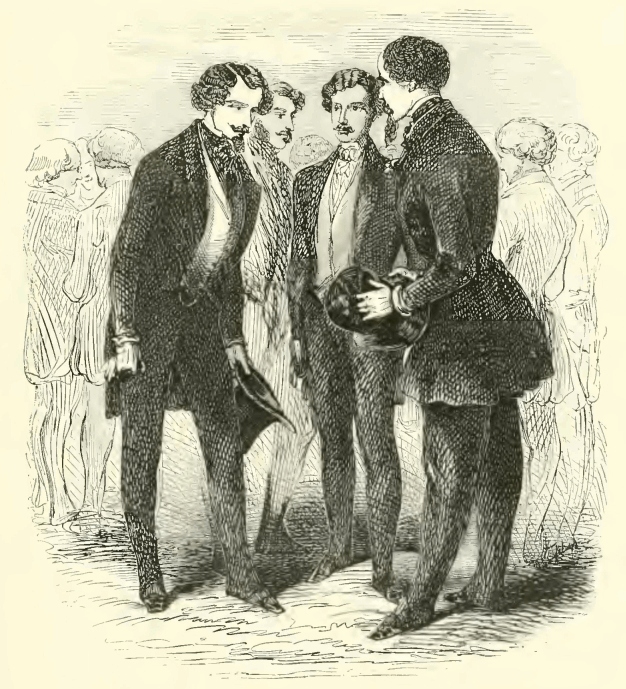
carriage and mingled in the crowd who followed on foot. Château-Renaud
perceived him and immediately alighting from his coupé, joined him;
Beauchamp did the same.
The count looked attentively through every opening in the crowd; he was
evidently watching for someone, but his search ended in disappointment.
“Where is Morrel?” he asked; “do either of these gentlemen know where
he is?”
“We have already asked that question,” said Château-Renaud, “for none
of us has seen him.”
The count was silent, but continued to gaze around him. At length they
arrived at the cemetery. The piercing eye of Monte Cristo glanced
through clusters of bushes and trees, and was soon relieved from all
anxiety, for seeing a shadow glide between the yew-trees, Monte Cristo
recognized him whom he sought.
One funeral is generally very much like another in this magnificent
metropolis. Black figures are seen scattered over the long white
avenues; the silence of earth and heaven is alone broken by the noise
made by the crackling branches of hedges planted around the monuments;
then follows the melancholy chant of the priests, mingled now and then
with a sob of anguish, escaping from some woman concealed behind a mass
of flowers.
The shadow Monte Cristo had noticed passed rapidly behind the tomb of
Abélard and Héloïse, placed itself close to the heads of the horses
belonging to the hearse, and following the undertaker’s men, arrived
with them at the spot appointed for the burial. Each person’s attention
was occupied. Monte Cristo saw nothing but the shadow, which no one
else observed. Twice the count left the ranks to see whether the object
of his interest had any concealed weapon beneath his clothes. When the
procession stopped, this shadow was recognized as Morrel, who, with his
coat buttoned up to his throat, his face livid, and convulsively
crushing his hat between his fingers, leaned against a tree, situated
on an elevation commanding the mausoleum, so that none of the funeral
details could escape his observation.
Everything was conducted in the usual manner. A few men, the least
impressed of all by the scene, pronounced a discourse, some deploring
this premature death, others expatiating on the grief of the father,
and one very ingenious person quoting the fact that Valentine had
solicited pardon of her father for criminals on whom the arm of justice
was ready to fall—until at length they exhausted their stores of
metaphor and mournful speeches, elaborate variations on the stanzas of
Malherbe to Du Périer.
Monte Cristo heard and saw nothing, or rather he only saw Morrel, whose
calmness had a frightful effect on those who knew what was passing in
his heart.
“See,” said Beauchamp, pointing out Morrel to Debray. “What is he doing
up there?” And they called Château-Renaud’s attention to him.
“How pale he is!” said Château-Renaud, shuddering.
“He is cold,” said Debray.
“Not at all,” said Château-Renaud, slowly; “I think he is violently
agitated. He is very susceptible.”
“Bah,” said Debray; “he scarcely knew Mademoiselle de Villefort; you
said so yourself.”
“True. Still I remember he danced three times with her at Madame de
Morcerf’s. Do you recollect that ball, count, where you produced such
an effect?”
“No, I do not,” replied Monte Cristo, without even knowing of what or
to whom he was speaking, so much was he occupied in watching Morrel,
who was holding his breath with emotion.
“The discourse is over; farewell, gentlemen,” said the count,
unceremoniously.
And he disappeared without anyone seeing whither he went.
The funeral being over, the guests returned to Paris. Château-Renaud
looked for a moment for Morrel; but while they were watching the
departure of the count, Morrel had quitted his post, and
Château-Renaud, failing in his search, joined Debray and Beauchamp.
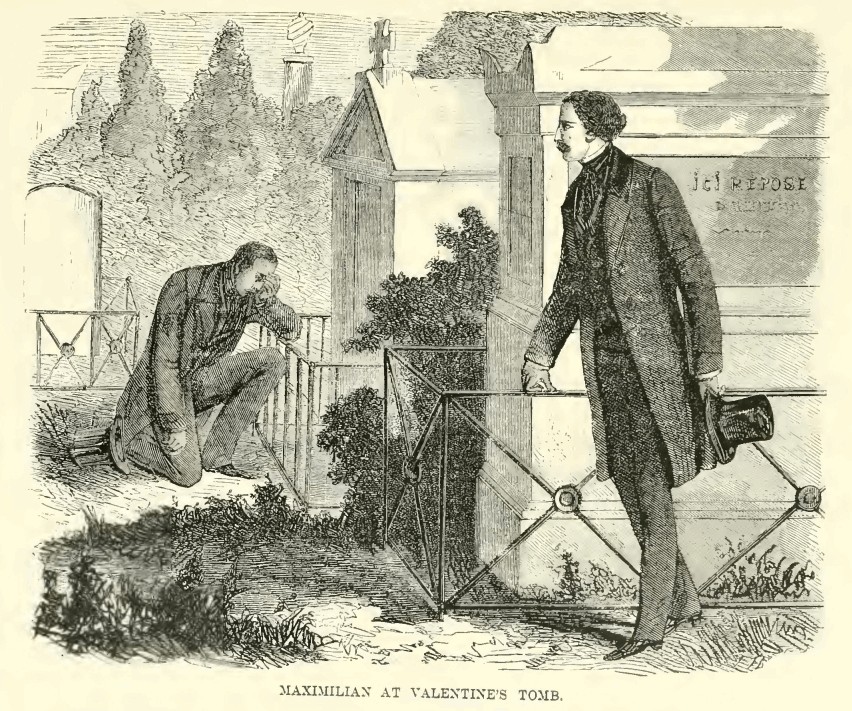
Monte Cristo concealed himself behind a large tomb and awaited the
arrival of Morrel, who by degrees approached the tomb now abandoned by
spectators and workmen. Morrel threw a glance around, but before it
reached the spot occupied by Monte Cristo the latter had advanced yet
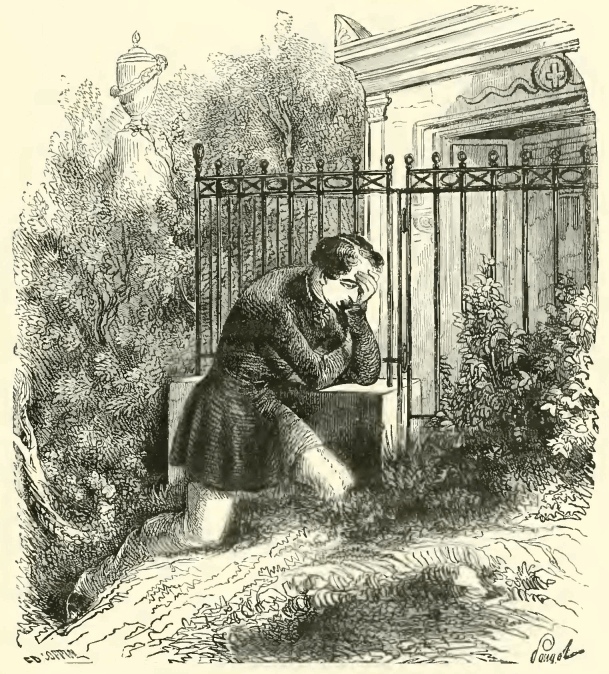
nearer, still unperceived. The young man knelt down. The count, with
outstretched neck and glaring eyes, stood in an attitude ready to
pounce upon Morrel upon the first occasion. Morrel bent his head till
it touched the stone, then clutching the grating with both hands, he
murmured:
“Oh, Valentine!”
The count’s heart was pierced by the utterance of these two words; he
stepped forward, and touching the young man’s shoulder, said:
“I was looking for you, my friend.” Monte Cristo expected a burst of
passion, but he was deceived, for Morrel turning round, said calmly,—
“You see I was praying.” The scrutinizing glance of the count searched
the young man from head to foot. He then seemed more easy.
“Shall I drive you back to Paris?” he asked.
“No, thank you.”
“Do you wish anything?”
“Leave me to pray.”
The count withdrew without opposition, but it was only to place himself
in a situation where he could watch every movement of Morrel, who at
length arose, brushed the dust from his knees, and turned towards
Paris, without once looking back. He walked slowly down the Rue de la
Roquette. The count, dismissing his carriage, followed him about a
hundred paces behind. Maximilian crossed the canal and entered the Rue
Meslay by the boulevards.
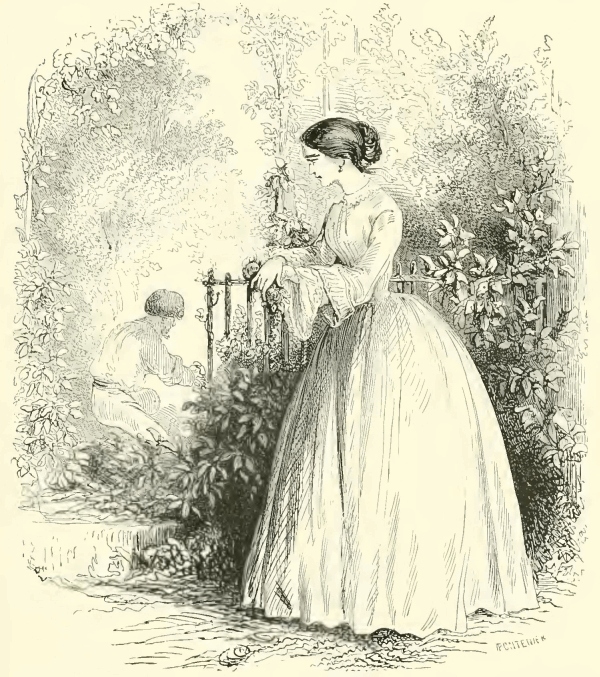
Five minutes after the door had been closed on Morrel’s entrance, it
was again opened for the count. Julie was at the entrance of the
garden, where she was attentively watching Penelon, who, entering with
zeal into his profession of gardener, was very busy grafting some
Bengal roses. “Ah, count,” she exclaimed, with the delight manifested
by every member of the family whenever he visited the Rue Meslay.
“Maximilian has just returned, has he not, madame?” asked the count.
“Yes, I think I saw him pass; but pray, call Emmanuel.”
“Excuse me, madame, but I must go up to Maximilian’s room this
instant,” replied Monte Cristo, “I have something of the greatest
importance to tell him.”
“Go, then,” she said with a charming smile, which accompanied him until
he had disappeared.
Monte Cristo soon ran up the staircase conducting from the ground floor
to Maximilian’s room; when he reached the landing he listened
attentively, but all was still. Like many old houses occupied by a
single family, the room door was panelled with glass; but it was
locked, Maximilian was shut in, and it was impossible to see what was
passing in the room, because a red curtain was drawn before the glass.
The count’s anxiety was manifested by a bright color which seldom
appeared on the face of that imperturbable man.
“What shall I do!” he uttered, and reflected for a moment; “shall I
ring? No, the sound of a bell, announcing a visitor, will but
accelerate the resolution of one in Maximilian’s situation, and then
the bell would be followed by a louder noise.”
Monte Cristo trembled from head to foot and as if his determination had
been taken with the rapidity of lightning, he struck one of the panes
of glass with his elbow; the glass was shivered to atoms, then
withdrawing the curtain he saw Morrel, who had been writing at his
desk, bound from his seat at the noise of the broken window.
“I beg a thousand pardons,” said the count, “there is nothing the
matter, but I slipped down and broke one of your panes of glass with my
elbow. Since it is opened, I will take advantage of it to enter your
room; do not disturb yourself—do not disturb yourself!”
And passing his hand through the broken glass, the count opened the
door. Morrel, evidently discomposed, came to meet Monte Cristo less
with the intention of receiving him than to exclude his entry.
“Ma foi,” said Monte Cristo, rubbing his elbow, “it’s all your
servant’s fault; your stairs are so polished, it is like walking on
glass.”
“Are you hurt, sir?” coldly asked Morrel.
“I believe not. But what are you about there? You were writing.”
“I?”
“Your fingers are stained with ink.”
“Ah, true, I was writing. I do sometimes, soldier though I am.”
Monte Cristo advanced into the room; Maximilian was obliged to let him
pass, but he followed him.
“You were writing?” said Monte Cristo with a searching look.
“I have already had the honor of telling you I was,” said Morrel.
The count looked around him.
“Your pistols are beside your desk,” said Monte Cristo, pointing with
his finger to the pistols on the table.
“I am on the point of starting on a journey,” replied Morrel
disdainfully.
“My friend,” exclaimed Monte Cristo in a tone of exquisite sweetness.
“Sir?”
“My friend, my dear Maximilian, do not make a hasty resolution, I
entreat you.”
“I make a hasty resolution?” said Morrel, shrugging his shoulders; “is
there anything extraordinary in a journey?”
“Maximilian,” said the count, “let us both lay aside the mask we have
assumed. You no more deceive me with that false calmness than I impose
upon you with my frivolous solicitude. You can understand, can you not,
that to have acted as I have done, to have broken that glass, to have
intruded on the solitude of a friend—you can understand that, to have
done all this, I must have been actuated by real uneasiness, or rather
by a terrible conviction. Morrel, you are going to destroy yourself!”
“Indeed, count,” said Morrel, shuddering; “what has put this into your
head?”
“I tell you that you are about to destroy yourself,” continued the
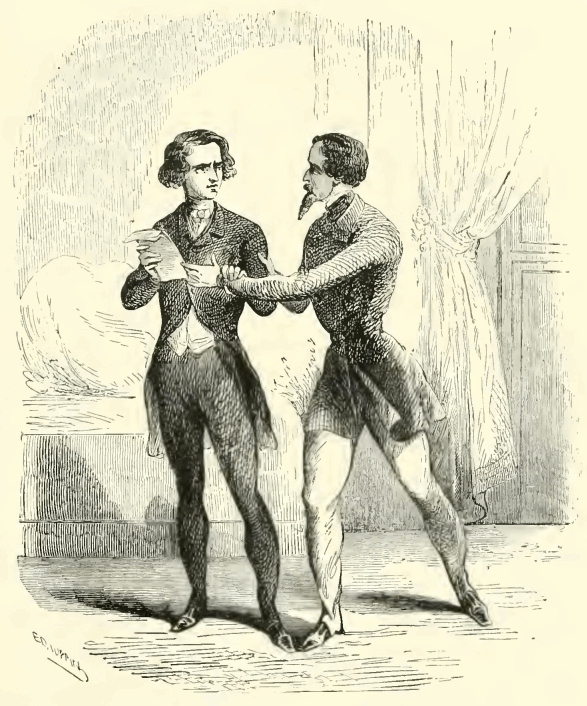
count, “and here is proof of what I say;” and, approaching the desk, he
removed the sheet of paper which Morrel had placed over the letter he
had begun, and took the latter in his hands.
Morrel rushed forward to tear it from him, but Monte Cristo perceiving
his intention, seized his wrist with his iron grasp.
“You wish to destroy yourself,” said the count; “you have written it.”
“Well,” said Morrel, changing his expression of calmness for one of
violence—“well, and if I do intend to turn this pistol against myself,
who shall prevent me—who will dare prevent me? All my hopes are
blighted, my heart is broken, my life a burden, everything around me is
sad and mournful; earth has become distasteful to me, and human voices
distract me. It is a mercy to let me die, for if I live I shall lose my
reason and become mad. When, sir, I tell you all this with tears of
heartfelt anguish, can you reply that I am wrong, can you prevent my
putting an end to my miserable existence? Tell me, sir, could you have
the courage to do so?”
“Yes, Morrel,” said Monte Cristo, with a calmness which contrasted
strangely with the young man’s excitement; “yes, I would do so.”
“You?” exclaimed Morrel, with increasing anger and reproach—“you, who
have deceived me with false hopes, who have cheered and soothed me with
vain promises, when I might, if not have saved her, at least have seen
her die in my arms! You, who pretend to understand everything, even the
hidden sources of knowledge,—and who enact the part of a guardian angel
upon earth, and could not even find an antidote to a poison
administered to a young girl! Ah, sir, indeed you would inspire me with
pity, were you not hateful in my eyes.”
“Morrel——”
“Yes; you tell me to lay aside the mask, and I will do so, be
satisfied! When you spoke to me at the cemetery, I answered you—my
heart was softened; when you arrived here, I allowed you to enter. But
since you abuse my confidence, since you have devised a new torture
after I thought I had exhausted them all, then, Count of Monte Cristo
my pretended benefactor—then, Count of Monte Cristo, the universal
guardian, be satisfied, you shall witness the death of your friend;”
and Morrel, with a maniacal laugh, again rushed towards the pistols.
“And I again repeat, you shall not commit suicide.”
“Prevent me, then!” replied Morrel, with another struggle, which, like
the first, failed in releasing him from the count’s iron grasp.
“I will prevent you.”
“And who are you, then, that arrogate to yourself this tyrannical right
over free and rational beings?”
“Who am I?” repeated Monte Cristo. “Listen; I am the only man in the
world having the right to say to you, ‘Morrel, your father’s son shall
not die today;’” and Monte Cristo, with an expression of majesty and
sublimity, advanced with arms folded toward the young man, who,
involuntarily overcome by the commanding manner of this man, recoiled a
step.
“Why do you mention my father?” stammered he; “why do you mingle a
recollection of him with the affairs of today?”
“Because I am he who saved your father’s life when he wished to destroy
himself, as you do today—because I am the man who sent the purse to
your young sister, and the Pharaon to old Morrel—because I am the
Edmond Dantès who nursed you, a child, on my knees.”
Morrel made another step back, staggering, breathless, crushed; then
all his strength give way, and he fell prostrate at the feet of Monte
Cristo. Then his admirable nature underwent a complete and sudden
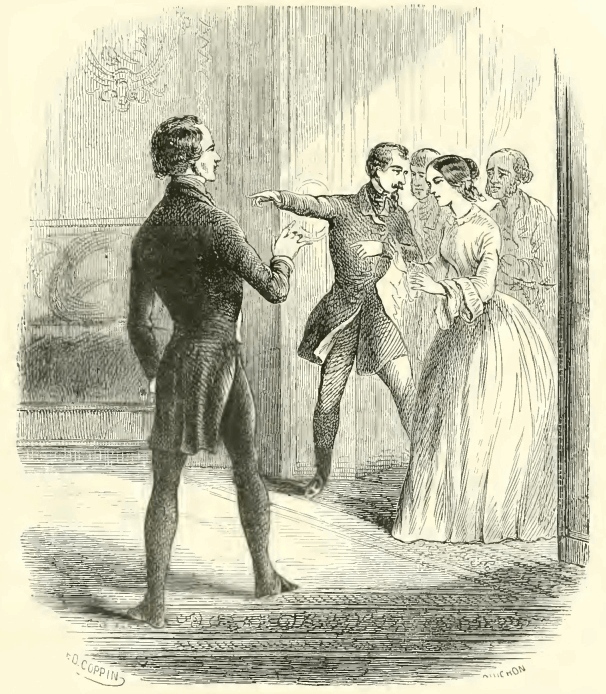
revulsion; he arose, rushed out of the room and to the stairs,
exclaiming energetically, “Julie, Julie—Emmanuel, Emmanuel!”
Monte Cristo endeavored also to leave, but Maximilian would have died
rather than relax his hold of the handle of the door, which he closed
upon the count. Julie, Emmanuel, and some of the servants, ran up in
alarm on hearing the cries of Maximilian. Morrel seized their hands,
and opening the door exclaimed in a voice choked with sobs:
“On your knees—on your knees—he is our benefactor—the saviour of our
father! He is——”
He would have added “Edmond Dantès,” but the count seized his arm and
prevented him.
Julie threw herself into the arms of the count; Emmanuel embraced him
as a guardian angel; Morrel again fell on his knees, and struck the
ground with his forehead. Then the iron-hearted man felt his heart
swell in his breast; a flame seemed to rush from his throat to his
eyes, he bent his head and wept. For a while nothing was heard in the
room but a succession of sobs, while the incense from their grateful
hearts mounted to heaven. Julie had scarcely recovered from her deep
emotion when she rushed out of the room, descended to the next floor,
ran into the drawing-room with childlike joy and raised the crystal
globe which covered the purse given by the unknown of the Allées de
Meilhan. Meanwhile, Emmanuel in a broken voice said to the count:
“Oh, count, how could you, hearing us so often speak of our unknown
benefactor, seeing us pay such homage of gratitude and adoration to his
memory,—how could you continue so long without discovering yourself to
us? Oh, it was cruel to us, and—dare I say it?—to you also.”
“Listen, my friends,” said the count—“I may call you so since we have
really been friends for the last eleven years—the discovery of this
secret has been occasioned by a great event which you must never know.
I wished to bury it during my whole life in my own bosom, but your
brother Maximilian wrested it from me by a violence he repents of now,
I am sure.”
Then turning around, and seeing that Morrel, still on his knees, had
thrown himself into an armchair, he added in a low voice, pressing
Emmanuel’s hand significantly, “Watch over him.”
“Why so?” asked the young man, surprised.
“I cannot explain myself; but watch over him.” Emmanuel looked around
the room and caught sight of the pistols; his eyes rested on the
weapons, and he pointed to them. Monte Cristo bent his head. Emmanuel
went towards the pistols.
“Leave them,” said Monte Cristo. Then walking towards Morrel, he took
his hand; the tumultuous agitation of the young man was succeeded by a
profound stupor. Julie returned, holding the silken purse in her hands,
while tears of joy rolled down her cheeks, like dewdrops on the rose.
“Here is the relic,” she said; “do not think it will be less dear to us
now we are acquainted with our benefactor!”
“My child,” said Monte Cristo, coloring, “allow me to take back that
purse? Since you now know my face, I wish to be remembered alone
through the affection I hope you will grant me.
“Oh,” said Julie, pressing the purse to her heart, “no, no, I beseech
you do not take it, for some unhappy day you will leave us, will you
not?”
“You have guessed rightly, madame,” replied Monte Cristo, smiling; “in
a week I shall have left this country, where so many persons who merit
the vengeance of Heaven lived happily, while my father perished of
hunger and grief.”
While announcing his departure, the count fixed his eyes on Morrel, and
remarked that the words, “I shall have left this country,” had failed
to rouse him from his lethargy. He then saw that he must make another
struggle against the grief of his friend, and taking the hands of
Emmanuel and Julie, which he pressed within his own, he said with the
mild authority of a father:
“My kind friends, leave me alone with Maximilian.”
Julie saw the means offered of carrying off her precious relic, which
Monte Cristo had forgotten. She drew her husband to the door. “Let us
leave them,” she said.
The count was alone with Morrel, who remained motionless as a statue.
“Come,” said Monte-Cristo, touching his shoulder with his finger, “are
you a man again, Maximilian?”
“Yes; for I begin to suffer again.”
The count frowned, apparently in gloomy hesitation.
“Maximilian, Maximilian,” he said, “the ideas you yield to are unworthy
of a Christian.”
“Oh, do not fear, my friend,” said Morrel, raising his head, and
smiling with a sweet expression on the count; “I shall no longer
attempt my life.”
“Then we are to have no more pistols—no more despair?”
“No; I have found a better remedy for my grief than either a bullet or
a knife.”
“Poor fellow, what is it?”
“My grief will kill me of itself.”
“My friend,” said Monte Cristo, with an expression of melancholy equal
to his own, “listen to me. One day, in a moment of despair like yours,
since it led to a similar resolution, I also wished to kill myself; one
day your father, equally desperate, wished to kill himself too. If
anyone had said to your father, at the moment he raised the pistol to
his head—if anyone had told me, when in my prison I pushed back the
food I had not tasted for three days—if anyone had said to either of us
then, ‘Live—the day will come when you will be happy, and will bless
life!’—no matter whose voice had spoken, we should have heard him with
the smile of doubt, or the anguish of incredulity,—and yet how many
times has your father blessed life while embracing you—how often have I
myself——”
“Ah,” exclaimed Morrel, interrupting the count, “you had only lost your
liberty, my father had only lost his fortune, but I have lost
Valentine.”
“Look at me,” said Monte Cristo, with that expression which sometimes
made him so eloquent and persuasive—“look at me. There are no tears in
my eyes, nor is there fever in my veins, yet I see you suffer—you,
Maximilian, whom I love as my own son. Well, does not this tell you
that in grief, as in life, there is always something to look forward to
beyond? Now, if I entreat, if I order you to live, Morrel, it is in the
conviction that one day you will thank me for having preserved your
life.”
“Oh, heavens,” said the young man, “oh, heavens—what are you saying,
count? Take care. But perhaps you have never loved!”
“Child!” replied the count.
“I mean, as I love. You see, I have been a soldier ever since I
attained manhood. I reached the age of twenty-nine without loving, for
none of the feelings I before then experienced merit the appellation of
love. Well, at twenty-nine I saw Valentine; for two years I have loved
her, for two years I have seen written in her heart, as in a book, all
the virtues of a daughter and wife. Count, to possess Valentine would
have been a happiness too infinite, too ecstatic, too complete, too
divine for this world, since it has been denied me; but without
Valentine the earth is desolate.”
“I have told you to hope,” said the count.
“Then have a care, I repeat, for you seek to persuade me, and if you
succeed I should lose my reason, for I should hope that I could again
behold Valentine.”
The count smiled.
“My friend, my father,” said Morrel with excitement, “have a care, I
again repeat, for the power you wield over me alarms me. Weigh your
words before you speak, for my eyes have already become brighter, and
my heart beats strongly; be cautious, or you will make me believe in
supernatural agencies. I must obey you, though you bade me call forth
the dead or walk upon the water.”
“Hope, my friend,” repeated the count.
“Ah,” said Morrel, falling from the height of excitement to the abyss
of despair—“ah, you are playing with me, like those good, or rather
selfish mothers who soothe their children with honeyed words, because
their screams annoy them. No, my friend, I was wrong to caution you; do
not fear, I will bury my grief so deep in my heart, I will disguise it
so, that you shall not even care to sympathize with me. Adieu, my
friend, adieu!”
“On the contrary,” said the count, “after this time you must live with
me—you must not leave me, and in a week we shall have left France
behind us.”
“And you still bid me hope?”
“I tell you to hope, because I have a method of curing you.”
“Count, you render me sadder than before, if it be possible. You think
the result of this blow has been to produce an ordinary grief, and you
would cure it by an ordinary remedy—change of scene.” And Morrel
dropped his head with disdainful incredulity.
“What can I say more?” asked Monte Cristo. “I have confidence in the
remedy I propose, and only ask you to permit me to assure you of its
efficacy.”
“Count, you prolong my agony.”
“Then,” said the count, “your feeble spirit will not even grant me the
trial I request? Come—do you know of what the Count of Monte Cristo is
capable? do you know that he holds terrestrial beings under his
control? nay, that he can almost work a miracle? Well, wait for the
miracle I hope to accomplish, or——”
“Or?” repeated Morrel.
“Or, take care, Morrel, lest I call you ungrateful.”
“Have pity on me, count!”
“I feel so much pity towards you, Maximilian, that—listen to me
attentively—if I do not cure you in a month, to the day, to the very
hour, mark my words, Morrel, I will place loaded pistols before you,
and a cup of the deadliest Italian poison—a poison more sure and prompt
than that which has killed Valentine.”
“Will you promise me?”
“Yes; for I am a man, and have suffered like yourself, and also
contemplated suicide; indeed, often since misfortune has left me I have
longed for the delights of an eternal sleep.”
“But you are sure you will promise me this?” said Morrel, intoxicated.
“I not only promise, but swear it!” said Monte Cristo extending his
hand.
“In a month, then, on your honor, if I am not consoled, you will let me
take my life into my own hands, and whatever may happen you will not
call me ungrateful?”
“In a month, to the day, the very hour and the date is a sacred one,
Maximilian. I do not know whether you remember that this is the 5th of
September; it is ten years today since I saved your father’s life, who
wished to die.”
Morrel seized the count’s hand and kissed it; the count allowed him to
pay the homage he felt due to him.
“In a month you will find on the table, at which we shall be then
sitting, good pistols and a delicious draught; but, on the other hand,
you must promise me not to attempt your life before that time.”
“Oh, I also swear it!”
Monte Cristo drew the young man towards him, and pressed him for some
time to his heart. “And now,” he said, “after today, you will come and
live with me; you can occupy Haydée’s apartment, and my daughter will
at least be replaced by my son.”
“Haydée?” said Morrel, “what has become of her?”
“She departed last night.”
“To leave you?”
“To wait for me. Hold yourself ready then to join me at the
Champs-Élysées, and lead me out of this house without anyone seeing my
departure.”
Maximilian hung his head, and obeyed with childlike reverence.
Chapter CVI
The Share-Out
The apartment on the first floor of the house in the Rue
Saint-Germain-des-Prés, where Albert de Morcerf had selected a home for
his mother, was let to a very mysterious person. This was a man whose
face the concierge himself had never seen, for in the winter his chin
was buried in one of the large red handkerchiefs worn by gentlemen’s
coachmen on a cold night, and in the summer he made a point of always
blowing his nose just as he approached the door. Contrary to custom,
this gentleman had not been watched, for as the report ran that he was
a person of high rank, and one who would allow no impertinent
interference, his incognito was strictly respected.
His visits were tolerably regular, though occasionally he appeared a
little before or after his time, but generally, both in summer and
winter, he took possession of his apartment about four o’clock, though
he never spent the night there. At half-past three in the winter the
fire was lighted by the discreet servant, who had the superintendence
of the little apartment, and in the summer ices were placed on the
table at the same hour. At four o’clock, as we have already stated, the
mysterious personage arrived.
Twenty minutes afterwards a carriage stopped at the house, a lady
alighted in a black or dark blue dress, and always thickly veiled; she
passed like a shadow through the lodge, and ran upstairs without a
sound escaping under the touch of her light foot. No one ever asked her
where she was going. Her face, therefore, like that of the gentleman,
was perfectly unknown to the two concierges, who were perhaps
unequalled throughout the capital for discretion. We need not say she
stopped at the first floor. Then she tapped in a peculiar manner at a
door, which after being opened to admit her was again fastened, and
curiosity penetrated no farther. They used the same precautions in
leaving as in entering the house. The lady always left first, and as
soon as she had stepped into her carriage, it drove away, sometimes
towards the right hand, sometimes to the left; then about twenty
minutes afterwards the gentleman would also leave, buried in his cravat
or concealed by his handkerchief.
The day after Monte Cristo had called upon Danglars, the mysterious
lodger entered at ten o’clock in the morning instead of four in the
afternoon. Almost directly afterwards, without the usual interval of
time, a cab arrived, and the veiled lady ran hastily upstairs. The door
opened, but before it could be closed, the lady exclaimed:
“Oh, Lucien—oh, my friend!”
The concierge therefore heard for the first time that the lodger’s name
was Lucien; still, as he was the very perfection of a door-keeper, he
made up his mind not to tell his wife.
“Well, what is the matter, my dear?” asked the gentleman whose name the
lady’s agitation revealed; “tell me what is the matter.”
“Oh, Lucien, can I confide in you?”
“Of course, you know you can do so. But what can be the matter? Your
note of this morning has completely bewildered me. This
precipitation—this unusual appointment. Come, ease me of my anxiety, or
else frighten me at once.”
“Lucien, a great event has happened!” said the lady, glancing
inquiringly at Lucien,—“M. Danglars left last night!”
“Left?—M. Danglars left? Where has he gone?”
“I do not know.”
“What do you mean? Has he gone intending not to return?”
“Undoubtedly;—at ten o’clock at night his horses took him to the
barrier of Charenton; there a post-chaise was waiting for him—he
entered it with his valet de chambre, saying that he was going to
Fontainebleau.”
“Then what did you mean——”
“Stay—he left a letter for me.”
“A letter?”
“Yes; read it.”
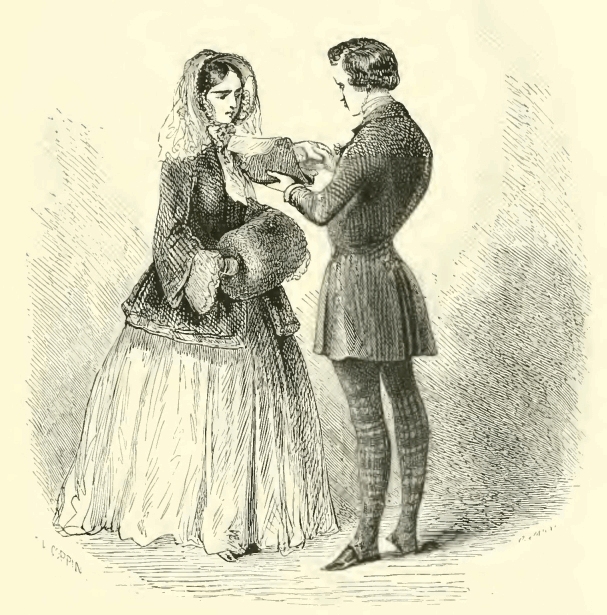
And the baroness took from her pocket a letter which she gave to
Debray. Debray paused a moment before reading, as if trying to guess
its contents, or perhaps while making up his mind how to act, whatever
it might contain. No doubt his ideas were arranged in a few minutes,
for he began reading the letter which caused so much uneasiness in the
heart of the baroness, and which ran as follows:
“‘Madame and most faithful wife.’”
Debray mechanically stopped and looked at the baroness, whose face
became covered with blushes.
“Read,” she said.
Debray continued:
“‘When you receive this, you will no longer have a husband. Oh, you
need not be alarmed, you will only have lost him as you have lost your
daughter; I mean that I shall be travelling on one of the thirty or
forty roads leading out of France. I owe you some explanations for my
conduct, and as you are a woman that can perfectly understand me, I
will give them. Listen, then. I received this morning five millions
which I paid away; almost directly afterwards another demand for the
same sum was presented to me; I put this creditor off till tomorrow and
I intend leaving today, to escape that tomorrow, which would be rather
too unpleasant for me to endure. You understand this, do you not, my
most precious wife? I say you understand this, because you are as
conversant with my affairs as I am; indeed, I think you understand them
better, since I am ignorant of what has become of a considerable
portion of my fortune, once very tolerable, while I am sure, madame,
that you know perfectly well. For women have infallible instincts; they
can even explain the marvellous by an algebraic calculation they have
invented; but I, who only understand my own figures, know nothing more
than that one day these figures deceived me. Have you admired the
rapidity of my fall? Have you been slightly dazzled at the sudden
fusion of my ingots? I confess I have seen nothing but the fire; let us
hope you have found some gold among the ashes. With this consoling
idea, I leave you, madame, and most prudent wife, without any
conscientious reproach for abandoning you; you have friends left, and
the ashes I have already mentioned, and above all the liberty I hasten
to restore to you. And here, madame, I must add another word of
explanation. So long as I hoped you were working for the good of our
house and for the fortune of our daughter, I philosophically closed my
eyes; but as you have transformed that house into a vast ruin I will
not be the foundation of another man’s fortune. You were rich when I
married you, but little respected. Excuse me for speaking so very
candidly, but as this is intended only for ourselves, I do not see why
I should weigh my words. I have augmented our fortune, and it has
continued to increase during the last fifteen years, till extraordinary
and unexpected catastrophes have suddenly overturned it,—without any
fault of mine, I can honestly declare. You, madame, have only sought to
increase your own, and I am convinced that you have succeeded. I leave
you, therefore, as I took you,—rich, but little respected. Adieu! I
also intend from this time to work on my own account. Accept my
acknowledgments for the example you have set me, and which I intend
following.
“‘Your very devoted husband,
“‘Baron Danglars.’”
The baroness had watched Debray while he read this long and painful
letter, and saw him, notwithstanding his self-control, change color
once or twice. When he had ended the perusal, he folded the letter and
resumed his pensive attitude.
“Well?” asked Madame Danglars, with an anxiety easy to be understood.
“Well, madame?” unhesitatingly repeated Debray.
“With what ideas does that letter inspire you?”
“Oh, it is simple enough, madame; it inspires me with the idea that M.
Danglars has left suspiciously.”
“Certainly; but is this all you have to say to me?”
“I do not understand you,” said Debray with freezing coldness.
“He is gone! Gone, never to return!”
“Oh, madame, do not think that!”
“I tell you he will never return. I know his character; he is
inflexible in any resolutions formed for his own interests. If he could
have made any use of me, he would have taken me with him; he leaves me
in Paris, as our separation will conduce to his benefit;—therefore he
has gone, and I am free forever,” added Madame Danglars, in the same
supplicating tone.
Debray, instead of answering, allowed her to remain in an attitude of
nervous inquiry.
“Well?” she said at length, “do you not answer me?”
“I have but one question to ask you,—what do you intend to do?”
“I was going to ask you,” replied the baroness with a beating heart.
“Ah, then, you wish to ask advice of me?”
“Yes; I do wish to ask your advice,” said Madame Danglars with anxious
expectation.
“Then if you wish to take my advice,” said the young man coldly, “I
would recommend you to travel.”
“To travel!” she murmured.
“Certainly; as M. Danglars says, you are rich, and perfectly free. In
my opinion, a withdrawal from Paris is absolutely necessary after the
double catastrophe of Mademoiselle Danglars’ broken contract and M.
Danglars’ disappearance. The world will think you abandoned and poor,
for the wife of a bankrupt would never be forgiven, were she to keep up
an appearance of opulence. You have only to remain in Paris for about a
fortnight, telling the world you are abandoned, and relating the
details of this desertion to your best friends, who will soon spread
the report. Then you can quit your house, leaving your jewels and
giving up your jointure, and everyone’s mouth will be filled with
praises of your disinterestedness. They will know you are deserted, and
think you also poor, for I alone know your real financial position, and
am quite ready to give up my accounts as an honest partner.”
The dread with which the pale and motionless baroness listened to this,
was equalled by the calm indifference with which Debray had spoken.
“Deserted?” she repeated; “ah, yes, I am, indeed, deserted! You are
right, sir, and no one can doubt my position.”
These were the only words that this proud and violently enamoured woman
could utter in response to Debray.
“But then you are rich,—very rich, indeed,” continued Debray, taking
out some papers from his pocket-book, which he spread upon the table.
Madame Danglars did not see them; she was engaged in stilling the
beatings of her heart, and restraining the tears which were ready to
gush forth. At length a sense of dignity prevailed, and if she did not
entirely master her agitation, she at least succeeded in preventing the
fall of a single tear.
“Madame,” said Debray, “it is nearly six months since we have been
associated. You furnished a principal of 100,000 francs. Our
partnership began in the month of April. In May we commenced
operations, and in the course of the month gained 450,000 francs. In
June the profit amounted to 900,000. In July we added 1,700,000
francs,—it was, you know, the month of the Spanish bonds. In August we
lost 300,000 francs at the beginning of the month, but on the 13th we
made up for it, and we now find that our accounts, reckoning from the
first day of partnership up to yesterday, when I closed them, showed a
capital of 2,400,000 francs, that is, 1,200,000 for each of us. Now,
madame,” said Debray, delivering up his accounts in the methodical
manner of a stockbroker, “there are still 80,000 francs, the interest
of this money, in my hands.”
“But,” said the baroness, “I thought you never put the money out to
interest.”
“Excuse me, madame,” said Debray coldly, “I had your permission to do
so, and I have made use of it. There are, then, 40,000 francs for your
share, besides the 100,000 you furnished me to begin with, making in
all 1,340,000 francs for your portion. Now, madame, I took the
precaution of drawing out your money the day before yesterday; it is
not long ago, you see, and I was in continual expectation of being
called on to deliver up my accounts. There is your money,—half in
bank-notes, the other half in checks payable to bearer. I say there,
for as I did not consider my house safe enough, or lawyers sufficiently
discreet, and as landed property carries evidence with it, and moreover
since you have no right to possess anything independent of your
husband, I have kept this sum, now your whole fortune, in a chest
concealed under that closet, and for greater security I myself
concealed it there.
“Now, madame,” continued Debray, first opening the closet, then the
chest;—“now, madame, here are 800 notes of 1,000 francs each,
resembling, as you see, a large book bound in iron; to this I add a
certificate in the funds of 25,000 francs; then, for the odd cash,
making I think about 110,000 francs, here is a check upon my banker,
who, not being M. Danglars, will pay you the amount, you may rest
assured.”
Madame Danglars mechanically took the check, the bond, and the heap of
bank-notes. This enormous fortune made no great appearance on the
table. Madame Danglars, with tearless eyes, but with her breast heaving
with concealed emotion, placed the bank-notes in her bag, put the
certificate and check into her pocket-book, and then, standing pale and
mute, awaited one kind word of consolation.
But she waited in vain.
“Now, madame,” said Debray, “you have a splendid fortune, an income of
about 60,000 livres a year, which is enormous for a woman who cannot
keep an establishment here for a year, at least. You will be able to
indulge all your fancies; besides, should you find your income
insufficient, you can, for the sake of the past, madame, make use of
mine; and I am ready to offer you all I possess, on loan.”
“Thank you, sir—thank you,” replied the baroness; “you forget that what
you have just paid me is much more than a poor woman requires, who
intends for some time, at least, to retire from the world.”
Debray was, for a moment, surprised, but immediately recovering
himself, he bowed with an air which seemed to say, “As you please,
madame.”
Madame Danglars had until then, perhaps, hoped for something; but when
she saw the careless bow of Debray, and the glance by which it was
accompanied, together with his significant silence, she raised her
head, and without passion or violence or even hesitation, ran
downstairs, disdaining to address a last farewell to one who could thus
part from her.
“Bah,” said Debray, when she had left, “these are fine projects! She
will remain at home, read novels, and speculate at cards, since she can
no longer do so on the Bourse.”
Then taking up his account book, he cancelled with the greatest care
all the entries of the amounts he had just paid away.
“I have 1,060,000 francs remaining,” he said. “What a pity Mademoiselle
de Villefort is dead! She suited me in every respect, and I would have
married her.”
And he calmly waited until the twenty minutes had elapsed after Madame
Danglars’ departure before he left the house. During this time he
occupied himself in making figures, with his watch by his side.
Asmodeus—that diabolical personage, who would have been created by
every fertile imagination if Le Sage had not acquired the priority in
his great masterpiece—would have enjoyed a singular spectacle, if he
had lifted up the roof of the little house in the Rue
Saint-Germain-des-Prés, while Debray was casting up his figures.
Above the room in which Debray had been dividing two millions and a
half with Madame Danglars was another, inhabited by persons who have
played too prominent a part in the incidents we have related for their
appearance not to create some interest.
Mercédès and Albert were in that room.
Mercédès was much changed within the last few days; not that even in
her days of fortune she had ever dressed with the magnificent display
which makes us no longer able to recognize a woman when she appears in
a plain and simple attire; nor indeed, had she fallen into that state
of depression where it is impossible to conceal the garb of misery; no,
the change in Mercédès was that her eye no longer sparkled, her lips no
longer smiled, and there was now a hesitation in uttering the words
which formerly sprang so fluently from her ready wit.
It was not poverty which had broken her spirit; it was not a want of
courage which rendered her poverty burdensome. Mercédès, although
deposed from the exalted position she had occupied, lost in the sphere
she had now chosen, like a person passing from a room splendidly
lighted into utter darkness, appeared like a queen, fallen from her
palace to a hovel, and who, reduced to strict necessity, could neither
become reconciled to the earthen vessels she was herself forced to
place upon the table, nor to the humble pallet which had become her
bed.
The beautiful Catalane and noble countess had lost both her proud
glance and charming smile, because she saw nothing but misery around
her; the walls were hung with one of the gray papers which economical
landlords choose as not likely to show the dirt; the floor was
uncarpeted; the furniture attracted the attention to the poor attempt
at luxury; indeed, everything offended eyes accustomed to refinement
and elegance.
Madame de Morcerf had lived there since leaving her house; the
continual silence of the spot oppressed her; still, seeing that Albert
continually watched her countenance to judge the state of her feelings,
she constrained herself to assume a monotonous smile of the lips alone,
which, contrasted with the sweet and beaming expression that usually
shone from her eyes, seemed like “moonlight on a statue,”—yielding
light without warmth.
Albert, too, was ill at ease; the remains of luxury prevented him from
sinking into his actual position. If he wished to go out without
gloves, his hands appeared too white; if he wished to walk through the
town, his boots seemed too highly polished. Yet these two noble and
intelligent creatures, united by the indissoluble ties of maternal and
filial love, had succeeded in tacitly understanding one another, and
economizing their stores, and Albert had been able to tell his mother
without extorting a change of countenance:
“Mother, we have no more money.”
Mercédès had never known misery; she had often, in her youth, spoken of
poverty, but between want and necessity, those synonymous words, there
is a wide difference.
Amongst the Catalans, Mercédès wished for a thousand things, but still
she never really wanted any. So long as the nets were good, they caught
fish; and so long as they sold their fish, they were able to buy twine
for new nets. And then, shut out from friendship, having but one
affection, which could not be mixed up with her ordinary pursuits, she
thought of herself—of no one but herself. Upon the little she earned
she lived as well as she could; now there were two to be supported, and
nothing to live upon.
Winter approached. Mercédès had no fire in that cold and naked
room—she, who was accustomed to stoves which heated the house from the
hall to the boudoir; she had not even one little flower—she whose
apartment had been a conservatory of costly exotics. But she had her
son. Hitherto the excitement of fulfilling a duty had sustained them.
Excitement, like enthusiasm, sometimes renders us unconscious to the
things of earth. But the excitement had calmed down, and they felt
themselves obliged to descend from dreams to reality; after having
exhausted the ideal, they found they must talk of the actual.
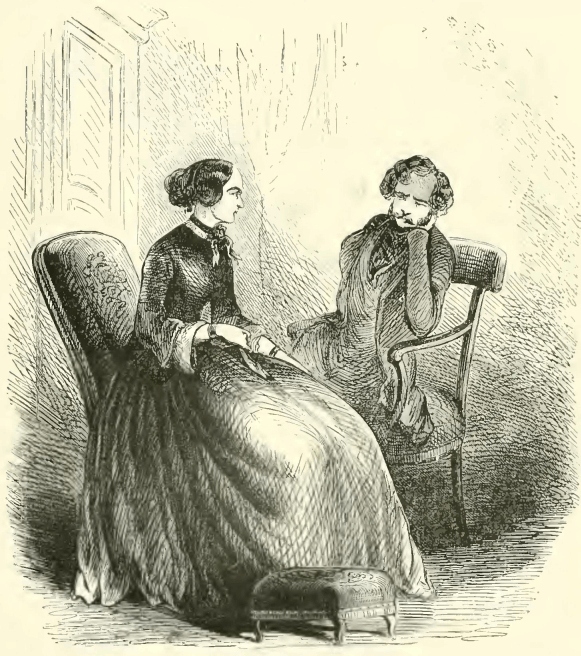
“Mother,” exclaimed Albert, just as Madame Danglars was descending the
stairs, “let us reckon our riches, if you please; I want capital to
build my plans upon.”
“Capital—nothing!” replied Mercédès with a mournful smile.
“No, mother,—capital 3,000 francs. And I have an idea of our leading a
delightful life upon this 3,000 francs.”
“Child!” sighed Mercédès.
“Alas, dear mother,” said the young man, “I have unhappily spent too
much of your money not to know the value of it. These 3,000 francs are
enormous, and I intend building upon this foundation a miraculous
certainty for the future.”
“You say this, my dear boy; but do you think we ought to accept these
3,000 francs?” said Mercédès, coloring.
“I think so,” answered Albert in a firm tone. “We will accept them the
more readily, since we have them not here; you know they are buried in
the garden of the little house in the Allées de Meilhan, at Marseilles.
With 200 francs we can reach Marseilles.”
“With 200 francs?—are you sure, Albert?”
“Oh, as for that, I have made inquiries respecting the diligences and
steamboats, and my calculations are made. You will take your place in
the coupé to Châlons. You see, mother, I treat you handsomely for
thirty-five francs.”
Albert then took a pen, and wrote:
Frs. Coupé,
thirty-five
francs........
..............
........ 35.
From Châlons
to Lyons you
will go on by
the
steamboat..
6. From Lyons
to Avignon
(still by
steamboat)....
......... 16.
From Avignon
to Marseilles,
seven
francs........
....... 7.
Expenses on
the road,
about fifty
francs........
....... 50.
Total.........
..............
..............
............
114 frs.
“Let us put down 120,” added Albert, smiling. “You see I am generous,
am I not, mother?”
“But you, my poor child?”
“I? do you not see that I reserve eighty francs for myself? A young man
does not require luxuries; besides, I know what travelling is.”
“With a post-chaise and valet de chambre?”
“Any way, mother.”
“Well, be it so. But these 200 francs?”
“Here they are, and 200 more besides. See, I have sold my watch for 100
francs, and the guard and seals for 300. How fortunate that the
ornaments were worth more than the watch. Still the same story of
superfluities! Now I think we are rich, since instead of the 114 francs
we require for the journey we find ourselves in possession of 250.”
“But we owe something in this house?”
“Thirty francs; but I pay that out of my 150 francs,—that is
understood,—and as I require only eighty francs for my journey, you see
I am overwhelmed with luxury. But that is not all. What do you say to
this, mother?”
And Albert took out of a little pocket-book with golden clasps, a
remnant of his old fancies, or perhaps a tender souvenir from one of
the mysterious and veiled ladies who used to knock at his little
door,—Albert took out of this pocket-book a note of 1,000 francs.
“What is this?” asked Mercédès.
“A thousand francs.”
“But whence have you obtained them?”
“Listen to me, mother, and do not yield too much to agitation.” And
Albert, rising, kissed his mother on both cheeks, then stood looking at
her. “You cannot imagine, mother, how beautiful I think you!” said the
young man, impressed with a profound feeling of filial love. “You are,
indeed, the most beautiful and most noble woman I ever saw!”
“Dear child!” said Mercédès, endeavoring in vain to restrain a tear
which glistened in the corner of her eye. “Indeed, you only wanted
misfortune to change my love for you to admiration. I am not unhappy
while I possess my son!”
“Ah, just so,” said Albert; “here begins the trial. Do you know the
decision we have come to, mother?”
“Have we come to any?”
“Yes; it is decided that you are to live at Marseilles, and that I am
to leave for Africa, where I will earn for myself the right to use the
name I now bear, instead of the one I have thrown aside.” Mercédès
sighed. “Well, mother, I yesterday engaged myself as substitute in the
Spahis,”25 added the young man, lowering his eyes with a certain
feeling of shame, for even he was unconscious of the sublimity of his
self-abasement. “I thought my body was my own, and that I might sell
it. I yesterday took the place of another. I sold myself for more than
I thought I was worth,” he added, attempting to smile; “I fetched 2,000
francs.”
“Then these 1,000 francs——” said Mercédès, shuddering.
“Are the half of the sum, mother; the other will be paid in a year.”
Mercédès raised her eyes to heaven with an expression it would be
impossible to describe, and tears, which had hitherto been restrained,
now yielded to her emotion, and ran down her cheeks.
“The price of his blood!” she murmured.
“Yes, if I am killed,” said Albert, laughing. “But I assure you,
mother, I have a strong intention of defending my person, and I never
felt half so strong an inclination to live as I do now.”
“Merciful Heavens!”
“Besides, mother, why should you make up your mind that I am to be
killed? Has Lamoricière, that Ney of the South, been killed? Has
Changarnier been killed? Has Bedeau been killed? Has Morrel, whom we
know, been killed? Think of your joy, mother, when you see me return
with an embroidered uniform! I declare, I expect to look magnificent in
it, and chose that regiment only from vanity.”
Mercédès sighed while endeavoring to smile; the devoted mother felt
that she ought not to allow the whole weight of the sacrifice to fall
upon her son.
“Well, now you understand, mother!” continued Albert; “here are more
than 4,000 francs settled on you; upon these you can live at least two
years.”
“Do you think so?” said Mercédès.
These words were uttered in so mournful a tone that their real meaning
did not escape Albert; he felt his heart beat, and taking his mother’s
hand within his own he said, tenderly:
“Yes, you will live!”
“I shall live!—then you will not leave me, Albert?”
“Mother, I must go,” said Albert in a firm, calm voice; “you love me
too well to wish me to remain useless and idle with you; besides, I
have signed.”
“You will obey your own wish and the will of Heaven!”
“Not my own wish, mother, but reason—necessity. Are we not two
despairing creatures? What is life to you?—Nothing. What is life to
me?—Very little without you, mother; for believe me, but for you I
should have ceased to live on the day I doubted my father and renounced
his name. Well, I will live, if you promise me still to hope; and if
you grant me the care of your future prospects, you will redouble my
strength. Then I will go to the governor of Algeria; he has a royal
heart, and is essentially a soldier; I will tell him my gloomy story. I
will beg him to turn his eyes now and then towards me, and if he keep
his word and interest himself for me, in six months I shall be an
officer, or dead. If I am an officer, your fortune is certain, for I
shall have money enough for both, and, moreover, a name we shall both
be proud of, since it will be our own. If I am killed—well then mother,
you can also die, and there will be an end of our misfortunes.”
“It is well,” replied Mercédès, with her eloquent glance; “you are
right, my love; let us prove to those who are watching our actions that
we are worthy of compassion.”
“But let us not yield to gloomy apprehensions,” said the young man; “I
assure you we are, or rather we shall be, very happy. You are a woman
at once full of spirit and resignation; I have become simple in my
tastes, and am without passion, I hope. Once in service, I shall be
rich—once in M. Dantès’ house, you will be at rest. Let us strive, I
beseech you,—let us strive to be cheerful.”
“Yes, let us strive, for you ought to live, and to be happy, Albert.”
“And so our division is made, mother,” said the young man, affecting
ease of mind. “We can now part; come, I shall engage your passage.”
“And you, my dear boy?”
“I shall stay here for a few days longer; we must accustom ourselves to
parting. I want recommendations and some information relative to
Africa. I will join you again at Marseilles.”
“Well, be it so—let us part,” said Mercédès, folding around her
shoulders the only shawl she had taken away, and which accidentally
happened to be a valuable black cashmere. Albert gathered up his papers
hastily, rang the bell to pay the thirty francs he owed to the
landlord, and offering his arm to his mother, they descended the
stairs.
Someone was walking down before them, and this person, hearing the
rustling of a silk dress, turned around. “Debray!” muttered Albert.
“You, Morcerf?” replied the secretary, resting on the stairs. Curiosity
had vanquished the desire of preserving his incognito, and he was
recognized. It was, indeed, strange in this unknown spot to find the
young man whose misfortunes had made so much noise in Paris.
“Morcerf!” repeated Debray. Then noticing in the dim light the still
youthful and veiled figure of Madame de Morcerf:
“Pardon me,” he added with a smile, “I leave you, Albert.” Albert
understood his thoughts.
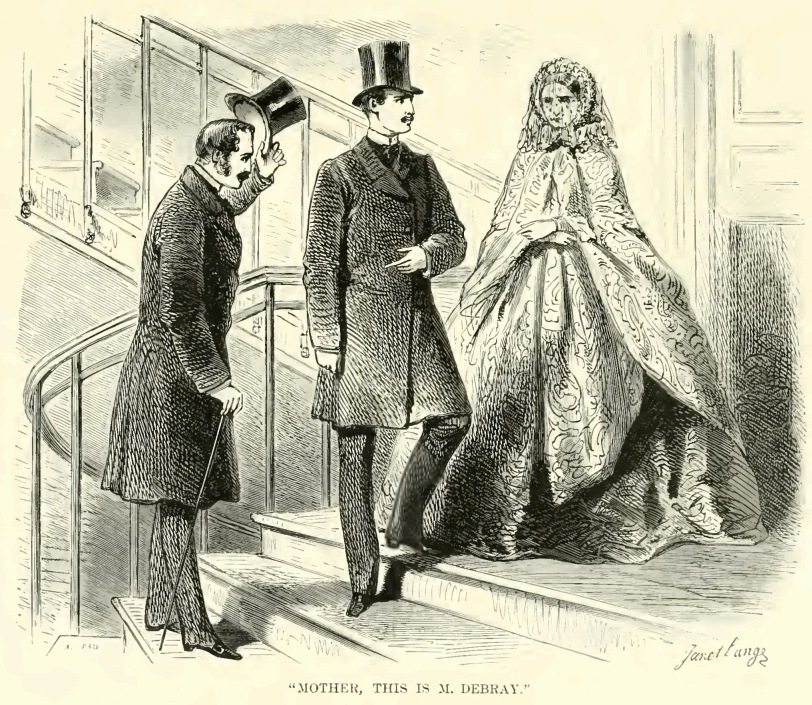
“Mother,” he said, turning towards Mercédès, “this is M. Debray,
secretary of the Minister for the Interior, once a friend of mine.”
“How once?” stammered Debray; “what do you mean?”
“I say so, M. Debray, because I have no friends now, and I ought not to
have any. I thank you for having recognized me, sir.” Debray stepped
forward, and cordially pressed the hand of his interlocutor.
“Believe me, dear Albert,” he said, with all the emotion he was capable
of feeling,—“believe me, I feel deeply for your misfortunes, and if in
any way I can serve you, I am yours.”
“Thank you, sir,” said Albert, smiling. “In the midst of our
misfortunes, we are still rich enough not to require assistance from
anyone. We are leaving Paris, and when our journey is paid, we shall
have 5,000 francs left.”
The blood mounted to the temples of Debray, who held a million in his
pocket-book, and unimaginative as he was he could not help reflecting
that the same house had contained two women, one of whom, justly
dishonored, had left it poor with 1,500,000 francs under her cloak,
while the other, unjustly stricken, but sublime in her misfortune, was
yet rich with a few deniers. This parallel disturbed his usual
politeness, the philosophy he witnessed appalled him, he muttered a few
words of general civility and ran downstairs.
That day the minister’s clerks and the subordinates had a great deal to
put up with from his ill-humor. But that same night, he found himself
the possessor of a fine house, situated on the Boulevard de la
Madeleine, and an income of 50,000 livres.
The next day, just as Debray was signing the deed, that is about five
o’clock in the afternoon, Madame de Morcerf, after having
affectionately embraced her son, entered the coupé of the diligence,
which closed upon her.
A man was hidden in Lafitte’s banking-house, behind one of the little
arched windows which are placed above each desk; he saw Mercédès enter
the diligence, and he also saw Albert withdraw. Then he passed his hand
across his forehead, which was clouded with doubt.
“Alas,” he exclaimed, “how can I restore the happiness I have taken
away from these poor innocent creatures? God help me!”