LXXXI. La chambre du boulanger retiré
LXXXI. The Retired Baker's Room
Continued from the previous installment.
“Well,” pursued Caderousse, “can you without expending one sou, put me in the way of getting fifteen thousand francs? No, fifteen thousand are not enough,—I cannot again become an honest man with less than thirty thousand francs.”
“No,” replied Andrea, dryly, “no, I cannot.”
“I do not think you understand me,” replied Caderousse, calmly; “I said without your laying out a sou.”
“Do you want me to commit a robbery, to spoil all my good fortune—and yours with mine—and both of us to be dragged down there again?”
“It would make very little difference to me,” said Caderousse, “if I were retaken, I am a poor creature to live alone, and sometimes pine for my old comrades; not like you, heartless creature, who would be glad never to see them again.”
Andrea did more than tremble this time, he turned pale.
“Come, Caderousse, no nonsense!” said he.
“Don’t alarm yourself, my little Benedetto, but just point out to me some means of gaining those thirty thousand francs without your assistance, and I will contrive it.”
“Well, I’ll see—I’ll try to contrive some way,” said Andrea.
“Meanwhile you will raise my monthly allowance to five hundred francs, my little fellow? I have a fancy, and mean to get a housekeeper.”
“Well, you shall have your five hundred francs,” said Andrea; “but it is very hard for me, my poor Caderousse—you take advantage——”
“Bah,” said Caderousse, “when you have access to countless stores.”
One would have said Andrea anticipated his companion’s words, so did his eye flash like lightning, but it was but for a moment.
“True,” he replied, “and my protector is very kind.”
“That dear protector,” said Caderousse; “and how much does he give you monthly?”
“Five thousand francs.”
“As many thousands as you give me hundreds! Truly, it is only bastards who are thus fortunate. Five thousand francs per month! What the devil can you do with all that?”
“Oh, it is no trouble to spend that; and I am like you, I want capital.”
“Capital?—yes—I understand—everyone would like capital.”
“Well, and I shall get it.”
“Who will give it to you—your prince?”
“Yes, my prince. But unfortunately I must wait.”
“You must wait for what?” asked Caderousse.
“For his death.”
“The death of your prince?”
“Yes.”
“How so?”
“Because he has made his will in my favor.”
“Indeed?”
“On my honor.”
“For how much?”
“For five hundred thousand.”
“Only that? It’s little enough.”
“But so it is.”
“No, it cannot be!”
“Are you my friend, Caderousse?”
“Yes, in life or death.”
“Well, I will tell you a secret.”
“What is it?”
“But remember——”
“Ah! pardieu! mute as a carp.”
“Well, I think——”
Andrea stopped and looked around.
“You think? Do not fear; pardieu! we are alone.”
“I think I have discovered my father.”
“Your true father?”
“Yes.”
“Not old Cavalcanti?”
“No, for he has gone again; the true one, as you say.”
“And that father is——”
“Well, Caderousse, it is Monte Cristo.”
“Bah!”
“Yes, you understand, that explains all. He cannot acknowledge me openly, it appears, but he does it through M. Cavalcanti, and gives him fifty thousand francs for it.”
“Fifty thousand francs for being your father? I would have done it for half that, for twenty thousand, for fifteen thousand; why did you not think of me, ungrateful man?”
“Did I know anything about it, when it was all done when I was down there?”
“Ah, truly? And you say that by his will——”
“He leaves me five hundred thousand livres.”
“Are you sure of it?”
“He showed it me; but that is not all—there is a codicil, as I said just now.”
“Probably.”
“And in that codicil he acknowledges me.”
“Oh, the good father, the brave father, the very honest father!” said Caderousse, twirling a plate in the air between his two hands.
“Now, say if I conceal anything from you?”
“No, and your confidence makes you honorable in my opinion; and your princely father, is he rich, very rich?”
“Yes, he is that; he does not himself know the amount of his fortune.”
“Is it possible?”
“It is evident enough to me, who am always at his house. The other day a banker’s clerk brought him fifty thousand francs in a portfolio about the size of your plate; yesterday his banker brought him a hundred thousand francs in gold.”
Caderousse was filled with wonder; the young man’s words sounded to him like metal, and he thought he could hear the rushing of cascades of louis.
“And you go into that house?” cried he briskly.
“When I like.”
Caderousse was thoughtful for a moment. It was easy to perceive he was revolving some unfortunate idea in his mind. Then suddenly,—
“How I should like to see all that,” cried he; “how beautiful it must be!”
“It is, in fact, magnificent,” said Andrea.
“And does he not live in the Champs-Élysées?”
“Yes, No. 30.”
“Ah,” said Caderousse, “No. 30.”
“Yes, a fine house standing alone, between a courtyard and a garden,—you must know it.”
“Possibly; but it is not the exterior I care for, it is the interior. What beautiful furniture there must be in it!”
“Have you ever seen the Tuileries?”
“No.”
“Well, it surpasses that.”
“It must be worth one’s while to stoop, Andrea, when that good M. Monte Cristo lets fall his purse.”
“It is not worthwhile to wait for that,” said Andrea; “money is as plentiful in that house as fruit in an orchard.”
“But you should take me there one day with you.”
“How can I? On what plea?”
“You are right; but you have made my mouth water. I must absolutely see it; I shall find a way.”
“No nonsense, Caderousse!”
“I will offer myself as floor-polisher.”
“The rooms are all carpeted.”
“Well, then, I must be contented to imagine it.”
“That is the best plan, believe me.”
“Try, at least, to give me an idea of what it is.”
“How can I?”
“Nothing is easier. Is it large?”
“Middling.”
“How is it arranged?”
“Faith, I should require pen, ink, and paper to make a plan.”
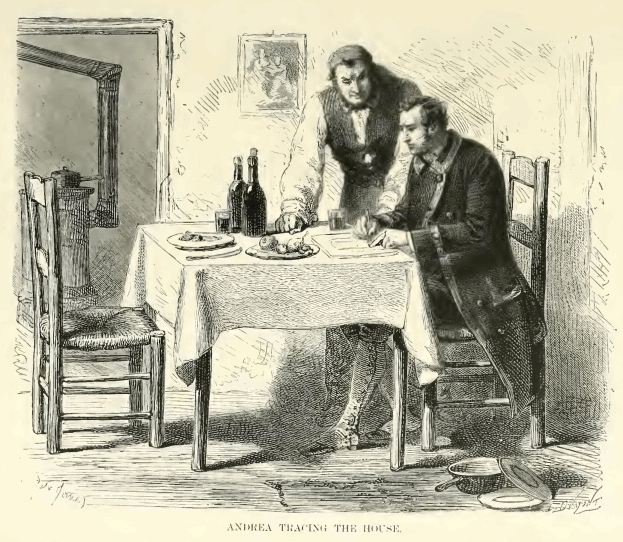
“They are all here,” said Caderousse, briskly. He fetched from an old secretaire a sheet of white paper and pen and ink. “Here,” said Caderousse, “draw me all that on the paper, my boy.”
Andrea took the pen with an imperceptible smile and began.
“The house, as I said, is between the court and the garden; in this way, do you see?” Andrea drew the garden, the court and the house.
“High walls?”
“Not more than eight or ten feet.”
“That is not prudent,” said Caderousse.
“In the court are orange-trees in pots, turf, and clumps of flowers.”
“And no steel-traps?”
“No.”
“The stables?”
“Are on either side of the gate, which you see there.” And Andrea continued his plan.
“Let us see the ground floor,” said Caderousse.
“On the ground floor, dining-room, two drawing-rooms, billiard-room, staircase in the hall, and a little back staircase.”
“Windows?”
“Magnificent windows, so beautiful, so large, that I believe a man of your size should pass through each frame.”
“Why the devil have they any stairs with such windows?”
“Luxury has everything.”
“But shutters?”
“Yes, but they are never used. That Count of Monte Cristo is an original, who loves to look at the sky even at night.”
“And where do the servants sleep?”
“Oh, they have a house to themselves. Picture to yourself a pretty coach-house at the right-hand side where the ladders are kept. Well, over that coach-house are the servants’ rooms, with bells corresponding with the different apartments.”
“Ah, diable! bells did you say?”
“What do you mean?”
“Oh, nothing! I only say they cost a load of money to hang, and what is the use of them, I should like to know?”
“There used to be a dog let loose in the yard at night, but it has been taken to the house at Auteuil, to that you went to, you know.”
“Yes.”
“I was saying to him only yesterday, ‘You are imprudent, Monsieur Count; for when you go to Auteuil and take your servants the house is left unprotected.’ ‘Well,’ said he, ‘what next?’ ‘Well, next, some day you will be robbed.’”
“What did he answer?”
“He quietly said, ‘What do I care if I am?’”
“Andrea, he has some secretaire with a spring.”
“How do you know?”
“Yes, which catches the thief in a trap and plays a tune. I was told there were such at the last exhibition.”
“He has simply a mahogany secretaire, in which the key is always kept.”
“And he is not robbed?”
“No; his servants are all devoted to him.”
“There ought to be some money in that secretaire?”
“There may be. No one knows what there is.”
“And where is it?”
“On the first floor.”
“Sketch me the plan of that floor, as you have done of the ground floor, my boy.”
“That is very simple.” Andrea took the pen. “On the first story, do you see, there is the anteroom and the drawing-room; to the right of the drawing-room, a library and a study; to the left, a bedroom and a dressing-room. The famous secretaire is in the dressing-room.”
“Is there a window in the dressing-room?”
“Two,—one here and one there.” Andrea sketched two windows in the room, which formed an angle on the plan, and appeared as a small square added to the rectangle of the bedroom. Caderousse became thoughtful.
“Does he often go to Auteuil?” added he.
“Two or three times a week. Tomorrow, for instance, he is going to spend the day and night there.”
“Are you sure of it?”
“He has invited me to dine there.”
“There’s a life for you,” said Caderousse; “a town house and a country house.”
“That is what it is to be rich.”
“And shall you dine there?”
“Probably.”
“When you dine there, do you sleep there?”
“If I like; I am at home there.”
Caderousse looked at the young man, as if to get at the truth from the bottom of his heart. But Andrea drew a cigar-case from his pocket, took a Havana, quietly lit it, and began smoking.
“When do you want your twelve hundred francs?” said he to Caderousse.
“Now, if you have them.” Andrea took five-and-twenty louis from his pocket.
“Yellow boys?” said Caderousse; “no, I thank you.”
“Oh, you despise them.”
“On the contrary, I esteem them, but will not have them.”
“You can change them, idiot; gold is worth five sous.”
“Exactly; and he who changes them will follow friend Caderousse, lay hands on him, and demand what farmers pay him their rent in gold. No nonsense, my good fellow; silver simply, round coins with the head of some monarch or other on them. Anybody may possess a five-franc piece.”
“But do you suppose I carry five hundred francs about with me? I should want a porter.”
“Well, leave them with your porter; he is to be trusted. I will call for them.”
“Today?”
“No, tomorrow; I shall not have time today.”
“Well, tomorrow I will leave them when I go to Auteuil.”
“May I depend on it?”
“Certainly.”
“Because I shall secure my housekeeper on the strength of it.”
“Now see here, will that be all? Eh? And will you not torment me any more?”
“Never.”
Caderousse had become so gloomy that Andrea feared he should be obliged to notice the change. He redoubled his gayety and carelessness.
“How sprightly you are,” said Caderousse; “One would say you were already in possession of your property.”
“No, unfortunately; but when I do obtain it——”
“Well?”
“I shall remember old friends, I can tell you that.”
“Yes, since you have such a good memory.”
“What do you want? It looks as if you were trying to fleece me?”
“I? What an idea! I, who am going to give you another piece of good advice.”
“What is it?”
“To leave behind you the diamond you have on your finger. We shall both get into trouble. You will ruin both yourself and me by your folly.”
“How so?” said Andrea.
“How? You put on a livery, you disguise yourself as a servant, and yet keep a diamond on your finger worth four or five thousand francs.”
“You guess well.”
“I know something of diamonds; I have had some.”
“You do well to boast of it,” said Andrea, who, without becoming angry, as Caderousse feared, at this new extortion, quietly resigned the ring. Caderousse looked so closely at it that Andrea well knew that he was examining to see if all the edges were perfect.
“It is a false diamond,” said Caderousse.
“You are joking now,” replied Andrea.
“Do not be angry, we can try it.” Caderousse went to the window, touched the glass with it, and found it would cut.
“Confiteor!” said Caderousse, putting the diamond on his little finger; “I was mistaken; but those thieves of jewellers imitate so well that it is no longer worthwhile to rob a jeweller’s shop—it is another branch of industry paralyzed.”
“Have you finished?” said Andrea,—“do you want anything more?—will you have my waistcoat or my hat? Make free, now you have begun.”
“No; you are, after all, a good companion; I will not detain you, and will try to cure myself of my ambition.”
“But take care the same thing does not happen to you in selling the diamond you feared with the gold.”
“I shall not sell it—do not fear.”
“Not at least till the day after tomorrow,” thought the young man.
“Happy rogue,” said Caderousse; “you are going to find your servants, your horses, your carriage, and your betrothed!”
“Yes,” said Andrea.
“Well, I hope you will make a handsome wedding-present the day you marry Mademoiselle Danglars.”
“I have already told you it is a fancy you have taken in your head.”
“What fortune has she?”
“But I tell you——”
“A million?”
Andrea shrugged his shoulders.
“Let it be a million,” said Caderousse; “you can never have so much as I wish you.”
“Thank you,” said the young man.
“Oh, I wish it you with all my heart!” added Caderousse with his hoarse laugh. “Stop, let me show you the way.”
“It is not worthwhile.”
“Yes, it is.”
“Why?”
“Because there is a little secret, a precaution I thought it desirable to take, one of Huret & Fichet’s locks, revised and improved by Gaspard Caderousse; I will manufacture you a similar one when you are a capitalist.”
“Thank you,” said Andrea; “I will let you know a week beforehand.”
They parted. Caderousse remained on the landing until he had not only seen Andrea go down the three stories, but also cross the court. Then he returned hastily, shut his door carefully, and began to study, like a clever architect, the plan Andrea had left him.
“Dear Benedetto,” said he, “I think he will not be sorry to inherit his fortune, and he who hastens the day when he can touch his five hundred thousand will not be his worst friend.”