XLVI. Le crédit illimité
XLVI. Unlimited Credit
Continued from the previous installment.
As the hand of the clock pointed to five the count struck thrice upon his gong. When Ali was wanted one stroke was given, two summoned Baptistin, and three Bertuccio. The steward entered.
“My horses,” said Monte Cristo.
“They are at the door harnessed to the carriage as your excellency desired. Does your excellency wish me to accompany him?”
“No, the coachman, Ali, and Baptistin will go.”
The count descended to the door of his mansion, and beheld his carriage drawn by the very pair of horses he had so much admired in the morning as the property of Danglars. As he passed them he said:
“They are extremely handsome certainly, and you have done well to purchase them, although you were somewhat remiss not to have procured them sooner.”
“Indeed, your excellency, I had very considerable difficulty in obtaining them, and, as it is, they have cost an enormous price.”
“Does the sum you gave for them make the animals less beautiful,” inquired the count, shrugging his shoulders.
“Nay, if your excellency is satisfied, it is all that I could wish. Whither does your excellency desire to be driven?”
“To the residence of Baron Danglars, Rue de la Chaussée d’Antin.”
This conversation had passed as they stood upon the terrace, from which a flight of stone steps led to the carriage-drive. As Bertuccio, with a respectful bow, was moving away, the count called him back.
“I have another commission for you, M. Bertuccio,” said he; “I am desirous of having an estate by the seaside in Normandy—for instance, between Le Havre and Boulogne. You see I give you a wide range. It will be absolutely necessary that the place you may select have a small harbor, creek, or bay, into which my corvette can enter and remain at anchor. She draws only fifteen feet. She must be kept in constant readiness to sail immediately I think proper to give the signal. Make the requisite inquiries for a place of this description, and when you have met with an eligible spot, visit it, and if it possess the advantages desired, purchase it at once in your own name. The corvette must now, I think, be on her way to Fécamp, must she not?”
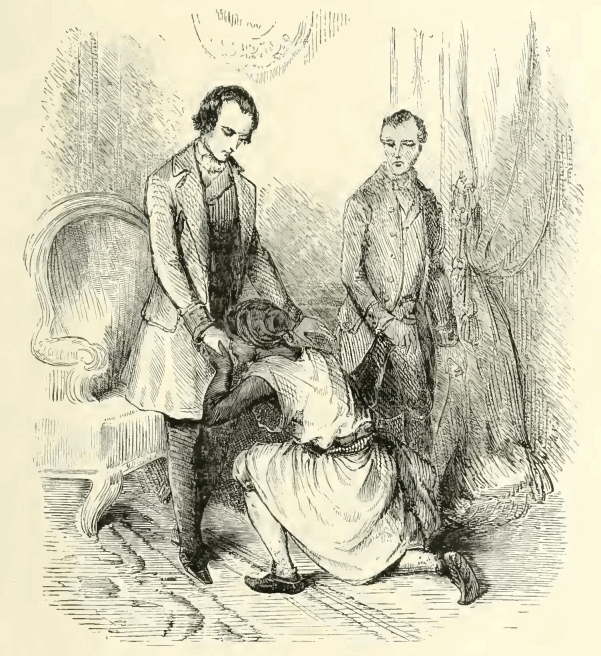
“Certainly, your excellency; I saw her put to sea the same evening we quitted Marseilles.”
“And the yacht.”
“Was ordered to remain at Martigues.”
“’Tis well. I wish you to write from time to time to the captains in charge of the two vessels so as to keep them on the alert.”
“And the steamboat?”
“She is at Châlons?”
“Yes.”
“The same orders for her as for the two sailing vessels.”
“Very good.”
“When you have purchased the estate I desire, I want constant relays of horses at ten leagues apart along the northern and southern road.”
“Your excellency may depend upon me.”
The Count made a gesture of satisfaction, descended the terrace steps, and sprang into his carriage, which was whirled along swiftly to the banker’s house.
Danglars was engaged at that moment, presiding over a railroad committee. But the meeting was nearly concluded when the name of his visitor was announced. As the count’s title sounded on his ear he rose, and addressing his colleagues, who were members of one or the other Chamber, he said:
“Gentlemen, pardon me for leaving you so abruptly; but a most ridiculous circumstance has occurred, which is this,—Thomson & French, the Roman bankers, have sent to me a certain person calling himself the Count of Monte Cristo, and have given him an unlimited credit with me. I confess this is the drollest thing I have ever met with in the course of my extensive foreign transactions, and you may readily suppose it has greatly roused my curiosity. I took the trouble this morning to call on the pretended count—if he were a real count he wouldn’t be so rich. But, would you believe it, ‘He was not receiving.’ So the master of Monte Cristo gives himself airs befitting a great millionaire or a capricious beauty. I made inquiries, and found that the house in the Champs-Élysées is his own property, and certainly it was very decently kept up. But,” pursued Danglars with one of his sinister smiles, “an order for unlimited credit calls for something like caution on the part of the banker to whom that order is given. I am very anxious to see this man. I suspect a hoax is intended, but the instigators of it little knew whom they had to deal with. ‘They laugh best who laugh last!’”
Having delivered himself of this pompous address, uttered with a degree of energy that left the baron almost out of breath, he bowed to the assembled party and withdrew to his drawing-room, whose sumptuous furnishings of white and gold had caused a great sensation in the Chaussée d’Antin. It was to this apartment he had desired his guest to be shown, with the purpose of overwhelming him at the sight of so much luxury. He found the count standing before some copies of Albano and Fattore that had been passed off to the banker as originals; but which, mere copies as they were, seemed to feel their degradation in being brought into juxtaposition with the gaudy colors that covered the ceiling.
The count turned round as he heard the entrance of Danglars into the room. With a slight inclination of the head, Danglars signed to the count to be seated, pointing significantly to a gilded armchair, covered with white satin embroidered with gold. The count sat down.
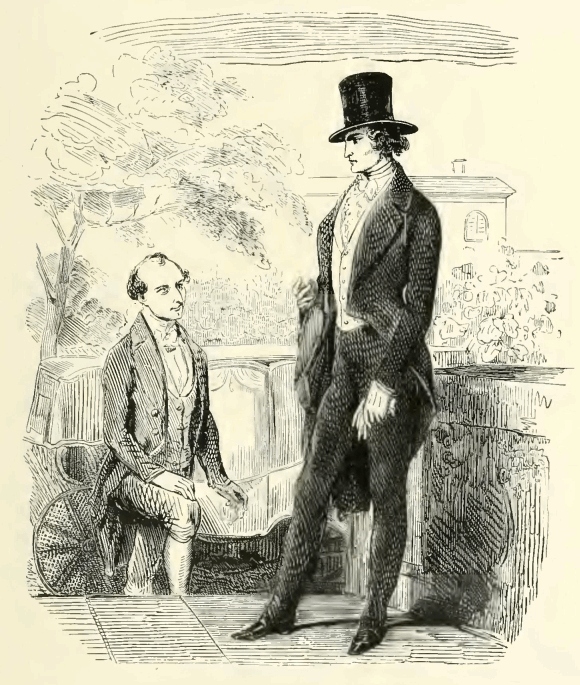
“I have the honor, I presume, of addressing M. de Monte Cristo.”
The count bowed.
“And I of speaking to Baron Danglars, chevalier of the Legion of Honor, and member of the Chamber of Deputies?”
Monte Cristo repeated all the titles he had read on the baron’s card.
Danglars felt the irony and compressed his lips.
“You will, I trust, excuse me, monsieur, for not calling you by your title when I first addressed you,” he said, “but you are aware that we are living under a popular form of government, and that I am myself a representative of the liberties of the people.”
“So much so,” replied Monte Cristo, “that while you call yourself baron you are not willing to call anybody else count.”
“Upon my word, monsieur,” said Danglars with affected carelessness, “I attach no sort of value to such empty distinctions; but the fact is, I was made baron, and also chevalier of the Legion of Honor, in return for services rendered, but——”
“But you have discarded your titles after the example set you by Messrs. de Montmorency and Lafayette? That was a noble example to follow, monsieur.”
“Why,” replied Danglars, “not entirely so; with the servants,—you understand.”
“I see; to your domestics you are ‘my lord,’ the journalists style you ‘monsieur,’ while your constituents call you ‘citizen.’ These are distinctions very suitable under a constitutional government. I understand perfectly.”
Again Danglars bit his lips; he saw that he was no match for Monte Cristo in an argument of this sort, and he therefore hastened to turn to subjects more congenial.
“Permit me to inform you, Count,” said he, bowing, “that I have received a letter of advice from Thomson & French, of Rome.”
“I am glad to hear it, baron,—for I must claim the privilege of addressing you after the manner of your servants. I have acquired the bad habit of calling persons by their titles from living in a country where barons are still barons by right of birth. But as regards the letter of advice, I am charmed to find that it has reached you; that will spare me the troublesome and disagreeable task of coming to you for money myself. You have received a regular letter of advice?”
“Yes,” said Danglars, “but I confess I didn’t quite comprehend its meaning.”
“Indeed?”
“And for that reason I did myself the honor of calling upon you, in order to beg for an explanation.”
“Go on, monsieur. Here I am, ready to give you any explanation you desire.”
“Why,” said Danglars, “in the letter—I believe I have it about me”—here he felt in his breast-pocket—“yes, here it is. Well, this letter gives the Count of Monte Cristo unlimited credit on our house.”
“Well, baron, what is there difficult to understand about that?”
“Merely the term unlimited—nothing else, certainly.”
“Is not that word known in France? The people who wrote are Anglo-Germans, you know.”
“Oh, as for the composition of the letter, there is nothing to be said; but as regards the competency of the document, I certainly have doubts.”
“Is it possible?” asked the count, assuming all air and tone of the utmost simplicity and candor. “Is it possible that Thomson & French are not looked upon as safe and solvent bankers? Pray tell me what you think, baron, for I feel uneasy, I can assure you, having some considerable property in their hands.”
“Thomson & French are perfectly solvent,” replied Danglars, with an almost mocking smile; “but the word unlimited, in financial affairs, is so extremely vague.”
“Is, in fact, unlimited,” said Monte Cristo.
“Precisely what I was about to say,” cried Danglars. “Now what is vague is doubtful; and it was a wise man who said, ‘when in doubt, keep out.’”
“Meaning to say,” rejoined Monte Cristo, “that however Thomson & French may be inclined to commit acts of imprudence and folly, the Baron Danglars is not disposed to follow their example.”
“Not at all.”
“Plainly enough; Messrs. Thomson & French set no bounds to their engagements while those of M. Danglars have their limits; he is a wise man, according to his own showing.”
“Monsieur,” replied the banker, drawing himself up with a haughty air, “the extent of my resources has never yet been questioned.”
“It seems, then, reserved for me,” said Monte Cristo coldly, “to be the first to do so.”
“By what right, sir?”
“By right of the objections you have raised, and the explanations you have demanded, which certainly must have some motive.”
Once more Danglars bit his lips. It was the second time he had been worsted, and this time on his own ground. His forced politeness sat awkwardly upon him, and approached almost to impertinence. Monte Cristo on the contrary, preserved a graceful suavity of demeanor, aided by a certain degree of simplicity he could assume at pleasure, and thus possessed the advantage.
“Well, sir,” resumed Danglars, after a brief silence, “I will endeavor to make myself understood, by requesting you to inform me for what sum you propose to draw upon me?”
“Why, truly,” replied Monte Cristo, determined not to lose an inch of the ground he had gained, “my reason for desiring an ‘unlimited’ credit was precisely because I did not know how much money I might need.”
The banker thought the time had come for him to take the upper hand. So throwing himself back in his armchair, he said, with an arrogant and purse-proud air:
“Let me beg of you not to hesitate in naming your wishes; you will then be convinced that the resources of the house of Danglars, however limited, are still equal to meeting the largest demands; and were you even to require a million——”
“I beg your pardon,” interposed Monte Cristo.
“I said a million,” replied Danglars, with the confidence of ignorance.
“But could I do with a million?” retorted the count. “My dear sir, if a trifle like that could suffice me, I should never have given myself the trouble of opening an account. A million? Excuse my smiling when you speak of a sum I am in the habit of carrying in my pocket-book or dressing-case.”
And with these words Monte Cristo took from his pocket a small case containing his visiting-cards, and drew forth two orders on the treasury for 500,000 francs each, payable at sight to the bearer. A man like Danglars was wholly inaccessible to any gentler method of correction. The effect of the present revelation was stunning; he trembled and was on the verge of apoplexy. The pupils of his eyes, as he gazed at Monte Cristo dilated horribly.
“Come, come,” said Monte Cristo, “confess honestly that you have not perfect confidence in Thomson & French. I understand, and foreseeing that such might be the case, I took, in spite of my ignorance of affairs, certain precautions. See, here are two similar letters to that you have yourself received; one from the house of Arstein & Eskeles of Vienna, to Baron Rothschild, the other drawn by Baring of London, upon M. Lafitte. Now, sir, you have but to say the word, and I will spare you all uneasiness by presenting my letter of credit to one or other of these two firms.”
The blow had struck home, and Danglars was entirely vanquished; with a trembling hand he took the two letters from the count, who held them carelessly between finger and thumb, and proceeded to scrutinize the signatures, with a minuteness that the count might have regarded as insulting, had it not suited his present purpose to mislead the banker.
“Oh, sir,” said Danglars, after he had convinced himself of the authenticity of the documents he held, and rising as if to salute the power of gold personified in the man before him,—“three letters of unlimited credit! I can be no longer mistrustful, but you must pardon me, my dear count, for confessing to some degree of astonishment.”
“Nay,” answered Monte Cristo, with the most gentlemanly air, “’tis not for such trifling sums as these that your banking house is to be incommoded. Then, you can let me have some money, can you not?”
“Whatever you say, my dear count; I am at your orders.”
“Why,” replied Monte Cristo, “since we mutually understand each other—for such I presume is the case?” Danglars bowed assentingly. “You are quite sure that not a lurking doubt or suspicion lingers in your mind?”
“Oh, my dear count,” exclaimed Danglars, “I never for an instant entertained such a feeling towards you.”
“No, you merely wished to be convinced, nothing more; but now that we have come to so clear an understanding, and that all distrust and suspicion are laid at rest, we may as well fix a sum as the probable expenditure of the first year, suppose we say six millions to——”
“Six millions!” gasped Danglars—“so be it.”
“Then, if I should require more,” continued Monte Cristo in a careless manner, “why, of course, I should draw upon you; but my present intention is not to remain in France more than a year, and during that period I scarcely think I shall exceed the sum I mentioned. However, we shall see. Be kind enough, then, to send me 500,000 francs tomorrow. I shall be at home till midday, or if not, I will leave a receipt with my steward.”
“The money you desire shall be at your house by ten o’clock tomorrow morning, my dear count,” replied Danglars. “How would you like to have it? in gold, silver, or notes?”
“Half in gold, and the other half in bank-notes, if you please,” said the count, rising from his seat.
“I must confess to you, count,” said Danglars, “that I have hitherto imagined myself acquainted with the degree of all the great fortunes of Europe, and still wealth such as yours has been wholly unknown to me. May I presume to ask whether you have long possessed it?”
“It has been in the family a very long while,” returned Monte Cristo, “a sort of treasure expressly forbidden to be touched for a certain period of years, during which the accumulated interest has doubled the capital. The period appointed by the testator for the disposal of these riches occurred only a short time ago, and they have only been employed by me within the last few years. Your ignorance on the subject, therefore, is easily accounted for. However, you will be better informed as to me and my possessions ere long.”
And the count, while pronouncing these latter words, accompanied them with one of those ghastly smiles that used to strike terror into poor Franz d’Épinay.
“With your tastes, and means of gratifying them,” continued Danglars, “you will exhibit a splendor that must effectually put us poor miserable millionaires quite in the shade. If I mistake not you are an admirer of paintings, at least I judged so from the attention you appeared to be bestowing on mine when I entered the room. If you will permit me, I shall be happy to show you my picture gallery, composed entirely of works by the ancient masters—warranted as such. Not a modern picture among them. I cannot endure the modern school of painting.”
“You are perfectly right in objecting to them, for this one great fault—that they have not yet had time to become old.”
“Or will you allow me to show you several fine statues by Thorwaldsen, Bartoloni, and Canova?—all foreign artists, for, as you may perceive, I think but very indifferently of our French sculptors.”
“You have a right to be unjust to them, monsieur; they are your compatriots.”
“But all this may come later, when we shall be better known to each other. For the present, I will confine myself (if perfectly agreeable to you) to introducing you to the Baroness Danglars—excuse my impatience, my dear count, but a client like you is almost like a member of the family.”
Monte Cristo bowed, in sign that he accepted the proffered honor; Danglars rang and was answered by a servant in a showy livery.
“Is the baroness at home?” inquired Danglars.
“Yes, my lord,” answered the man.
“And alone?”
“No, my lord, madame has visitors.”
“Have you any objection to meet any persons who may be with madame, or do you desire to preserve a strict incognito?”
“No, indeed,” replied Monte Cristo with a smile, “I do not arrogate to myself the right of so doing.”
“And who is with madame?—M. Debray?” inquired Danglars, with an air of indulgence and good-nature that made Monte Cristo smile, acquainted as he was with the secrets of the banker’s domestic life.
“Yes, my lord,” replied the servant, “M. Debray is with madame.”
Danglars nodded his head; then, turning to Monte Cristo, said, “M. Lucien Debray is an old friend of ours, and private secretary to the Minister of the Interior. As for my wife, I must tell you, she lowered herself by marrying me, for she belongs to one of the most ancient families in France. Her maiden name was De Servières, and her first husband was Colonel the Marquis of Nargonne.”
“I have not the honor of knowing Madame Danglars; but I have already met M. Lucien Debray.”
“Ah, indeed?” said Danglars; “and where was that?”
“At the house of M. de Morcerf.”
“Ah! you are acquainted with the young viscount, are you?”
“We were together a good deal during the Carnival at Rome.”
“True, true,” cried Danglars. “Let me see; have I not heard talk of some strange adventure with bandits or thieves hid in ruins, and of his having had a miraculous escape? I forget how, but I know he used to amuse my wife and daughter by telling them about it after his return from Italy.”
“Her ladyship is waiting to receive you, gentlemen,” said the servant, who had gone to inquire the pleasure of his mistress.
“With your permission,” said Danglars, bowing, “I will precede you, to show you the way.”
“By all means,” replied Monte Cristo; “I follow you.”