XLIV. La vendetta
XLIV. The Vendetta
Continued from the previous installment.
The man who was with Caderousse was evidently a stranger to the South of France; he was one of those merchants who come to sell jewellery at the Beaucaire fair, and who during the month the fair lasts, and during which there is so great an influx of merchants and customers from all parts of Europe, often have dealings to the amount of 100,000 to 150,000 francs. Caderousse entered hastily. Then, seeing that the room was, as usual, empty, and only guarded by the dog, he called to his wife, ‘Hello, Carconte,’ said he, ‘the worthy priest has not deceived us; the diamond is real.’
“An exclamation of joy was heard, and the staircase creaked beneath a feeble step. ‘What do you say?’ asked his wife, pale as death.
“‘I say that the diamond is real, and that this gentleman, one of the first jewellers of Paris, will give us 50,000 francs for it. Only, in order to satisfy himself that it really belongs to us, he wishes you to relate to him, as I have done already, the miraculous manner in which the diamond came into our possession. In the meantime please to sit down, monsieur, and I will fetch you some refreshment.’
“The jeweller examined attentively the interior of the inn and the apparent poverty of the persons who were about to sell him a diamond that seemed to have come from the casket of a prince.
“‘Relate your story, madame,’ said he, wishing, no doubt, to profit by the absence of the husband, so that the latter could not influence the wife’s story, to see if the two recitals tallied.
“‘Oh,’ returned she, ‘it was a gift of heaven. My husband was a great friend, in 1814 or 1815, of a sailor named Edmond Dantès. This poor fellow, whom Caderousse had forgotten, had not forgotten him, and at his death he bequeathed this diamond to him.’
“‘But how did he obtain it?’ asked the jeweller; ‘had he it before he was imprisoned?’
“‘No, monsieur; but it appears that in prison he made the acquaintance of a rich Englishman, and as in prison he fell sick, and Dantès took the same care of him as if he had been his brother, the Englishman, when he was set free, gave this stone to Dantès, who, less fortunate, died, and, in his turn, left it to us, and charged the excellent abbé, who was here this morning, to deliver it.’
“‘The same story,’ muttered the jeweller; ‘and improbable as it seemed at first, it may be true. There’s only the price we are not agreed about.’
“‘How not agreed about?’ said Caderousse. ‘I thought we agreed for the price I asked.’
“‘That is,’ replied the jeweller, ‘I offered 40,000 francs.’
‘Forty thousand,’ cried La Carconte; ‘we will not part with it for that sum. The abbé told us it was worth 50,000 without the setting.’
“‘What was the abbé’s name?’ asked the indefatigable questioner.
“‘The Abbé Busoni,’ said La Carconte.
“‘He was a foreigner?’
“‘An Italian from the neighborhood of Mantua, I believe.’
“‘Let me see this diamond again,’ replied the jeweller; ‘the first time you are often mistaken as to the value of a stone.’
“Caderousse took from his pocket a small case of black shagreen, opened, and gave it to the jeweller. At the sight of the diamond, which was as large as a hazel-nut, La Carconte’s eyes sparkled with cupidity.”
“And what did you think of this fine story, eavesdropper?” said Monte Cristo; “did you credit it?”
“Yes, your excellency. I did not look on Caderousse as a bad man, and I thought him incapable of committing a crime, or even a theft.”
“That did more honor to your heart than to your experience, M. Bertuccio. Had you known this Edmond Dantès, of whom they spoke?”
“No, your excellency, I had never heard of him before, and never but once afterwards, and that was from the Abbé Busoni himself, when I saw him in the prison at Nîmes.”
“Go on.”
“The jeweller took the ring, and drawing from his pocket a pair of steel pliers and a small set of copper scales, he took the stone out of its setting, and weighed it carefully.
“‘I will give you 45,000,’ said he, ‘but not a sou more; besides, as that is the exact value of the stone, I brought just that sum with me.’
“‘Oh, that’s no matter,’ replied Caderousse, ‘I will go back with you to fetch the other 5,000 francs.’
“‘No,’ returned the jeweller, giving back the diamond and the ring to Caderousse, ‘no, it is worth no more, and I am sorry I offered so much, for the stone has a flaw in it, which I had not seen. However, I will not go back on my word, and I will give 45,000.’
“‘At least, replace the diamond in the ring,’ said La Carconte sharply.
“‘Ah, true,’ replied the jeweller, and he reset the stone.
“‘No matter,’ observed Caderousse, replacing the box in his pocket, ‘someone else will purchase it.’
“‘Yes,’ continued the jeweller; ‘but someone else will not be so easy as I am, or content himself with the same story. It is not natural that a man like you should possess such a diamond. He will inform against you. You will have to find the Abbé Busoni; and abbés who give diamonds worth two thousand louis are rare. The law would seize it, and put you in prison; if at the end of three or four months you are set at liberty, the ring will be lost, or a false stone, worth three francs, will be given you, instead of a diamond worth 50,000 or perhaps 55,000 francs; from which you must allow that one runs considerable risk in purchasing.’
“Caderousse and his wife looked eagerly at each other.
“‘No,’ said Caderousse, ‘we are not rich enough to lose 5,000 francs.’
“‘As you please, my dear sir,’ said the jeweller; ‘I had, however, as you see, brought you the money in bright coin.’ And he drew from his pocket a handful of gold, and held it sparkling before the dazzled eyes of the innkeeper, and in the other hand he held a packet of bank-notes.
“There was evidently a severe struggle in the mind of Caderousse; it was plain that the small shagreen case, which he turned over and over in his hand, did not seem to him commensurate in value to the enormous sum which fascinated his gaze. He turned towards his wife.
“‘What do you think of this?’ he asked in a low voice.
“‘Let him have it—let him have it,’ she said. ‘If he returns to Beaucaire without the diamond, he will inform against us, and, as he says, who knows if we shall ever again see the Abbé Busoni?—in all probability we shall never see him.’
“‘Well, then, so I will!’ said Caderousse; ‘so you may have the diamond for 45,000 francs. But my wife wants a gold chain, and I want a pair of silver buckles.’
“The jeweller drew from his pocket a long flat box, which contained several samples of the articles demanded. ‘Here,’ he said, ‘I am very straightforward in my dealings—take your choice.’
“The woman selected a gold chain worth about five louis, and the husband a pair of buckles, worth perhaps fifteen francs.
“‘I hope you will not complain now?’ said the jeweller.
“‘The abbé told me it was worth 50,000 francs,’ muttered Caderousse.
“‘Come, come—give it to me! What a strange fellow you are,’ said the jeweller, taking the diamond from his hand. ‘I give you 45,000 francs—that is, 2,500 livres of income,—a fortune such as I wish I had myself, and you are not satisfied!’
“‘And the five-and-forty thousand francs,’ inquired Caderousse in a hoarse voice, ‘where are they? Come—let us see them.’
“‘Here they are,’ replied the jeweller, and he counted out upon the table 15,000 francs in gold, and 30,000 francs in bank-notes.
“‘Wait whilst I light the lamp,’ said La Carconte; ‘it is growing dark, and there may be some mistake.’ In fact, night had come on during this conversation, and with night the storm which had been threatening for the last half-hour. The thunder growled in the distance; but it was apparently not heard by the jeweller, Caderousse, or La Carconte, absorbed as they were all three with the demon of gain. I myself felt a strange kind of fascination at the sight of all this gold and all these bank-notes; it seemed to me that I was in a dream, and, as it always happens in a dream, I felt myself riveted to the spot. Caderousse counted and again counted the gold and the notes, then handed them to his wife, who counted and counted them again in her turn. During this time, the jeweller made the diamond play and sparkle in the lamplight, and the gem threw out jets of light which made him unmindful of those which—precursors of the storm—began to play in at the windows.
“‘Well,’ inquired the jeweller, ‘is the cash all right?’
“‘Yes,’ said Caderousse. ‘Give me the pocket-book, La Carconte, and find a bag somewhere.’
“La Carconte went to a cupboard, and returned with an old leathern pocket-book and a bag. From the former she took some greasy letters, and put in their place the bank-notes, and from the bag took two or three crowns of six livres each, which, in all probability, formed the entire fortune of the miserable couple.
“‘There,’ said Caderousse; ‘and now, although you have wronged us of perhaps 10,000 francs, will you have your supper with us? I invite you with good-will.’
“‘Thank you,’ replied the jeweller, ‘it must be getting late, and I must return to Beaucaire—my wife will be getting uneasy.’ He drew out his watch, and exclaimed, ‘Morbleu! nearly nine o’clock—why, I shall not get back to Beaucaire before midnight! Good-night, my friends. If the Abbé Busoni should by any accident return, think of me.’
“‘In another week you will have left Beaucaire,’ remarked Caderousse, ‘for the fair ends in a few days.’
“‘True, but that makes no difference. Write to me at Paris, to M. Joannes, in the Palais Royal, arcade Pierre, No. 45. I will make the journey on purpose to see him, if it is worth while.’
“At this moment there was a tremendous clap of thunder, accompanied by a flash of lightning so vivid, that it quite eclipsed the light of the lamp.
“‘See here,’ exclaimed Caderousse. ‘You cannot think of going out in such weather as this.’
“‘Oh, I am not afraid of thunder,’ said the jeweller.
“‘And then there are robbers,’ said La Carconte. ‘The road is never very safe during fair time.’
“‘Oh, as to the robbers,’ said Joannes, ‘here is something for them,’ and he drew from his pocket a pair of small pistols, loaded to the muzzle. ‘Here,’ said he, ‘are dogs who bark and bite at the same time, they are for the two first who shall have a longing for your diamond, Friend Caderousse.’
“Caderousse and his wife again interchanged a meaning look. It seemed as though they were both inspired at the same time with some horrible thought. ‘Well, then, a good journey to you,’ said Caderousse.
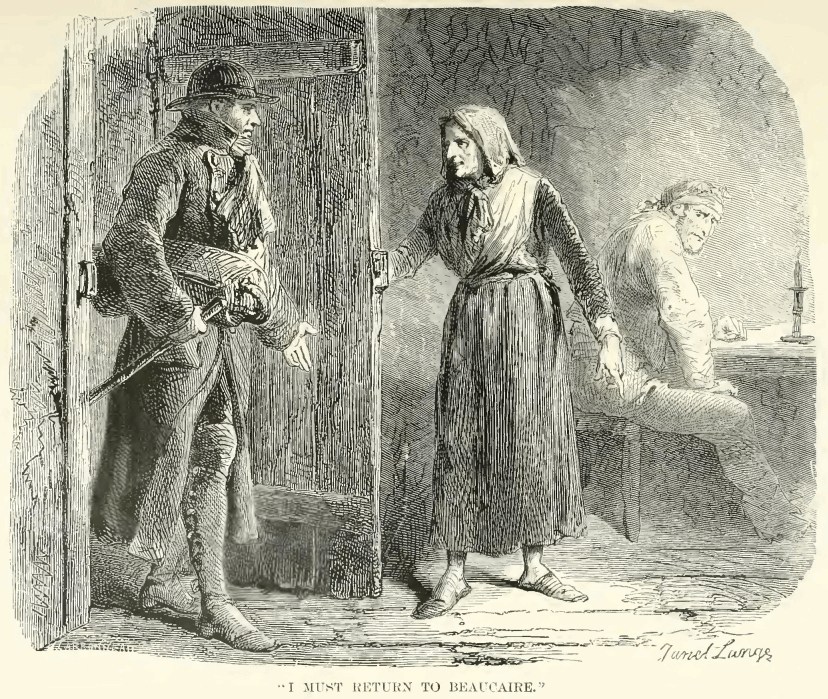
“‘Thanks,’ replied the jeweller. He then took his cane, which he had placed against an old cupboard, and went out. At the moment when he opened the door, such a gust of wind came in that the lamp was nearly extinguished. ‘Oh,’ said he, ‘this is very nice weather, and two leagues to go in such a storm.’
“‘Remain,’ said Caderousse. ‘You can sleep here.’
“‘Yes; do stay,’ added La Carconte in a tremulous voice; ‘we will take every care of you.’
“‘No; I must sleep at Beaucaire. So, once more, good-night.’ Caderousse followed him slowly to the threshold. ‘I can see neither heaven nor earth,’ said the jeweller, who was outside the door. ‘Do I turn to the right, or to the left hand?’
“‘To the right,’ said Caderousse. ‘You cannot go wrong—the road is bordered by trees on both sides.’
“‘Good—all right,’ said a voice almost lost in the distance.
“‘Close the door,’ said La Carconte; ‘I do not like open doors when it thunders.’
“‘Particularly when there is money in the house, eh?’ answered Caderousse, double-locking the door.
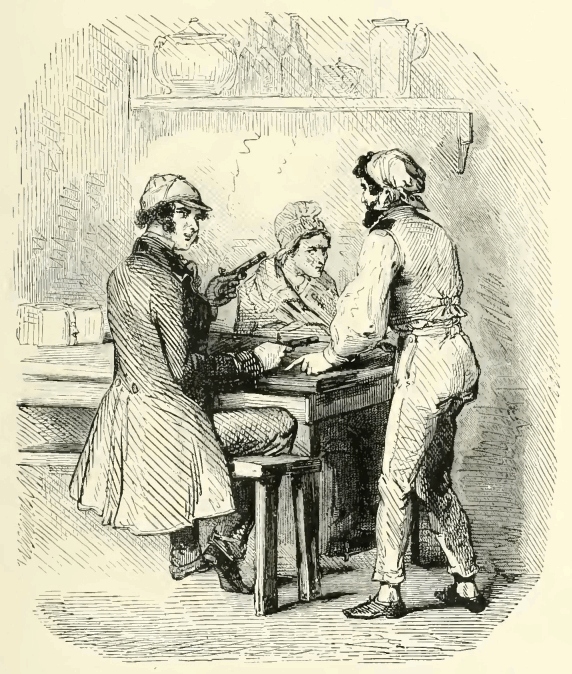
“He came into the room, went to the cupboard, took out the bag and pocket-book, and both began, for the third time, to count their gold and bank-notes. I never saw such an expression of cupidity as the flickering lamp revealed in those two countenances. The woman, especially, was hideous; her usual feverish tremulousness was intensified, her countenance had become livid, and her eyes resembled burning coals.
“‘Why,’ she inquired in a hoarse voice, ‘did you invite him to sleep here tonight?’
“‘Why?’ said Caderousse with a shudder; ‘why, that he might not have the trouble of returning to Beaucaire.’
“‘Ah,’ responded the woman, with an expression impossible to describe; ‘I thought it was for something else.’
“‘Woman, woman—why do you have such ideas?’ cried Caderousse; ‘or, if you have them, why don’t you keep them to yourself?’
“‘Well,’ said La Carconte, after a moment’s pause, ‘you are not a man.’
“‘What do you mean?’ added Caderousse.
“‘If you had been a man, you would not have let him go from here.’
“‘Woman!’
“‘Or else he should not have reached Beaucaire.’
“‘Woman!’
“‘The road takes a turn—he is obliged to follow it—while alongside of the canal there is a shorter road.’
“‘Woman!—you offend the good God. There—listen!’
And at this moment there was a tremendous peal of thunder, while the livid lightning illumined the room, and the thunder, rolling away in the distance, seemed to withdraw unwillingly from the cursed abode. ‘Mercy!’ said Caderousse, crossing himself.
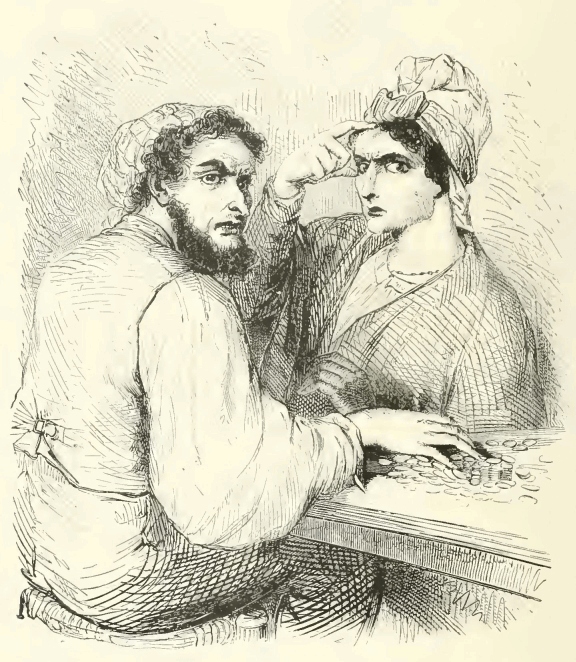
“At the same moment, and in the midst of the terrifying silence which usually follows a clap of thunder, they heard a knocking at the door. Caderousse and his wife started and looked aghast at each other.
“‘Who’s there?’ cried Caderousse, rising, and drawing up in a heap the gold and notes scattered over the table, and which he covered with his two hands.
“‘It is I,’ shouted a voice.
“‘And who are you?’
“‘Eh, pardieu! Joannes, the jeweller.’
“‘Well, and you said I offended the good God,’ said La Carconte with a horrid smile. ‘Why, the good God sends him back again.’ Caderousse sank pale and breathless into his chair.
“La Carconte, on the contrary, rose, and going with a firm step towards the door, opened it, saying, as she did so:
“‘Come in, dear M. Joannes.’
“‘Ma foi,’ said the jeweller, drenched with rain, ‘I am not destined to return to Beaucaire tonight. The shortest follies are best, my dear Caderousse. You offered me hospitality, and I accept it, and have returned to sleep beneath your friendly roof.’
“Caderousse stammered out something, while he wiped away the sweat that started to his brow. La Carconte double-locked the door behind the jeweller.”