XXXI. Italie. — Simbad le marin
XXXI. Italy — Sinbad the Sailor
Continued from the previous installment.
As for his suspicions, once on terra firma, once that he had seen the indifferent, if not friendly, appearance of his hosts, his anxiety had quite disappeared, or rather, at sight of the goat, had turned to appetite. He mentioned this to Gaetano, who replied that nothing could be more easy than to prepare a supper when they had in their boat, bread, wine, half a dozen partridges, and a good fire to roast them by.
“Besides,” added he, “if the smell of their roast meat tempts you, I will go and offer them two of our birds for a slice.”
“You are a born diplomat,” returned Franz; “go and try.”
Meanwhile the sailors had collected dried sticks and branches with which they made a fire. Franz waited impatiently, inhaling the aroma of the roasted meat, when the captain returned with a mysterious air.
“Well,” said Franz, “anything new?—do they refuse?”
“On the contrary,” returned Gaetano, “the chief, who was told you were a young Frenchman, invites you to sup with him.”
“Well,” observed Franz, “this chief is very polite, and I see no objection—the more so as I bring my share of the supper.”
“Oh, it is not that; he has plenty, and to spare, for supper; but he makes one condition, and rather a peculiar one, before he will receive you at his house.”
“His house? Has he built one here, then?”
“No, but he has a very comfortable one all the same, so they say.”
“You know this chief, then?”
“I have heard talk of him.”
“Favorably or otherwise?”
“Both.”
“The deuce!—and what is this condition?”
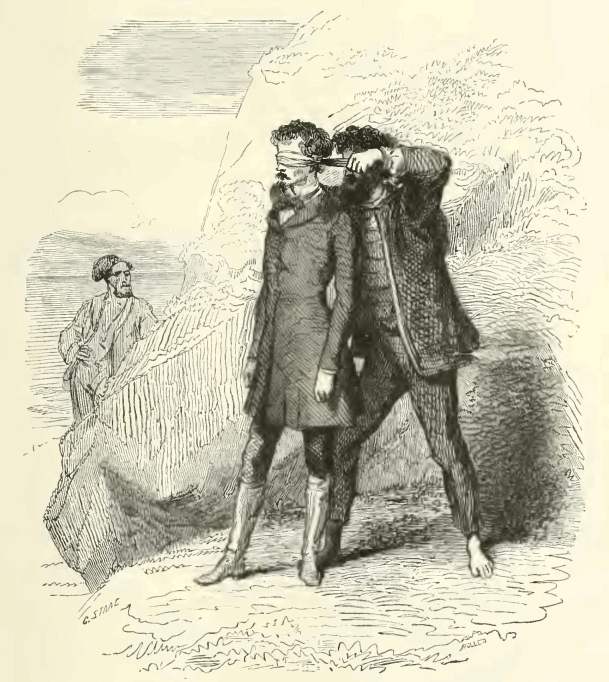
“That you are blindfolded, and do not take off the bandage until he himself bids you.”
Franz looked at Gaetano, to see, if possible, what he thought of this proposal. “Ah,” replied he, guessing Franz’s thought, “I know this is a serious matter.”
“What should you do in my place?”
“I, who have nothing to lose,—I should go.”
“You would accept?”
“Yes, were it only out of curiosity.”
“There is something very peculiar about this chief, then?”
“Listen,” said Gaetano, lowering his voice, “I do not know if what they say is true”—he stopped to see if anyone was near.
“What do they say?”
“That this chief inhabits a cavern to which the Pitti Palace is nothing.”
“What nonsense!” said Franz, reseating himself.
“It is no nonsense; it is quite true. Cama, the pilot of the _Saint Ferdinand_, went in once, and he came back amazed, vowing that such treasures were only to be heard of in fairy tales.”
“Do you know,” observed Franz, “that with such stories you make me think of Ali Baba’s enchanted cavern?”
“I tell you what I have been told.”
“Then you advise me to accept?”
“Oh, I don’t say that; your excellency will do as you please; I should be sorry to advise you in the matter.”
Franz pondered the matter for a few moments, concluded that a man so rich could not have any intention of plundering him of what little he had, and seeing only the prospect of a good supper, accepted. Gaetano departed with the reply. Franz was prudent, and wished to learn all he possibly could concerning his host. He turned towards the sailor, who, during this dialogue, had sat gravely plucking the partridges with the air of a man proud of his office, and asked him how these men had landed, as no vessel of any kind was visible.
“Never mind that,” returned the sailor, “I know their vessel.”
“Is it a very beautiful vessel?”
“I would not wish for a better to sail round the world.”
“Of what burden is she?”
“About a hundred tons; but she is built to stand any weather. She is what the English call a yacht.”
“Where was she built?”
“I know not; but my own opinion is she is a Genoese.”
“And how did a leader of smugglers,” continued Franz, “venture to build a vessel designed for such a purpose at Genoa?”
“I did not say that the owner was a smuggler,” replied the sailor.
“No; but Gaetano did, I thought.”
“Gaetano had only seen the vessel from a distance, he had not then spoken to anyone.”
“And if this person be not a smuggler, who is he?”
“A wealthy signor, who travels for his pleasure.”
“Come,” thought Franz, “he is still more mysterious, since the two accounts do not agree.”
“What is his name?”
“If you ask him, he says Sinbad the Sailor; but I doubt if it be his real name.”
“Sinbad the Sailor?”
“Yes.”
“And where does he reside?”
“On the sea.”
“What country does he come from?”
“I do not know.”
“Have you ever seen him?”
“Sometimes.”
“What sort of a man is he?”
“Your excellency will judge for yourself.”
“Where will he receive me?”
“No doubt in the subterranean palace Gaetano told you of.”
“Have you never had the curiosity, when you have landed and found this island deserted, to seek for this enchanted palace?”
“Oh, yes, more than once, but always in vain; we examined the grotto all over, but we never could find the slightest trace of any opening; they say that the door is not opened by a key, but a magic word.”
“Decidedly,” muttered Franz, “this is an Arabian Nights’ adventure.”
“His excellency waits for you,” said a voice, which he recognized as that of the sentinel. He was accompanied by two of the yacht’s crew.
Franz drew his handkerchief from his pocket, and presented it to the man who had spoken to him. Without uttering a word, they bandaged his eyes with a care that showed their apprehensions of his committing some indiscretion. Afterwards he was made to promise that he would not make the least attempt to raise the bandage. He promised.
Then his two guides took his arms, and he went on, guided by them, and preceded by the sentinel. After going about thirty paces, he smelt the appetizing odor of the kid that was roasting, and knew thus that he was passing the bivouac; they then led him on about fifty paces farther, evidently advancing towards that part of the shore where they would not allow Gaetano to go—a refusal he could now comprehend.
Presently, by a change in the atmosphere, he knew that they were entering a cave; after going on for a few seconds more he heard a crackling, and it seemed to him as though the atmosphere again changed, and became balmy and perfumed. At length his feet touched on a thick and soft carpet, and his guides let go their hold of him. There was a moment’s silence, and then a voice, in excellent French, although, with a foreign accent, said:
“Welcome, sir. I beg you will remove your bandage.”
It may be supposed, then, Franz did not wait for a repetition of this permission, but took off the handkerchief, and found himself in the presence of a man from thirty-eight to forty years of age, dressed in a Tunisian costume, that is to say, a red cap with a long blue silk tassel, a vest of black cloth embroidered with gold, pantaloons of deep red, large and full gaiters of the same color, embroidered with gold like the vest, and yellow slippers; he had a splendid cashmere round his waist, and a small sharp and crooked cangiar was passed through his girdle.
Although of a paleness that was almost livid, this man had a remarkably handsome face; his eyes were penetrating and sparkling; his nose, quite straight, and projecting direct from the brow, was of the pure Greek type, while his teeth, as white as pearls, were set off to admiration by the black moustache that encircled them.
His pallor was so peculiar, that it seemed to pertain to one who had been long entombed, and who was incapable of resuming the healthy glow and hue of life. He was not particularly tall, but extremely well made, and, like the men of the South, had small hands and feet. But what astonished Franz, who had treated Gaetano’s description as a fable, was the splendor of the apartment in which he found himself.
The entire chamber was lined with crimson brocade, worked with flowers of gold. In a recess was a kind of divan, surmounted with a stand of Arabian swords in silver scabbards, and the handles resplendent with gems; from the ceiling hung a lamp of Venetian glass, of beautiful shape and color, while the feet rested on a Turkey carpet, in which they sunk to the instep; tapestry hung before the door by which Franz had entered, and also in front of another door, leading into a second apartment which seemed to be brilliantly illuminated.
The host gave Franz time to recover from his surprise, and, moreover, returned look for look, not even taking his eyes off him.
“Sir,” he said, after a pause, “a thousand excuses for the precaution taken in your introduction hither; but as, during the greater portion of the year, this island is deserted, if the secret of this abode were discovered, I should doubtless, find on my return my temporary retirement in a state of great disorder, which would be exceedingly annoying, not for the loss it occasioned me, but because I should not have the certainty I now possess of separating myself from all the rest of mankind at pleasure. Let me now endeavor to make you forget this temporary unpleasantness, and offer you what no doubt you did not expect to find here—that is to say, a tolerable supper and pretty comfortable beds.”
“Ma foi, my dear sir,” replied Franz, “make no apologies. I have always observed that they bandage people’s eyes who penetrate enchanted palaces, for instance, those of Raoul in the Huguenots, and really I have nothing to complain of, for what I see makes me think of the wonders of the Arabian Nights.”
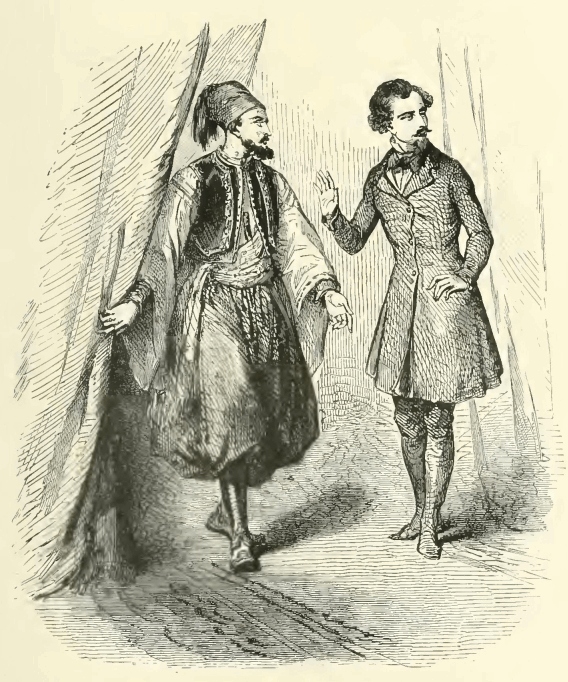
“Alas! I may say with Lucullus, if I could have anticipated the honor of your visit, I would have prepared for it. But such as is my hermitage, it is at your disposal; such as is my supper, it is yours to share, if you will. Ali, is the supper ready?”
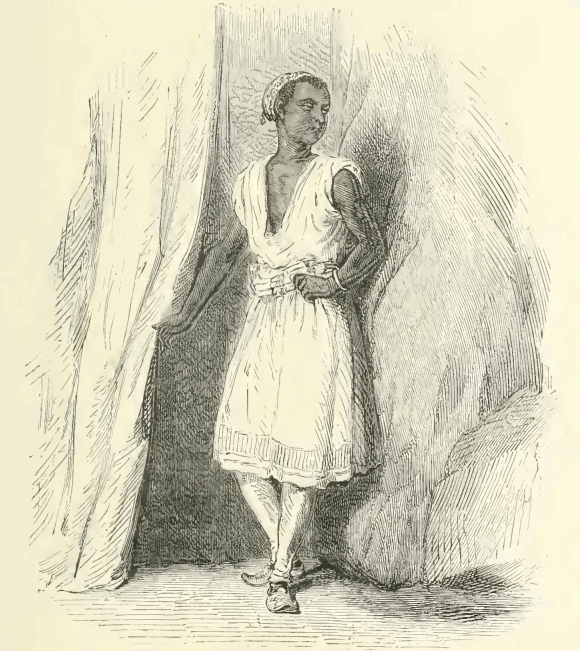
At this moment the tapestry moved aside, and a Nubian, black as ebony, and dressed in a plain white tunic, made a sign to his master that all was prepared in the dining-room.
“Now,” said the unknown to Franz, “I do not know if you are of my opinion, but I think nothing is more annoying than to remain two or three hours together without knowing by name or appellation how to address one another. Pray observe, that I too much respect the laws of hospitality to ask your name or title. I only request you to give me one by which I may have the pleasure of addressing you. As for myself, that I may put you at your ease, I tell you that I am generally called ‘Sinbad the Sailor.’”
“And I,” replied Franz, “will tell you, as I only require his wonderful lamp to make me precisely like Aladdin, that I see no reason why at this moment I should not be called Aladdin. That will keep us from going away from the East whither I am tempted to think I have been conveyed by some good genius.”
“Well, then, Signor Aladdin,” replied the singular Amphitryon, “you heard our repast announced, will you now take the trouble to enter the dining-room, your humble servant going first to show the way?”
At these words, moving aside the tapestry, Sinbad preceded his guest. Franz now looked upon another scene of enchantment; the table was splendidly covered, and once convinced of this important point he cast his eyes around him. The dining-room was scarcely less striking than the room he had just left; it was entirely of marble, with antique bas-reliefs of priceless value; and at the four corners of this apartment, which was oblong, were four magnificent statues, having baskets in their hands. These baskets contained four pyramids of most splendid fruit; there were Sicily pine-apples, pomegranates from Malaga, oranges from the Balearic Isles, peaches from France, and dates from Tunis.
The supper consisted of a roast pheasant garnished with Corsican blackbirds; a boar’s ham with jelly, a quarter of a kid with tartar sauce, a glorious turbot, and a gigantic lobster. Between these large dishes were smaller ones containing various dainties. The dishes were of silver, and the plates of Japanese china.
Franz rubbed his eyes in order to assure himself that this was not a dream. Ali alone was present to wait at table, and acquitted himself so admirably, that the guest complimented his host thereupon.
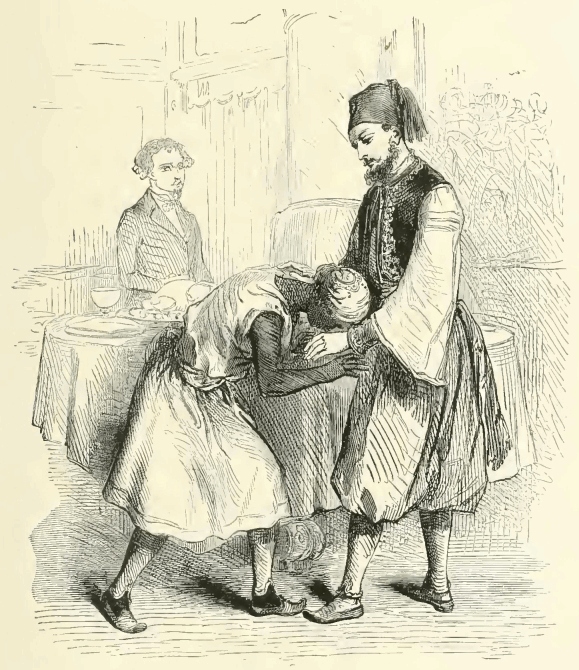
“Yes,” replied he, while he did the honors of the supper with much ease and grace—“yes, he is a poor devil who is much devoted to me, and does all he can to prove it. He remembers that I saved his life, and as he has a regard for his head, he feels some gratitude towards me for having kept it on his shoulders.”
Ali approached his master, took his hand, and kissed it.
“Would it be impertinent, Signor Sinbad,” said Franz, “to ask you the particulars of this kindness?”
“Oh, they are simple enough,” replied the host. “It seems the fellow had been caught wandering nearer to the harem of the Bey of Tunis than etiquette permits to one of his color, and he was condemned by the Bey to have his tongue cut out, and his hand and head cut off; the tongue the first day, the hand the second, and the head the third. I always had a desire to have a mute in my service, so learning the day his tongue was cut out, I went to the Bey, and proposed to give him for Ali a splendid double-barreled gun, which I knew he was very desirous of having. He hesitated a moment, he was so very desirous to complete the poor devil’s punishment. But when I added to the gun an English cutlass with which I had shivered his highness’s yataghan to pieces, the Bey yielded, and agreed to forgive the hand and head, but on condition that the poor fellow never again set foot in Tunis. This was a useless clause in the bargain, for whenever the coward sees the first glimpse of the shores of Africa, he runs down below, and can only be induced to appear again when we are out of sight of that quarter of the globe.”
Franz remained a moment silent and pensive, hardly knowing what to think of the half-kindness, half-cruelty, with which his host related the brief narrative.
“And like the celebrated sailor whose name you have assumed,” he said, by way of changing the conversation, “you pass your life in travelling?”
“Yes. I made a vow at a time when I little thought I should ever be able to accomplish it,” said the unknown with a singular smile; “and I made some others also which I hope I may fulfil in due season.”
Although Sinbad pronounced these words with much calmness, his eyes gave forth gleams of extraordinary ferocity.
“You have suffered a great deal, sir?” said Franz inquiringly.
Sinbad started and looked fixedly at him, as he replied, “What makes you suppose so?”
“Everything,” answered Franz,—“your voice, your look, your pallid complexion, and even the life you lead.”
“I?—I live the happiest life possible, the real life of a pasha. I am king of all creation. I am pleased with one place, and stay there; I get tired of it, and leave it; I am free as a bird and have wings like one; my attendants obey my slightest wish. Sometimes I amuse myself by delivering some bandit or criminal from the bonds of the law. Then I have my mode of dispensing justice, silent and sure, without respite or appeal, which condemns or pardons, and which no one sees. Ah, if you had tasted my life, you would not desire any other, and would never return to the world unless you had some great project to accomplish there.”
“Revenge, for instance!” observed Franz.
The unknown fixed on the young man one of those looks which penetrate into the depth of the heart and thoughts. “And why revenge?” he asked.
“Because,” replied Franz, “you seem to me like a man who, persecuted by society, has a fearful account to settle with it.”
“Ah!” responded Sinbad, laughing with his singular laugh, which displayed his white and sharp teeth. “You have not guessed rightly. Such as you see me I am, a sort of philosopher, and one day perhaps I shall go to Paris to rival Monsieur Appert, and the man in the little blue cloak.”
“And will that be the first time you ever took that journey?”
“Yes; it will. I must seem to you by no means curious, but I assure you that it is not my fault I have delayed it so long—it will happen one day or the other.”
“And do you propose to make this journey very shortly?”
“I do not know; it depends on circumstances which depend on certain arrangements.”
“I should like to be there at the time you come, and I will endeavor to repay you, as far as lies in my power, for your liberal hospitality displayed to me at Monte Cristo.”
“I should avail myself of your offer with pleasure,” replied the host, “but, unfortunately, if I go there, it will be, in all probability, incognito.”
The supper appeared to have been supplied solely for Franz, for the unknown scarcely touched one or two dishes of the splendid banquet to which his guest did ample justice. Then Ali brought on the dessert, or rather took the baskets from the hands of the statues and placed them on the table. Between the two baskets he placed a small silver cup with a silver cover. The care with which Ali placed this cup on the table roused Franz’s curiosity. He raised the cover and saw a kind of greenish paste, something like preserved angelica, but which was perfectly unknown to him. He replaced the lid, as ignorant of what the cup contained as he was before he had looked at it, and then casting his eyes towards his host he saw him smile at his disappointment.
“You cannot guess,” said he, “what there is in that small vase, can you?”
“No, I really cannot.”
“Well, then, that green preserve is nothing less than the ambrosia which Hebe served at the table of Jupiter.”
“But,” replied Franz, “this ambrosia, no doubt, in passing through mortal hands has lost its heavenly appellation and assumed a human name; in vulgar phrase, what may you term this composition, for which, to tell the truth, I do not feel any particular desire?”
“Ah, thus it is that our material origin is revealed,” cried Sinbad; “we frequently pass so near to happiness without seeing, without regarding it, or if we do see and regard it, yet without recognizing it. Are you a man for the substantials, and is gold your god? taste this, and the mines of Peru, Guzerat, and Golconda are opened to you. Are you a man of imagination—a poet? taste this, and the boundaries of possibility disappear; the fields of infinite space open to you, you advance free in heart, free in mind, into the boundless realms of unfettered reverie. Are you ambitious, and do you seek after the greatnesses of the earth? taste this, and in an hour you will be a king, not a king of a petty kingdom hidden in some corner of Europe like France, Spain, or England, but king of the world, king of the universe, king of creation; without bowing at the feet of Satan, you will be king and master of all the kingdoms of the earth. Is it not tempting what I offer you, and is it not an easy thing, since it is only to do thus? look!”
At these words he uncovered the small cup which contained the substance so lauded, took a teaspoonful of the magic sweetmeat, raised it to his lips, and swallowed it slowly with his eyes half shut and his head bent backwards. Franz did not disturb him whilst he absorbed his favorite sweetmeat, but when he had finished, he inquired:
“What, then, is this precious stuff?”
“Did you ever hear,” he replied, “of the Old Man of the Mountain, who attempted to assassinate Philippe Auguste?”
“Of course I have.”
“Well, you know he reigned over a rich valley which was overhung by the mountain whence he derived his picturesque name. In this valley were magnificent gardens planted by Hassen-ben-Sabah, and in these gardens isolated pavilions. Into these pavilions he admitted the elect, and there, says Marco Polo, gave them to eat a certain herb, which transported them to Paradise, in the midst of ever-blooming shrubs, ever-ripe fruit, and ever-lovely virgins. What these happy persons took for reality was but a dream; but it was a dream so soft, so voluptuous, so enthralling, that they sold themselves body and soul to him who gave it to them, and obedient to his orders as to those of a deity, struck down the designated victim, died in torture without a murmur, believing that the death they underwent was but a quick transition to that life of delights of which the holy herb, now before you, had given them a slight foretaste.”
“Then,” cried Franz, “it is hashish! I know that—by name at least.”
“That is it precisely, Signor Aladdin; it is hashish—the purest and most unadulterated hashish of Alexandria,—the hashish of Abou-Gor, the celebrated maker, the only man, the man to whom there should be built a palace, inscribed with these words, _A grateful world to the dealer in happiness_.”
“Do you know,” said Franz, “I have a very great inclination to judge for myself of the truth or exaggeration of your eulogies.”
“Judge for yourself, Signor Aladdin—judge, but do not confine yourself to one trial. Like everything else, we must habituate the senses to a fresh impression, gentle or violent, sad or joyous. There is a struggle in nature against this divine substance,—in nature which is not made for joy and clings to pain. Nature subdued must yield in the combat, the dream must succeed to reality, and then the dream reigns supreme, then the dream becomes life, and life becomes the dream. But what changes occur! It is only by comparing the pains of actual being with the joys of the assumed existence, that you would desire to live no longer, but to dream thus forever. When you return to this mundane sphere from your visionary world, you would seem to leave a Neapolitan spring for a Lapland winter—to quit paradise for earth—heaven for hell! Taste the hashish, guest of mine—taste the hashish.”
Franz’s only reply was to take a teaspoonful of the marvellous preparation, about as much in quantity as his host had eaten, and lift it to his mouth.
“Diable!” he said, after having swallowed the divine preserve. “I do not know if the result will be as agreeable as you describe, but the thing does not appear to me as palatable as you say.”
“Because your palate his not yet been attuned to the sublimity of the substances it flavors. Tell me, the first time you tasted oysters, tea, porter, truffles, and sundry other dainties which you now adore, did you like them? Could you comprehend how the Romans stuffed their pheasants with assafœtida, and the Chinese eat swallows’ nests? Eh? no! Well, it is the same with hashish; only eat for a week, and nothing in the world will seem to you to equal the delicacy of its flavor, which now appears to you flat and distasteful. Let us now go into the adjoining chamber, which is your apartment, and Ali will bring us coffee and pipes.”
They both arose, and while he who called himself Sinbad—and whom we have occasionally named so, that we might, like his guest, have some title by which to distinguish him—gave some orders to the servant, Franz entered still another apartment.
It was simply yet richly furnished. It was round, and a large divan completely encircled it. Divan, walls, ceiling, floor, were all covered with magnificent skins as soft and downy as the richest carpets; there were heavy-maned lion-skins from Atlas, striped tiger-skins from Bengal; panther-skins from the Cape, spotted beautifully, like those that appeared to Dante; bear-skins from Siberia, fox-skins from Norway, and so on; and all these skins were strewn in profusion one on the other, so that it seemed like walking over the most mossy turf, or reclining on the most luxurious bed.
Both laid themselves down on the divan; chibouques with jasmine tubes and amber mouthpieces were within reach, and all prepared so that there was no need to smoke the same pipe twice. Each of them took one, which Ali lighted and then retired to prepare the coffee.
There was a moment’s silence, during which Sinbad gave himself up to thoughts that seemed to occupy him incessantly, even in the midst of his conversation; and Franz abandoned himself to that mute reverie, into which we always sink when smoking excellent tobacco, which seems to remove with its fume all the troubles of the mind, and to give the smoker in exchange all the visions of the soul. Ali brought in the coffee.
“How do you take it?” inquired the unknown; “in the French or Turkish style, strong or weak, sugar or none, cool or boiling? As you please; it is ready in all ways.”
“I will take it in the Turkish style,” replied Franz.
“And you are right,” said his host; “it shows you have a tendency for an Oriental life. Ah, those Orientals; they are the only men who know how to live. As for me,” he added, with one of those singular smiles which did not escape the young man, “when I have completed my affairs in Paris, I shall go and die in the East; and should you wish to see me again, you must seek me at Cairo, Bagdad, or Ispahan.”
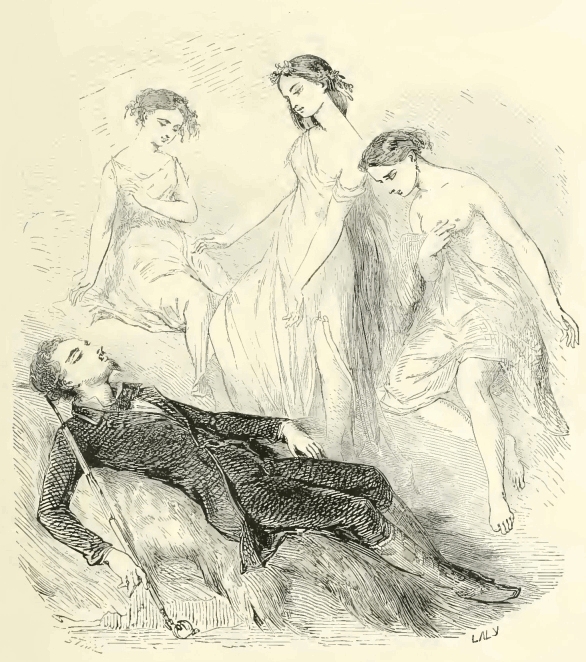
“Ma foi,” said Franz, “it would be the easiest thing in the world; for I feel eagle’s wings springing out at my shoulders, and with those wings I could make a tour of the world in four-and-twenty hours.”
“Ah, yes, the hashish is beginning its work. Well, unfurl your wings, and fly into superhuman regions; fear nothing, there is a watch over you; and if your wings, like those of Icarus, melt before the sun, we are here to ease your fall.”
He then said something in Arabic to Ali, who made a sign of obedience and withdrew, but not to any distance.
As to Franz a strange transformation had taken place in him. All the bodily fatigue of the day, all the preoccupation of mind which the events of the evening had brought on, disappeared as they do at the first approach of sleep, when we are still sufficiently conscious to be aware of the coming of slumber. His body seemed to acquire an airy lightness, his perception brightened in a remarkable manner, his senses seemed to redouble their power, the horizon continued to expand; but it was not the gloomy horizon of vague alarms, and which he had seen before he slept, but a blue, transparent, unbounded horizon, with all the blue of the ocean, all the spangles of the sun, all the perfumes of the summer breeze; then, in the midst of the songs of his sailors,—songs so clear and sonorous, that they would have made a divine harmony had their notes been taken down,—he saw the Island of Monte Cristo, no longer as a threatening rock in the midst of the waves, but as an oasis in the desert; then, as his boat drew nearer, the songs became louder, for an enchanting and mysterious harmony rose to heaven, as if some Loreley had decreed to attract a soul thither, or Amphion, the enchanter, intended there to build a city.
At length the boat touched the shore, but without effort, without shock, as lips touch lips; and he entered the grotto amidst continued strains of most delicious melody. He descended, or rather seemed to descend, several steps, inhaling the fresh and balmy air, like that which may be supposed to reign around the grotto of Circe, formed from such perfumes as set the mind a-dreaming, and such fires as burn the very senses; and he saw again all he had seen before his sleep, from Sinbad, his singular host, to Ali, the mute attendant; then all seemed to fade away and become confused before his eyes, like the last shadows of the magic lantern before it is extinguished, and he was again in the chamber of statues, lighted only by one of those pale and antique lamps which watch in the dead of the night over the sleep of pleasure.
They were the same statues, rich in form, in attraction, and poesy, with eyes of fascination, smiles of love, and bright and flowing hair. They were Phryne, Cleopatra, Messalina, those three celebrated courtesans. Then among them glided like a pure ray, like a Christian angel in the midst of Olympus, one of those chaste figures, those calm shadows, those soft visions, which seemed to veil its virgin brow before these marble wantons.
Then the three statues advanced towards him with looks of love, and approached the couch on which he was reposing, their feet hidden in their long white tunics, their throats bare, hair flowing like waves, and assuming attitudes which the gods could not resist, but which saints withstood, and looks inflexible and ardent like those with which the serpent charms the bird; and then he gave way before looks that held him in a torturing grasp and delighted his senses as with a voluptuous kiss.
It seemed to Franz that he closed his eyes, and in a last look about him saw the vision of modesty completely veiled; and then followed a dream of passion like that promised by the Prophet to the elect. Lips of stone turned to flame, breasts of ice became like heated lava, so that to Franz, yielding for the first time to the sway of the drug, love was a sorrow and voluptuousness a torture, as burning mouths were pressed to his thirsty lips, and he was held in cool serpent-like embraces. The more he strove against this unhallowed passion the more his senses yielded to its thrall, and at length, weary of a struggle that taxed his very soul, he gave way and sank back breathless and exhausted beneath the kisses of these marble goddesses, and the enchantment of his marvellous dream.